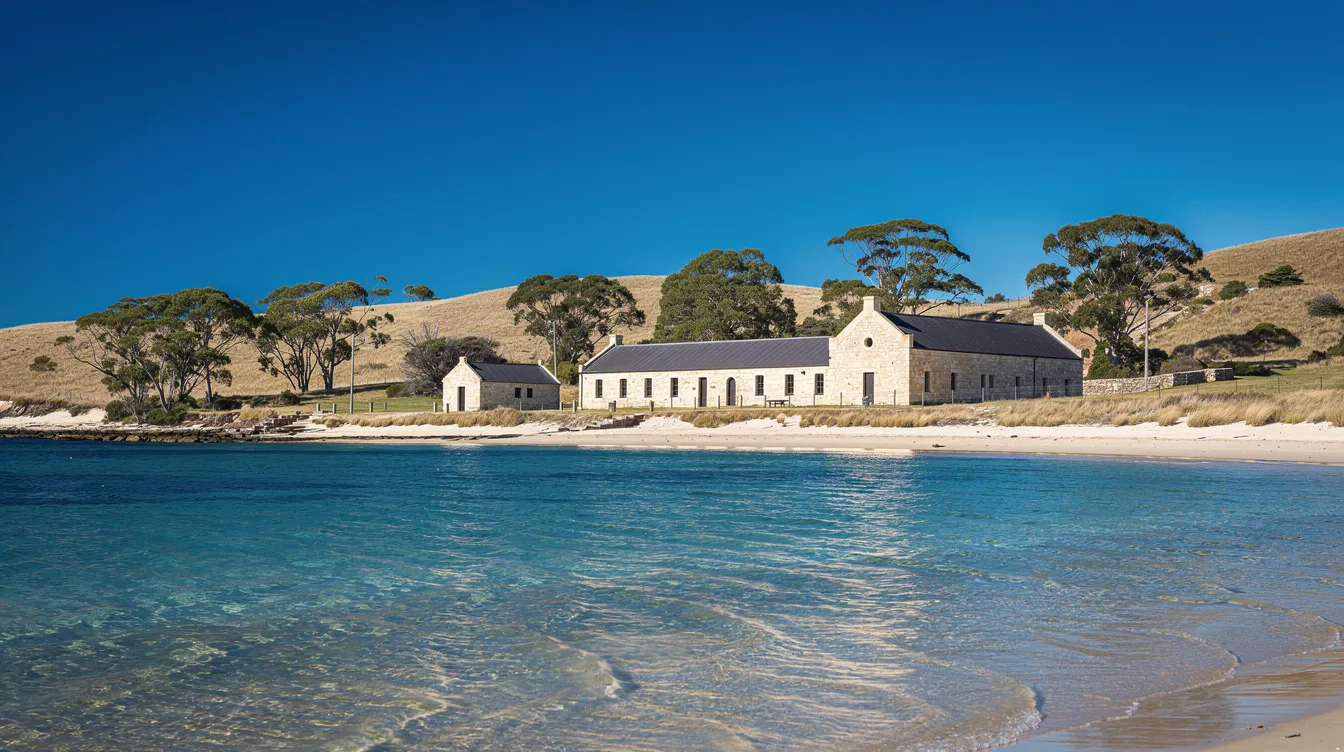
Maria Island is the rare Australian island where the first stop is a former penal settlement, not a cafe. Its only settlement, Darlington, holds 13 intact convict-era buildings and structures, so the ferry arrival feels less like a beach escape and more like walking into a place that never agreed to erase its harder chapters.
And that is the point of coming. Maria Island is a national park off Tasmania’s east coast, with free-roaming wombats, pale beaches, colored cliffs, and serious walking. But Darlington gives the island its sharpest edge, because its old buildings remain part of the day rather than a distant museum stop.
Darlington keeps the island’s convict story in plain view
Darlington is Maria Island’s sole settlement, near the island’s northern tip. It is also one of the 11 sites in the Australian Convict Sites World Heritage serial listing. You can see why this designation matters without needing an exhibit label at every turn.
The former probation station was part of two convict eras on the island. Today, the surviving structures make history feel close and physical: old walls, weathered masonry, and rooms that were built for control rather than comfort. It’s compelling, but it isn’t light sightseeing.
And the settlement has very few permanent inhabitants beyond park rangers. That absence changes the mood. You’re not touring a restored historic district full of souvenir shops.
You’re moving through a park where the old settlement is still the center of human activity.
The 45-minute crossing sets the pace
Maria Island is reached by passenger ferry from Triabunna, about 53.4 miles northeast of Hobart. The drive takes roughly 1 hour and 15 minutes, then the crossing to Darlington takes about 45 minutes. Ferry reservations are required, so this is not a trip to leave loose until breakfast.
But the boat is also a useful dividing line. Once you arrive, there are no cars on the island. You get around on foot or by bicycle, which slows the whole experience down and makes a day trip feel more deliberate than its distance from Hobart suggests.
You should bring food, water, and anything you’ll want for the day before boarding. There are no shops or cafes on Maria Island, and available water is not potable. That’s a real limitation, especially for travelers used to national parks with a visitor-center snack counter.
Wombats and cliffs pull you beyond the old buildings
Maria Island National Park has enough to fill a long day after Darlington. Wombats, wallabies, Forester kangaroos, Tasmanian devils, Cape Barren geese, and birds live here freely. The best approach is patient watching, with plenty of space between you and the animals.
And early morning or late afternoon around Darlington is a smart time to look for wombats. The light softens, the air cools, and the grass can suddenly appear to be moving. You’ll likely get better photographs by standing still than by chasing a sighting.
Painted Cliffs are another reason not to rush back to the jetty. Their sandstone layers show red, orange, brown, and white tones, and low tide makes the coastal access and rock details easier to appreciate. The colors are the attraction, but timing is the catch.
Fossil Cliffs offer a different kind of stop, with limestone outcrops and marine fossils near Darlington. You can pair either cliff walk with the settlement on a day visit. Trying to do every major walk at once, though, turns a good island day into a schedule.
Can you stay longer than a day?
Yes. A one-night visit gives you more time for both cliff areas, Darlington, beaches, and wildlife without watching the clock. For two or three nights, walkers and cyclists can consider Bishop and Clerk, Frenchs Farm, Encampment Cove, and the island’s southern reaches.
But longer trips demand more self-sufficiency. Bishop and Clerk has a sustained climb, while bike routes can be uneven and hilly. Weather in Tasmania can change quickly, so bring sun protection, rain and wind layers, enough food, and a charged battery.
The island runs roughly 12.4 miles north to south, with the sandy McRaes Isthmus linking its two larger sections. That compact shape can look manageable on a map. On foot, with water on your back and wind coming across the coast, it feels larger.
Summer crowds are real, silence still wins
During Australian summer school holidays, several hundred visitors can come to the island. Book the ferry early if that is when you’re traveling. It can feel busy around the arrival window, but crowds spread out once people choose a cliff walk, a beach, or a longer track.
And that is Maria Island’s best contrast: accessible from Hobart, yet stripped of the usual holiday machinery. By the time the last ferry leaves Darlington, old stone walls sit in the cooling light and the island’s quiet takes over again.