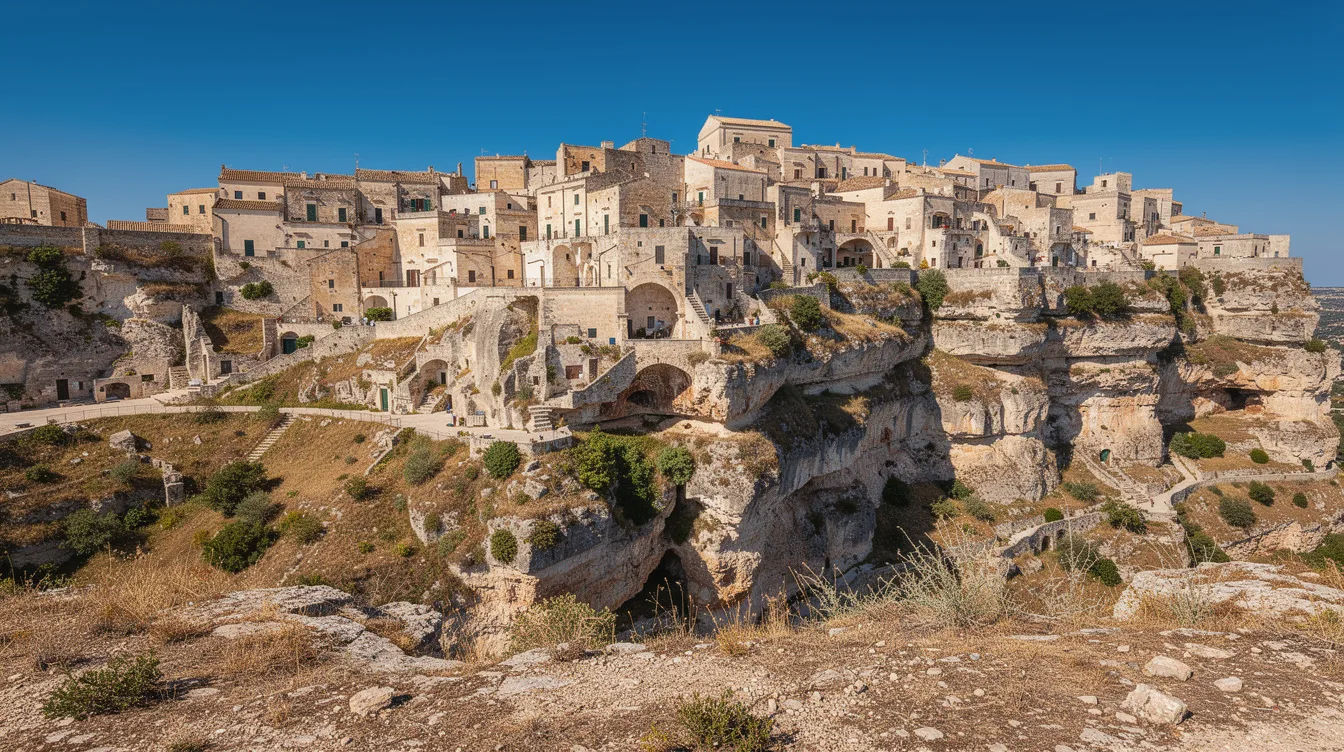
Matera does not reveal itself all at once. In Basilicata, southern Italy, its oldest quarters drop into a ravine in layers of pale stone, with homes, churches, passages, and courtyards cut directly from rock.
The claim is startling, but it holds: human occupation here reaches back to the 8th millennium BC. You can feel that age most clearly in the Sassi, where a doorway may sit below another dwelling and a street can run above a roof.
The Sassi make the city’s age visible
The Sassi di Matera are not a museum quarter built to imitate the past. They are a rock-cut urban core with continuous occupation reaching back to prehistory, so the city’s history is built into the stairs under your shoes.
And this is why Matera lands differently than an old town with polished façades. The stone looks worn rather than staged, while the Gravina gorge cuts a hard edge beside the houses.
The two main districts are Sasso Caveoso and Sasso Barisano. Walk them slowly in late afternoon, when the light catches the carved walls and the tight lanes begin to feel less like a map problem.
But don’t expect an easy stroll. The Sassi are steep, paved, and often pedestrian-only, which makes them deeply atmospheric but awkward with rolling luggage or a car.
Twelve levels above the Gravina
The Sassi stretch across about 12 levels over 1,247 feet of elevation change. Paths, stairways, and shared courtyards connect the layers, so you’re constantly choosing between a shortcut and another view.
At the center sits the Civita, the high ground between the two Sassi. Its cathedral gives you a useful visual reset, because the city’s arrangement can seem almost impossible when you are inside it.
The Romanesque Matera Cathedral dates to the late 13th century. From this higher point, you can trace the stone districts slipping toward the gorge, then watch the modern city spread beyond them.
And you should cross to the Belvedere della Murgia Materana near sunset if the weather allows. Across the Gravina, Matera reads as a whole, its stacked rooms and stairways catching the last warm light.
A city restored after a difficult chapter
Matera’s cave homes were not always romantic places to sleep. Part of the Sassi’s population was moved to modern housing in the 1950s, after the old quarters had become associated with extreme poverty and unsafe living conditions.
That history matters because restoration changed the experience without erasing the difficult context. Today you’ll find restored cave rooms and hotels, but the physical demands remain real: check baggage access and parking before you book.
UNESCO recognized the Sassi in 1993, alongside the rupestrian churches across the Gravina. The designation helped bring attention back to a place that had long been treated as a problem rather than a cultural inheritance.
Matera was also European Capital of Culture in 2019. It is touristy now, especially around the best viewpoints, but the scale of the old city still absorbs crowds better than you might expect.
Can you see Matera in two days?
Yes. Two nights give you two full days, which is enough to walk both Sassi, climb to the Civita, see rock-cut churches, and return to the gorge overlook without turning the visit into a race.
And you should leave room to wander without a destination. Matera works best when you stop following the obvious route and hear footsteps on stone somewhere above you.
For food, try pane di Matera, crapiata, a legume soup, and strazzate biscuits. The dishes are straightforward, which suits a city that asks you to pay attention to texture, shade, and stone instead of spectacle.
But timing matters. Go in April through June or September through October, when temperatures are more comfortable and the light makes the Sassi’s carved surfaces feel especially alive.
Getting there without overcomplicating it
Bari Airport is the simplest gateway for most visitors. Matera is about 40.4 miles away, reachable by car, shuttle, or regional FAL train.
Once you arrive, plan your lodging around access rather than a perfect postcard address. A cave room can be memorable, but the most dramatic locations may involve long uphill walks with bags.
By twilight, lamps begin to pick out windows across the ravine. The staircases darken, the stone turns honey-colored, and Matera finally feels less like an ancient claim than a city still making room for the night.