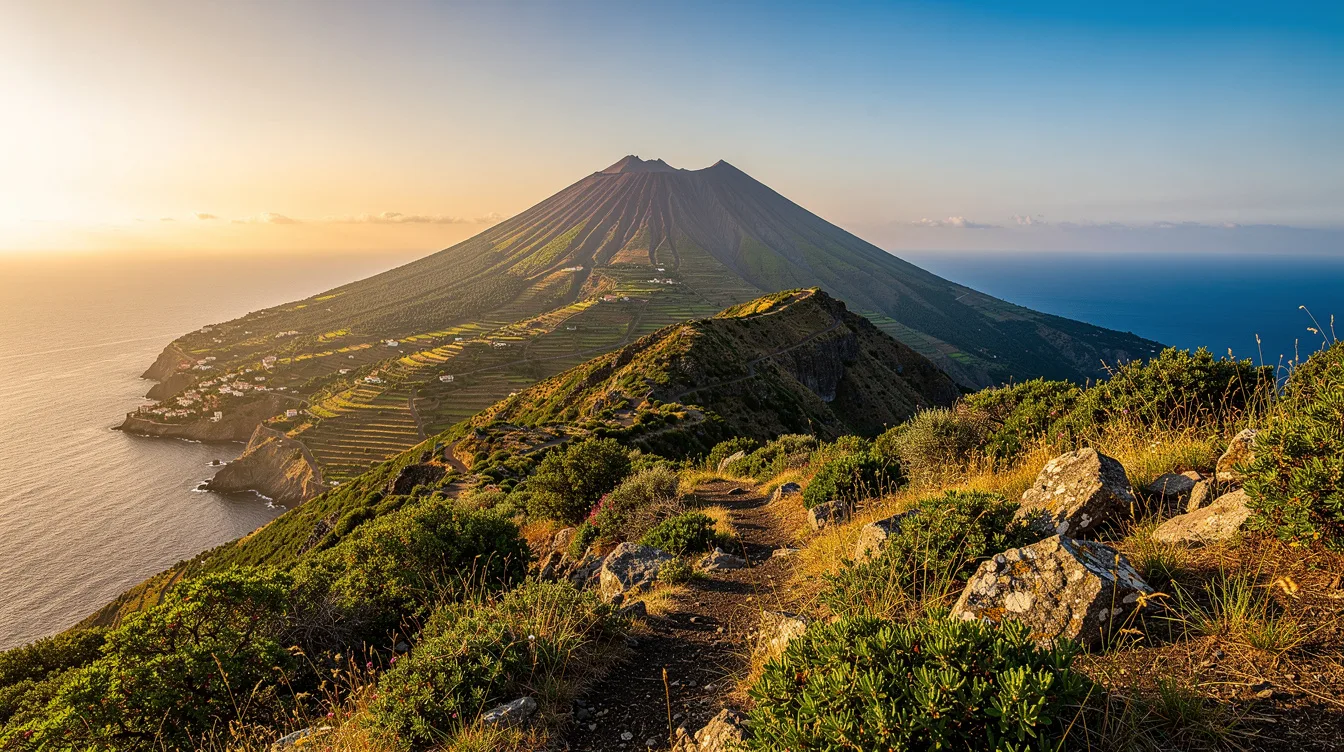
Salina rises to about 3,156 feet (962 m), making it higher than every other island in the Aeolian chain. But its real appeal is the quiet below that summit, where vineyards, caper terraces, white villages, and dark volcanic cliffs set a slower rhythm.
And you can reach the island from Milazzo in roughly 1 hour 30 minutes to 1 hour 40 minutes by hydrofoil. The crossing is short enough for a long weekend, yet Salina feels removed from Lipari’s busier pace almost as soon as you arrive.
Why Salina rises above the other Aeolian islands
And the high point is Monte Fossa delle Felci, one of Salina’s two extinct volcanoes. At 3,156 feet, it’s the highest summit in all the Aeolian Islands, so the island gives you a mountain day as well as a sea escape.
But the summit isn’t the only reason Salina looks different. Available fresh water supports greener valleys, while vines and caper terraces cover ground that feels more fertile than the other volcanic islands.
Salina is my pick if you want nature, food, and quiet in the same stay. You’ll hear more small boats and evening conversation than late-night music, especially compared with Panarea or Lipari.
The mountain walk changes the island’s scale
And the hike toward Monte Fossa delle Felci passes through denser vegetation than walks on the other Aeolian islands. The higher you go, the more the island becomes a patchwork of green slopes, volcanic ground, and open sea.
But this isn’t a casual stroll between beach bars. You should plan the walk as a real outing, because the summit is high and the route’s appeal comes from the change in vegetation and elevation.
I’d choose the mountain before the beach if you have only one full day. You’ll understand Salina better from above, where its two volcanic forms and fertile valleys finally make sense together.
Santa Marina, Malfa, and the right home base
And Santa Marina Salina is the most practical arrival point, with the island’s main port, restaurants, and everyday logistics close at hand. You can begin here without immediately needing a scooter or a detailed plan.
But Malfa has a calmer, more refined feel and works well for a comfortable stay. I’d choose it if you want a quieter base with easy access to the island’s food and coastal scenery.
Lingua keeps things simpler, with a small coastal setting, fishing boats, and an easy outing from Santa Marina. And Rinella, on the southwest side, suits travelers who want a quieter port and a dark-sand beach.
Pollara earns the sunset hour
And Pollara is where Salina makes its strongest visual argument. The overlook faces an old caldera open to the sea, with views toward Filicudi and Alicudi as the light fades.
But Pollara is isolated, so you shouldn’t treat it as a quick stop between several major sights. Stay for the sunset, listen to the quieter air, and let the lack of activity do some of the work.
I’d put Pollara ahead of a busy evening elsewhere. The island is at its most convincing when the sea darkens and the villages become small lights below.
Can you swim without giving up the quiet?
And you can swim at Spiaggia dello Scario near Malfa, a rocky cove known for clear water. Bring suitable footwear and expect a simple setting, because this is a pebble shore rather than a broad resort beach.
But Rinella offers a different mood, with a dark-sand beach and a more relaxed coastal feel. You can also explore Lingua on foot, watching small fishing boats while the day moves at its own pace.
Salina’s food gives the swimming stops a useful purpose. Try the island’s capers, fish, granitas, and Malvasia delle Lipari, a sweet local wine often served with dry biscuits.
How do you get to Salina?
And the usual route begins at Milazzo, where hydrofoils head toward Santa Marina Salina. Salina has no airport, so your trip depends on sea connections, weather, and the seasonal timetable.
But the crossing is manageable, and the payoff comes quickly. Once you arrive at Santa Marina, you can use a scooter, a small rental car, or CITIS buses between the main villages.
You’ll have more freedom with a scooter, especially if you want Malfa, Pollara, Lingua, and the beaches in one stay. I’d reserve early in summer, since vehicle availability becomes less forgiving during the busiest period.
May, June, and September make the case
And the easiest travel season runs from late April through October, when ferries, lodging, and restaurants generally operate widely. May and June bring a better balance of pleasant weather and lighter crowds.
But September may be the smartest choice if you want warmer water without the full summer rush. July and August are livelier and more expensive, so you’ll need to reserve earlier.
For most travelers, three to four nights gives Salina room to breathe. By the time the last boat settles in the harbor, the island’s strongest sound is usually the water against the quay.