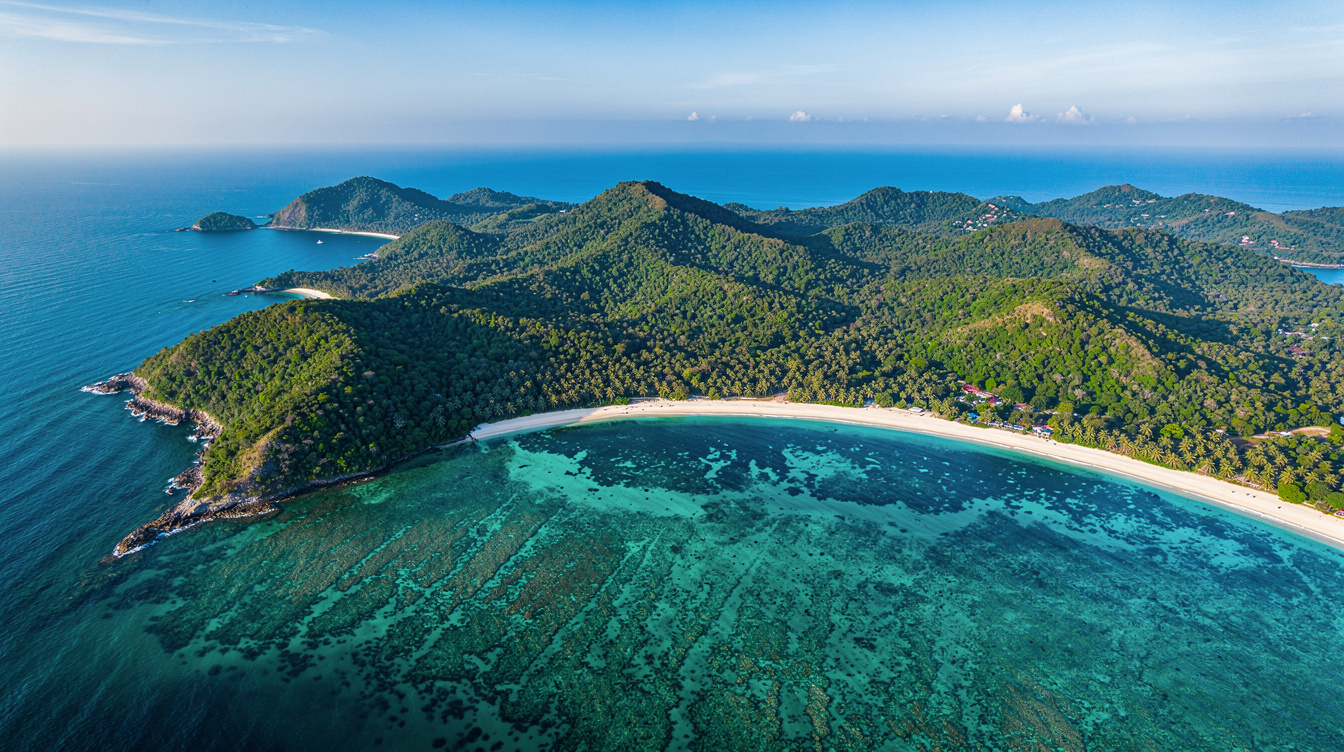
The party happens once a month, on a single beach, at the island’s southern tip. Hat Rin pulls somewhere between 20,000 and 30,000 people on Full Moon night, and for roughly 72 hours around that date, the beach runs fire shows, fluorescent paint, and $4 buckets of Thai whiskey. Then it drains. The ferries reverse. And the rest of Ko Pha-Ngan, about 50 square miles of forested hills and reef-fringed coast, carries on as it was.
What the Full Moon Party actually is and where it sits
Hat Rin occupies a narrow peninsula at the island’s southeastern corner, roughly 12 miles by road from Thong Sala, the main pier. The party itself takes place on Hat Rin Nok, a roughly 600-foot east-facing strip of sand. Because the peninsula is narrow, the noise stays contained. You can be 2 miles away and hear nothing.
The monthly cycle shifts across the calendar, so some Full Moons fall on weekdays, which dampens attendance. January and February pull the largest crowds because they land inside peak dry season. But the party’s physical footprint is small, and that’s the detail most US travelers miss.
For broader context on how Thai island geography shapes what you actually experience on the ground, Phuket’s monsoon logic applies directly here too.
The north coast that the party crowd doesn’t reach
Bottle Beach (Hat Khuat) sits on the northern shore, and the road from Thong Sala ends before you get there. The last leg is a 30-minute longtail from Chalok Lam village, costing around $3-5 USD. Because that extra boat ride filters out anyone without intent, the beach population stays small on most days. The sand is wide and white, the coral reef starts at the southern end, and the bungalows behind the treeline don’t have Wi-Fi worth mentioning.
And then there’s Haad Salad, on the northwest coast. A headland blocks the prevailing northeast swell, so the water stays flat even when winds pick up elsewhere. Local boat captains who’ve run this coast for decades will tell you it’s the most reliably swimmable shore on the island between November and February. The snorkeling holds because the chop never builds.
Reading the calendar like a tool, not a suggestion
Two cycles govern this island simultaneously: the lunar calendar and the monsoon. Full Moon dates are published a year in advance. In the 3-4 days before and after the party, guesthouses near Thong Sala and the northwest fill with people staging for or recovering from Hat Rin. In the 10 days centered on the new moon, occupancy drops sharply and prices at properties near Haad Yao run 30-50% lower than Full Moon week.
The Gulf of Thailand’s northeast monsoon hits Ko Pha-Ngan’s east coast first, roughly October through December. Hat Rin gets swell and rain. But the island’s forested interior ridge shelters the west coast. Khao Ra, the island’s high point at 1,729 feet, isn’t dramatic by any mountain standard, but it creates enough of a rain shadow to keep Haad Salad swimmable in months when the east coast closes down. That’s the cause-effect that changes your whole booking decision.
It’s worth comparing this dynamic to how Koh Samui handles the same geography, since Samui is your likely departure point anyway.
The interior: waterfalls and nobody around
Phaeng Waterfall sits about 4 miles from Thong Sala on a paved road that turns steep near the top. The national park charges a small entry fee. Trails beyond the main waterfall are poorly marked and the heat is real by 9am, so start early or don’t bother. But the pool at the base is cold even in April, and the sound of the water drowns out everything else.
And on a Tuesday in a new moon window, you may genuinely be the only person there.
Your questions about Ko Pha-Ngan answered
How do you get to Ko Pha-Ngan from Bangkok?
There’s no airport on the island. The fastest route is a flight to Koh Samui (USM), about 75 minutes on Bangkok Airways, then a high-speed catamaran to Thong Sala pier in roughly 20-30 minutes. The Surat Thani (URT) route is cheaper, around $30-50 USD total versus $80-120 USD via Samui, but the combined bus-and-ferry transfer runs 3-4 hours. Access time shapes every Gulf of Thailand island decision, and Ko Pha-Ngan is no different.
When is the best time to visit?
December through April is dry season on the west and northwest coasts. Temperatures run 86-91°F during the day and rain stays infrequent. March and April new moon windows give you dry-season conditions without January’s party congestion. Avoid the east coast in October and November entirely.
How much does Ko Pha-Ngan cost per day?
A basic bungalow near Haad Yao runs $15-30 USD per night outside Full Moon week. Mid-range northwest coast resorts run $50-90, and Full Moon week rates can double both tiers. Motorbike rental in Thong Sala costs around $7-10 per day. A realistic independent travel budget outside party week: $40-60 USD daily. The same planning logic that applies to Boracay holds here: the beach you choose changes the price as much as the season does.
The ferry back to Samui leaves Thong Sala at 8am. The pier smells like diesel and salt. Your bag is sandy at the bottom from three days on the north coast, and the longtail engines are already running across the water.