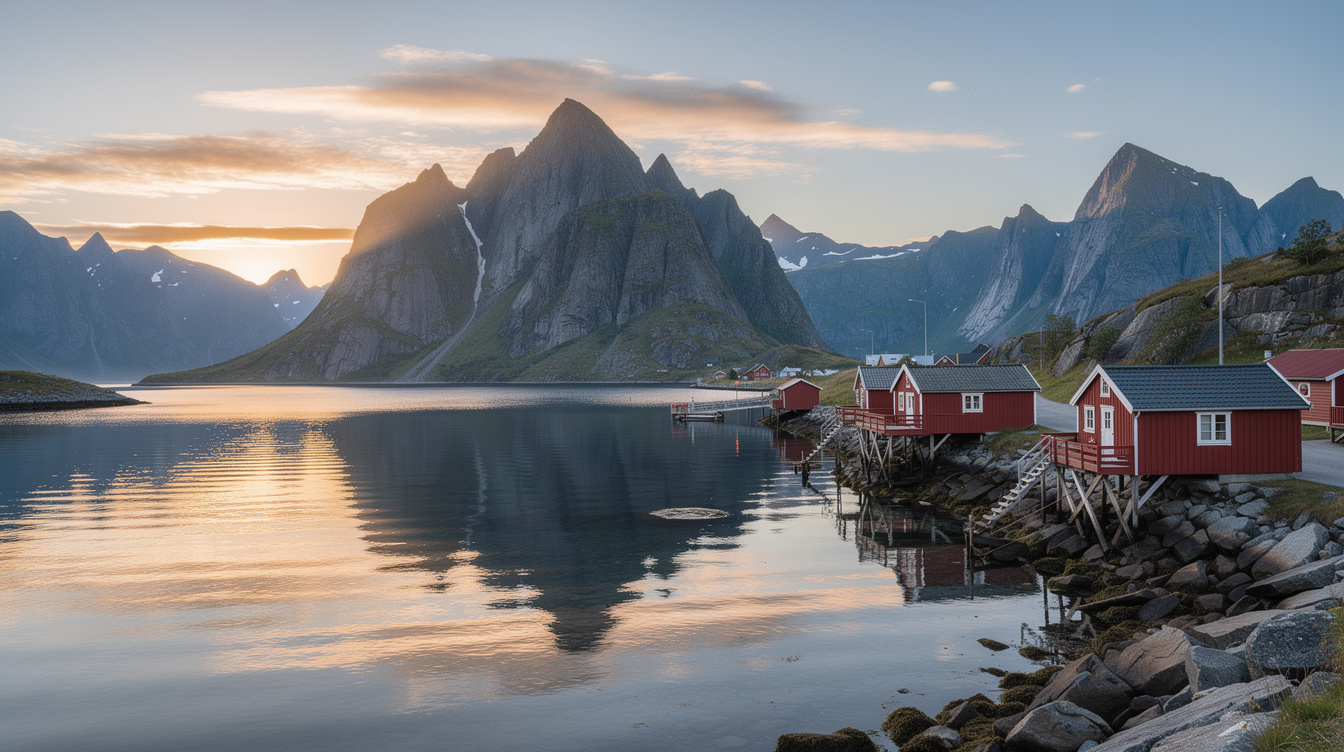
At Bodø terminal, it’s 11:45pm in late June. The light through the window is amber, low, and angled like late afternoon in October. Nobody on the Moskenes ferry deck is checking the time. They’re pointing cameras at a horizon the sun has no intention of crossing. That departure time isn’t a scheduling quirk. It’s a direct consequence of where these islands sit: 68°N to 69°N, above the Arctic Circle, where the sun hasn’t touched the horizon in three weeks and won’t for five more. That single geographic fact restructures every decision you’ll make in Lofoten.
The sun doesn’t set from late May to mid-July and the schedule shifts around it
At Svolvær, the midnight sun window runs from roughly late May through mid-July. Not bright twilight. Actual sun, casting shadows, warming rock faces, making the concept of bedtime feel invented. Because of that, restaurants in Reine and Henningsvær seat dinner at 10pm without comment.
Fishing boats leave the harbor at midnight. Hikers set out for Ryten summit at 11pm to catch 1am light over Kvalvika beach. The road doesn’t empty at dusk because there is no dusk. And most rorbuer, the traditional fishermen’s cabins converted to accommodation, come with blackout curtains for exactly this reason.
The light at 1:30am in late June is the color of early September evening. It doesn’t feel wrong until you check your watch. A boat captain who has run these waters for decades will tell you the midnight sun isn’t a spectacle so much as a persistent physical condition that the whole island has quietly organized itself around.
The E10 runs roughly 100 miles from Å to Fiskebøl and where you stop decides everything
The E10 is the only road connecting the main islands. It runs southwest to northeast through undersea tunnels and over causeways, from Å at the southern tip to Fiskebøl in the north. End to end takes about two and a half hours without stops. But that’s not how the road works.
Å sits at a dead end and holds a working stockfish museum. By June, the wooden drying racks along the waterfront are empty, the pale frames a ghost of the winter economy. Nusfjord, a UNESCO-listed fishing village 9 miles northeast, has 11 rorbuer for rent and one restaurant. It fills by February for summer.
Reine has roughly 300 permanent residents and a mountain backdrop that earns its reputation. The Reinebringen trail, regraded with steel steps, gains about 1,300 feet in under a mile and a half. Henningsvær, built across two small islands connected by bridges, has the archipelago’s best climbing gym and three restaurants worth a full evening. Where you stop along a linear geography determines which Lofoten you actually experience. Both villages book out in May for July. Both are worth it anyway.
The light calendar has two seasons and most Americans only book one
From approximately December 5 to January 7, the sun stays below the horizon at Svolvær. The sky cycles through blue hours, a pink edge at noon, and genuine darkness. Because of that darkness, the northern lights are visible from the road without a tour. Drive the E10 west toward Eggum, pull over, and wait. The wait can be 20 minutes or three nights.
January also opens the skrei cod season, when fishing boats arrive from across Norway and the harbors smell of salt and cold diesel. Summer rorbuer at Reine run $250-$450 per night in peak July. January rates drop to $120-$200 for the same cabin. But the E10 in winter requires snow tires, Norwegian law mandates them, and storms can close sections between Å and Svolvær with little warning.
Narrow seasonal windows reward travelers who plan around them rather than around habit. The family that runs the last café in Å will tell you the same thing in November that they’d never say in August: the island is better when it earns your attention.
The one thing working against Lofoten in summer
The campervan arrived sometime in the early 2010s and has not left. By late June, the E10 carries a near-continuous stream of rented vans moving at 40 miles per hour between pullouts. The parking area above Reine fills before 8am.
The Kvalvika trail, a 3-mile round trip from the Fredvang trailhead with roughly 1,000 feet of gain, sees 200 people on a clear June day. And none of this is a reason not to go. It’s a reason to walk at 10pm instead of 10am, when the light is better and the parking lot has already emptied.
Your questions about Lofoten answered
How do you get to Lofoten from the US?
Fly into Oslo Gardermoen (OSL), then connect to Svolvær (SVJ) on Widerøe or Norwegian. The Oslo leg takes roughly 1 hour 45 minutes. Alternatively, fly into Bodø (BOO) and take the ferry to Moskenes, a 3.5-hour crossing that costs roughly $40-$50 per person one way in summer. Total door-to-harbor time from the US East Coast: 16-20 hours.
When is the best time to visit Lofoten?
June and early July for midnight sun, empty trails at night, and the full green of the season. Late January through early March for northern lights, skrei season, and rates roughly half the summer price. The crossing is always worth it, but mid-July through August means peak crowds, peak prices, and the E10 at its slowest.
How much does a Lofoten trip cost?
Budget $200-$450 per night for a rorbuer in summer, $90-$200 in winter. Dinner in Reine or Henningsvær averages $25-$45 per person. A rental car from Svolvær runs $80-$120 per day. A realistic week from a US East Coast hub, including flights, accommodation, car, and meals, lands at $2,800-$4,500 per person.
At 1:30am the shadow of Reinebringen falls across the water at an angle that makes no sense for the hour. A single boat leaves its slip without turning on a running light. There is no need for one.