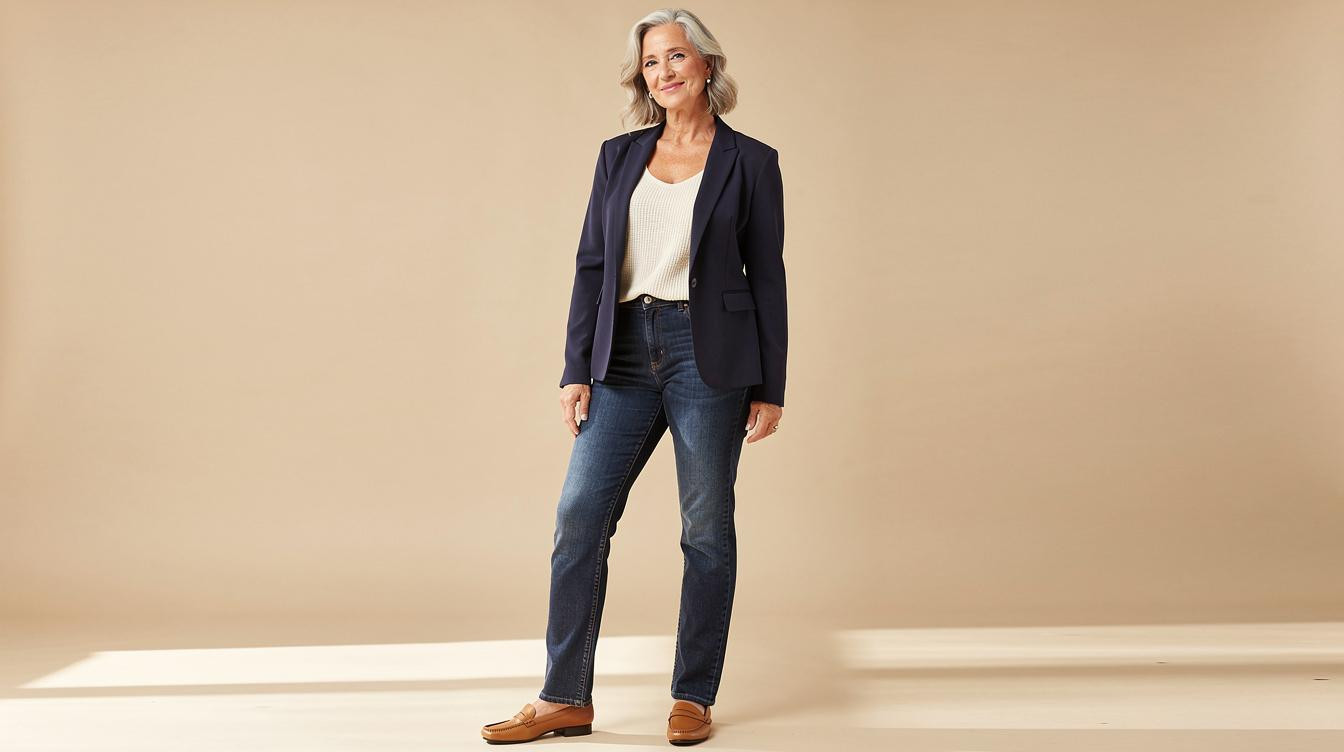
You’re standing in front of the mirror in dark jeans and a blazer, and something’s off. The blazer pulls across the back. The jeans look fine alone but wrong underneath it. That gap between almost polished and actually polished almost never comes down to the individual pieces. It comes down to the relationship between them: shoulder fit, wash, hem length, and what’s in the middle. Fix those four things and the outfit works every time.
The blazer shoulder is the one measurement that cannot be fudged
Every other blazer adjustment is possible at a tailor. The shoulder seam is not. A shoulder that sits even a half-inch too far forward creates drag lines across the chest that no styling trick removes. And after 50, when posture shifts slightly and the upper back can round, those drag lines read even more clearly.
The shoulder seam belongs exactly at the edge of the shoulder bone, not on the arm, not inside it. When it sits right, the lapels flatten, the back panel lies smooth, and the jeans underneath look like a deliberate choice rather than an afterthought. Comfort and polish are not in conflict, and the shoulder seam is where that argument starts.
For late spring and early summer, an unstructured linen-blend or soft twill blazer in navy, tan, or charcoal gives about half a size of movement while still reading polished. Prices run $120 to $250 at Banana Republic, Ann Taylor, and J.Crew. Structured wool blazers are less forgiving and too heavy for June.
The jeans have to earn the blazer
Not all denim can carry a blazer at business-casual level. The wash, the cut, and the rise each determine whether the jeans hold the outfit up or drag it down. The eye reads the most casual element first and classifies the whole look accordingly.
Wash depth does the heavy lifting
Dark indigo and black denim carry the visual weight of a blazer without competing with it. A faded wash, a whiskered finish, or anything distressed pulls the formality register down past the blazer’s ability to compensate. Dark indigo straight-leg jeans at mid-rise, sold at NYDJ ($89 to $128), Talbots ($79 to $109), and J.Crew ($98 to $118), hold their color through repeated washing in a way lighter denim cannot.
The cut that works and the two that don’t
Slim-straight and straight-leg are the fits that work under a blazer after 50. A skinny jean creates a top-heavy silhouette when the blazer ends at the hip. A wide-leg jean competes with the blazer’s volume, and both pieces end up fighting for the eye.
Mid-rise is the other non-negotiable: a low rise creates a gap at the back when you sit. Mid-rise, defined as 9 to 10 inches from the crotch seam to the waistband, keeps the proportion balanced. And the simpler the top underneath, the sharper the whole system reads. A fitted knit shell or clean tee outperforms a printed blouse here every time.
Where the blazer ends changes everything below it
Blazer hem length is the proportional hinge of the outfit. A blazer ending at or just below the hipbone creates a visual break that lets dark denim run the full length to the shoe. That unbroken vertical line reads longer and slimmer than anything you can achieve with the jeans alone.
A blazer ending at mid-thigh covers the slimmest part of the leg and stops the line where it should be starting. Hairstylists who specialize in mature styling often note the same principle in reverse: shorter length creates lift, which is why hem placement matters as much in a blazer as in a haircut. But if the blazer runs longer, the pieces underneath need to be more fitted, or the waist disappears entirely.
The top underneath follows the same logic. A fitted silk shell or fine-gauge cotton tee that stays tucked when you move keeps the middle clean. A loose, untucked blouse under an open blazer adds volume exactly where the outfit needs to stay flat. The shoe then completes the proportion argument or collapses it.
The shoe locks the formula in
Tan leather loafers, low-heeled pointed-toe pumps in black or nude, and minimalist leather sneakers all extend the leg line without pulling attention away from the denim. The jean hem should graze the top of the shoe, creating a continuous line from hip to floor. A chunky platform disrupts that line. A round-toe flat with a hem hitting mid-ankle shortens the leg.
The shoe is structural at this point, not decorative. And image consultants who dress women over 50 consistently name the ankle-length hem as the single easiest fix in the whole outfit system, because it costs nothing and works immediately.
Your questions about denim and blazers for business casual at 50, answered
Can I wear a blazer with jeans to an actual meeting?
Yes, with the right denim. A dark indigo or black straight-leg jean in a clean finish, paired with a blazer that closes without pulling, reads as business casual in most US workplace contexts in 2026. The top underneath is the critical variable: a silk shell or fine knit tee holds the formality register up. Polished without overdressed is a specific register, and this outfit hits it.
What if my blazer fits everywhere except the shoulders?
Take it to a tailor for every other adjustment. But do not buy a blazer that doesn’t fit the shoulders. The shoulder seam is the one alteration no tailor can make without rebuilding the garment from the armhole up, which costs more than the blazer.
Does blazer color matter against dark denim?
Navy and charcoal against dark indigo create a tonal, low-contrast look that reads polished and current. A tan or cream blazer against dark denim creates sharper contrast and a slightly more dressed-up register. Black blazer against black jeans creates a monochrome line that reads slim and clean. All four combinations work. Which one you choose depends on how formal the room is.
Dark indigo straight-leg jeans, a soft navy blazer with the shoulder seam sitting exactly where the arm begins, a cream knit shell, and tan loafers. The hem grazes the top of the shoe. Nothing shifts when you walk in. That’s the whole formula.