Piran began the Balkans’ first trolleybus line on October 24, 1909, a surprising piece of transport history for a compact Adriatic town. The route connected the waterfront with Portorož and Lucija, then gave way to a tramway that ran from 1912-1953.
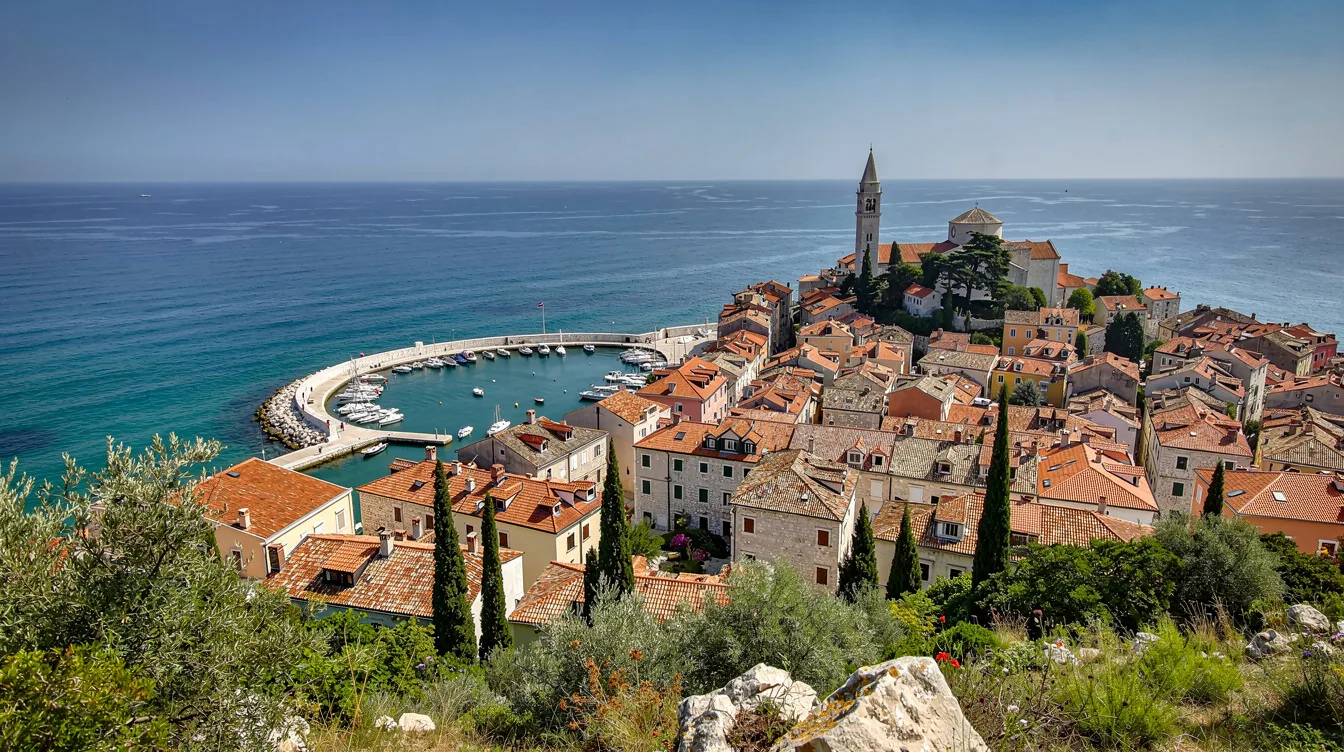
That history is still part of Piran’s appeal, even if you come for the sea. The town sits at the tip of a peninsula in southwestern Slovenia, where narrow lanes, Venetian facades, and salt-making traditions meet the Gulf of Trieste.
Why 1909 still matters in this seaside town
And the old transport story gives Piran a useful edge over prettier coastal stops. The trolleybus entered public service when the town belonged to Austria-Hungary, making this small peninsula an early experiment in electric travel.
But you won’t find a preserved trolleybus route waiting beside the harbor. The story works best as a reason to look closer, because Piran’s streets still reveal layers of Venetian and Central European influence.
From the waterfront, the town feels compact and easy to read. Slovenia’s short coast is nearby, but Piran has enough character for one full day and feels better with two nights.
The old center rewards slow walking
Start at the central oval square, then follow the lanes uphill toward the church above town. The hilltop church gives you an open view across red roofs and the sea, while the old walls show how tightly the peninsula was defended.
And the walk is short enough to repeat at different hours. In the morning, shutters open onto cool stone lanes; later, the harbor fills with boats and the waterfront takes on a warmer, saltier mood.
But Piran isn’t a beach-town choice in the usual sense. Water access comes from quays, rocks, platforms, and steps, so you should choose Fiesa or Portorož if your ideal afternoon needs a more classic bathing setting.
The town’s compact scale is its strongest feature. You can reach the peninsula’s point, the waterfront, and the old walls without turning the day into a logistical project.
Salt gives the coast its deeper flavor
Piran prospered through salt, and that trade still shapes the nearby coast. At the Sečovlje Salt Pans, traditional salt production continues alongside a museum about the work of salt makers.
And the salt pans make a good second-day choice when the old center starts to feel crowded. You get open space, working traditions, and a different view of the coast than the one framed by restaurant terraces.
Beyond the harbor, you can also explore Portorož, Fiesa, Strunjan, or the salt pans without abandoning Piran as your base. That combination makes the town practical for travelers who want a slower coastal stop.
For food, look toward seafood and Istrian-influenced cooking. Fish, calamari, and seafood risotto fit the setting, especially after an afternoon when the smell of salt hangs over the promenade.
Can you reach Piran without a long travel day?
Yes. From Ljubljana, the drive takes about one hour and 30 minutes, putting Piran within reach of a broader Slovenian trip. The bus is another useful option because the town doesn’t have a direct rail connection.
But parking and circulation become more difficult near the center, so arrive early and leave the car before walking into the old town. You’ll enjoy Piran more once the lanes, rather than the traffic, set the pace.
If you want to explore farther by bicycle, the Parenzana follows an old railway route through the coastal region. The full route covers about 80.8 miles, linking the Trieste area, Piran’s salt pans, and Poreč in Croatia.
When should you go?
May and June, along with September and October, offer the best balance for most visitors. The weather is generally more comfortable, the sea can remain suitable for swimming in autumn, and the crowds are lighter than during high summer.
And the shoulder seasons suit Piran’s personality. The town is lively but never loud, with enough activity for dinner and a walk while the waterfront still has room to breathe.
Stay for the evening light
A single day covers the essential sights, but two nights let you combine the old center with the salt pans or nearby coast. Portorož works for a more traditional resort atmosphere, while Piran feels more intimate and historic.
But don’t expect intense nightlife or broad sandy beaches. Piran is best for old stone, sea views, photography, and an Italianate coastal mood that becomes especially convincing near sunset.
At the peninsula’s point, the water darkens below the rocks and the last light catches the harbor facades. By then, the former trolleybus town feels quiet again, with the sea moving softly beyond the old walls.