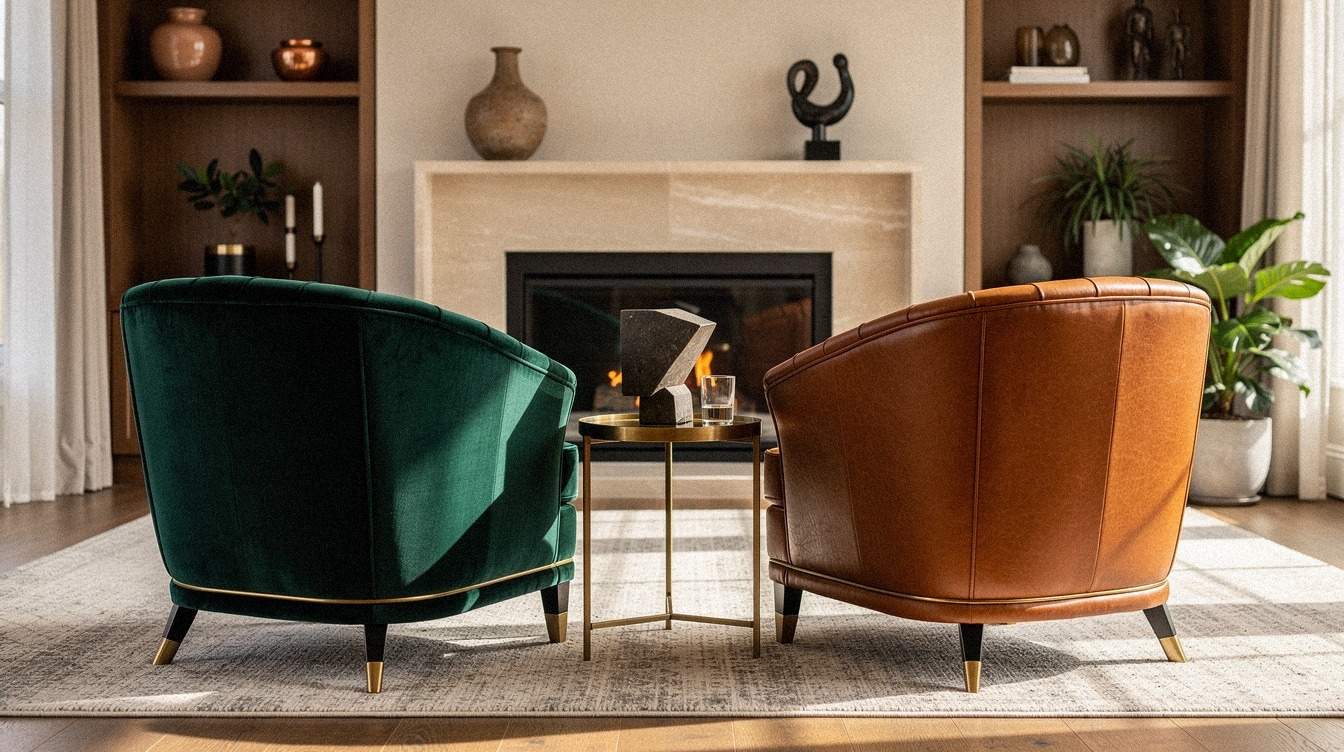
Speakeasy seating & furniture ideas worked in my living room because velvet, leather, and brass made it feel richer, moody, and inviting without tearing the room apart. I started this makeover after one long winter of sitting in a space that looked fine on paper and felt cold at 8 p.m. In one weekend, a few furniture swaps pulled the room together. Fast.
Here’s what it looked like before: The Too-Much-Space Problem
Before I touched a thing, the room had the full polite-but-forgettable setup: one square sofa, one oversized coffee table, and a layout that pushed every seat against the walls as if the fireplace didn’t matter. You could walk through it easily, sure, but you couldn’t settle into it. The gap in the middle felt bigger than the room itself, and the TV wall pulled all the attention away from the stone.
Harsh, stark, and empty. The kind of room you forget the second you leave it!
What fixed it wasn’t more furniture. It was better scale.
I kept thinking about the problem from your velvet throw is making your living room feel 8 degrees warmer than it actually is, because that was exactly my mistake. I had depth without intimacy, width without landing spots, and zero softness where your hands or elbows would rest. Once I accepted that the seating had to gather instead of spread, the whole plan got easier.
- I pulled two barrel chairs toward the fireplace
- Why did a curved cognac leather sofa work better here?
- I placed a round table within every reach
- I swapped the coffee table for nesting cocktail tables
- I added a velvet slipper chair by the window
- I tucked a cane cabinet behind the seating
- What made the room glow after dark?
- I brought in a narrow banquette against the wall
- I layered a small ottoman instead of a bulky bench
- I set a marble drinks table beside the armchair
- I used a low bookcase as the room divider
- Why did angling the chairs feel more intimate?
- I finished with leather stools under the console
1I pulled two barrel chairs toward the fireplace
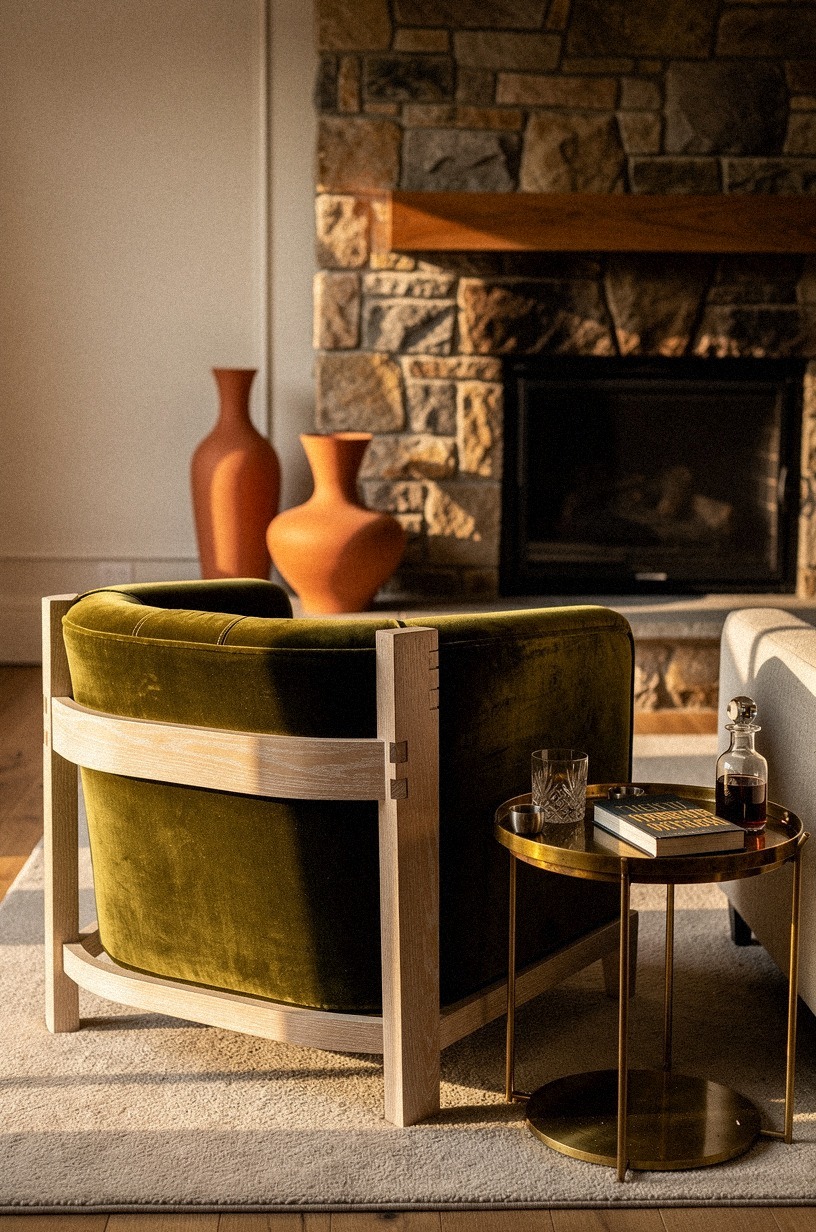
The first move was dragging two barrel chairs off the wall and turning them toward the stone fireplace until the room finally had a center. I used one in olive velvet and one in aged leather, and that little mismatch gave the space more life than a matching pair ever would’ve. If you’re trying this in your own room, let the front legs sit on the wool rug and keep the chairs close enough that you could set down a drink without leaning forward like you’re reaching across an airport lounge.
You don’t need a huge footprint for this to work. A barrel chair has presence, but its rounded back keeps the layout from feeling blocky, especially when your sofa depth already lands in that 35 to 40 inch range. I learned the hard way that symmetry only helps if the seats feel usable.
Too far apart, and nobody talks. Too tight, and your knees know it.
2Why did a curved cognac leather sofa work better here?
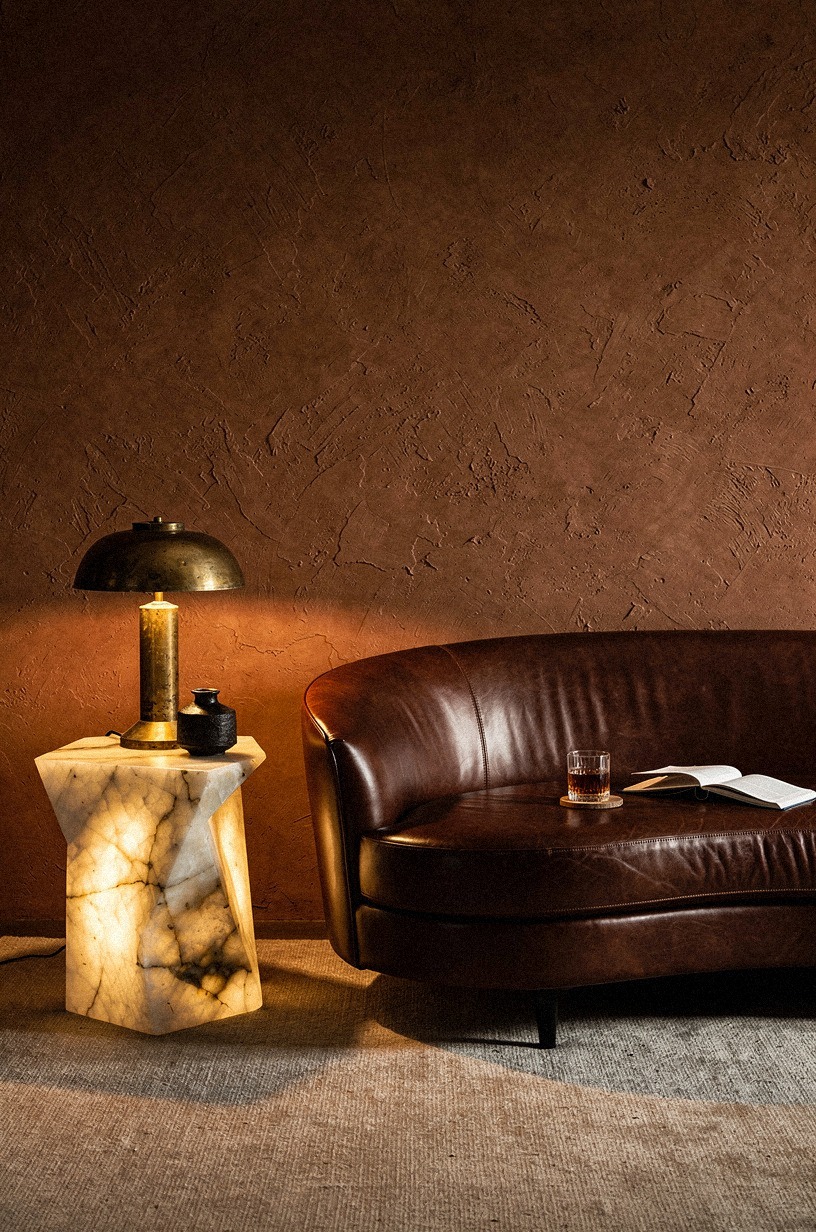
A curved Article Sven style sofa in dark cognac leather fixed the room because its rounded back felt less rigid, more soft, and more intimate than a square three-cushion profile. The line was elegant, the seat deep, and the leather rich without turning glossy. In a moody room, that quiet curve keeps the fireplace from fighting every other edge.
I kept the sofa around 88 inches wide, which gave me enough seating without letting one bulky piece dominate the whole conversation zone. I’d skip heavy tufting here.
Too formal. A smooth, refined leather surface looks better once you add a warm throw and one subtle lumbar pillow, and your knees still have an easy path around the cocktail table.
3I placed a round table within every reach
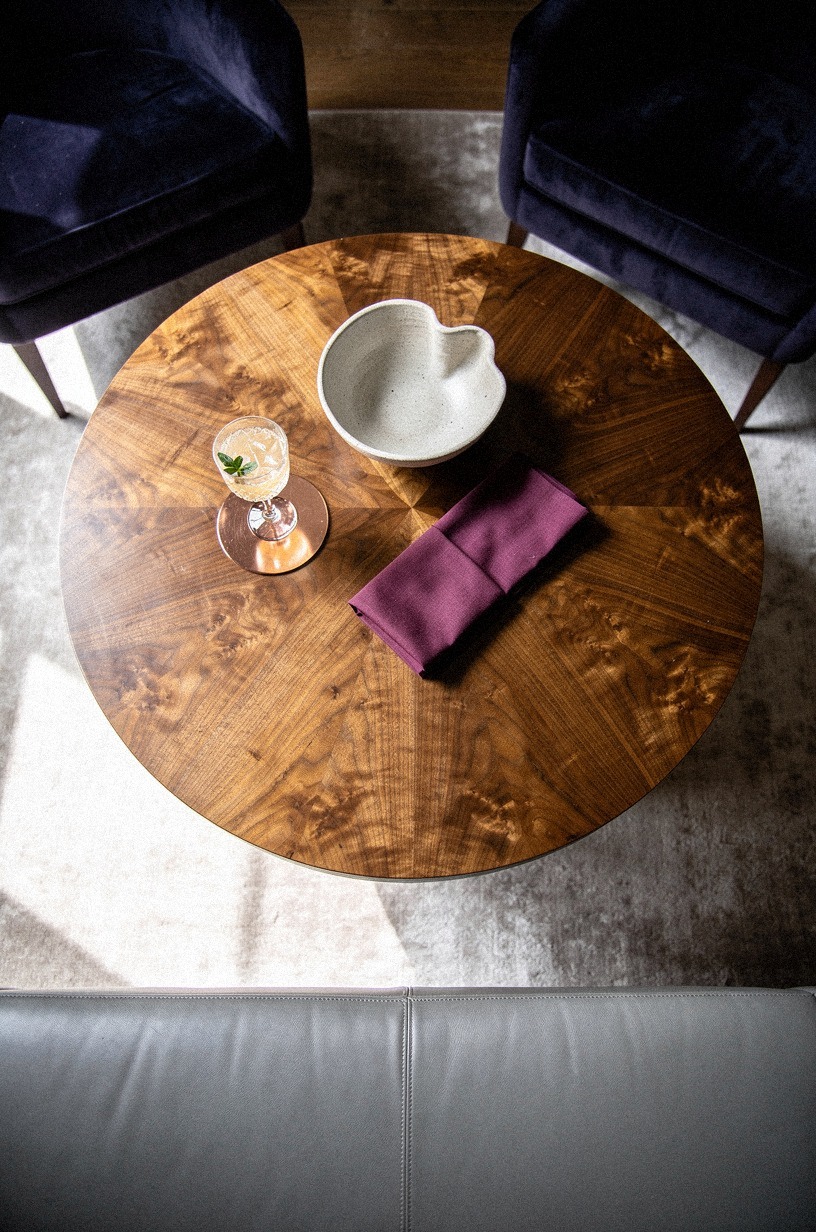
Once the seats were facing each other, the room needed a center piece that didn’t bark orders. A round cocktail table in book-matched walnut did the job because it kept the circulation fluid and gave every chair a place to land a glass, a candle, or a book. From above, the layout looks intentional instead of accidental, which matters more than people admit.
You want your coffee table about 16 to 18 inches tall, and roughly two thirds the sofa length, but shape matters just as much as size. Round is forgiving.
Corners are not. I skipped anything too glossy because the walnut grain already had enough movement, especially next to velvet club chairs and a low bowl.
If you style your rooms by touch as much as sight, you’ll get why your fingertips graze velvet and 5 sensory layers calm you instantly feels so true. Your hand reaches first.
Your eye catches up.
4I swapped the coffee table for nesting cocktail tables
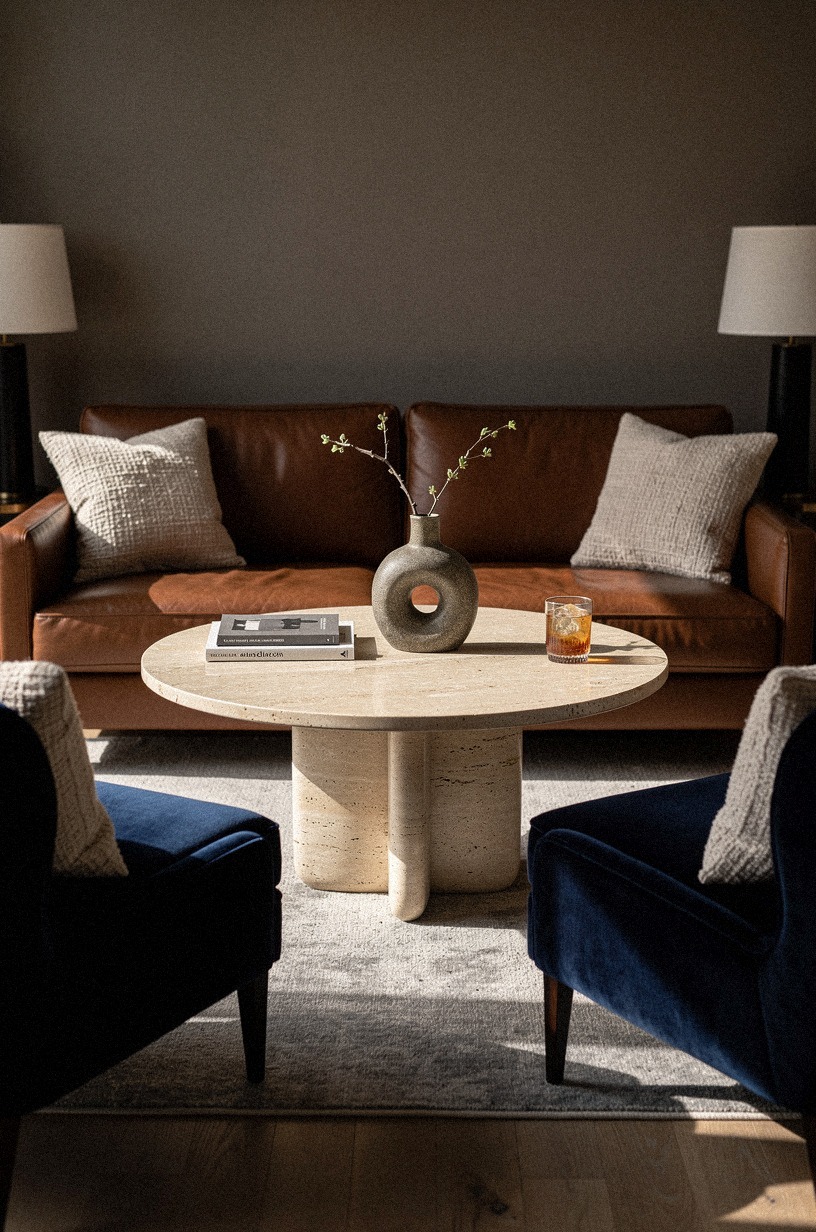
This was the switch that made the room more social. I traded one heavy coffee table for nesting cocktail tables in honey-toned travertine, and suddenly people could pull a surface closer without dragging half the room with them. Between navy velvet lounge chairs and a walnut-toned leather sofa, those tables read lighter than wood and quieter than black metal.
If your seating area has more than two main seats, nesting tables are simply smarter. You can split them when you have guests, tuck them back when you don’t, and the varied heights keep the middle from looking flat.
But don’t go tiny. A table still has to hold a tray and one proper drink.
I checked myself here against your winter balcony needs more furniture not less the nordic 4 layer formula, because the lesson carries over indoors too: layering is what makes a room feel finished, not just furnished.
5I added a velvet slipper chair by the window
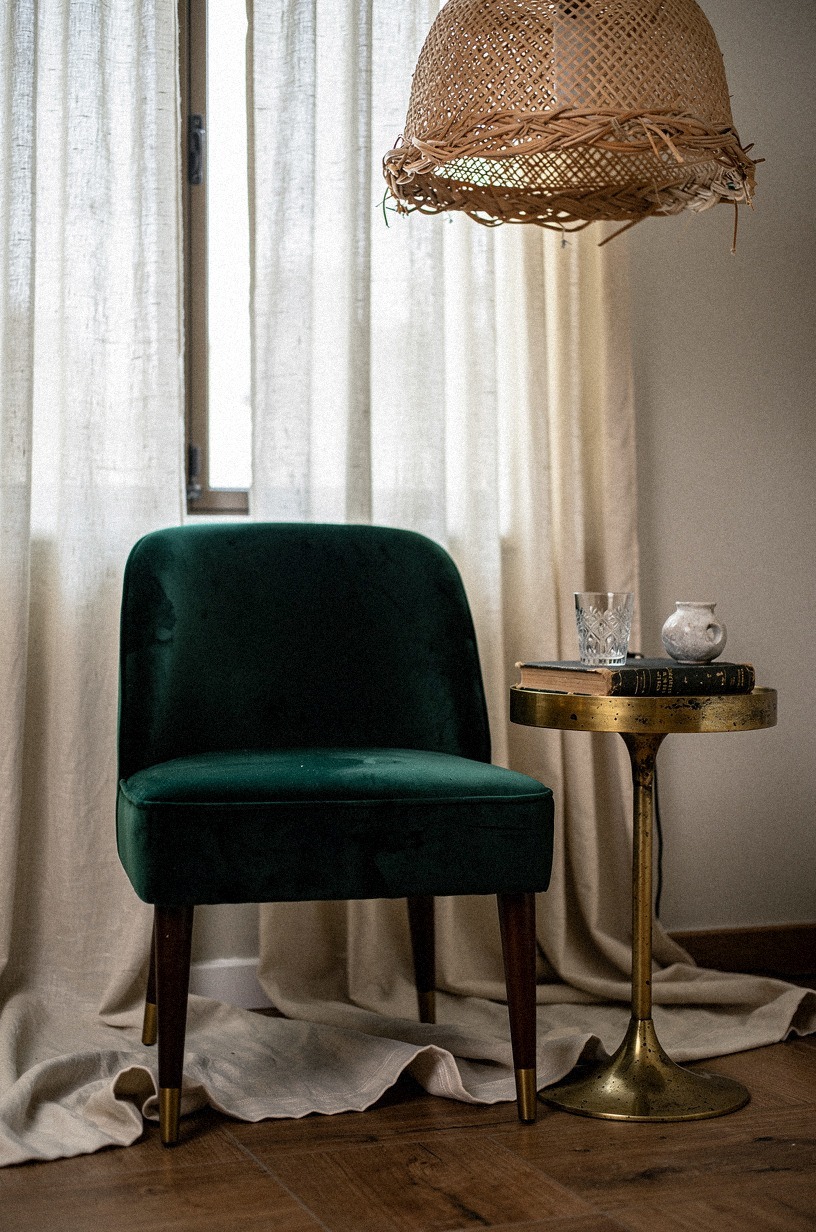
The window side used to be dead space, which is wild because that was where the best afternoon light landed. I slid in a slipper chair in deep emerald velvet, then paired it with an unlacquered brass side table and Belgian linen drapery so the corner would catch light instead of swallow it.
The woven rattan shade kept the scene grounded. Otherwise the green could’ve gone too polished, too quickly.
This kind of chair works because it sits low and doesn’t interrupt the line of the window. You still get a reading spot, but you don’t build a wall.
And if you’re worried about mixing materials, don’t be. Velvet, brass, and rattan sound busy on paper.
In person, they make each other look more relaxed. I almost used Sherwin-Williams Evergreen Fog SW 9130 on the trim beside this window, and honestly, I’d still do it if the room needed one more quiet layer. Soft, not sleepy.
6I tucked a cane cabinet behind the seating
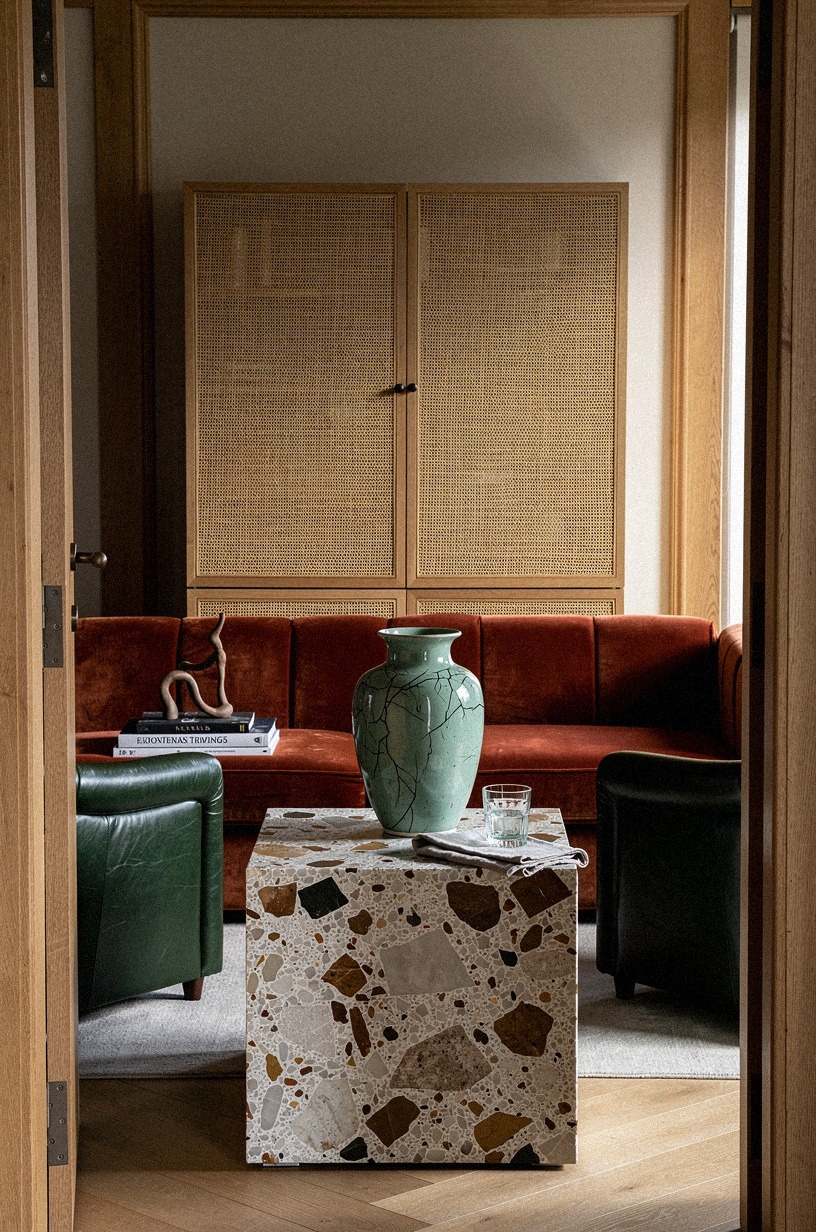
Storage was the one practical issue I couldn’t ignore, because a room can feel moody and layered right up until remotes, coasters, and chargers start living on every visible surface. I tucked a cane-front cabinet behind the rust velvet sofa so it read as architecture first, storage second. Through the doorway, you catch the cane texture, the natural oak trim, and the bigger silhouette, not the clutter it hides.
This is where I think people overbuy built-ins when they do not need to. A cane-front cabinet gives you airflow, texture, and enough visual softness that it does not feel like office furniture parked in the living room. If your layout has a pass-through or doorway view, keep the cabinet lower and wider instead of tall and skinny.
The room will breathe better. I had the same reaction I did reading neither sequins nor basics this 250 velvet leather satin formula covers 5 winter events: the mix is what makes it memorable, not one hero material trying too hard.
7What made the room glow after dark?
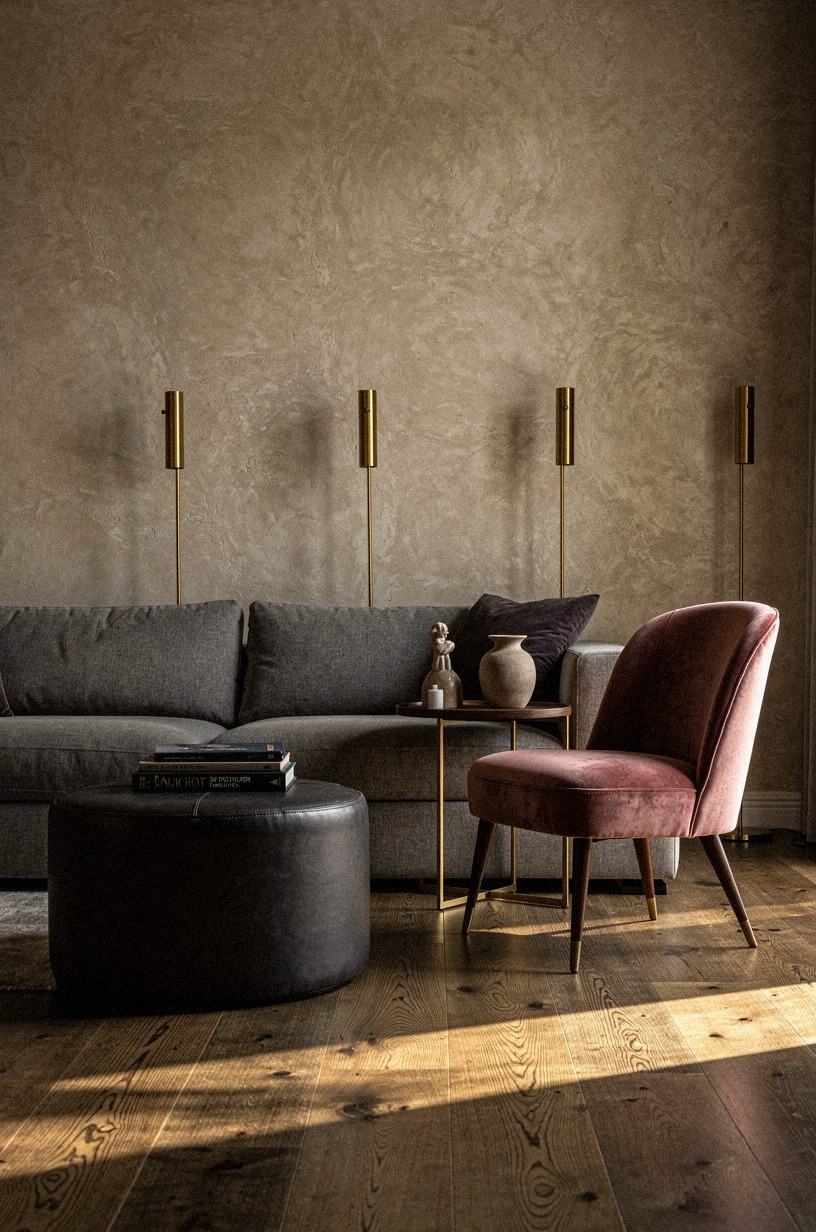
Overhead lighting was flattening the whole room, so I killed it and spread the glow with tall aged brass floor lamps instead. I wanted the light low, warm, and a little dramatic, the kind that makes leather look richer and velvet look softer by 8 p.m. The room felt more intimate the second the ceiling light stayed off.
If you’re copying this move, place one lamp just behind the sofa arm and another near the chair pair so the light overlaps instead of blasting from one corner. That’s the inviting part. You want a gentle pool on the rug, a subtle glint on the brass, and enough shadow to keep the room sophisticated instead of washed out and flat.
8I brought in a narrow banquette against the wall
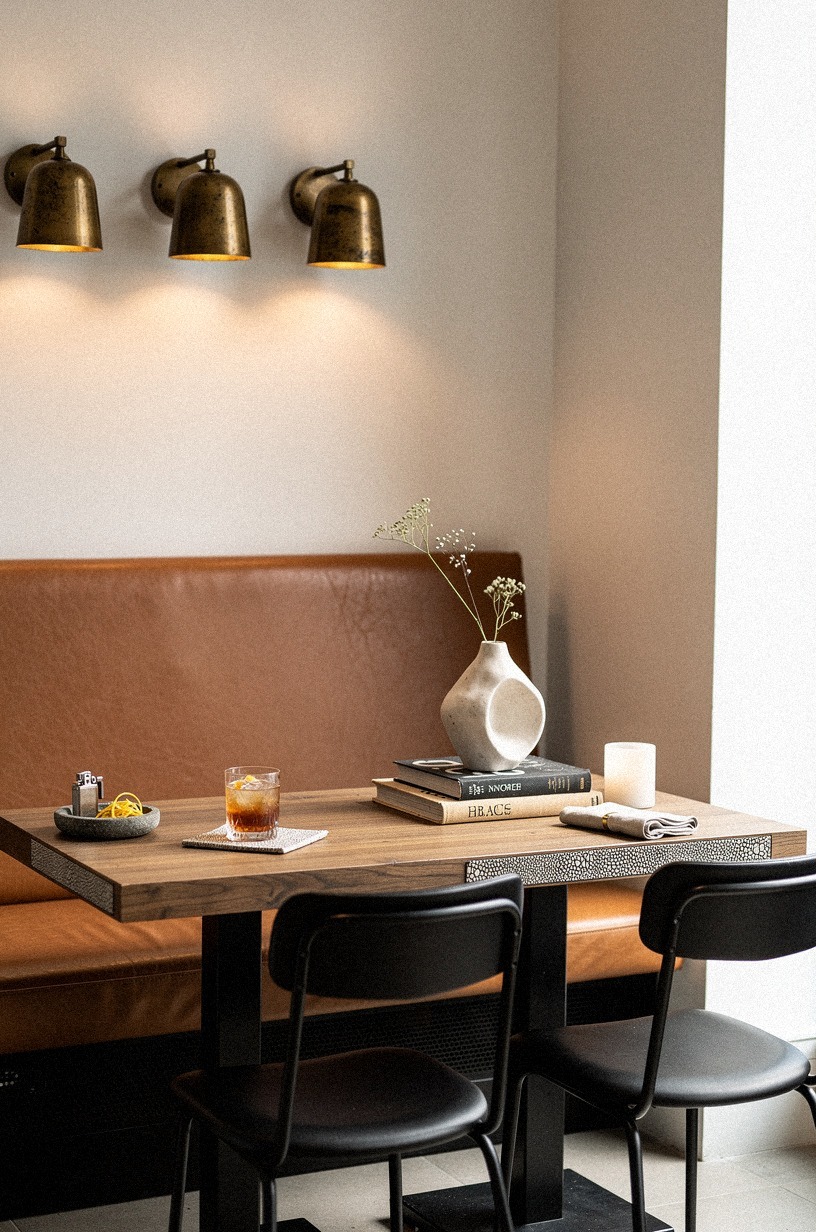
The wall opposite the fireplace had enough length for seating, but not enough depth for another full chair. A narrow camel leather banquette solved that in a cleaner way than I expected. Under aged brass sconces, with black-accented side chairs and a creamy backdrop, it turned an awkward stretch into a proper nook for drinks, cards, or the kind of long conversation that starts after dinner and somehow keeps going.
If you have a narrow wall, this is where restraint pays off. Don’t shove in a deep loveseat just because there’s empty space.
A banquette keeps the path open and gives you seating that feels built in, even when it isn’t. I measured the clearance twice because you still need to move behind the chairs without clipping your shin every night. Worth it.
And if your room already leans light, Benjamin Moore Revere Pewter HC-172 behind a camel banquette would keep it mellow without drifting beige.
9I layered a small ottoman instead of a bulky bench
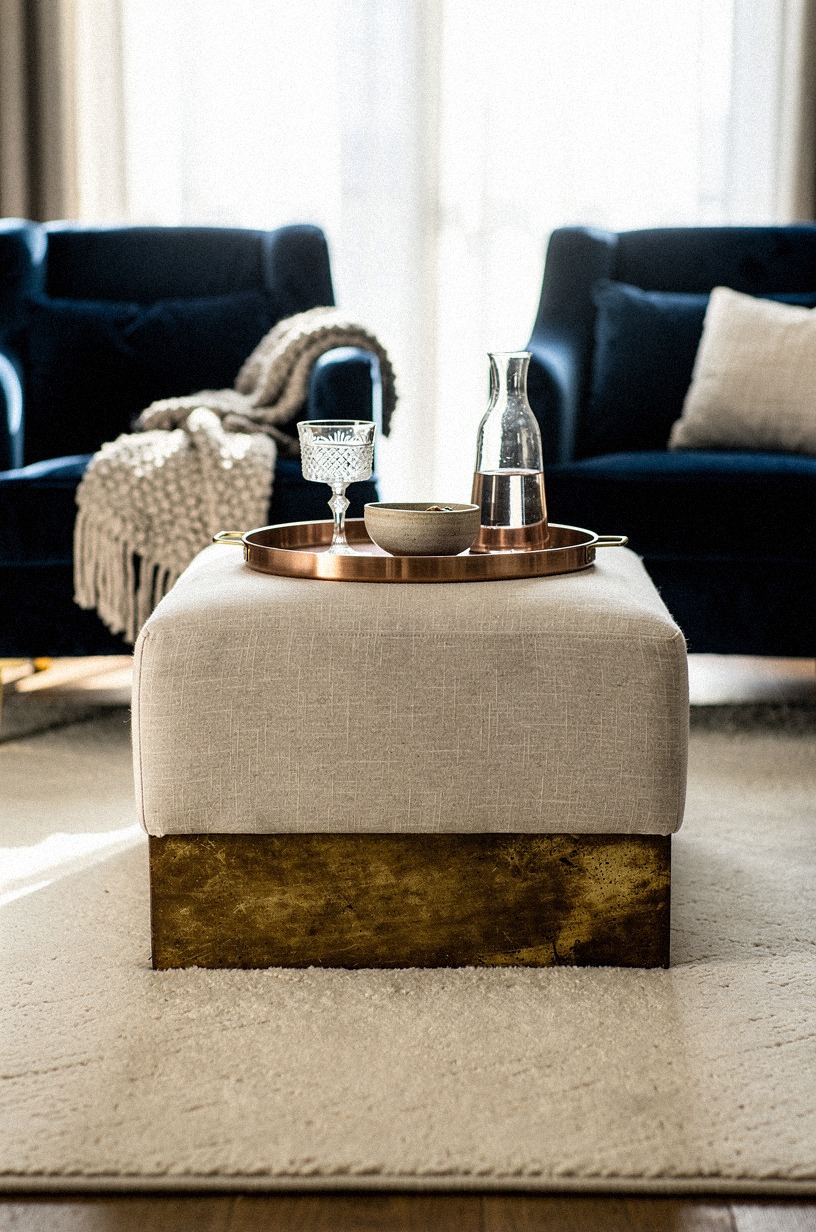
Two midnight blue velvet chairs looked polished on their own, but a little too composed. A small ottoman in camel mohair velvet broke that stiffness with one soft, easy landing spot for feet, a tray, or a folded throw. The shape stayed low and charming, which mattered more than squeezing in one more full seat.
I’d avoid a bench here unless your room is unusually wide. Benches read longer, harder, and more formal than they need to in a speakeasy layout. An ottoman keeps the scene relaxed, open, and easy to move around, especially when you already have a round table nearby.
10I set a marble drinks table beside the armchair
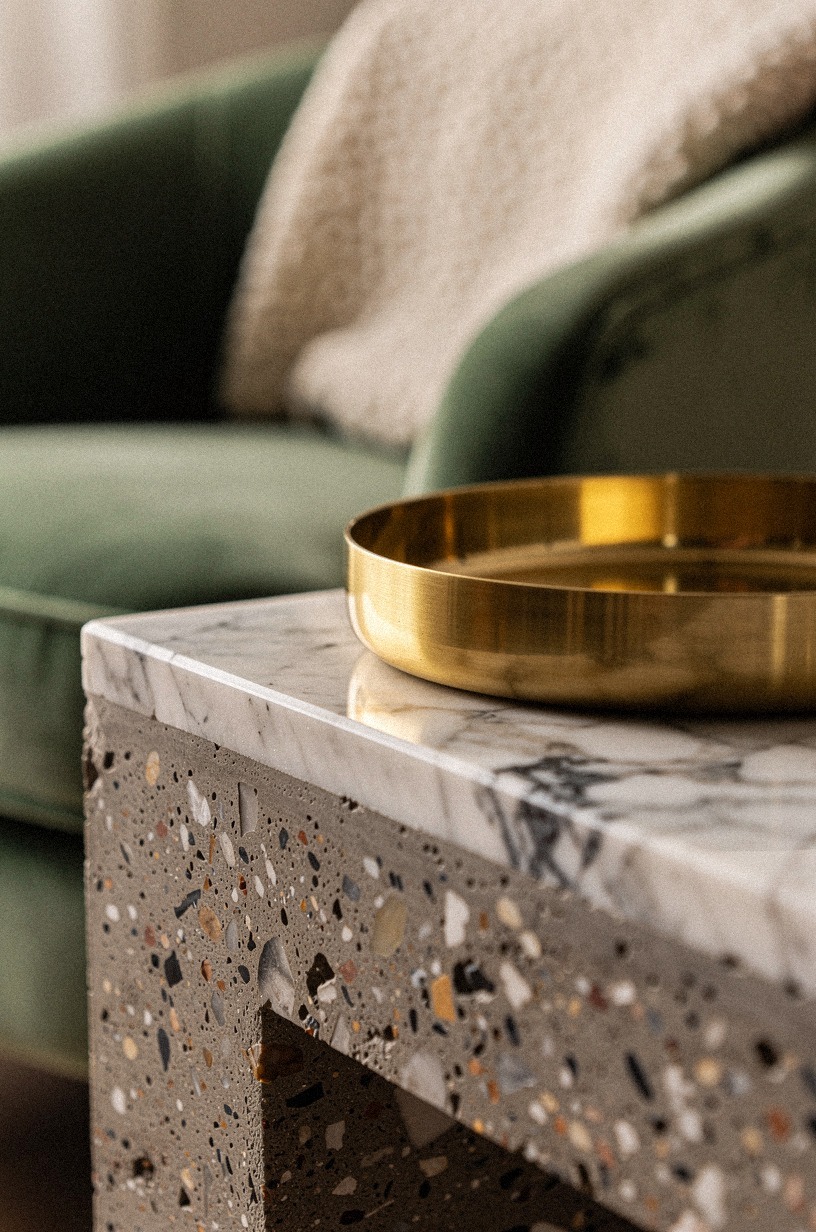
Some changes only matter in close-up. Beside a sage velvet armchair, I added a marble drinks table with a brass coupe tray, and suddenly the seat looked finished enough to deserve its own lamp and blanket. The bouclé upholstery in the background stayed quiet, which let the marble edge and the metal sheen do the talking.
A drinks table is tiny, but it fixes a big annoyance: where your cup goes when you are sitting in the best chair in the room. I do not like forcing people to reach across a side table jungle, and you probably do not either. The move is scale without fuss, which is why a slim marble top wins over anything bulky here.
I kept this detail near your fingertips graze velvet and 5 sensory layers calm you instantly in my head, because that post gets the point: small tactile details change the whole read of a room.
11I used a low bookcase as the room divider
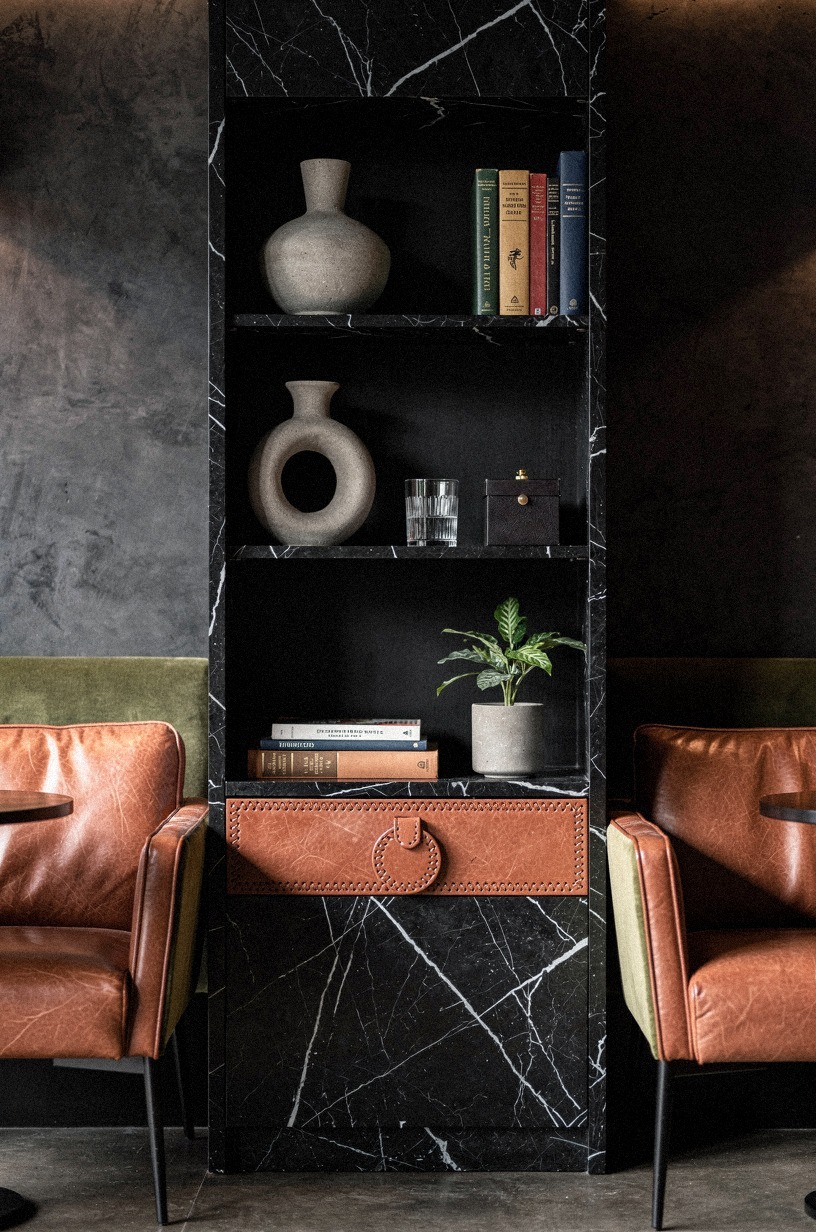
Open plans need boundaries, but I hate a divider that announces itself like a mall kiosk. A low Nero Marquina marble bookcase did the opposite. It split the speakeasy seating zone from the lounge path while still letting you see the terracotta leather chairs, the olive velvet sofa, and the length of the room beyond.
That view-through quality is why it works.
You don’t need a tall screen unless you’re trying to hide something ugly. Most of the time, a lower piece gives you all the zoning you need without chopping the room into awkward chunks.
I kept decor on top sparse. One stack of books, one brass object, one shallow bowl.
Done. Too much styling would’ve ruined the line. If you’re fighting scale in an open room, your Pinterest corner fails because furniture is too big for the space makes the same case from another angle, and it’s right.
12Why did angling the chairs feel more intimate?
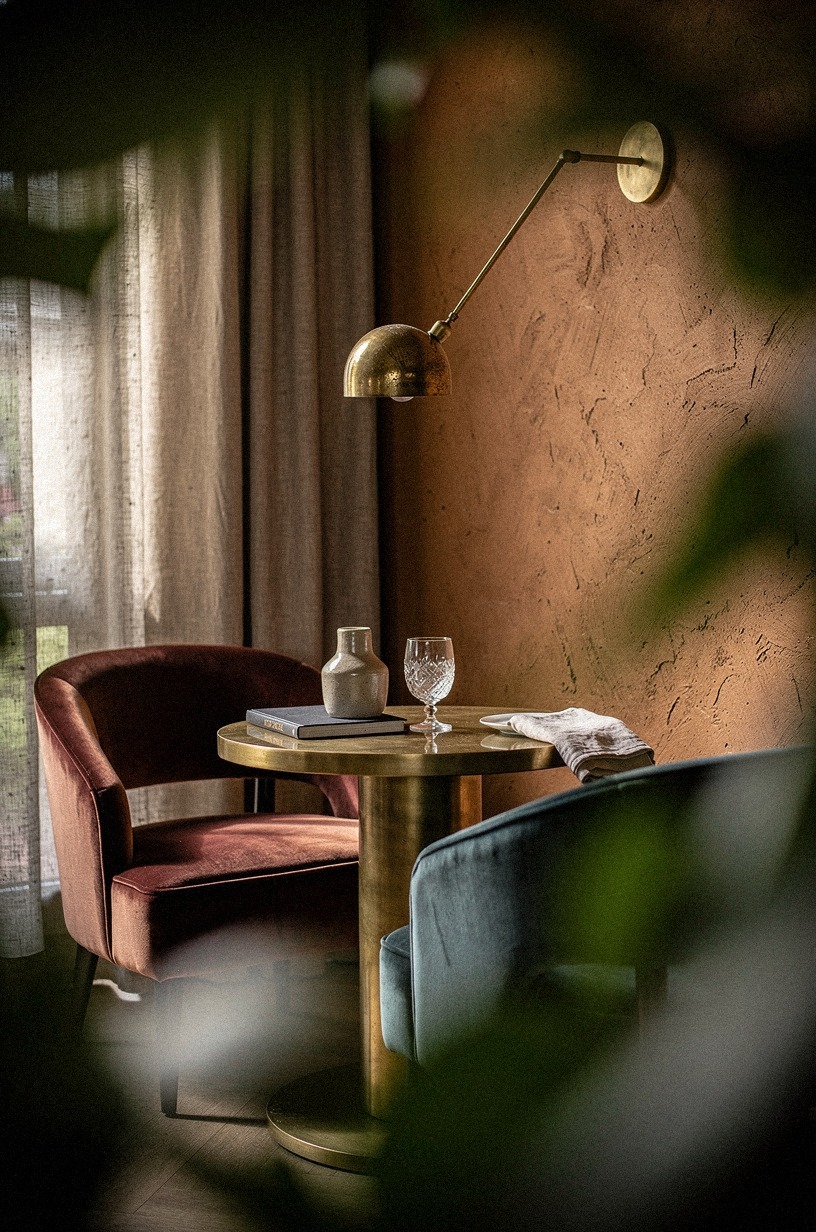
This was the emotional turn in the room. The second I angled the chairs inward, the layout stopped acting like a showroom and started feeling like a conversation.
You could see the fire, catch the lamp glow, and still look at the person across from you without twisting sideways. Small move, huge shift.
Straight rows feel efficient, but they aren’t very generous. A slight angle feels less stiff, more serene, and far more human because your body doesn’t have to work to join in. I keep coming back to that whenever a room feels stiff: if the chairs don’t invite you in, the palette won’t save you.
13I finished with leather stools under the console
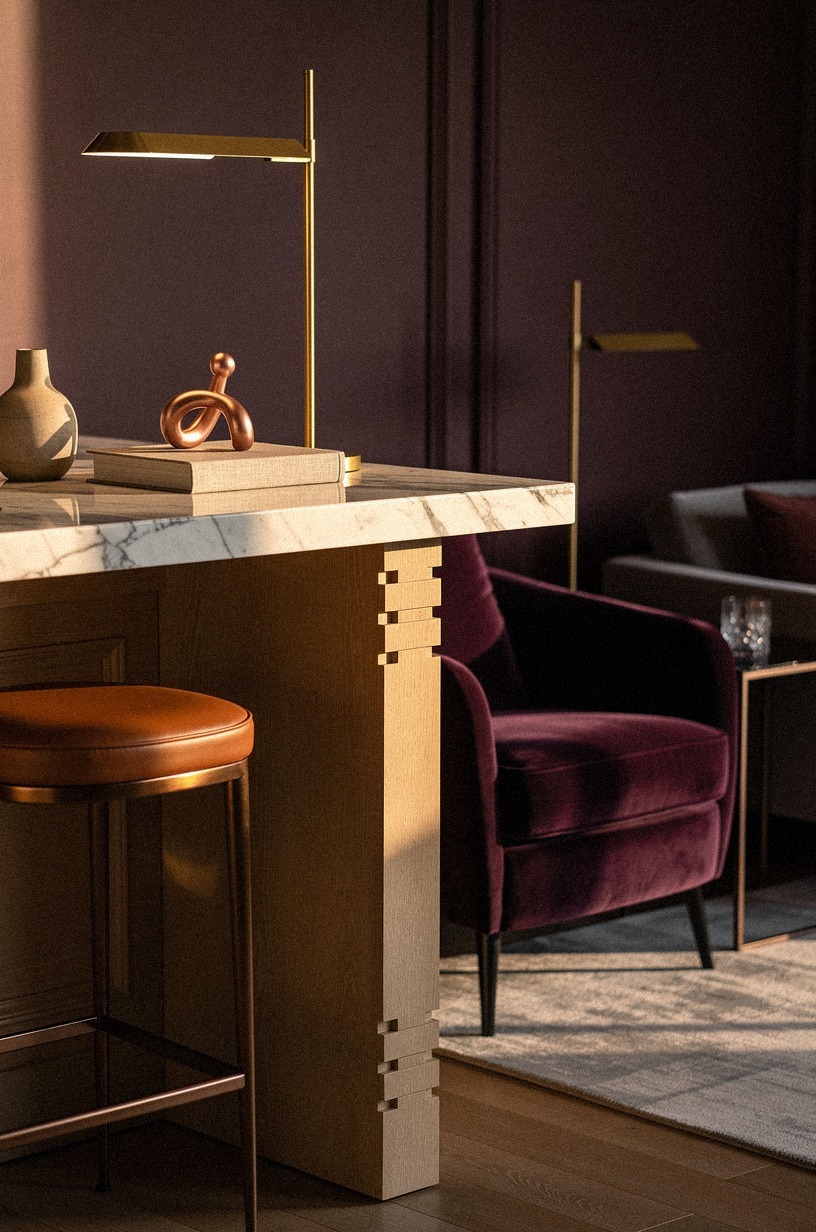
The last layer went under the console: leather stools tucked beneath a Carrara marble top with white oak joinery and visible dovetail details. In the plum and gray palette, with a little rose-gold glint nearby, the stools made the console work harder without making it look crowded. That mattered because this wall was one of the first things you saw when you walked in.
I love stools here because they stay useful without demanding floor space. You can pull one out for a guest, use one to drop a bag, or keep them parked and let the console stay clean.
If your room has a circulation path beside the seating area, this is a smart place to add function without bulk. I kept hearing the warning from your Pinterest nordic room feels cold because furniture is too big for the space in my head while finishing this side of the room.
Scale first. Style second. Always.
How much does the West Elm + Article velvet-leather seating formula cost?
I didn’t gut the room, and that’s why the numbers stayed sane. The short version is this: you can get the speakeasy feeling from surfaces and lighting first, then decide later if the sofa or custom pieces are worth the bigger spend. That’s the Two-Layer Budget Rule I followed, and it kept me from blowing money on the wrong line item.
The furniture math gets clearer when you price key pieces by category instead of by mood. A performance-fabric sofa usually lands between $1,200 and $4,000, a wool rug in 8×10 or 9×12 often runs $600 to $2,500, an oak coffee table can sit between $300 and $1,200, and linen drapes for a pair usually fall around $120 to $400.
That range is why I’d save on side seating before I’d cheap out on the main rug or sofa. You use those every single day.
The Low-Glow Rule: what I learned before the FAQ
What surprised me most about this makeover wasn’t the color story. It was how quickly the room changed once I stopped thinking of seating as furniture and started thinking of it as choreography.
I used to buy the biggest piece first and then try to force every other decision around it. That is backwards.
The room does not remember what cost the most. It remembers where your body settles, where your hand lands a glass, and whether the light makes you want to stay another hour.
That shift made the room feel more calming without adding anything flashy.
I also learned that velvet isn’t precious when the rest of the room is grounded. That’s the mistake I used to make in my head.
I thought velvet meant formal, leather meant masculine, brass meant a little too polished, and all three together would feel costume-y. They didn’t.
They felt believable because the shapes stayed practical: a curved sofa you could sink into, a drinks table within reach, stools that disappear under a console, a cane cabinet that hides the ugly bits. Texture carries drama better than silhouette does. That’s the difference.
The room read sophisticated, refined, and a little dramatic, not staged.
And money? Money matters, but not where most people think.
I would rather see you buy one chair in olive velvet and leave the rest of the room simpler than cram in four pieces that all shout at once. The room gets richer when the materials have contrast and the plan has restraint. I made that mistake once with too much leather in one zone, and the space felt flat, not luxurious. Dry, even.
Adding linen and cane fixed it faster than another expensive purchase would have. One panel, one earthy cabinet, and one lamp did more work than another matching chair. But restraint is what made the room feel expensive, not the spending.
And that shift stays with you long after the shopping is over. The lesson that keeps echoing is this: intimacy is a layout choice before it is a style choice.
If your chairs are too far apart, if your tables are too low to use, if your lamps throw light at the ceiling instead of at people, no amount of marble or brass will save the mood. That is why I kept circling back to your fingertips graze velvet and 5 sensory layers calm you instantly and your velvet throw is making your living room feel 8 degrees warmer than it actually is. Those pieces understand something a lot of design advice skips: your room has to feel good before it looks impressive.
The best version feels tranquil, comforting, and welcoming at the same time. Once I got that right, the speakeasy mood stopped being a theme and started feeling like home.
The Questions Worth Answering First
What is the best Speakeasy Seating & Furniture Ideas (Velvet, Leather & Brass) for a small living room?
A curved sofa plus one barrel chair is the best starting point for a small living room because it gives you flow and softness without blocking the path. Better movement is the whole win.
– A compact Article Sven style profile – One rounded chair, not two bulky recliners – A smaller round table within reach
Where can I buy Speakeasy Seating & Furniture Ideas (Velvet, Leather & Brass) pieces on a budget?
I’d start with IKEA, Target Threshold, and Wayfair, then check Facebook Marketplace before you buy any accent chair new. Cheaper texture mixing matters more than matching sets. And your winter balcony needs more furniture not less the nordic 4 layer formula has the same layering logic in a lighter setting.
– IKEA for stools and side tables – Target Threshold for lamps and pillows – Marketplace for leather chairs with patina
How much does a Speakeasy Seating & Furniture Ideas (Velvet, Leather & Brass) makeover cost?
About $300 to $1,200 gets you the budget version, and a fuller furniture redo can climb to $2,500 to $8,000 fast. Layered upgrades stretch farther than one giant purchase.
– Paint and textiles first – Rug and lighting next – Sofa upgrade last if needed
Can I create a Speakeasy Seating & Furniture Ideas (Velvet, Leather & Brass) on a budget?
Yes, and you don’t need custom millwork to pull it off. Mood for less comes from layout, light, and one strong material choice.
– Pull chairs off the wall – Swap bright bulbs for warm ones – Add one velvet or leather accent piece
Is a Speakeasy Seating & Furniture Ideas (Velvet, Leather & Brass) worth it in a small space?
Yes, especially in a small room, because tighter seating makes the mood feel intentional instead of empty. Closer conversation zones are easier to build when you are not filling a giant footprint. But your Pinterest corner fails because furniture is too big for the space is the warning I would read before buying anything.
– Front legs on the rug – Smaller round tables – Seats angled, not lined up
Is Speakeasy Seating & Furniture Ideas (Velvet, Leather & Brass) a good idea for a rental?
Yes, because most of the look comes from movable pieces and lighting, not construction. Rental-friendly warmth is very doable if you stay disciplined.
– Plug-in sconces instead of hardwire – Removable drapery hardware where allowed – No-damage styling layers from your winter balcony needs more furniture not less the nordic 4 layer formula
Where I’d Start First: The One-Seat Rule
If I had to pick one, I’d start with the barrel chairs by the fireplace. They force the room to gather instead of drift, and that changes every later choice.
Pin this layout for later and steal the spacing before you buy another table. It works!