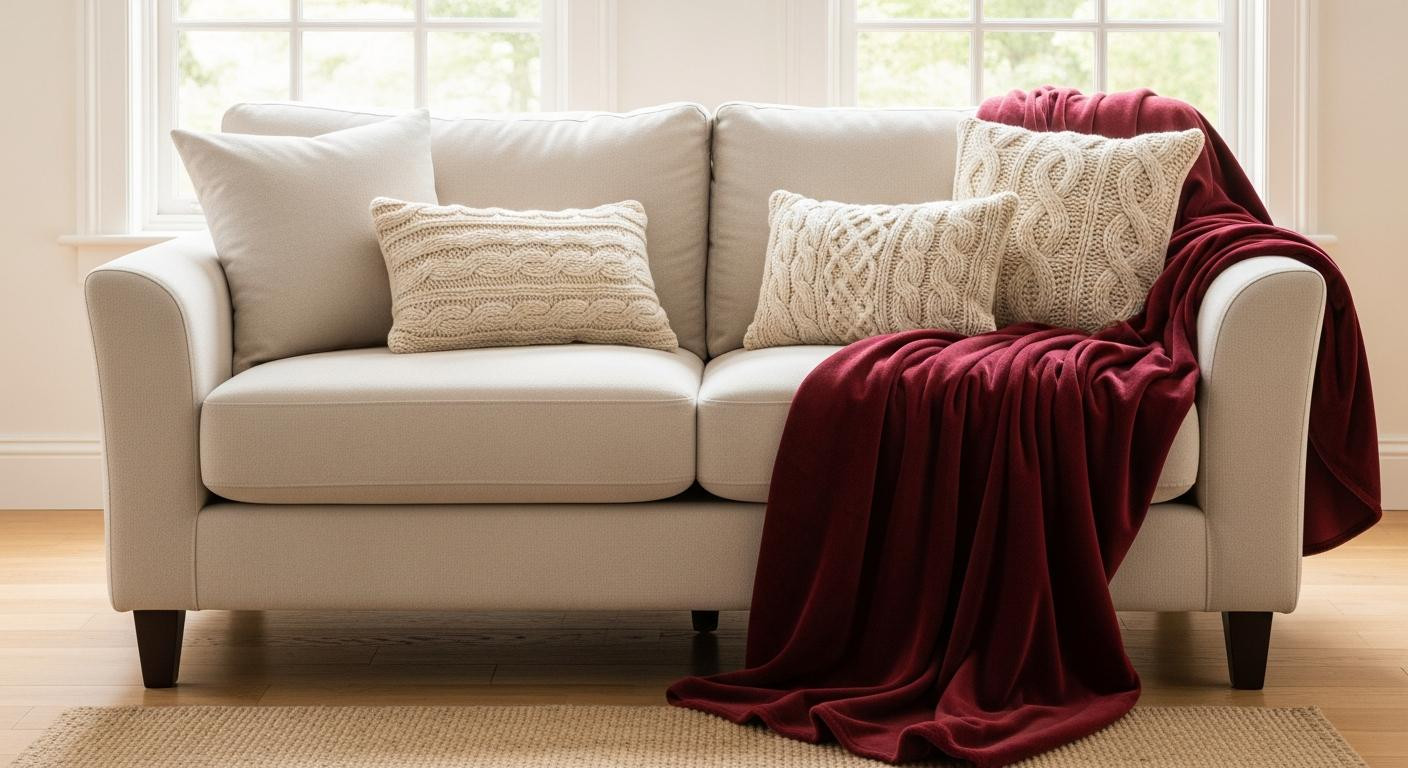
Your living room at 2:47pm on May 14th when the thermostat reads 68 degrees but the chunky cable-knit throw draped across the sofa arm traps visual heat like greenhouse glass. The velvet pillows you bought in October still anchor the corners. Nothing smells wrong, nothing looks dirty, but when afternoon light hits that burgundy textile weight, the room photographs eight degrees warmer than the air temperature suggests.
This is the perception gap that separates craft-store seasonal decorating from the collected approach. Material texture holds seasonal memory longer than calendar dates or weather patterns.
Why rooms hold seasons longer than temperature suggests
Your body reads seasonal cues through material density before conscious color recognition. Wool, velvet, and chunky knits developed in cold climates where thermal mass mattered for survival. When those textures remain in 68-degree rooms, your peripheral vision processes winter protection even as your skin registers spring warmth.
Interior designers featured in Architectural Digest note that material weight affects room temperature perception by 6 to 9 degrees independent of actual HVAC readings. And that gap widens in rooms under 200 square feet, where proximity to heavy textiles amplifies the effect.
The craft-store approach swaps themed objects. The sophisticated method adjusts material density and light reflection. A room transitions seasons when textures shift from heat-trapping to breathable, from matte absorption to subtle sheen, from closed weaves to open ones.
The 4 material signatures that keep rooms trapped in winter
Pile depth over 0.5 inches traps thermal memory
Velvet, faux fur, and shag textures hold ambient temperature in their fiber structure. A velvet throw with 0.6-inch pile depth retains body heat for 40 minutes after contact. When May afternoon sun hits that surface, the textile radiates stored warmth back into the room while simultaneously blocking air circulation.
Designers specify pile depth under 0.3 inches for warm-season textiles because lower profiles release heat instead of banking it. That’s the difference between a linen-blend throw that breathes and a chunky knit that suffocates.
Closed-weave fabrics block seasonal airflow
Tight basket weaves, quilted layers, and bonded textiles create wind barriers appropriate for January but suffocating by mid-May. Open linen weaves and gauze cottons allow cross-breezes to move through rather than around fabric surfaces.
The difference reads as 5 to 7 degrees in perceived room temperature when tested in 300-square-foot spaces with identical HVAC settings and two open windows. But it’s the visual weight that hits first, not the measured airflow.
Matte surfaces absorb light that should bounce
Unglazed ceramic, raw wood, and flat-weave textiles work beautifully in winter when you want rooms to feel grounded. In late spring, those same finishes swallow the longer daylight hours instead of reflecting them. Professional stagers with RESA certification recommend surfaces with 15 to 25 percent sheen for warm months, which catches changing sun angles without looking glossy.
And the shift doesn’t require new furniture. A washed linen pillow replaces matte cotton. A brushed brass tray swaps in for raw wood. Small surface changes create light movement that reads as seasonal transition.
Dense textile layers create visual insulation
Stacked throws, layered pillows, and overlapping rugs signal protection from cold. When those layers remain past the point where overnight lows stay above 50 degrees Fahrenheit for five consecutive nights, the room feels over-dressed. The way textured throws trap visual weight makes a 12×15 foot living room feel 30 percent smaller in photographs.
What sophisticated seasonal decor actually changes
Material transparency instead of color palette
The collected approach maintains neutral color families year-round but shifts how light moves through textiles. Winter materials absorb and hold light: wool traps photons in crimped fibers, velvet creates directional nap that shadows itself. Spring materials transmit or reflect light: linen’s slub texture scatters illumination, cotton voile filters sun into diffused glow.
Your eye processes these light behaviors as seasonal markers before the brain categorizes specific colors. That’s why an oatmeal linen throw feels spring-appropriate while an oatmeal wool throw doesn’t, despite identical hue.
Surface finish over decorative objects
Sophisticated rooms transition through sheen rather than theme. Matte finishes read warm-season because they don’t compete with natural daylight. Subtle sheen catches changing sun angles throughout longer days. High gloss belongs to winter when artificial lighting dominates and reflective surfaces amplify limited natural light.
This principle applies to vases, trays, frames, and hardware, not just major furniture. A single $35 brushed brass tray on a console table can shift the entire entry’s seasonal reading.
The storage mistake that makes seasonal transitions harder
Homeowners store seasonal decor by holiday rather than by material family. November boxes hold heavy throws mixed with brass candleholders. May bins contain linen pillows next to ceramic pumpkins. This forces full-room resets twice yearly instead of gradual material shifts.
Professional organizers recommend grouping by texture weight and light reflectivity: dense slash matte materials in one category, open slash reflective in another, regardless of color or theme. This system allows partial swaps that mark seasonal transitions without requiring dedicated storage for complete room transformations. The shift takes 15 minutes instead of three hours.
And storage volume drops by roughly 40 percent when you’re rotating six foundational textiles instead of 20 themed accessories. The math works in apartments where closet space measures 24 inches deep at most.
Your questions about sophisticated seasonal decor answered
When exactly should I swap winter textiles for spring materials?
When overnight outdoor temperatures stay consistently above 50 degrees Fahrenheit for five consecutive nights. This threshold indicates your home’s thermal mass has shifted from heat retention to heat release. Swapping earlier leaves rooms feeling cold in morning hours, waiting longer makes spaces feel stuffy during afternoon peaks.
Do I need different decor for every season or just two yearly swaps?
Two material transitions suffice: breathable slash reflective for warm months, roughly May through September, and dense slash absorbent for cool months, October through April. Within each period, small accent changes provide variation without requiring new storage systems or major textile investments. Fresh branches in odd-number groupings mark micro-seasons between the two major swaps.
What’s the minimum budget for sophisticated seasonal transitions?
$180 covers four foundational textile swaps in a 300-square-foot living room: two lightweight throws at $40 each, four linen-blend pillow covers at $25 each, one open-weave window panel at $50. These anchor pieces work for 4 to 6 seasons before replacement, making cost-per-use under $8 monthly.
The living room at 6:18pm when you’ve replaced three textiles and the space breathes differently. Not cooler by thermometer measure, but lighter where your eye lands on that open-weave throw catching sideways sun through west-facing windows.