
How to make detail room ideas feel straight out of a movie starts with millwork, not gadgets. I learned that after helping a friend hide a back office in her living room and realizing the wall looked theatrical only after we fixed the scale, color, and hardware. If your reveal feels cheesy, it usually isn’t the door. It’s the room around it.
- Start with a paneled bookcase wall
- Anchor the entrance behind framed built-ins
- Camouflage the door with matching millwork
- Layer artwork over a touch-latch panel
- Hang velvet curtains across the hidden opening
- Build a reading nook behind shelves
- Paint the reveal in smoky olive
- Install a mirror door beside the fireplace
- Frame the passage with picture lights
- Conceal hinges inside fluted wall panels
- Add a brass handle disguised as decor
- Tuck the doorway behind a gallery wall
- Wrap the entrance in grasscloth wallpaper
- Float storage cubes around the detail panel
- Light the threshold with warm sconces
- Style shelves to hide the seam lines
- Use arched molding for a storybook reveal
- Place a swivel chair near the entrance
- Finish with a jewel-box lounge inside
1Start with a paneled bookcase wall
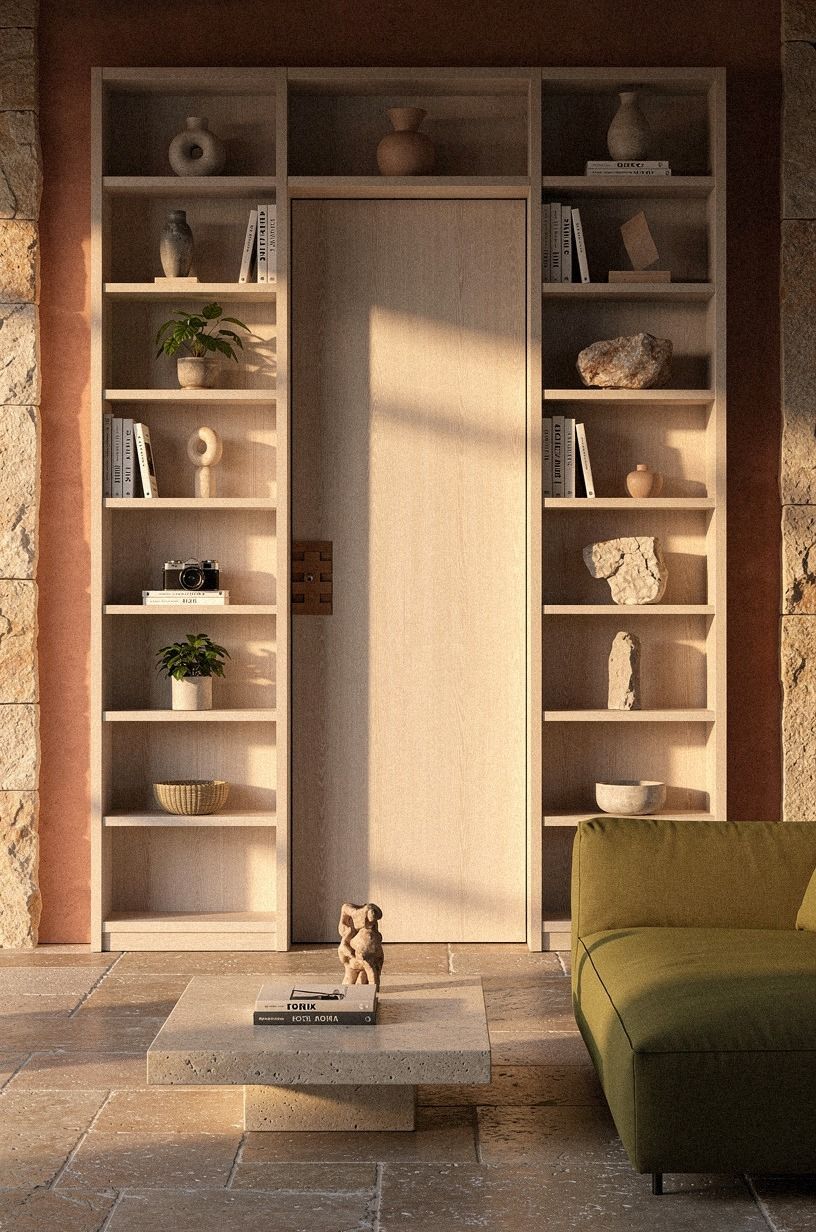
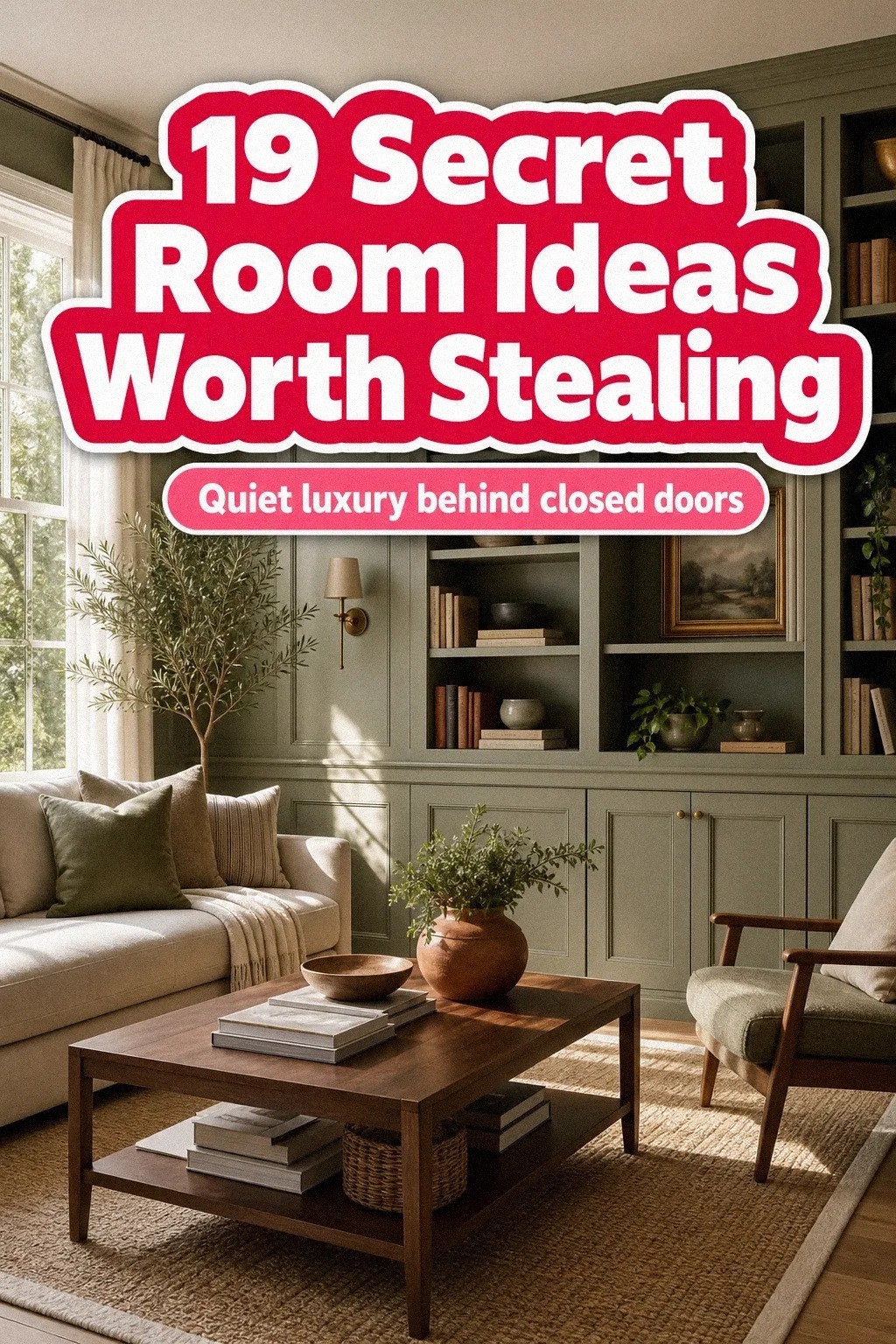
Start with a full paneled bookcase wall because you need the architecture to read as permanent before anyone believes the opening belongs there. In a terracotta, stone, and olive living room, I’d rather see cerused white oak shelves with deeper side stiles than a thin prefab unit that stops short of the ceiling.
You want your eye to land on proportion first, not on the possibility of a hidden door. If you’re already rethinking scale, this piece on your sofa being too big for the room helps you keep the wall from feeling crowded.
I like to set the lowest shelf zone around 16 to 18 inches above the floor so baskets or larger books can ground the wall, then keep the upper rhythm tight enough that the panel seams disappear. But you should let the bookcase color sit close to the room palette.
Sherwin-Williams Evergreen Fog SW 9130 beside terracotta upholstery and honed stone feels settled, not staged. The part that worked for us was simple: deeper shelves on the fixed sides, shallower shelving on the door panel, then trim across the whole run so your eye reads one big composition.
2Anchor the entrance behind framed built-ins
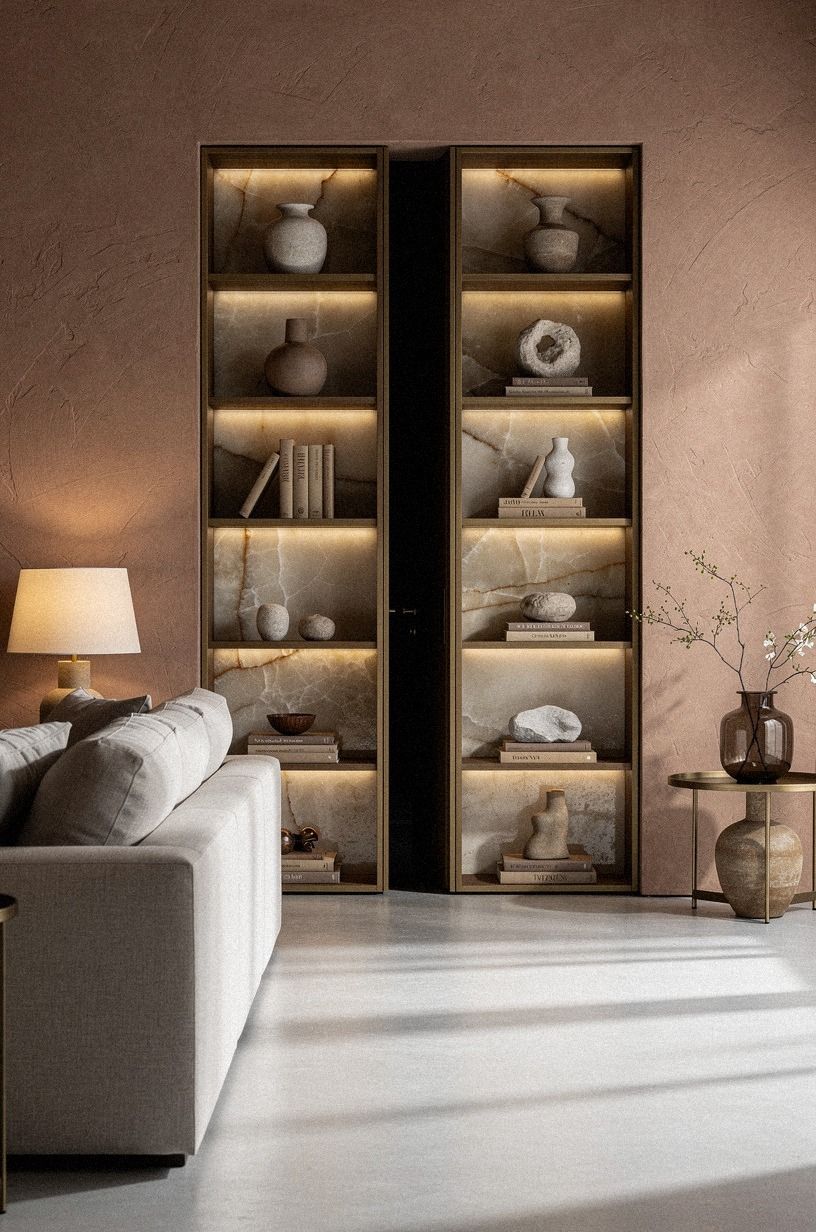
Anchor the entrance behind framed built-ins so the opening feels slightly off-center on purpose. In a clay, linen, and aged brass living room, a doorway hidden inside framed cabinetry works best when the static side carries more visual weight than the moving panel.
I wouldn’t center everything to death here. You want a little asymmetry, the kind that makes guests think the room simply evolved over time.
Use Benjamin Moore Revere Pewter HC-172 or another warm greige on the interior framing, then add aged brass picture-frame molding or inset trim that repeats across every bay. If you’re styling a narrow wall, give yourself at least one honest storage zone with real books, a lidded box, and one shaded lamp.
Otherwise the built-ins look fake, and fake is what gives the door away. But if the composition still feels stiff, pull some softness from this velvet-throw living room idea and let fabric take the edge off the carpentry.
3Camouflage the door with matching millwork
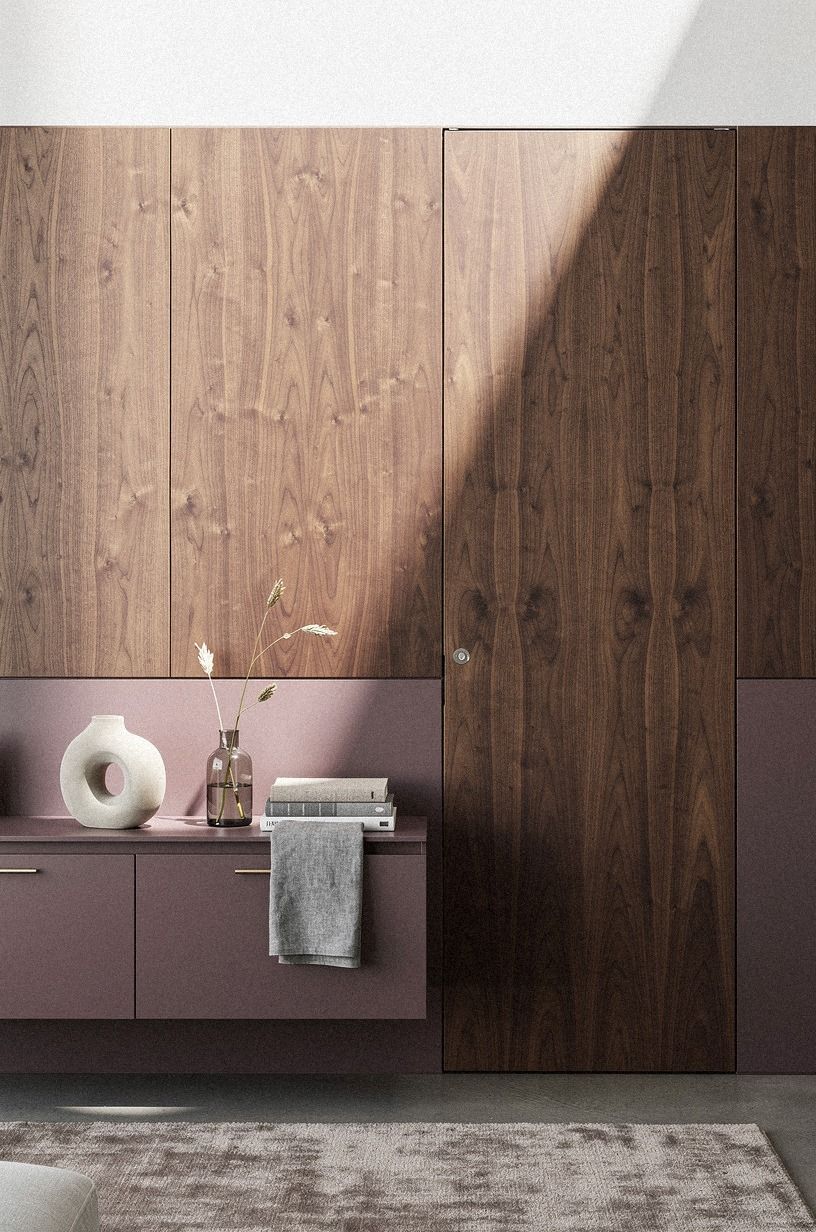
Camouflage the door with matching millwork, and don’t settle for “close enough” grain. The overhead view in that plum, grey, and rose-gold room works because the walnut feels book-matched from one panel to the next, almost like a tailored jacket where every seam lines up.
That’s your goal. If the figure flips direction or the stain goes cooler on the door leaf, you’ll spot it from across the room.
This is where I use what I call The Grain-Flow Rule: continue the most dramatic wood pattern across the operable panel, then move the pulls and reveals somewhere quieter. Book-matched walnut veneer costs more than flat stock, sure, but it’s doing all the illusion work here.
I made the mistake once of using two walnut sheets from different lots, and the door read purple while the fixed wall read brown. You couldn’t unsee it.
If custom veneer isn’t in the budget, use paint-grade panels instead and spend your money on crisp reveals and a push latch.
4Layer artwork over a touch-latch panel
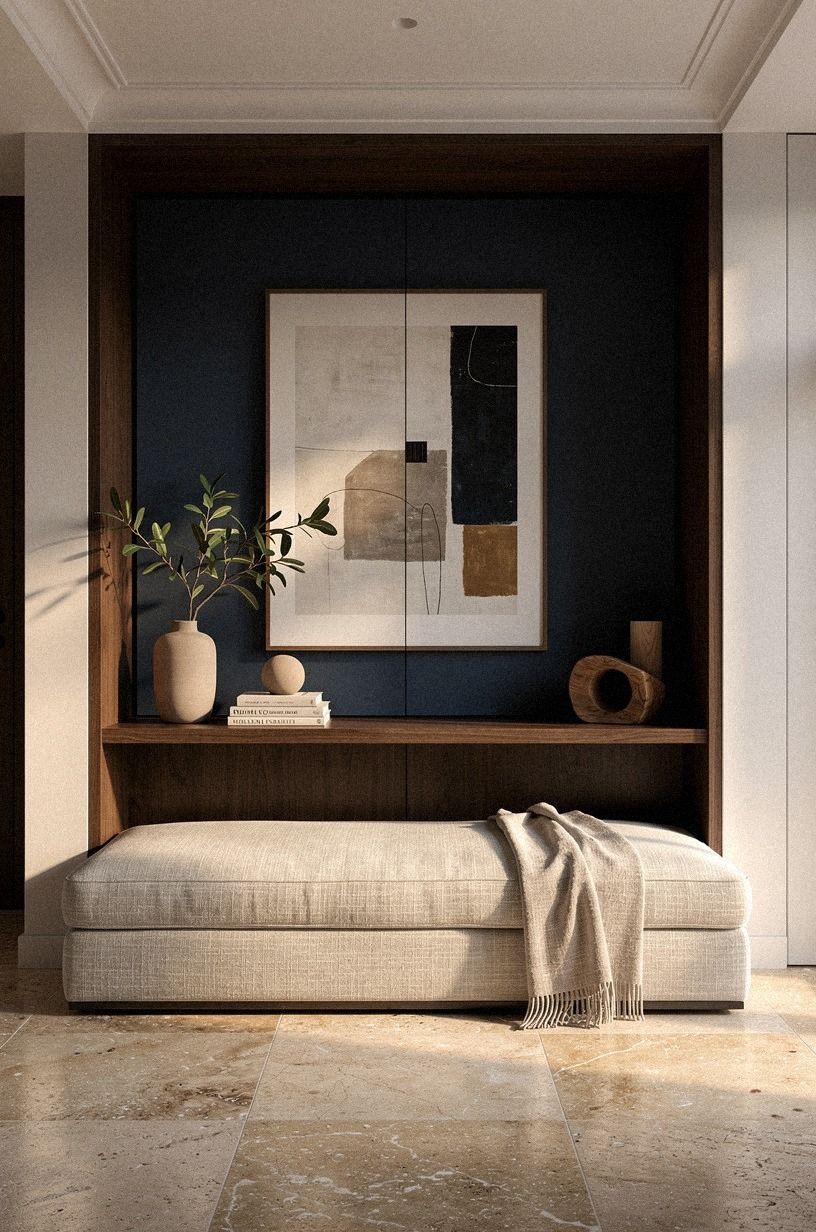
Layer artwork over a touch-latch panel when you need the wall to look domestic first, architectural second. In a navy, white, and walnut room, a symmetrical art arrangement lets the opening vanish because your eye reads frames and spacing before it reads hardware.
That’s the point. I don’t like oversized gallery pieces here unless the wall is truly large, because one huge canvas can telegraph the panel edge.
Try walnut gallery frames with cream mats, then hang the hero piece over the latch zone so the touch point feels natural. A panel this type usually works better with a soft-open magnetic catch than a visible knob, and the cleanest installs hide the pressure point roughly 36 to 42 inches off the floor where your hand lands without thinking. And if your navy wall is feeling too flat, the conversation about white trim making small living rooms feel smaller is worth a read before you sharpen the contrast too much.
5Hang velvet curtains across the hidden opening
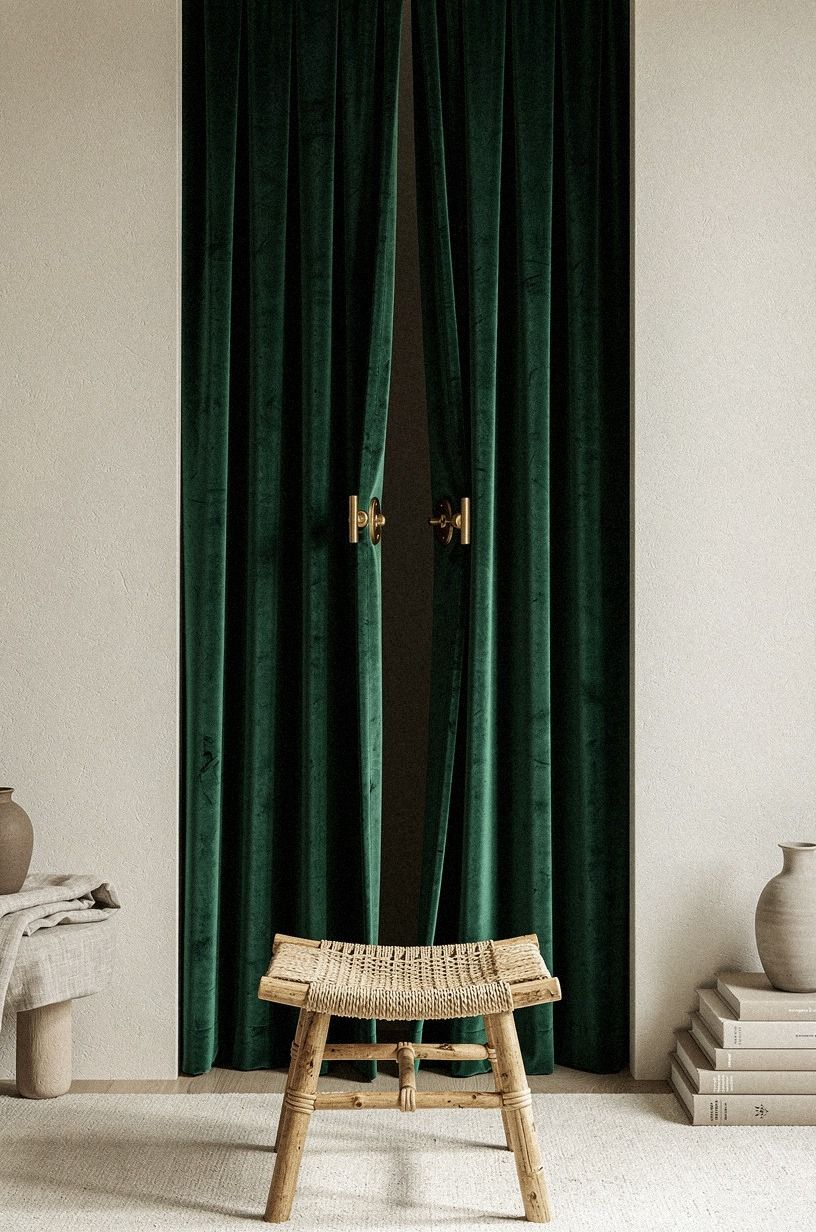
Hang velvet curtains across the hidden opening if your wall needs softness more than carpentry drama.
6Build a reading nook behind shelves
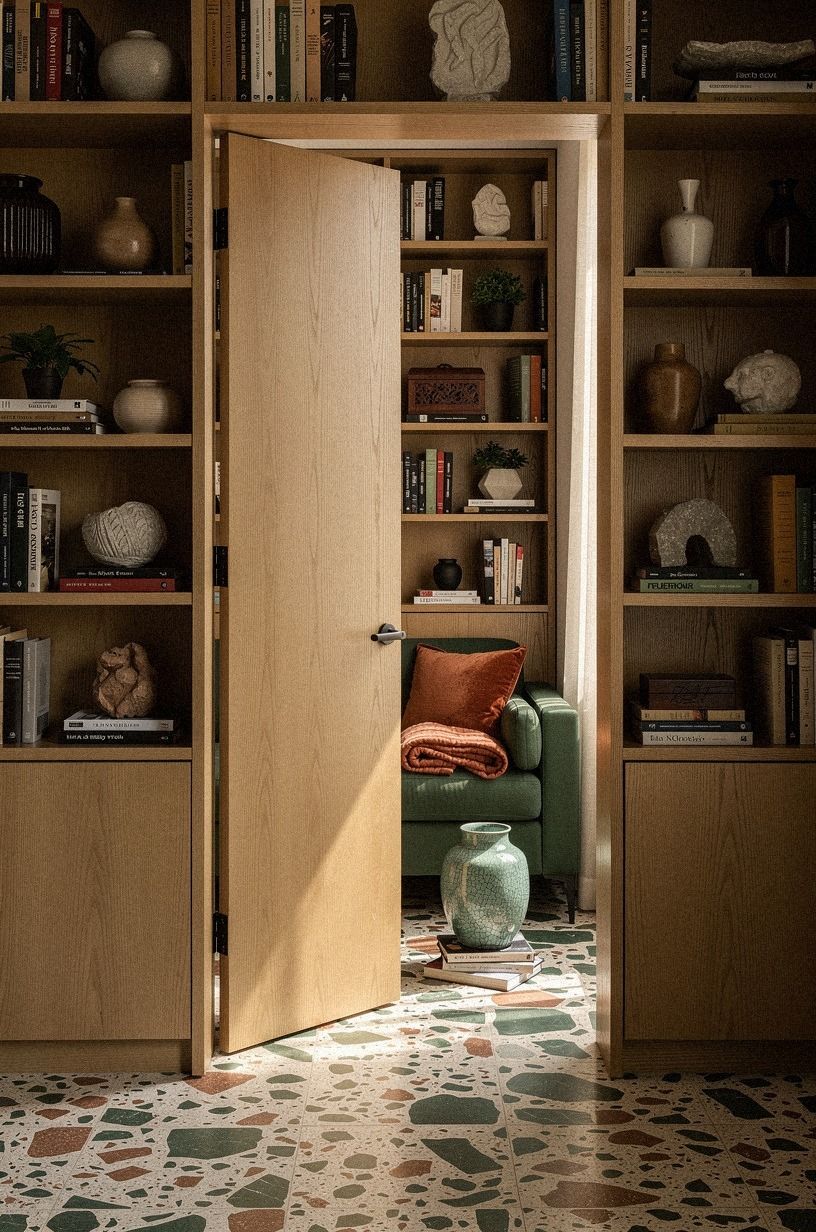
Build a reading nook behind shelves so the reveal pays off with a real destination, not just a novelty corridor. When you look through the doorway and see the bookcase entrance centered, the room beyond needs to promise comfort fast. That’s why I always start with the chair, the lamp, and one surface for a mug before I worry about the rest.
Want people to lean in? Give them a place they’d want to stay.
A compact nook works beautifully with a boucle swivel chair, a 16 to 18 inch side table, and a shaded lamp that throws light down instead of outward. If the seat is deep enough to curl into, around 35 to 40 inches, the whole tucked-away area feels intentional rather than leftover. But don’t crowd the floor.
A small wool rug 8×10 layered so the front legs sit on it is enough. If you’re testing room flow, this look at oversized sofas blocking circulation can save you from turning the entrance into a choke point.
7Paint the reveal in smoky olive
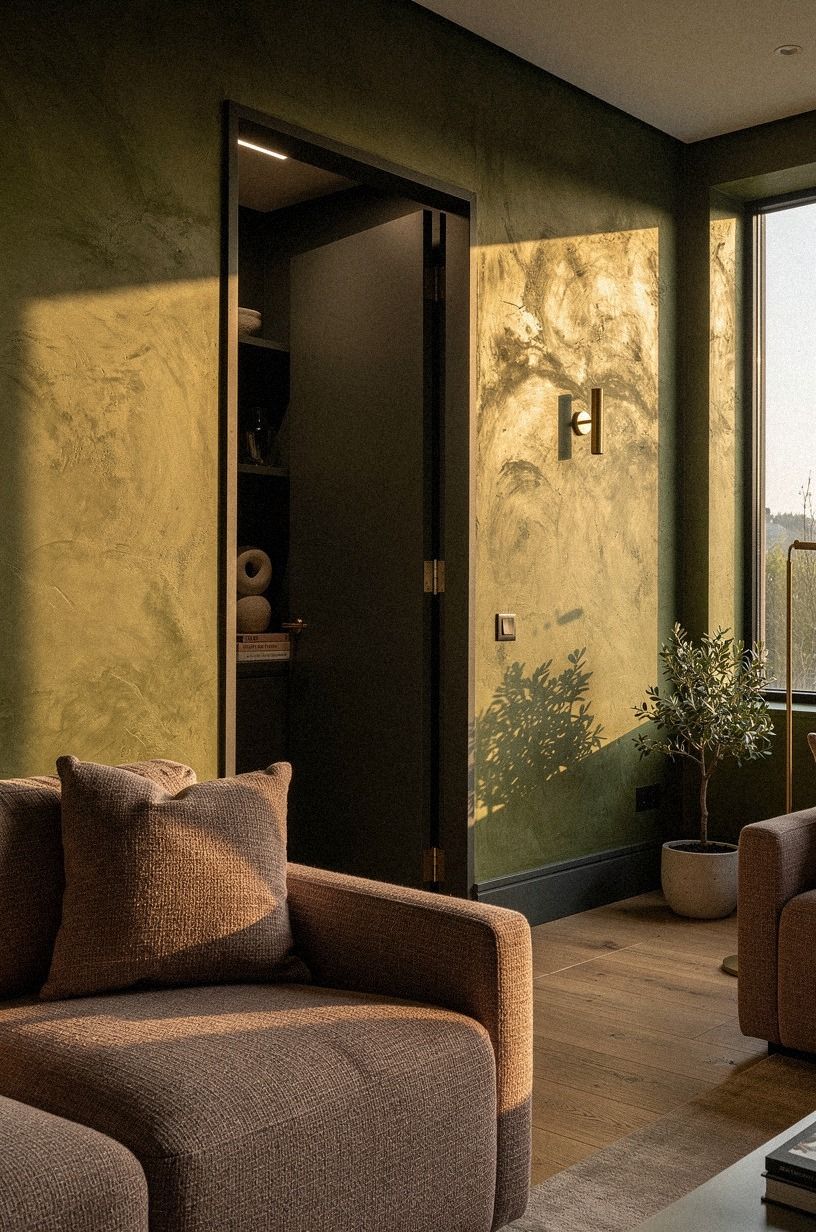
Paint the reveal in smoky olive when you want the inside edge of the opening to feel deeper and older than the main room. This is one of those moves that costs little and changes everything!
An olive reveal in a living room wall creates a visual pause, almost like the room beyond has its own atmosphere. I wouldn’t use a bright green here.
Too cheerful, and the spell breaks.
My favorite route is Sherwin-Williams Evergreen Fog SW 9130 on the reveal and a warmer neutral on the face trim so the transition feels deliberate. Think of it as The Threshold Shadow Move: the outer wall stays friendly while the inner edge goes moodier and more mysterious. If your room already leans warm with terracotta and stone, olive reads grounded instead of trendy.
And yes, paint every inner return, not just the flat face, because unfinished returns are where most DIY versions fall apart.
8Install a mirror door beside the fireplace
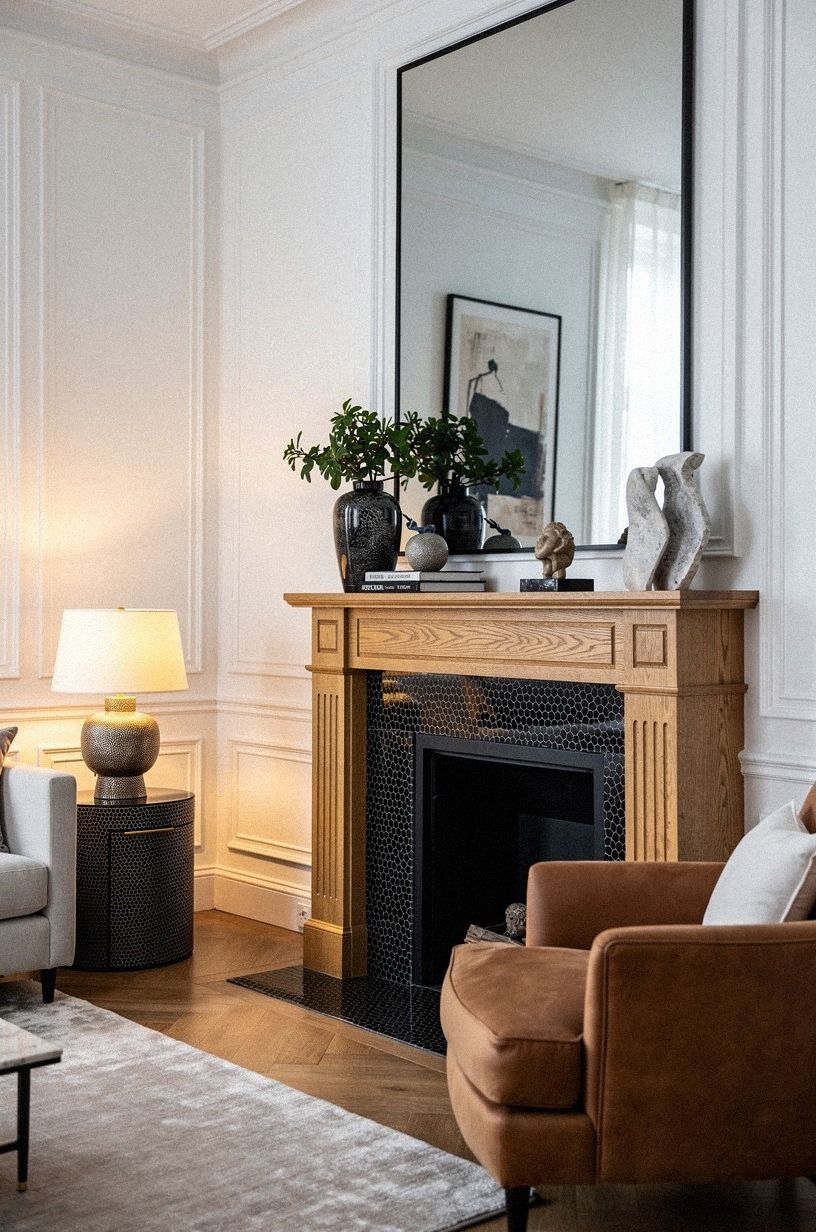
Install a mirror door beside the fireplace if you need the opening to reflect the room back at itself. In a warm white, camel, and black-accented living room, a mirror panel can hide in plain sight because it behaves like decor first.
But only if the proportions are right. A too-narrow mirror looks suspicious, and a too-tall one can feel like a dressing-room joke.
I prefer a blackened steel mirror frame or a warm antique mirror edge instead of bright chrome. Next to a fireplace, that restraint matters.
The mirror should echo the mantel weight, not compete with it. If your room has already been shaped around a hearth, this stone-fireplace living room piece is useful for scale cues.
And honestly, I’d skip mirrored bevels. They scream showroom.
Flat glass with a slim frame feels quieter, richer, and far more believable in a lived-in room.
9Frame the passage with picture lights
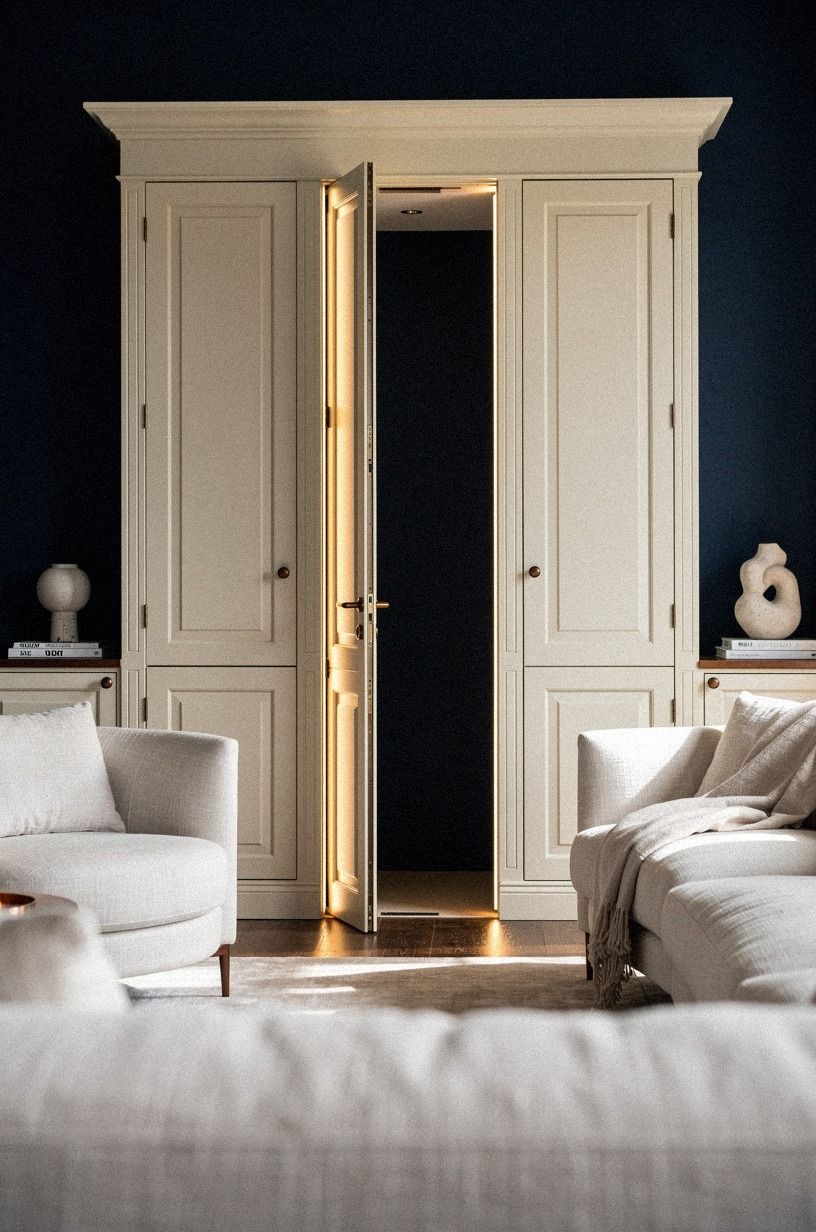
Frame the passage with picture lights when the wall needs a little ceremony. In a midnight blue, copper, and ivory room seen from a low angle, two picture lights do more than brighten art.
They carve out importance around the passage and tell your eye where to linger. This is one of those details people feel before they name it.
But use aged brass picture lights with warm bulbs, ideally around 2700K, and mount them so the beam grazes the wall instead of blasting it. The effect should stop short of theatrical.
I call this The Three-Height Glow Stack: floor lamp low, mantel or table light mid, picture lights high. When those three levels are present, the opening feels layered and expensive.
But if all you have is overhead light, wait. Hard ceiling light ruins more hidden-room drama than bad trim ever does.
10Conceal hinges inside fluted wall panels
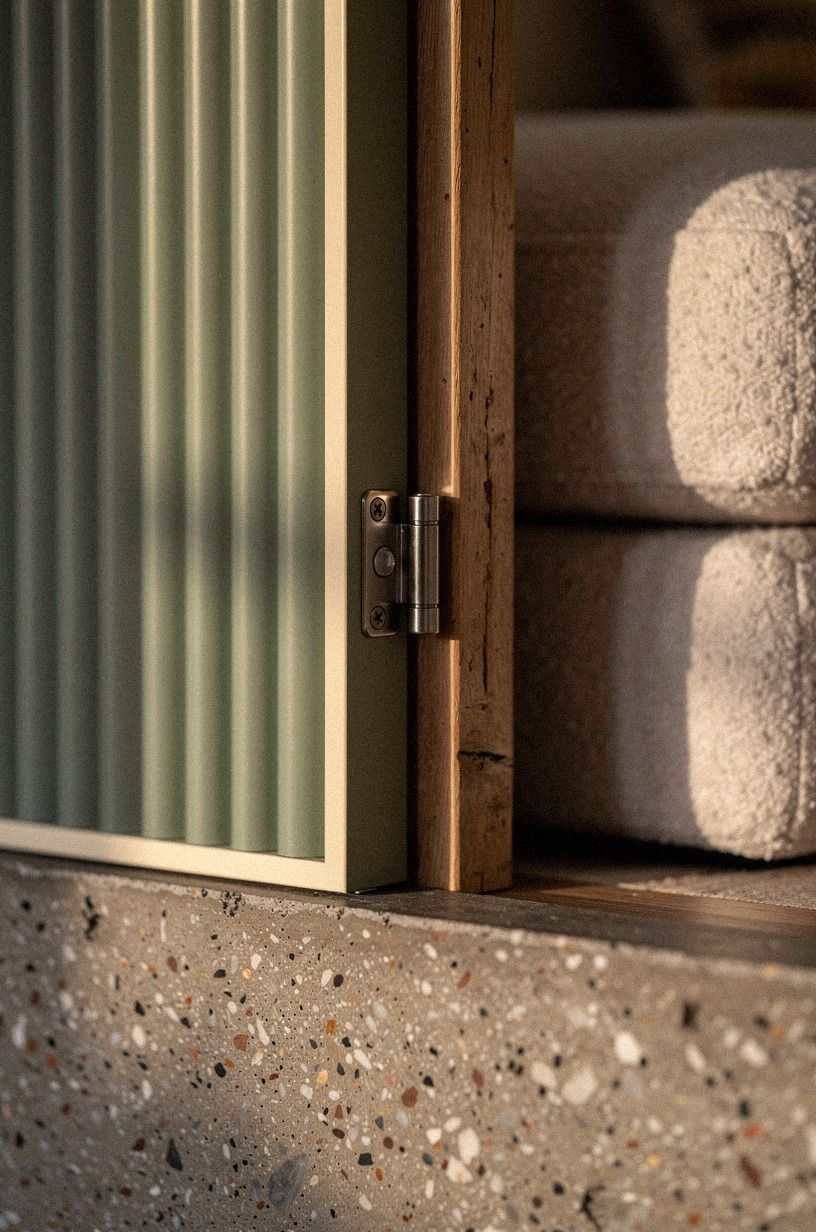
Conceal hinges inside fluted wall panels because hardware is usually where the illusion dies.
11Add a brass handle disguised as decor
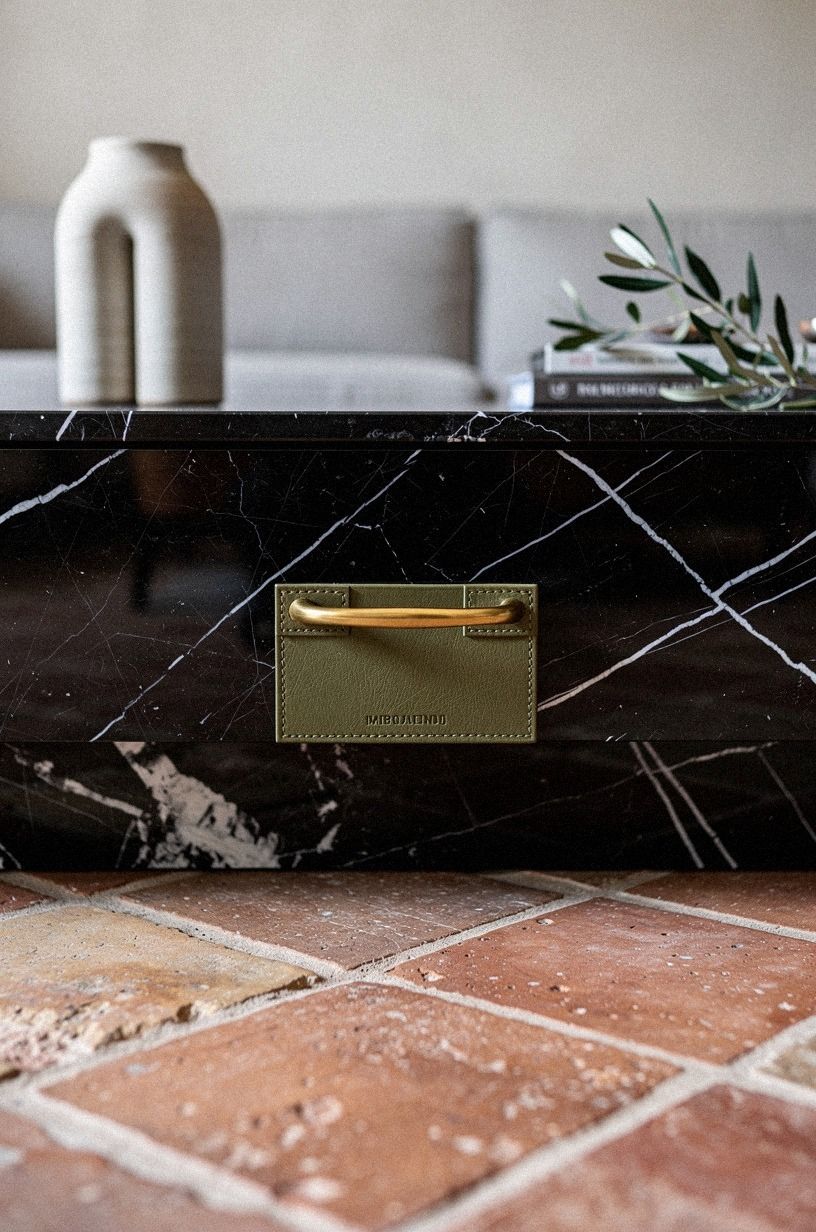
Add a brass handle disguised as decor when you need the door to open easily without announcing itself. In that terracotta, stone, and olive palette, the smartest handle doesn’t look like a handle at all. A small brass pull can read as an applied ornament, a shelf detail, or even part of a layered still life if you place it low and give it company.
Try a unlacquered brass tab near a stack of books, a stone box, or a low bowl so the metal reads like styling instead of hardware. The key is repetition.
If there’s one lone brass element on the panel, people notice it. If there’s brass on the lamp, the frame, and the tray, it disappears into the language of the room. And don’t polish it too much.
Soft patina helps. For another example of a room detail doing more work than expected, this velvet throw article nails that idea.
12Tuck the doorway behind a gallery wall
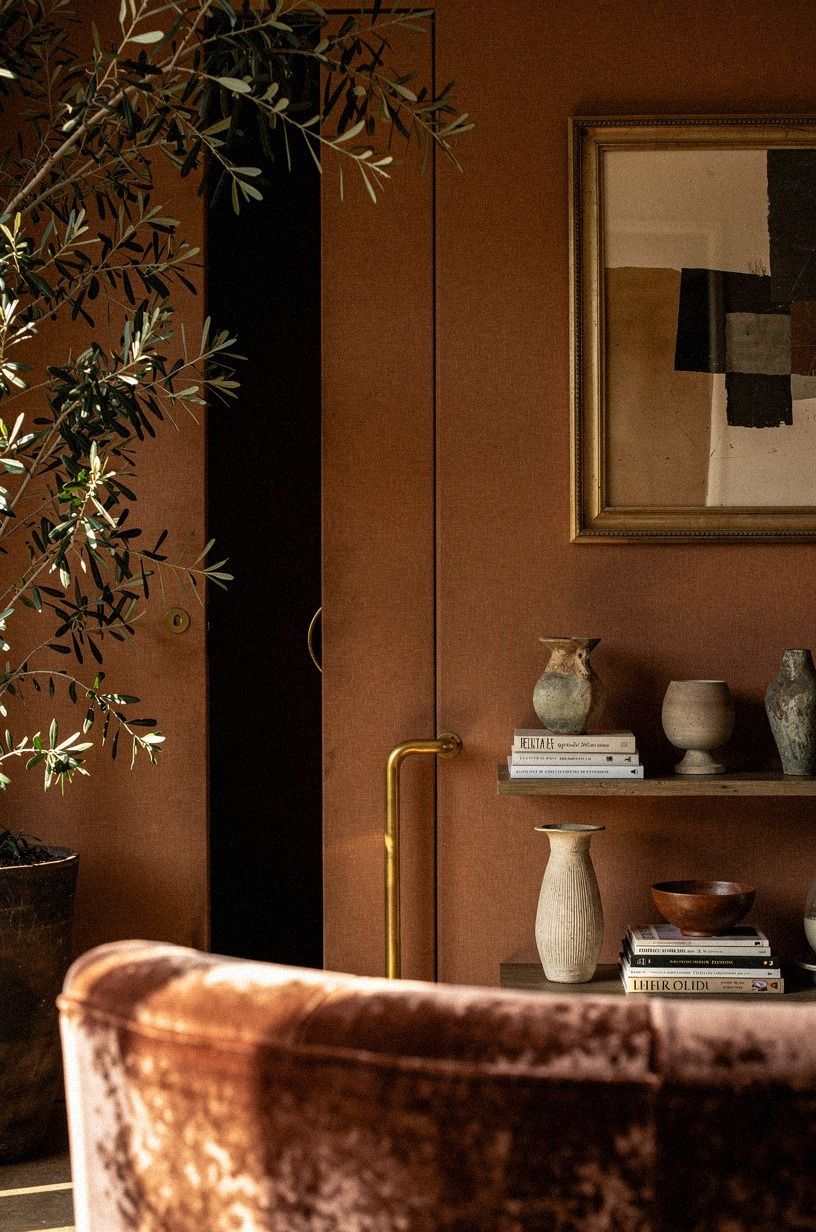
Tuck the doorway behind a gallery wall if you want the opening to feel discovered rather than announced. Framed through foliage, in a clay, linen, and aged-brass room, the effect works because the art wall gives you visual noise in the best possible way.
Seams get lost. Handles disappear.
The eye hops from frame to frame and stops asking structural questions.
Mix oak frames, thinner brass frames, and one fabric-backed piece so the arrangement feels collected over time. I wouldn’t use identical prints in identical sizes.
That’s too stiff. Instead, let the lower frames sit slightly denser around the door seam and keep one larger anchor piece off-center. If you’re drawn to that “hidden destination” feeling, the story energy in this Norman village article about a detail room is a good mood reference, even though the subject is different.
13Wrap the entrance in grasscloth wallpaper
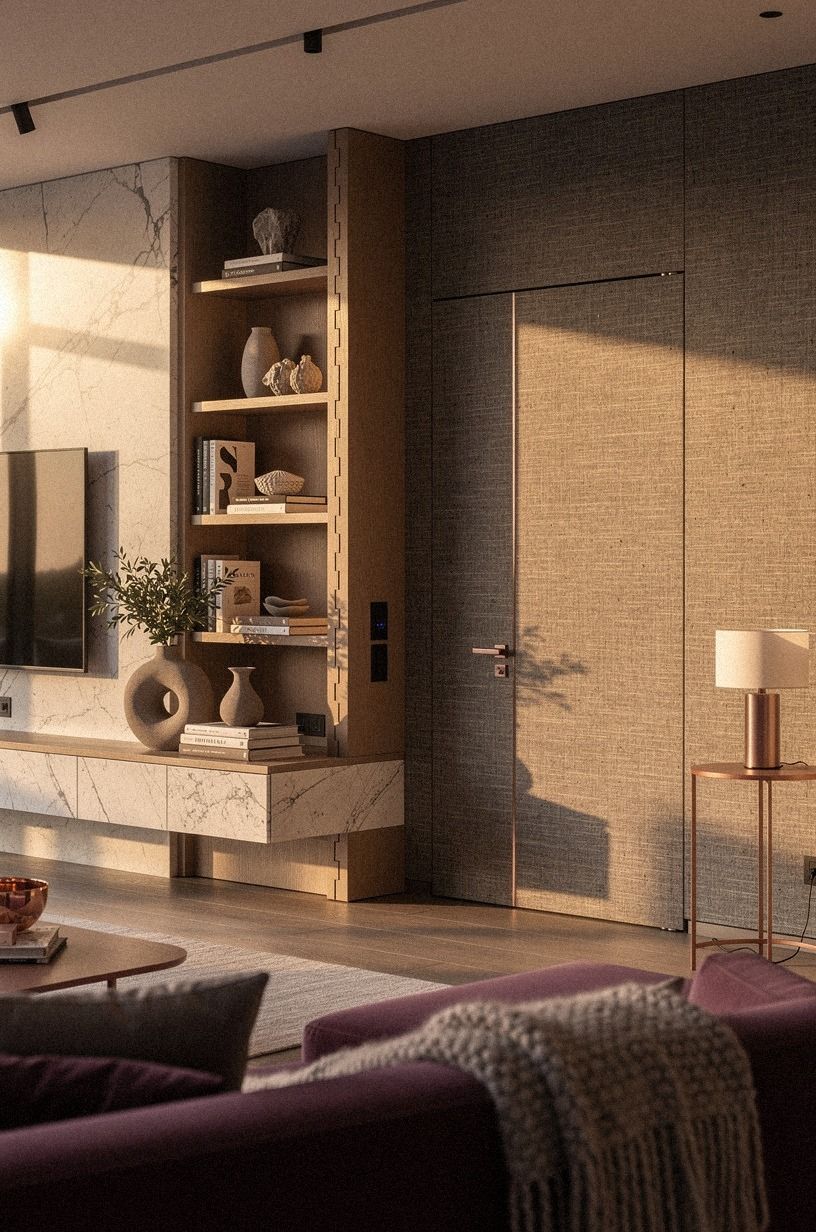
Wrap the entrance in grasscloth wallpaper when paint isn’t enough to blur the cut lines. In a plum, grey, and rose-gold living room, grasscloth works because it gives you texture, direction, and a little inconsistency all at once.
That’s a gift for concealment. Tiny shade shifts across the wall make seams much harder to read than they would be on a flat eggshell paint.
Use natural grasscloth in a midtone, not something shiny or highly contrasted. The panel and wall should be wrapped from the same batch if you can manage it, because dye variation is part of the charm until it lands right on the door edge.
But you do need to accept a little imperfection here. That’s the whole point.
If your trim is too crisp and the wallpaper too uniform, the entrance still looks engineered. Texture should relax the wall, not sharpen it.
14Float storage cubes around the detail panel
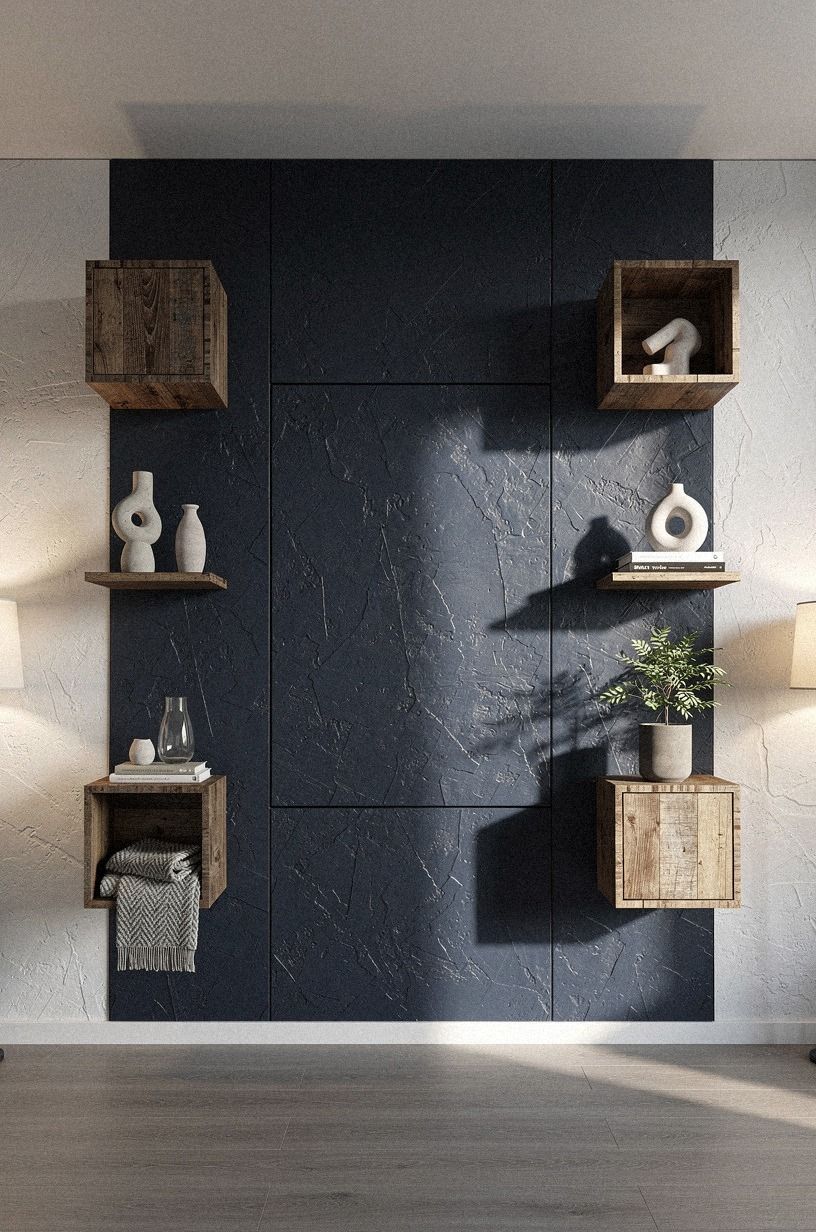
Float storage cubes around the detail panel so the wall reads as practical storage instead of theatrical scenery.
15Light the threshold with warm sconces
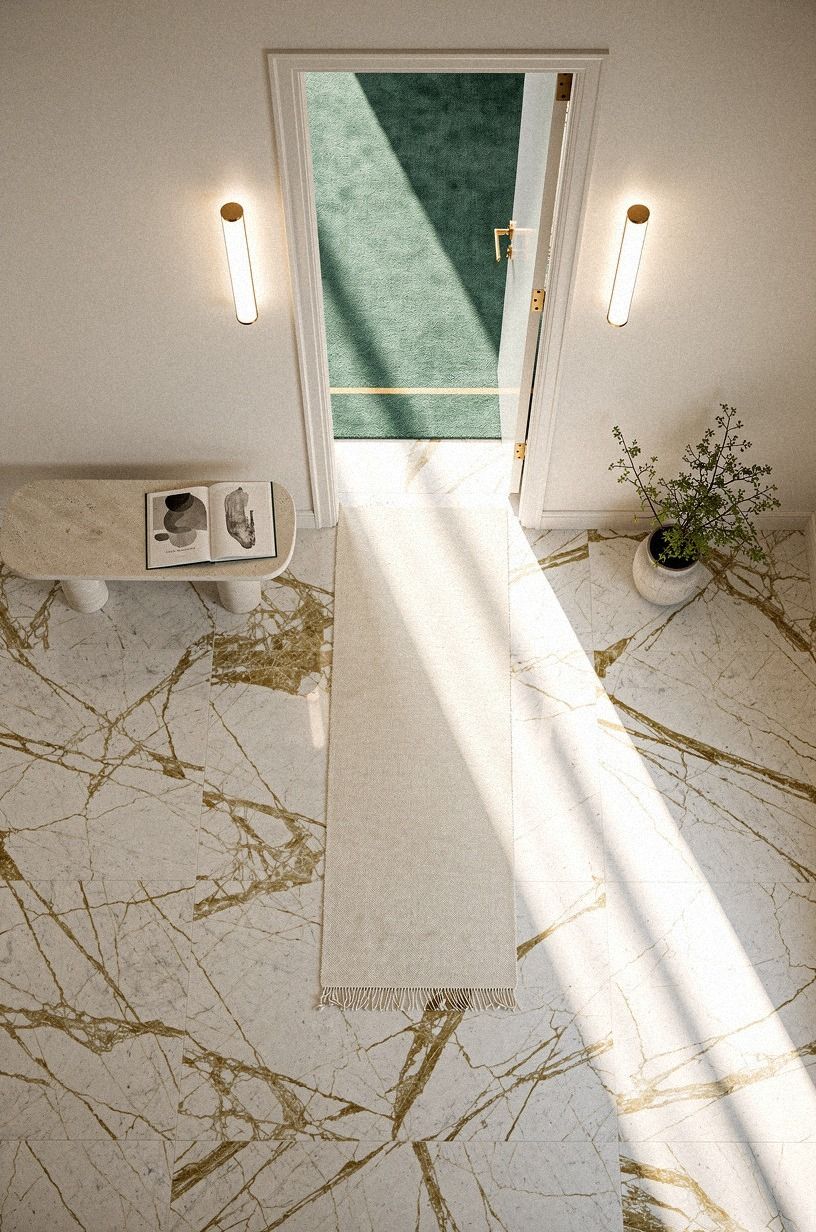
Light the threshold with warm sconces because transitions matter as much as the door itself. In the overhead view of that emerald, gold, and cream entry zone, the sconces tell your body where to go before your brain catches up. And that little bit of guidance makes the reveal feel cinematic instead of confusing.
Good lighting is quiet direction.
Use aged bronze sconces or compact brass shades with warm bulbs, and keep the light close to the wall so it pools rather than floods. I aim for a gentle amber wash that lands at the edge of the rug and no farther.
That’s enough. If the threshold feels chilly, add a runner or a small wool mat so the light and the floor finish the story together.
For more on layering glow instead of relying on one fixture, this warm-room velvet throw article reinforces the same idea.
16Style shelves to hide the seam lines
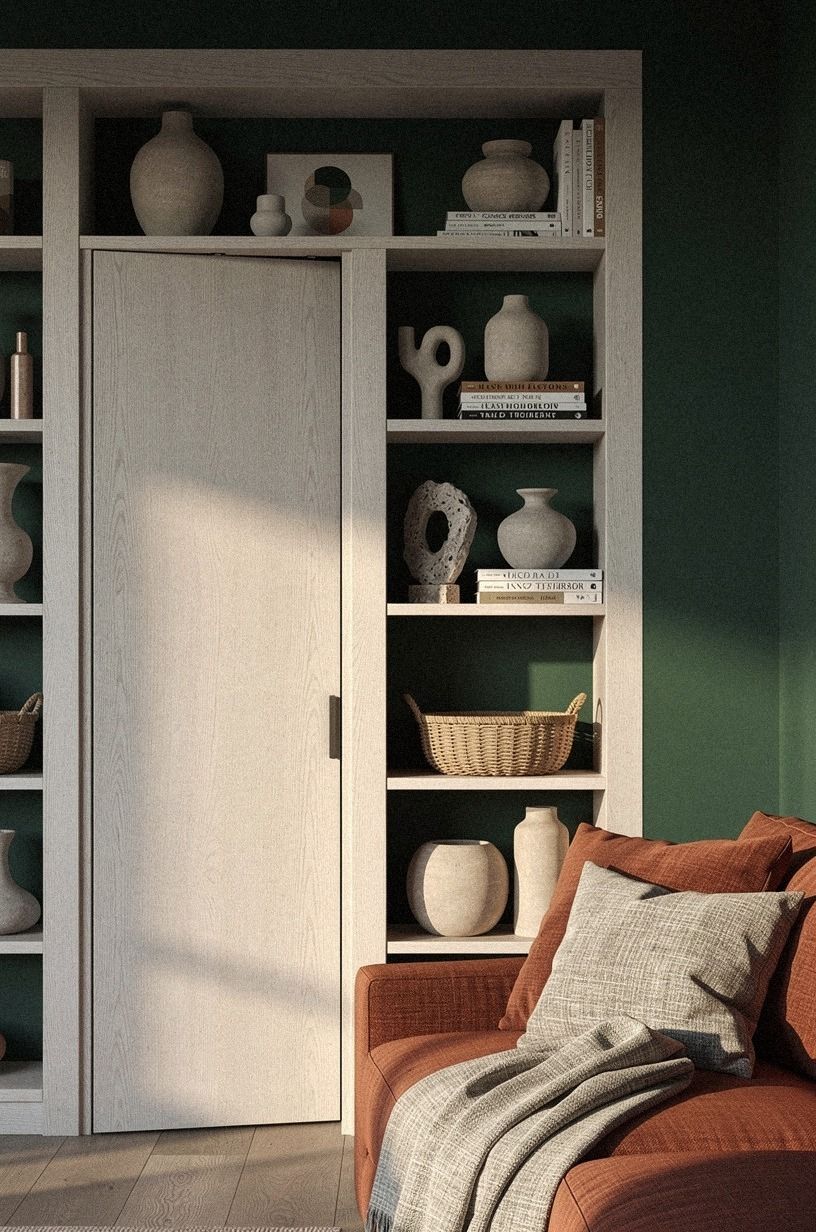
Style shelves to hide the seam lines, but don’t over-style them. A forest green, rust, and natural oak wall only keeps its magic when the shelf contents look plausible for daily life.
Too many decorative objects and the whole thing starts to feel like a store display. I’d rather see fewer things with more weight than twenty tiny pieces that jitter across the eye line.
Use stacked books, one ceramic lamp, a rust-toned box, and one trailing stem to break the vertical seam without making the shelf look busy. And vary height in front of the door edge so the cut line keeps getting interrupted. This is what I call The Staggered Object Mask.
It works because your eye follows silhouettes, not construction details. If the room beyond is small, this guide on sofa scale and blocked hallways is a good reminder that concealment should never cost you circulation.
17Use arched molding for a storybook reveal
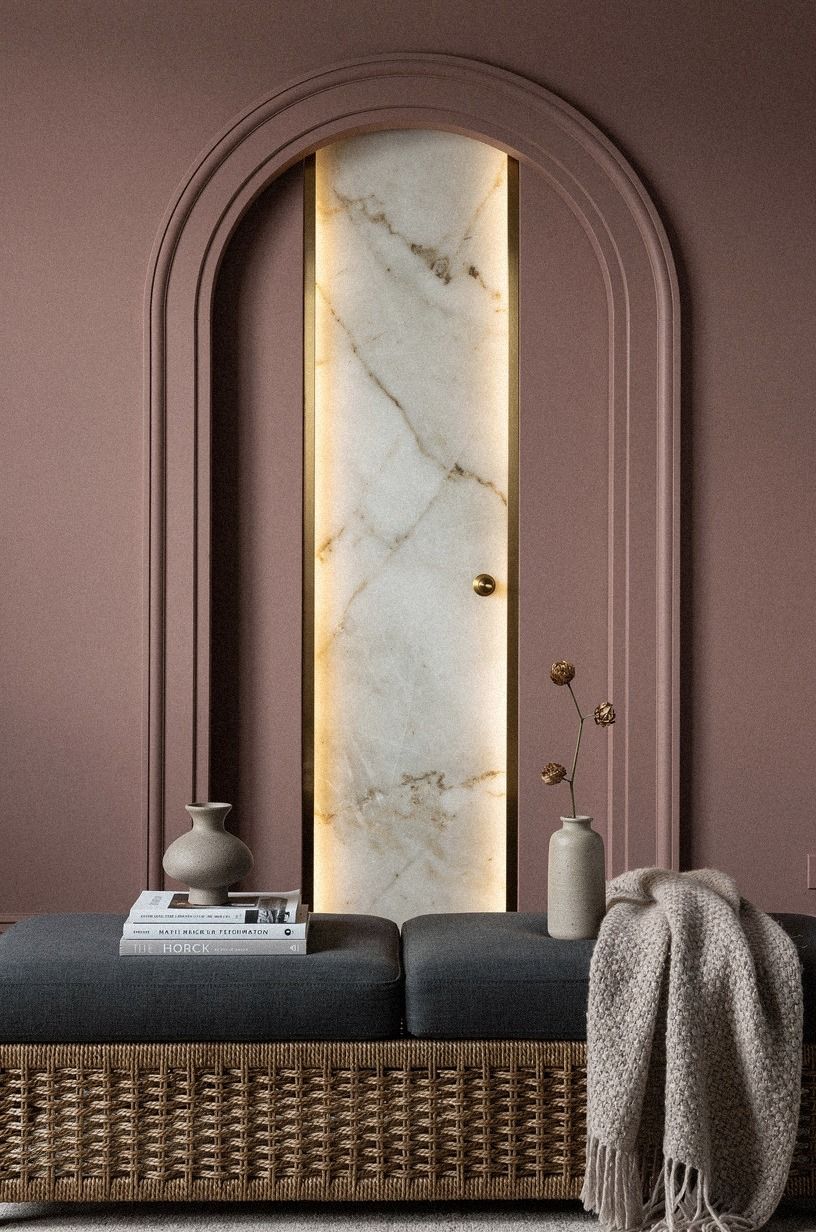
Use arched molding for a storybook reveal if you want the entrance to feel architectural in the romantic sense, not in the castle-theme sense.
18Place a swivel chair near the entrance
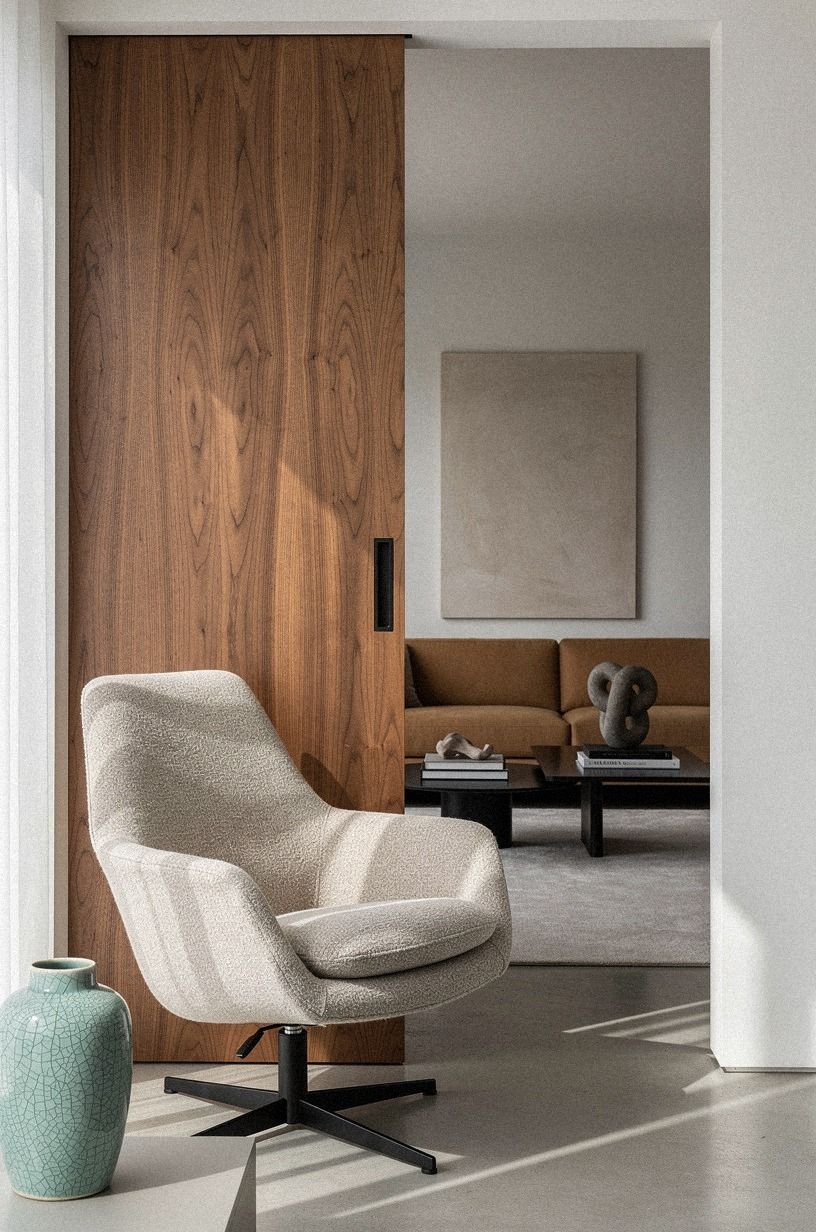
Place a swivel chair near the entrance so the room invites movement instead of freezing around the hidden opening. In that warm white, camel, and black-accented living room, a swivel chair does two jobs at once: it softens the approach and lets you reorient toward the room beyond. That’s more useful than a rigid accent chair that always points one way.
Look for a performance-fabric swivel chair with a compact footprint and a seat that turns smoothly without scraping the floor finish. You want the piece close enough to create a conversational cluster, but not so close that it blocks the door swing.
I usually give the opening a clean operating path, then let the chair sit just outside it with a small drink table. But if you have to choose between a second chair and a comfortable reveal, skip the extra seat.
The reveal wins.
19Finish with a jewel-box lounge inside
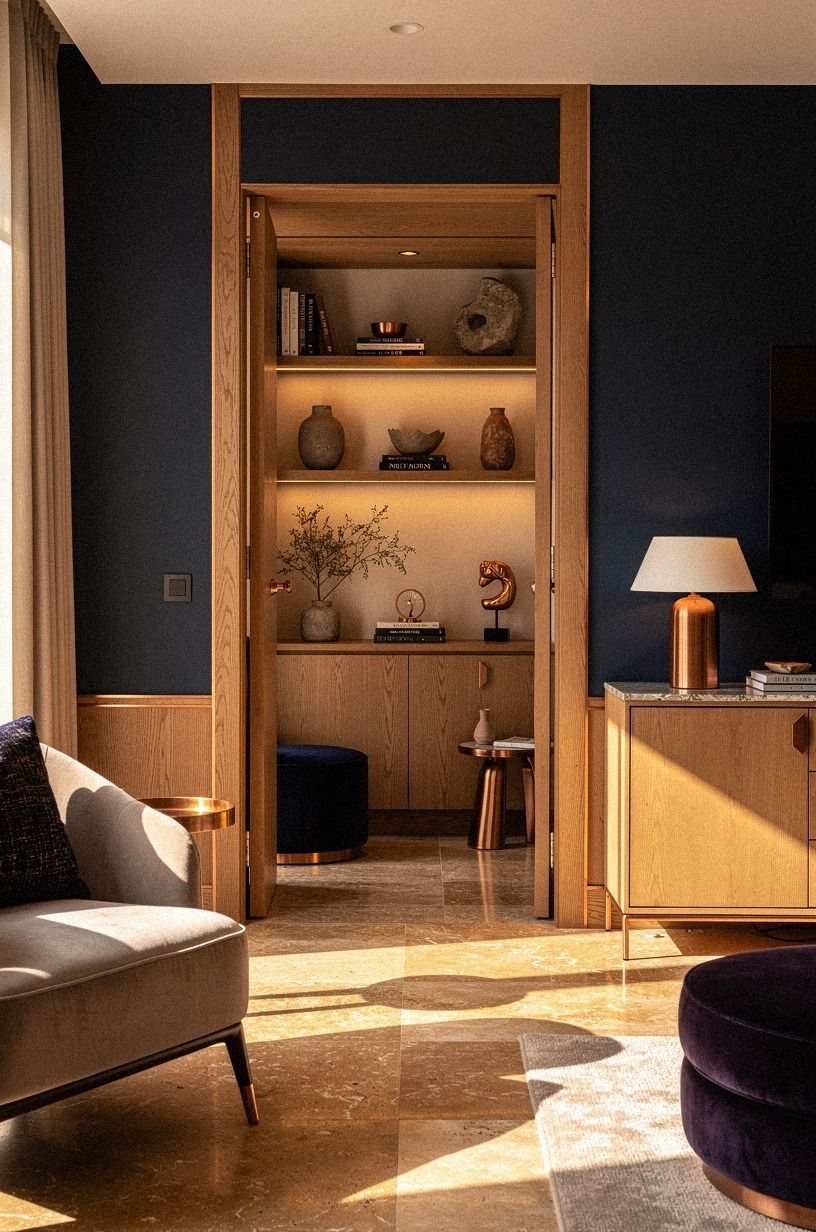
Finish with a jewel-box lounge inside because the room beyond should deliver a payoff, not a shrug. When the revealed entrance opens into midnight blue, copper, and ivory, the drama works because the palette tightens instead of spreading out. Smaller rooms can take bolder choices.
In fact, they often should. Why waste the reveal on a bland continuation of the main room?
Think one enveloping wall color, one rich fabric, one warm metal, and one seat you’d cross the room for. Midnight blue paint, mohair velvet, and hammered copper lighting can make even a modest nook feel cocooning. If you need a spending framework before you commit, here’s the honest range most living rooms live in:
And if you’re trying to picture a room with an almost impossible sense of place, these hidden-feeling spots in Red River Gorge strangely capture the mood.
Before you start
Before you start, decide whether you’re building a disguised door, styling a concealed opening, or simply giving an existing odd nook better drama. Those are different jobs, and you’ll waste money if you treat them the same.
A paint-and-style version can shift a room fast. A millwork version needs planning, hardware, and patience.
The good news is that you don’t need a mansion to make this feel convincing.
For living-room scale, I keep returning to the numbers because they save you from decorative regret. A sofa depth of 35 to 40 inches keeps the seating substantial without swallowing the path to the opening.
A coffee table should sit 16 to 18 inches high and run about two-thirds the sofa length. Rugs that anchor the zone usually land at 8×10 or 9×12, with the front legs of seating on them. And if a television shares the room, your viewing distance typically works best at about 1.5 to 2.5 times the screen diagonal.
Those measurements sound dry, but they keep the reveal from feeling like a gimmick attached to a badly planned room.
If you’re buying materials, I would prioritize the door hardware, paint, and one convincing surface treatment before splurging on decor. Real talk: shelves full of pretty objects won’t rescue a panel that binds or a hinge line that catches light.
Start with function. Then make it irresistible.
Why this works when other hidden-room ideas don’t
I’ve seen a lot of hidden-room ideas fail for one boring reason: people treat the opening like the star instead of the supporting actor. The room notices. A good reveal doesn’t beg for attention.
It earns it slowly, by looking like it belongs to the architecture, the palette, and the daily habits of the people living there. That’s why I keep pushing millwork, textiles, paint depth, and believable furniture scale before any dramatic flourish.
The other mistake is thinking mystery comes from complication. It doesn’t.
It comes from restraint. If I had to explain the difference in one sentence, it’s this: the best hidden rooms feel inevitable after you see them.
Not flashy. Not overloaded.
I used to think the door itself had to be ingenious. Now I think the door can be pretty simple, as long as the surrounding room is thoughtful enough to protect the illusion.
When you zoom out, the real design question isn’t “How do I fool people?” It’s “What kind of room would make this concealment feel natural?” In a warm living room, that usually means softer contrast, richer materials, and fewer hard visual stops. A panel disappears more easily into grasscloth wallpaper than plain drywall.
A seam gets lost faster behind walnut frames and aged brass than against empty white paint. And a hidden lounge feels more satisfying when it gives you a tonal shift, not a random one. I made the mistake early on of chasing novelty.
A rotating bookcase! A mirrored wall!
A dramatic latch! But novelty fades, and architecture doesn’t.
The rooms that still feel good six months later are the ones that used movie logic in a practical way. They built suspense with light, texture, proportion, and a little editing discipline. You can do that in a regular living room.
You just have to respect the boring details first.
What People Always Want to Know
What is the best 27 Detail Room Ideas That Feel Straight Out of a Movie for a small living room?
A paneled shelf wall is the best place to start because it’s doing storage and concealment at once. Dual-purpose architecture wins in a small room. Think shallow shelving, a compact IKEA KALLAX-style base, one chair, and a wall color that doesn’t chop the room into pieces.
Where can I buy 27 Detail Room Ideas That Feel Straight Out of a Movie pieces on a budget?
Start with IKEA, Target Threshold, and Wayfair for boxes, curtains, frames, and sconces. That’s the easiest mix for a believable look without custom pricing. – Brass-look frames. – Velvet curtain panels. – Cube storage. And yes, Facebook Marketplace is still gold for mirrors and wood tables.
How much does a 27 Detail Room Ideas That Feel Straight Out of a Movie makeover cost?
A style-first version usually runs about $300 to $1,200, while a more built-out living room can land between $2,500 and $8,000. Paint and styling give the biggest visual lift per dollar. – Low-cost paint. – Ready-made shelving. – Reused art. – Existing chair, reupholstered if needed. If you need a spending gut-check, this warm stone fireplace room shows how much atmosphere a focused upgrade can create.
Can I create a 27 Detail Room Ideas That Feel Straight Out of a Movie on a budget?
Yes, and you don’t need custom joinery to get the mood. Small material upgrades do a lot of work. – Paint the reveal a darker tone. – Hang velvet panels on a simple rod. – Restyle shelves to break the seam. – Add one warm sconce instead of rewiring the whole room.
Is a 27 Detail Room Ideas That Feel Straight Out of a Movie worth it in a small space?
Yes, especially if the hidden area becomes storage, reading space, or a tiny lounge. A small room benefits from every element working twice. Keep the path clear, let front furniture legs sit on the rug, and don’t place a deep sofa where it blocks the reveal.
But if your furniture is swallowing the pathway, this sofa-scale warning is the first fix I’d read.
Is 27 Detail Room Ideas That Feel Straight Out of a Movie a good idea for a rental?
Yes, if you stay with reversible moves. You can get the atmosphere without permanent carpentry. – Peel-and-stick grasscloth look wallpaper. – Tension-rod velvet panels. – Removable picture hooks. – Leaned mirror. – Freestanding shelves placed to suggest a concealed opening. And if your trim color is making the room feel choppier than it should, this white-trim piece is surprisingly relevant.
Where I’d Start First
If I had to pick one step, I’d start with the paneled bookcase wall. It fixes the architecture before you spend on drama, and that order matters.
Get the shell right first. Everything layered after that feels convincing.