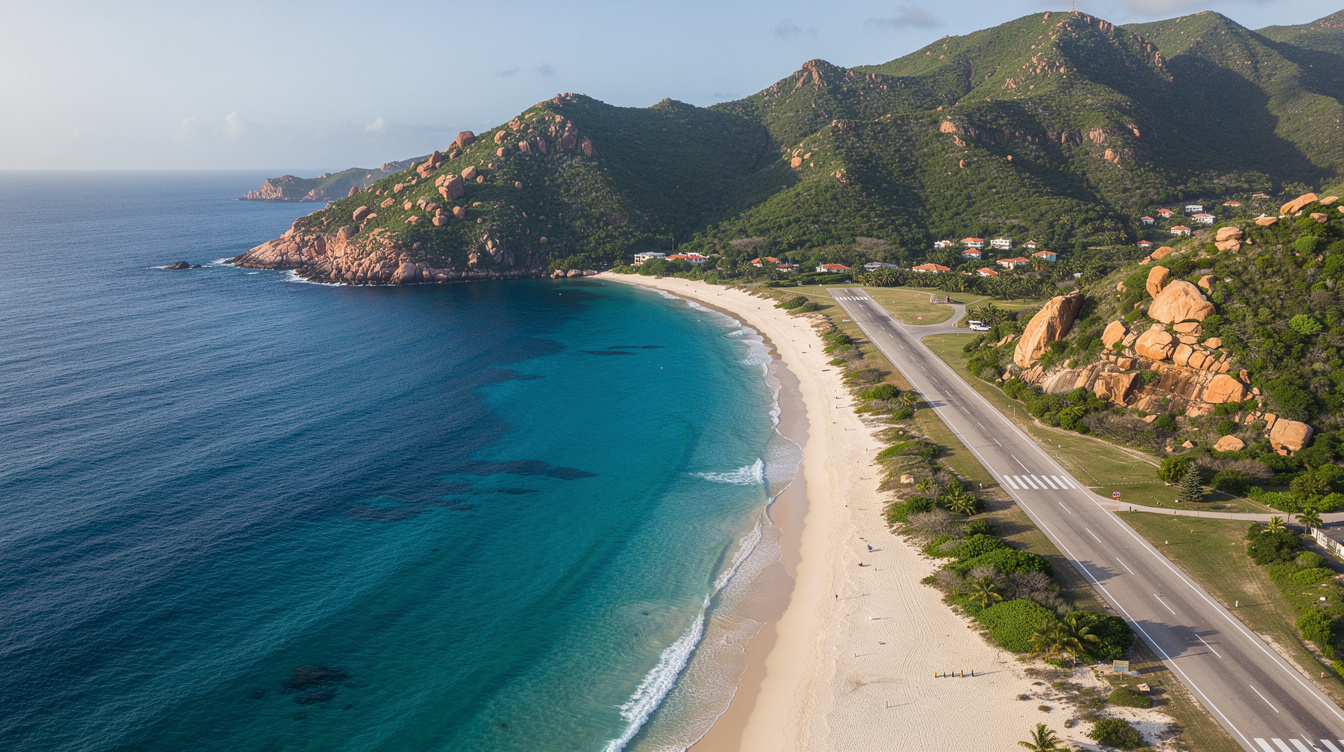
The approach to Gustaf III Airport descends over a hill called La Tourmente. The runway below is roughly 2,100 feet long, and the pilot drops fast, steep, and visual, banking left over St. Jean Beach before the wheels touch. First-timers grip the seat. You step out into 82-degree air and walk twenty feet to a terminal that’s open-sided like a bus shelter. This is Saint-Barth: the most expensive island in the Caribbean greets everyone with the same lurching descent, regardless of what they paid to get here.
The island is 10 square miles, and you can cross it in 20 minutes
Saint-Barth runs roughly 8 miles east to west and 4 miles at its widest point north to south. The road connecting Gustavia on the west coast to the airport at St. Jean, then east toward Lorient and Grand Cul de Sac, takes under 25 minutes in light traffic. Because the island is this compact, the gap between a $4,000-a-night villa and a free public beach is never more than a few minutes by car.
A rental car is essentially mandatory. A Smart car or Suzuki Jimny runs $65-90 per day, and having one is the difference between accessing the island and being stranded near your hotel. But the roads are steep and narrow, GPS loses confidence on the switchbacks, and a local boat captain who has run these waters for decades will tell you that paper maps still make sense here.
That’s the first thing Saint-Barth teaches you: the island doesn’t accommodate you. You accommodate it. The same geographic logic applies across the Caribbean, where the coast you choose shapes the entire experience.
Gustavia’s harbor holds $50 million in yachts and Shell Beach is a two-minute walk
During high season, December through April, the boats along the Quai de la République include vessels that cost more than most small island nations earn in a year. The harbor itself carries the Swedish colonial period, 1784 to 1878: the clocktower, the narrow streets with Swedish naming heritage, the harbor grid that feels quietly northern for a place this warm. A beer at a harborside café runs about $12. That’s the price of the view.
Walk two minutes south on Rue du Bord de Mer and the road ends at Shell Beach, formally Anse de la Carenage. The surface is crushed coral and shell fragments, white and coarse, warm underfoot by 10am. Because Gustavia’s promontory blocks the northeast trade wind swell, the water stays calm here most mornings. The yachts are visible from the waterline. Nobody checks who you are.
The south beaches have no chairs and the wind explains why
The northeast trade winds hit the island’s Atlantic-facing beaches hard, churning Lorient and Grand Cul de Sac for much of the year. But the central ridge absorbs that wind before it reaches the southern coast, which is why Anse de Grande Saline and Anse du Gouverneur stay flat and clear even on rough days. That wind logic is why both beaches remain undeveloped: the shelter that makes them beautiful also made them harder to build on profitably. Wind and reef geometry determine water quality across Caribbean beaches more than any other single factor.
Saline requires a 10-15 minute walk from the parking area through salt flats and low scrub. No restaurant, no chairs, no vendors. And Gouverneur sits half a mile west, reached by a switchback road steep enough to require first gear, ending at a pale sand beach curved between two rock headlands. In January, when the harbor holds its peak concentration of yachts, Gouverneur is quiet enough that you hear the water pulling back between waves.
What Saint-Barth charges for sleep and what it charges for a day are two different numbers
High-season rooms at properties like Eden Rock or Le Sereno start above $1,000 per night and climb well past $5,000. That price is real. But the boulangerie in St. Jean sells a pain au chocolat for under $2. The Champion supermarket stocks French staples at French prices. A sandwich from the rôtisserie counter at the Gustavia market costs less than a coffee at most Manhattan cafés. Atlantic islands with extreme reputations consistently reward visitors who understand the actual cost structure.
A full day at Saline, Gouverneur, and Shell Beach with a boulangerie breakfast and market lunch can come in under $50 per person. The beaches have no admission price. The Swedish clocktower has no admission price. The view from the road above Gouverneur has no admission price. The room is where Saint-Barth collects its fee.
Your questions about Saint-Barth answered
How do you actually get to Saint-Barth from the US?
There are no direct commercial flights from the US mainland to SBH. The standard route goes through Sint Maarten’s Princess Juliana Airport (SXM), where Winair operates turboprop flights covering roughly 15 miles to SBH in about 10 minutes. Connections are also available from San Juan (SJU) and Guadeloupe (PTP). Most US travelers fly to SXM on major carriers, then connect. Total travel time from the East Coast typically runs 6 to 8 hours. Caribbean island access consistently rewards travelers who understand the connection logic.
When is the best time to visit?
High season peaks around New Year’s and the Bucket Regatta in late April, when prices and crowds hit their maximum. Shoulder season from late April through June offers the same geography with hotel rates dropping 40 to 60 percent at many properties. Hurricane season runs June through November, with September and October carrying the highest statistical risk. But June and early July are genuinely good months: warm water, manageable prices, and beaches that don’t require arriving at 8am to claim space.
Can you visit Saint-Barth without spending a fortune?
It depends entirely on where you sleep. Day costs run roughly comparable to an expensive US city. The beaches cost nothing. Travelers who stay in Sint Maarten and take the Winair day-flight to Saint-Barth, spending six or eight hours on the island before flying back, experience Gustavia and the south coast beaches without the accommodation premium. The one-way Winair fare from SXM runs approximately $80-120 depending on season. That math works if the island is the point, not the hotel.
By late afternoon, Saline empties out because the walk back discourages lingering. The salt flats go golden, the scrub goes still, and the parking area holds maybe three cars. That’s when the island feels least like its own reputation.