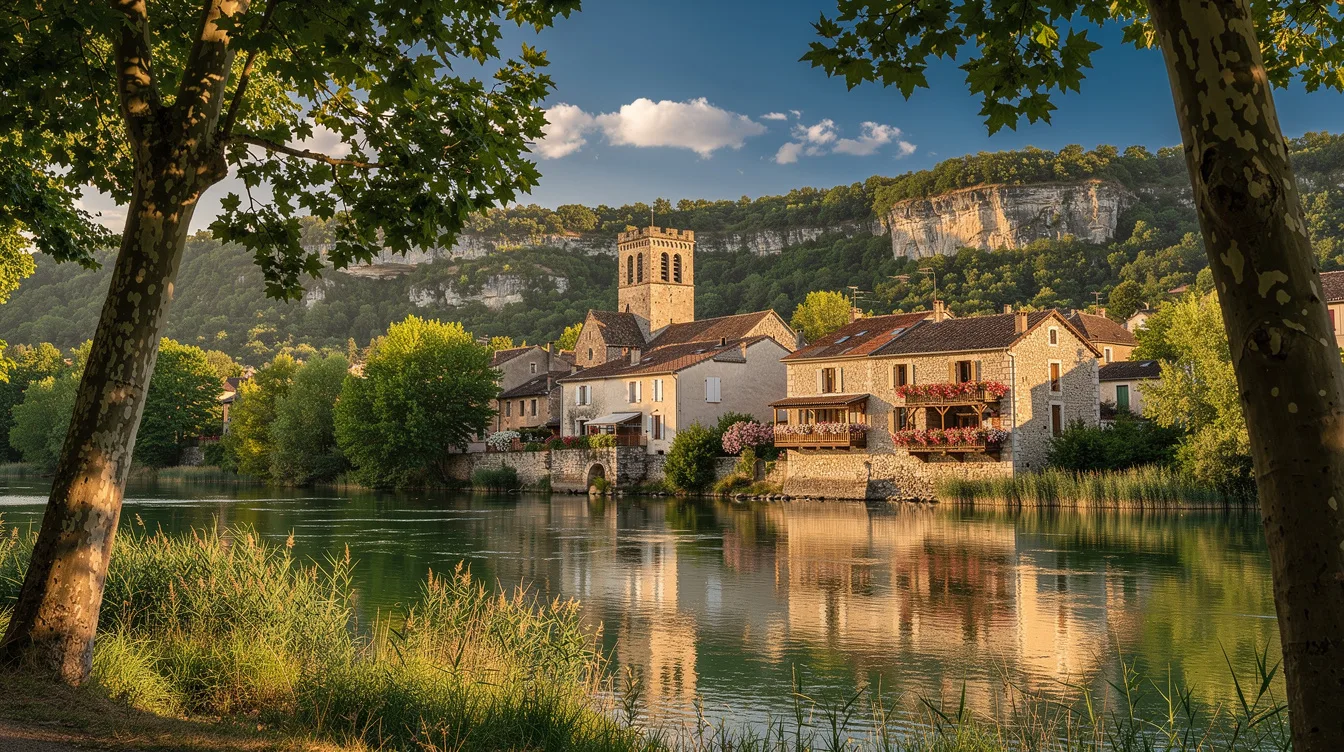
Sainte-Eulalie-d’Olt runs on just 373 residents, which is exactly why its medieval streets feel lived in rather than staged. The title’s claim about age is best read as atmosphere, not a documented ranking: the verified record calls this a medieval village, and that’s plenty of history for one small bend in the Lot Valley.
You come for the round river pebbles worked into the houses. But you stay because the village hasn’t traded its small scale for a polished visitor routine.
A medieval village with a riverbank address
Sainte-Eulalie-d’Olt sits on the left bank of the Lot River, in Aveyron’s Haute Vallée du Lot. Its position gives the village a clear edge and a quieter pace, while the tight, twisting lanes pull you inward toward the old center.
And the river pebbles matter here. They give the facades a tactile, irregular surface that changes with the light, so a slow walk feels more rewarding than rushing toward one headline sight.
The village is listed among Les Plus Beaux Villages de France, a designation that can sometimes bring a crowd-first mood. Here, the scale keeps that impulse in check. It’s recognized, but still intimate.
You won’t find a sprawling historic district to conquer. Instead, give yourself room to wander, look up at the pebble-built walls, and let a wrong turn become part of the visit.
Why the pebble houses are the point
The houses are built from pebbles of the Lot, which makes Sainte-Eulalie-d’Olt feel tied to its riverbank rather than placed beside it. The material is humble, but it creates a townscape with more character than a row of perfect stone facades.
But don’t expect a museum village frozen behind ropes. The village is also known as a place of artists and art craftspeople, so the old fabric has an active use rather than a purely decorative one.
That mix is the real appeal. You get medieval architecture, yet the encounter can feel current when you come across work made by people who have chosen this very small village as their base.
For you, that means keeping your eyes open at street level. A workshop window or a handmade object can be the more memorable discovery, even when the lane itself is already doing most of the work.
Rodez is close, Saint-Geniez-d’Olt is closer
Sainte-Eulalie-d’Olt is about 18.6 miles from Rodez, to the northeast, putting it within reach of a wider Aveyron itinerary. It’s also about 2.5 miles downstream of Saint-Geniez-d’Olt, so the two villages make sense together on the map.
And that proximity is useful because Sainte-Eulalie-d’Olt doesn’t need to fill an entire day with programmed attractions. It works best as a deliberate pause, with enough time to follow its lanes and sit near the riverbank.
The setting is in the Lot Valley, on a fertile plain. That detail explains the open feel around a village whose interior streets can seem close and enclosed.
You should resist treating it as a checklist stop between bigger destinations. The reward is quieter than that: rough pebbled walls, narrow turns, and the soft sense that ordinary village life still has room around the visitor.
What the small population changes
Small population is more than a statistic in Sainte-Eulalie-d’Olt. With 373 residents, the village can’t manufacture the bustle of a city, and it shouldn’t try. The calm is part of the experience.
But calm doesn’t mean empty of purpose. The village’s artistic identity gives a reason to look beyond the medieval label and notice how old buildings continue to hold present-day work.
There’s a trade-off. If you need packed schedules or constant activity, this may feel slight. If you want a place where architecture, craft, and a river setting can carry an afternoon, it has the right proportions.
By the time you turn back toward the Lot, the pebble walls hold the last of the light, and the village feels content to remain small.