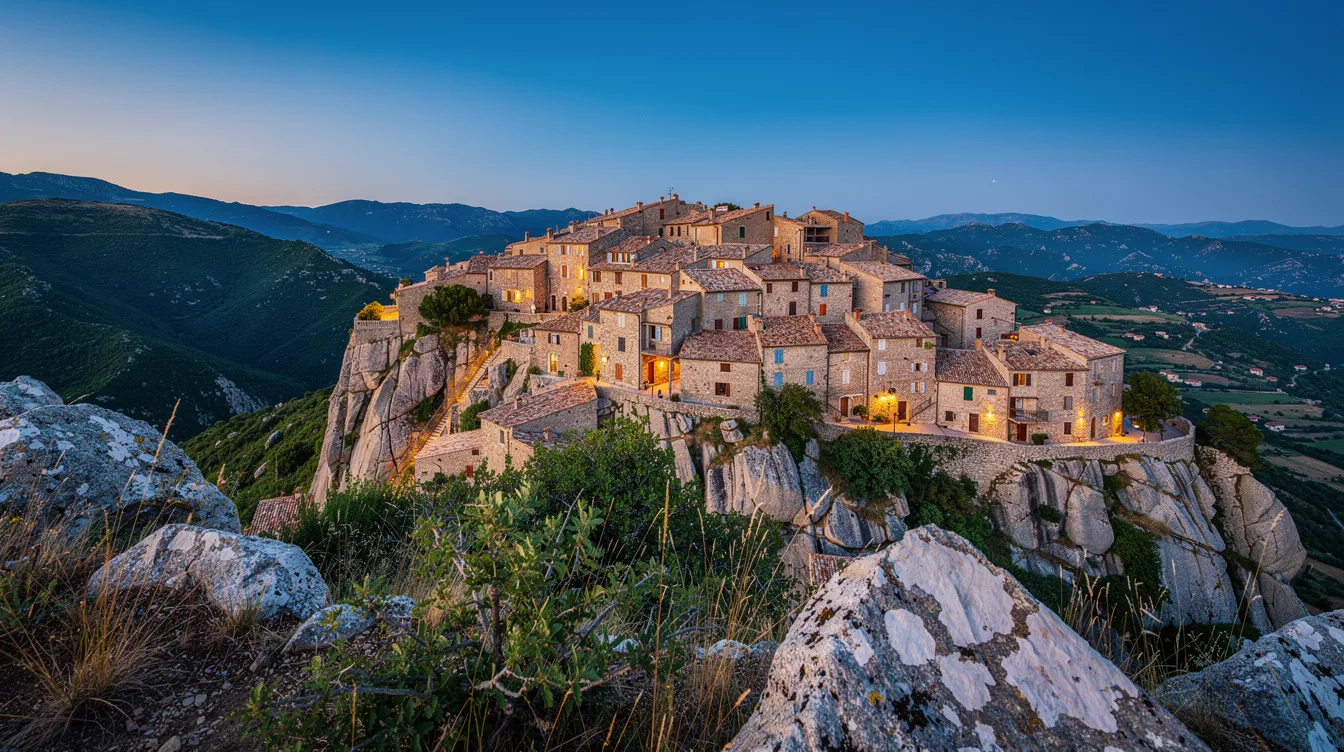
Sant’Antonino rises to 1,640 feet on a granite outcrop in Corsica’s Balagne region, between Calvi and L’Île-Rousse. Its lanes were shaped for defense, which is why the village feels less like a viewpoint with houses and more like a stone maze you have to earn.
It is overlooked by larger resort stops, but summer visitors do find it. Go early or late in the day, when the paving is cooler underfoot and the light catches the rough walls without turning the narrow passages into a bottleneck.
A high village built to make you slow down
At first, Sant’Antonino can feel almost too compact to justify a detour. Then you start climbing. Narrow lanes, stone steps, and vaulted passages fold back on one another, so you stop checking your route and begin looking up.
And that’s the right way to see it. The village is recognized among Les Plus Beaux Villages de France, a designation that fits because the architecture still dictates the experience rather than simply decorating it.
You’ll want shoes with grip. The lanes are steep and often paved, which gives them texture and character, but makes flimsy sandals a poor choice. But the compact scale means you can take your time without committing to a full-day hike.
The old castello has the payoff
Keep heading upward toward the summit and the remains of the former castello. From there, the view opens across Balagne, the mountains, and the Mediterranean. The reward is broad, but the approach stays close and enclosed until the last stretch.
That contrast is Sant’Antonino’s best trick. You move through shaded stone corridors, then suddenly stand in open air with the whole region spread beyond the walls. It’s the kind of stop that makes a short drive from the coast feel well spent.
And don’t rush back down after taking the view in. The strongest moments here are often the small ones: a worn stair edge, a dark archway, warm stone holding the afternoon sun. There’s no need to manufacture an itinerary around it.
Is Sant’Antonino worth visiting from Calvi?
Yes, especially if you want a half-day break from Calvi’s coast. The village works as a focused outing rather than an all-day expedition. Arrive with enough time to wander without treating the summit as a finish line.
But it won’t suit travelers who need a long checklist of attractions. Sant’Antonino is about walking, looking, and accepting that its pleasures are concentrated in a few steep streets and one commanding perch.
A 17th-century church, then quieter corners
The Church of the Annunciation dates from the 17th century and has an organ from the 18th century, along with older works inside. It gives the village a different pace after the climb, trading exposed views for a more contained and reflective stop.
And the Chapel of the Trinity adds another layer of local medieval heritage. You don’t need a lecture to appreciate the setting. The stone, the tight passages, and the changes between sun and shadow already explain why this hilltop was built up this way.
There are only 127 residents, according to the 2023 census. That small population matters because Sant’Antonino is a real commune, not an open-air set. Visit gently, keep voices down in the lanes, and let daily life remain visible.
How to time a visit from L’Île-Rousse
From L’Île-Rousse, Sant’Antonino is about 7.5 miles away. Road access comes by the D413 from the D151 on the Cateri side, and there is parking at the village entrance. Parking arrangements and prices can change with the season, so don’t assume a fixed rate.
Once parked, you’ll explore on foot. That makes the arrival simple, but it also means mobility limitations deserve an honest look before you go. The village’s steep, paved lanes are integral to the experience, not an optional side route.
Early morning is the calmest choice. Late afternoon is nearly as good, because the summer crowd thins and the granite takes on a softer glow. By the time you return to the entrance, the sound of footsteps on stone may be all that follows you down.