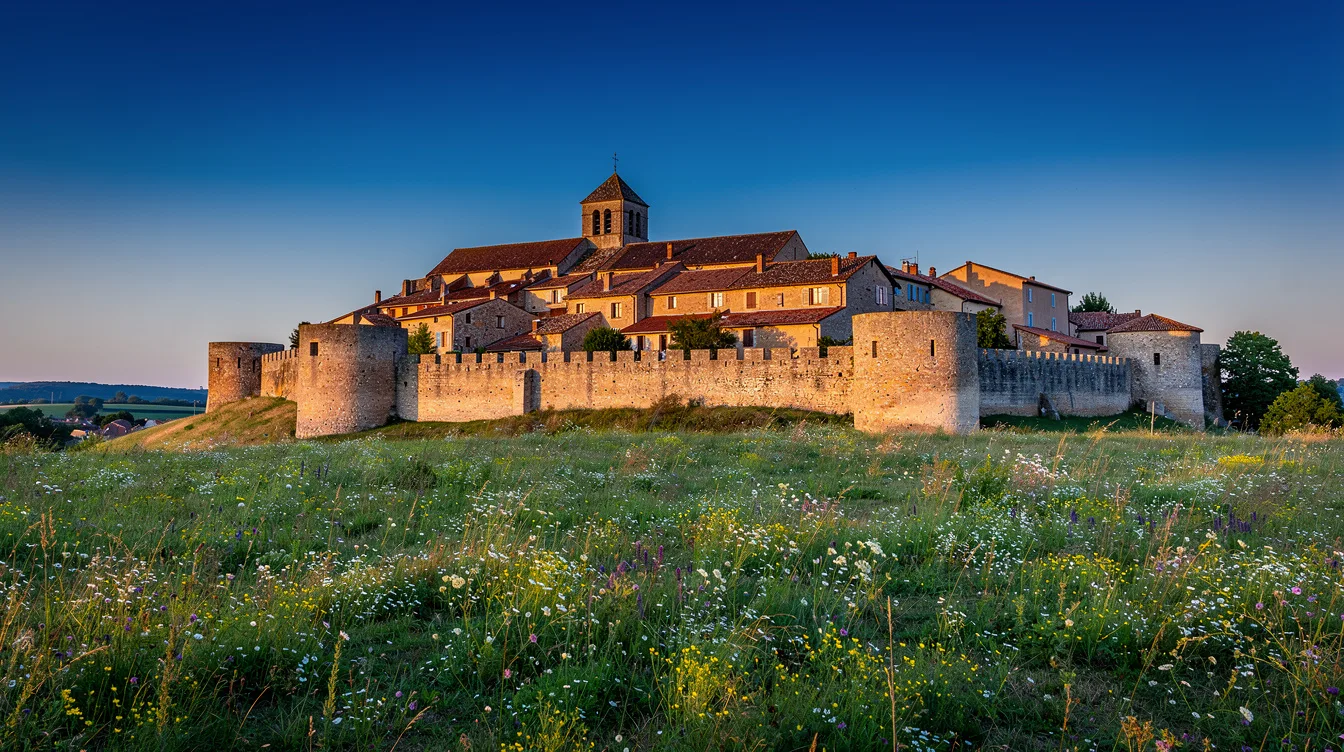
Pérouges nearly disappeared before it became a day trip from Lyon. In the 19th century, its population fell from 1,500 people to just 90 residents, after roads and railways shifted away from the old hilltop town.
Then restoration began in 1911. That reversal is the real story here, not a vague medieval fantasy. You come to see a fortified place that survived because houses were saved when there were hardly enough people left to fill them.
A hilltop town that almost lost its reason to exist
Pérouges sits in France’s Ain department, about 18.6 miles from Lyon. It overlooks the plain of the River Ain from a small hill, so the approach gives the walls a satisfying sense of separation from the modern roads below.
But this isn’t an isolated mountain outpost. Its position between Lyon and Geneva once put it near active trade routes, which helped craftsmen and trade flourish. When transport patterns changed in the 19th century, that advantage became a problem.
The decline was brutally simple. Fewer people stayed, the population collapsed, and homes faced abandonment. Because the revival started before the town vanished altogether, Pérouges still has a coherent enclosed center rather than a few scattered historical fragments.
Today, the commune has roughly 1,273 to 1,387 residents in recent censuses, though only around 80 people live inside the old walled city. It draws more than 500,000 visitors a year, which means you should expect company, especially in the warmer travel months.
Its medieval claim has real dates behind it
The fortress first appears in written records in the 12th century. That matters because Pérouges doesn’t need invented legends to hold your attention. The stones, gates, and enclosed streets already carry a long paper trail.
And the inhabitants gained communal freedoms in 1236. That detail gives the place more texture than its postcard image suggests. This was a working town with people asserting local rights, not merely a decorative stop on a modern itinerary.
The town became French in 1601. Before that, its setting near a significant regional route shaped its fortunes. History here feels practical: trade moved, political borders changed, and eventually transport bypassed the community.
Its streets are narrow and cobbled, with stone ramparts and two gates enclosing timber-framed houses from the 15th and 16th centuries. The effect is atmospheric, but the uneven ground is part of the deal. Wear shoes that can handle cobbles.
Walk slowly inside the walls
Start with the ramparts and gates, then let the winding lanes dictate the pace. You don’t need a rigid checklist here. The reward is the compressed scale, where walls, old façades, and passageways keep pulling your attention sideways.
But Pérouges can feel crowded because it is compact and popular. Visit with patience, and don’t expect private streets at peak times. The town has also appeared in period films, which makes sense once the modern world drops out of view.
The church dates to the 15th century and is integrated into the fortifications. That union of worship and defense is one of the clearest reminders that the walls were never only for looks. They were part of everyday security.
Save room for galette de Pérouges, a local bread pastry topped with sugar and sold around the village. It is a modest pleasure, but it suits the stop: simple, sweet, and more memorable than another hurried café break beside a highway.
How to time a Lyon side trip
From Lyon, Pérouges is reachable by car via the A42 motorway. You can also take a train from Lyon to nearby Meximieux-Pérouges station. That access makes the town easy to pair with the city, but it also explains why it rarely feels undiscovered.
And if you’re arriving by air, Lyon-Saint Exupéry Airport is about a 35-minute drive away. The old center sits within a commune ranging from 673 to 994 feet in elevation, though the experience is more hilltop stroll than strenuous climb.
The annual spring festival runs between April and June, with music ranging from Baroque to jazz. That is a good window if you want a reason to linger, though the village’s small enclosed streets may feel busier during event days.
Pérouges is touristy, and it should be. Few places recover so visibly from near-empty streets. By the time you leave the gates, the cobbles still hold the day’s foot traffic, while the plain of the Ain opens quietly below.