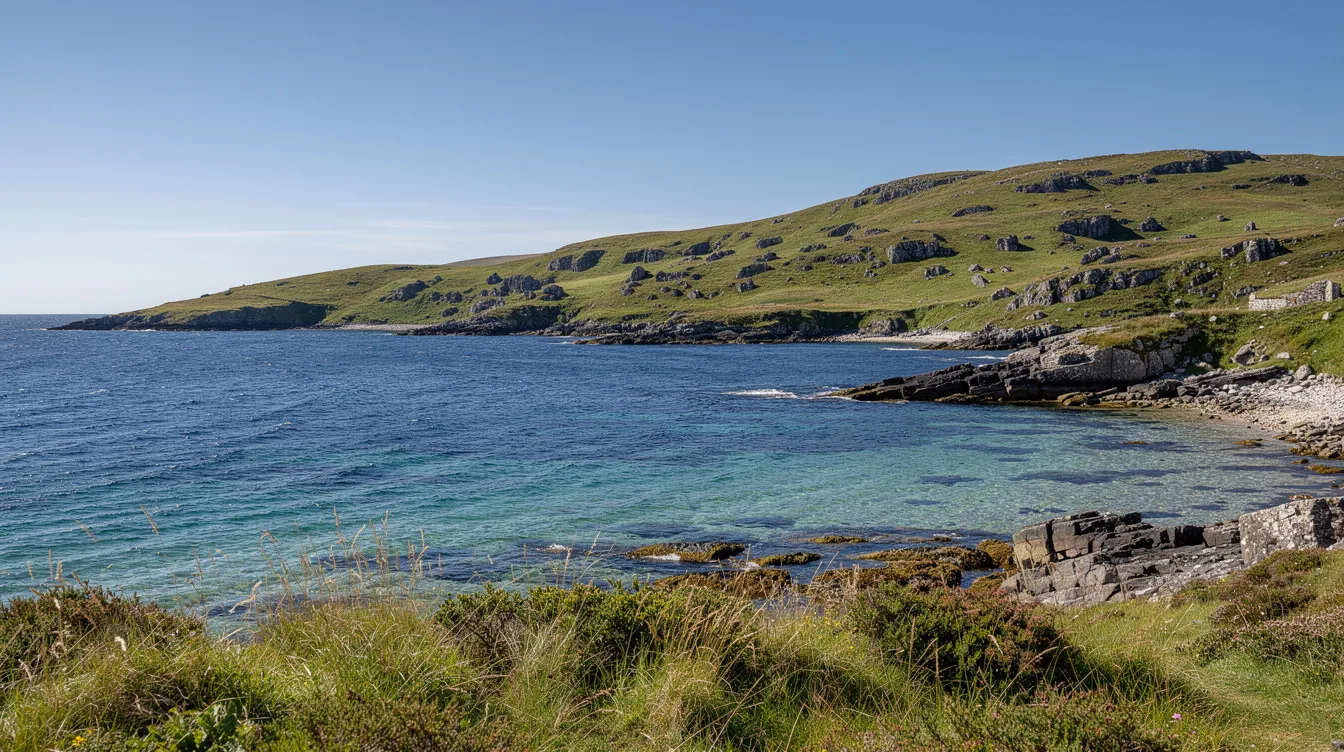
Colonsay takes 2 hours 20 minutes from Oban by ferry, which is long enough to make the mainland feel irrelevant. On its sheltered east coast at Staosnaig, archaeologists found a shallow Mesolithic pit packed with hundreds of thousands of burned hazelnut shells, dated to around 6000 BC.
That discovery is the reason to look beyond the usual island checklist. The beach is there, certainly. But this is an island where a heap of charred shells tells a bigger story than any viewpoint.
Staosnaig makes the island’s oldest case
At Staosnaig, the shells came from hazelnuts gathered in a single year. Pollen analysis indicates the hazel trees were cut down at the same time, so this was organized work on a scale exceptional in Scotland.
And the pit was once close to the shore. There were also two smaller stone-lined pits, a hearth, and another cluster of pits, although their purpose remains uncertain. You can feel the value of that uncertainty here.
Colonsay doesn’t package its past into easy answers.
Hazelnuts appear at other Mesolithic sites, but rarely in such concentrated quantities. Similar places are known at Farnham in Surrey and Cass ny Hawin on the Isle of Man, which makes the Staosnaig find unusually weighty for such a small island.
Small enough to travel slowly
Colonsay lies between Mull and Islay in Scotland’s Inner Hebrides. It is about 8 miles long, and its highest point, Carnan Eoin, reaches 469 feet. The island looks spare from the water, but its interior is more sheltered and wooded than that first impression suggests.
But don’t arrive expecting buses to connect every stop. There is no public transport, so you’ll explore on foot or by bike. Camper vans and motorhomes aren’t permitted, which keeps the roads and ferry arrival quieter than many Scottish island trips.
Scalasaig is the practical starting point because the ferry terminal is there. It also has a post office, general store, café, bookshop, village hall, bakery, and the island’s only hotel. With a 2022 population of 117 residents, this is lived-in smallness, not a theme-park version of remoteness.
Can you make Colonsay a day trip?
Yes, Hebridean Air Services runs small aircraft from Oban, allowing day trips with several hours ashore. But the ferry better suits the island’s pace. The crossing gives you time to notice how the sea narrows your plans, then improves them.
The CalMac route from Oban is the main way in. A seasonal service from Islay via Kennacraig takes roughly 70 minutes, so Colonsay can also fit into a longer Hebrides route. Just check schedules before committing, because island access is never something to treat casually.
Kiloran Bay earns the detour
Kiloran Bay is Colonsay’s best-known beach, a broad sweep of golden sand backed by dunes and hills. It is popular, but it still feels isolated. The wind moves across the open shore, and the beach has enough room to absorb company.
And that is the useful contrast on Colonsay. The island is tranquil, but it is not empty of things to do. Heather-covered moorland, gardens with a near-tropical character, wild goats, and seabirds give a walk some texture without demanding a rigid itinerary.
Beyond the bay, watch for black-legged kittiwakes, cormorants, guillemots, corncrakes, and golden eagles. There are also about 50 colonies of European dark bees on Colonsay and Oronsay. The islands have special protection against other honeybees, a small detail that says plenty about local scale.
The Strand has its own timetable
At Colonsay’s southern end, The Strand is a tidal sandbar linking the island to Oronsay. You can cross it on foot at low tide, and Oronsay has archaeological remains dating back to 7000 BC. Timing matters, so don’t treat the crossing like an all-day promenade.
But it is worth planning around. The low-tide walk gives the trip a satisfying edge: sand underfoot, exposed waterlines, and another island waiting just beyond the causeway. Colonsay is remote, but not difficult if you accept that tides get a vote.
Go when the days stay open longer
May through September is the best period for warmer weather, long daylight, and peak wildflowers. Accommodation includes B&Bs, self-catering stays, a hostel that closes in winter, and a hotel that closes from November through March. Wild camping is allowed.
On a practical note, shop hours vary by season. The post office is a reliable source of local information, and that is the kind of advice worth using on an island this small. A ferry return fare was listed in early 2026 at £19.20 for an adult and £98.50 for a car.
By the time the ferry pulls away from Scalasaig, the shore shrinks to pale sand and dark ground. Somewhere beyond it sits the old Staosnaig pit, quiet now, holding the memory of one very busy hazelnut year.