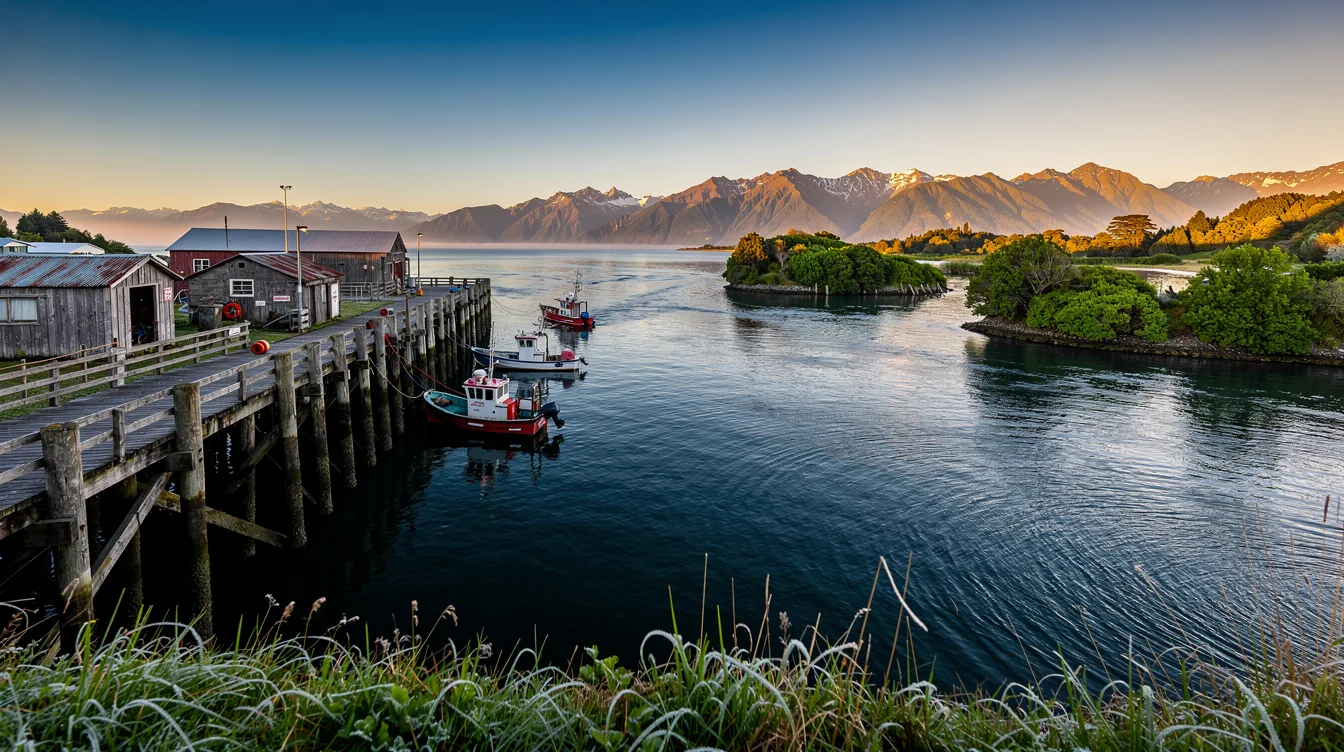
Hokitika is the rare harbor town where a walk along the river mouth can make you picture masts crowding the water. On September 16, 1867, 41 ships sat alongside its wharf, sometimes three and four deep.
That traffic was no coastal footnote. In 1867, this West Coast port ranked first in New Zealand for ships entering and the total value of exports, chiefly gold. You can still feel the old urgency in a town that now moves at an entirely different pace.
A gold port with a hard edge
Hokitika grew fast after gold mining began in 1864. By late 1866, it had become one of New Zealand’s most populous centers, and the harbor was the engine. Gold left from here because the sea offered a route outward, even when it made arrivals dangerous.
But this was never an easy port. Between 1865 and 1867, it recorded 108 strandings and 32 ships lost. That fact changes the view from the shore, where the Tasman surf still looks forceful and the river mouth feels exposed.
The boom faded with the gold, and the lack of nearby coal hastened the decline. Hokitika remained an official port of entry until the 1950s, but it no longer performs for visitors as a preserved rush-era set. It’s a working small town, relaxed but not sleepy.
What the harbor town feels like now
Today, about 3,420 residents live in Hokitika, on New Zealand’s South Island West Coast. It sits near the Hokitika River mouth, between the Tasman Sea and the Southern Alps, so the weather and terrain keep the town looking outward.
And the town’s current identity is more pounamu than gold. Revell Street has galleries and greenstone carvers, and locally made New Zealand jade is a meaningful souvenir if you want something more lasting than another road-trip T-shirt.
Hokitika Beach is the place to start. Dark sand, big driftwood pieces, and the familiar HOKITIKA sign give it a deliberately rough character. You may come for sunset, but the sound of the surf is the part that stays with you.
It isn’t a classic swim beach, and that’s worth saying plainly. The Tasman Sea surf can be powerful. Go for the walk, the salt air, and the feeling that the coast hasn’t been softened for anyone’s convenience.
Why Hokitika Gorge earns the detour
The clearest reason to leave town is Hokitika Gorge, about a 30-minute drive east. Its water is a vivid blue-green, and a short forest route ends at a metal rope suspension bridge above the gorge.
You’ll walk 1.5 miles round trip, which makes this an unusually rewarding stop for travelers who don’t want a full hiking day. The forest tightens around the path, then the color of the water does the work.
But don’t mistake short for remote-free. This is a popular visitor stop, and the dramatic water is the point. I’d pair it with an unhurried morning in town instead of trying to cram it between long West Coast drives.
Can you make a full day of it?
Yes. Start on Revell Street, then head to the beach before driving to the gorge. Return for the last light over the Tasman, and visit Glow Worm Dell after dark, where glowworms appear in native bush near town.
If you have another day, Hokitika also works as a base for Lake Kaniere, Dorothy Falls, the West Coast Treetop Walk, or part of the West Coast Wilderness Trail. The choice depends on whether you’d rather pedal through rainforest or linger near water.
Getting here without making it complicated
Hokitika is 24.9 miles south of Greymouth, with State Highway 6 running through town. It’s also roughly 1 hour 45 minutes north of Franz Josef, which makes it an easy pause on a longer South Island route.
And you don’t have to arrive by road. Hokitika Airport has Air New Zealand service from Christchurch, while the airport itself sits just northeast of town. That access makes the place feel remote in mood, but not difficult to reach.
The annual Wildfoods Festival gives the town a louder moment, while the Driftwood and Sand Festival takes place every January on the beach. Outside those events, Hokitika’s appeal is quieter: galleries, wet forest, dark sand, and a harbor that once carried a nation’s gold.
By evening, driftwood silhouettes gather against the Tasman Sea, and the old port feels less like history than weather.