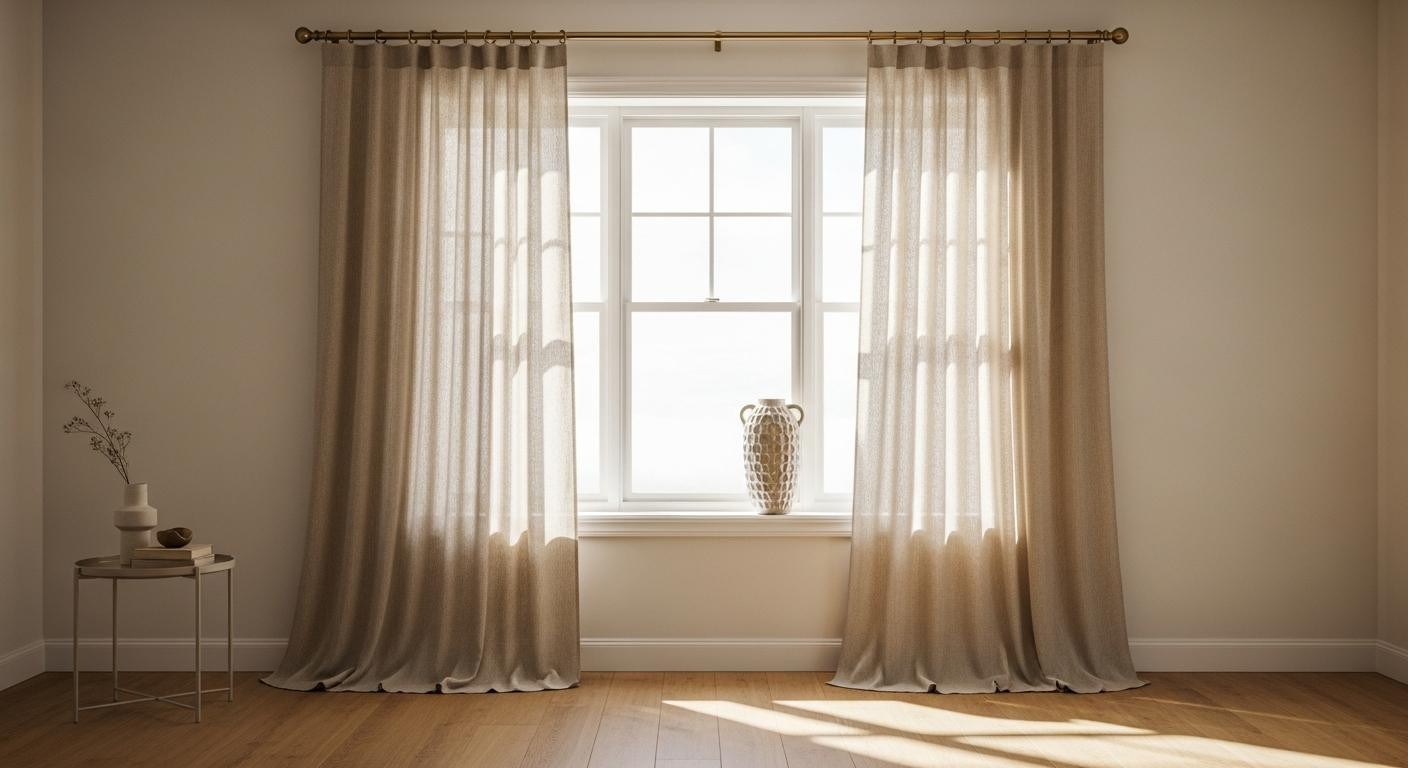
Your living room on May 16th when you calculate what three years of spring refreshes actually cost. The 2023 floral pillows went to Goodwill in November 2024. The 2024 rattan basket cracked in January 2025. The 2025 pastel throw already feels dated because the weave catches light like polyester, which it is. That’s $287 spent across 36 months on objects that photographed well but lasted eight months each. Meanwhile, your neighbor bought linen curtains in April 2023 that still make her windows look expensive in 2026.
One approach costs $95 per year. The other costs $60 per year and gets better with age.
Linen curtains at $89 per panel outlast 6 seasonal window treatments
Pottery Barn’s Belgian Flax Linen Curtain, 50×96 inches, runs $89 per panel in May 2026. Buy two panels now, use them through spring 2029, and the annual cost drops to $29.67. Target’s seasonal curtains at $34.99 fade after one summer of direct light, requiring replacement each spring at $104.97 total over three years. The linen softens with washing. The print curtains degrade.
The texture tells the story. Undyed linen catches morning light without the plasticky sheen that marks cheap fabric. And the weight matters. Heavier weaves at 220 grams per square meter or higher hold their drape across multiple wash cycles while lighter cotton blends pucker and lose shape.
Admittedly, linen wrinkles. This only pays off if you’re willing to iron twice a year or embrace the rumpled look that some people call lived-in and others call lazy.
The spring pieces that cost more now but less by 2029
Natural fiber rugs survive 4 springs, jute lasts while sisal frays
West Elm’s Basketweave Jute Rug, 8×10 feet, costs $399 in May 2026. Jute’s tensile strength outlasts synthetic spring rugs at $179 that mat down after 18 months of foot traffic. The math works like this: $399 divided by 4 years equals $99.75 per year versus $179 every 1.5 years at $119.33 annually. That’s where the cost-per-year logic proves itself.
But jute stains easily and can’t handle spills. This only makes sense in low-moisture rooms where the weave can breathe without trapping humidity.
Scalloped linen pillows at $68 beat $24 printed covers every spring
CB2’s embroidered linen pillow covers run $68 versus Target’s printed cotton at $24. Piped edges and heavier linen at 220 GSM minimum keep shape across multiple washes while printed cotton fades and puckers. Cost per year over three springs: $22.67 for linen versus $24 annually for replacement cotton. The difference seems small until you realize the linen version still looks intentional in 2029 while the cotton reads like clearance.
Interior designers with ASID certification consistently recommend buying textiles that transition across seasons. The scalloped edge adds visual interest without locking you into one aesthetic the way bold prints do.
What spring pieces aren’t worth the investment premium
Seasonal florals on upholstery fail by next spring
Laura Ashley floral quilts look heritage-quality at $180 but date themselves because the print locks you into one aesthetic. When grandmillennial shifts to the next trend cycle in 2027, that quilt reads like a time capsule. Better strategy: solid linen duvet at $140 that works across trend cycles, with $28 floral pillowcases you swap out.
The texture of raw linen feels cooler against skin in warm weather than synthetic quilts, which trap heat and lose shape faster under repeated washing.
Pastel ceramics lose value faster than neutral stoneware
The $24 Target pastel vase seems spring-appropriate but the color commitment limits year-round use. A $38 unglazed ceramic vase in cream, terracotta, or charcoal works in spring with tulips, winter with evergreen branches, fall with dried grasses. Annual cost drops when the piece earns its shelf space across four seasons instead of one. And the matte finish on unglazed stoneware hides water marks better than glossy pastel glazes that show every mineral deposit.
Professional organizers with certification confirm that single-season decor creates visual clutter because it forces you to store items eight months per year.
The investment test that separates spring decor from spring furniture
Decor refreshes emotion. Furniture anchors rooms. That distinction determines whether the spring purchase pays off. A $340 travertine side table costs $113 per year across three springs and works in June, October, February. An $87 rattan tray feels spring-specific and sits in the closet from July to March, costing $87 per active season.
The test: if the piece only makes sense when tulips are blooming, it’s decor. If it works the day after Thanksgiving, it’s an investment. Your budget should reflect that difference, especially when you apply the 60-25-15 budget rule to room planning.
Your questions about spring investment pieces answered
What’s the cost-per-year threshold that makes spring pieces worth buying?
Divide the price by realistic lifespan in years. If the annual cost beats comparable replacements, buy it. For textiles: $60 per year or less. For furniture: $150 per year or less. For decor: $25 per year or less. Anything above those thresholds needs exceptional durability or aesthetic staying power to justify the purchase.
Do English country pieces hold value when the trend shifts?
Classic English country, with its florals, stripes, and skirted furniture, has cycled in and out since the 1980s with 8 to 12 year intervals. If you’re buying in 2026, expect relevance through 2030 minimum, making the investment math work. But only if you actually like waking up to that floral pattern in 2028, not just 2026.
What’s the biggest mistake people make buying spring investment pieces?
Confusing trend longevity with personal longevity. A piece lasts for years in your home only if you actually like living with it past April. The grandmillennial quilt might stay relevant through 2029, but if you’re tired of it by 2027, the math doesn’t matter. That’s why budget refreshes sometimes make more sense than expensive commitments.
Design experts featured in Architectural Digest note that the most successful spring purchases feel collected rather than coordinated. That means buying one $180 piece you love beats three $60 pieces you like.
Where finish quality changes the math
Matte ceramic makes spring pastels look expensive while glossy finishes read like Easter clearance. The surface treatment determines whether a $38 vase still looks intentional next year or dated by July. That’s the kind of detail that quietly elevates the whole space without requiring a bigger budget.
Your linen curtains on May 16, 2029, three springs after purchase, catching morning light with the particular softness that only comes from 36 months of washing. The fabric cost $178 in 2026. The seasonal polyester versions your neighbor replaced annually cost $314 total. One approach ages. The other just gets old.