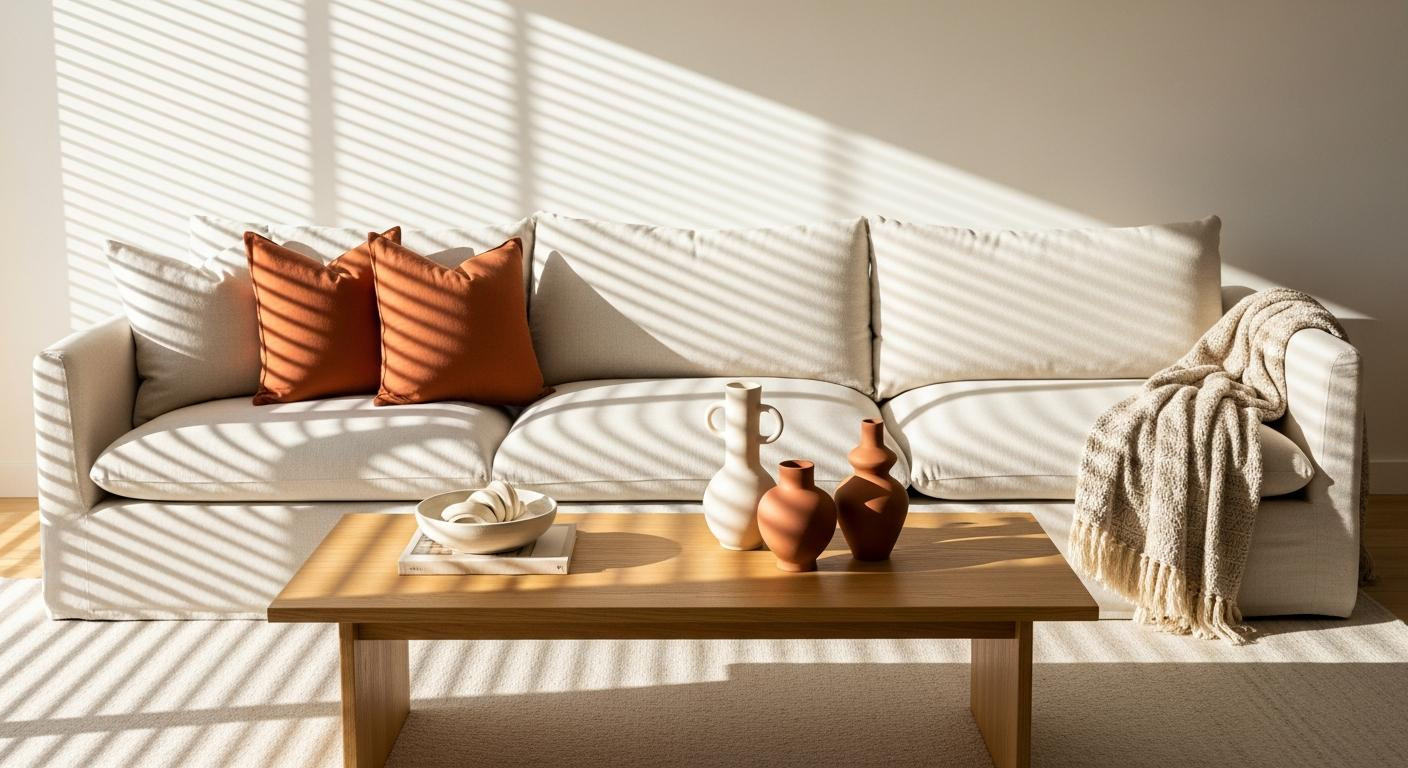
Your living room holds $2,847 worth of furniture but reads temporary because you spent evenly: $1,299 on the West Elm sofa, $428 on the rug, $380 on the coffee table, $740 spread across four accent chairs. Your neighbor’s room cost $2,680 but looks like quiet luxury because she put $1,180 into an oversized linen sectional dupe and $67 into three ceramic accessories from HomeGoods. Neither space is expensive. Hers concentrates budget where eyes and bodies land most, creating the Restoration Hardware effect through allocation hierarchy rather than total spend.
The difference isn’t taste. It’s math that controls how a room reads once you step back from the doorway.
The 60-25-15 rule that makes $2,400 look like $6,000
Put 60% of your budget into one cornerstone piece, 25% into supporting furniture, and 15% into accessories and textiles. That’s the framework interior designers use when they want the RH look without the RH invoice. A $1,440 sofa anchors a room in a way six $240 pieces never will, even if the math adds up the same.
Consider the Oslo side table comparison. Restoration Hardware sells theirs for $1,280. The Home Depot alternative costs $295. But that dupe only works visually when the sofa it sits beside carries enough material weight to anchor the room. A cheap nightstand next to a substantial bed frame reads intentional. A cheap nightstand next to a cheap bed frame just reads cheap.
Why your $400 coffee table looks cheap next to your $299 sofa
Smaller furniture reveals the quality of larger pieces, not the other way around. A $400 marble-top coffee table looks like a splurge when paired with a $1,200 sectional in performance linen. Next to a $299 loveseat with shiny legs and thin cushions, that same table starts looking like you grabbed whatever was in stock.
And yes, it works in reverse. Quality large pieces elevate budget small pieces in a way that feels intentional, not accidental.
West Elm vs. Article vs. Wayfair for cornerstone budget
For $1,200 to $1,800, Article delivers the best RH-adjacent scale and materials in oak case goods. West Elm works for discontinued floor models in neutral linen, especially during outlet events. Wayfair carries the widest selection of upholstered pieces over 90 inches, which is the minimum length that reads substantial rather than apartment-sized.
According to ASID-certified designers who specialize in budget transformations, the sweet spot for a cornerstone sofa sits between $1,000 and $1,500. Below that, frame construction and cushion fill start compromising faster than most people expect.
Materials that make $563 nightstands read like $1,265 RH pieces
Restoration Hardware’s perceived luxury comes from material honesty, not perfect joinery. Real wood grain. Actual stone weight. Natural fiber texture you can feel when you run your hand across the arm of a chair. A $563 nightstand in solid oak with visible grain and matte finish reads richer than an $890 nightstand in high-gloss painted MDF, even though the cheaper piece might use better drawer glides.
The checklist is shorter than you think. Avoid anything shiny: glossy paint, chrome hardware, glass tops. Prioritize matte or natural finishes. Choose visible wood grain over solid color. Select chunky proportions over delicate legs. The way your $980 sofa concentrates quality where hands land most applies to every piece in the room.
The marble tray test that reveals material honesty
Pick up a $36.99 marble tray and feel the weight. Real marble is cool to the touch, shows natural veining that doesn’t repeat, and sits heavy in your hands. A resin lookalike weighs half as much and warms up fast under your palm. That tactile difference is what makes budget accessories either work or fail.
Why boucle makes $130 chairs look like $500 ones
Texture diffuses light and hides construction flaws that smooth upholstery reveals. A $130 woven dining chair in boucle reads expensive because the nubby fabric catches shadows and creates visual depth. The same chair in smooth cotton blend shows every wobble and uneven seam. Designers quoted in current trend coverage note that boucle, linen, and cane all share this forgiving quality.
Target and HomeGoods for the 15% layer, not the 60% anchor
Budget retail works for accessories where material finish matters more than construction durability. A $24 ceramic vase from Anthropologie reads expensive because of matte glaze, sculptural form, and 8-inch height. A $24 side table from the same retailer reads cheap because it’s lightweight, wobbly, and scaled wrong for adult rooms.
The giant clamshell dupe at $212 costs a third of the RH price and still delivers because it’s decor, not furniture. Accessories at 30-40% of RH cost work. Furniture under 50% of RH cost usually fails the scale and stability test. That’s the breakpoint professional organizers with residential portfolios confirm when budgeting client transformations.
But don’t ignore warm beige that keeps north-facing rooms from reading cold. Paint is still the cheapest way to make budget furniture look intentional rather than random.
The rooms where RH dupes fail completely
Dining rooms under 120 square feet turn claustrophobic when you add an oversized table that’s supposed to read luxurious. Rentals with builder-grade finishes highlight the gap between expensive-looking furniture and cheap trim. High-traffic family rooms show wear on a $2,034 dresser alternative faster than the $4,520 original, especially around drawer pulls and edges.
And south-facing windows fade budget fabrics within 8 months. Performance fabric upgrades cost $180 to $240 but extend lifespan to 3 years instead of 18 months. That’s the kind of detail matte ceramic that makes budget vases look like studio pottery also depends on: finish quality over base cost.
Dupes work best in low-traffic, neutral-light spaces with at least one architectural asset. Crown molding, good floors, or 9-foot ceilings all help.
Your questions about Restoration Hardware dupes answered
Does the RH look work in rentals with white walls and carpet?
Yes, if you add one warm beige accent wall and layer a jute rug over carpet to add texture weight. The rug creates a new floor plane that separates your furniture from builder-grade carpet. Removable wallpaper in textured linen patterns works the same way without painting.
Which stores carry RH-scale furniture under $800?
Article for oak case goods. Wayfair for upholstered pieces over 90 inches. West Elm outlet for discontinued floor models in neutral linen. Admittedly, IKEA hacks that lasted nine months versus versions that failed require more effort, but Hemnes and Besta base units in oak veneer hit the right proportions if you swap the hardware for brass pulls.
How long do $500 RH dupe sofas actually last?
Lighting designers with residential portfolios note that 18 to 24 months with careful use in adult-only spaces. Eight to twelve months with kids or pets. Performance fabric upgrades extend that to 3 years, but you’re still replacing cushions sooner than you’d like.
The linen sectional at 3pm on a Tuesday in May when afternoon light hits the oak coffee table and the whole room holds together not because each piece is perfect, but because the sofa is substantial enough to anchor everything else into looking intentional.