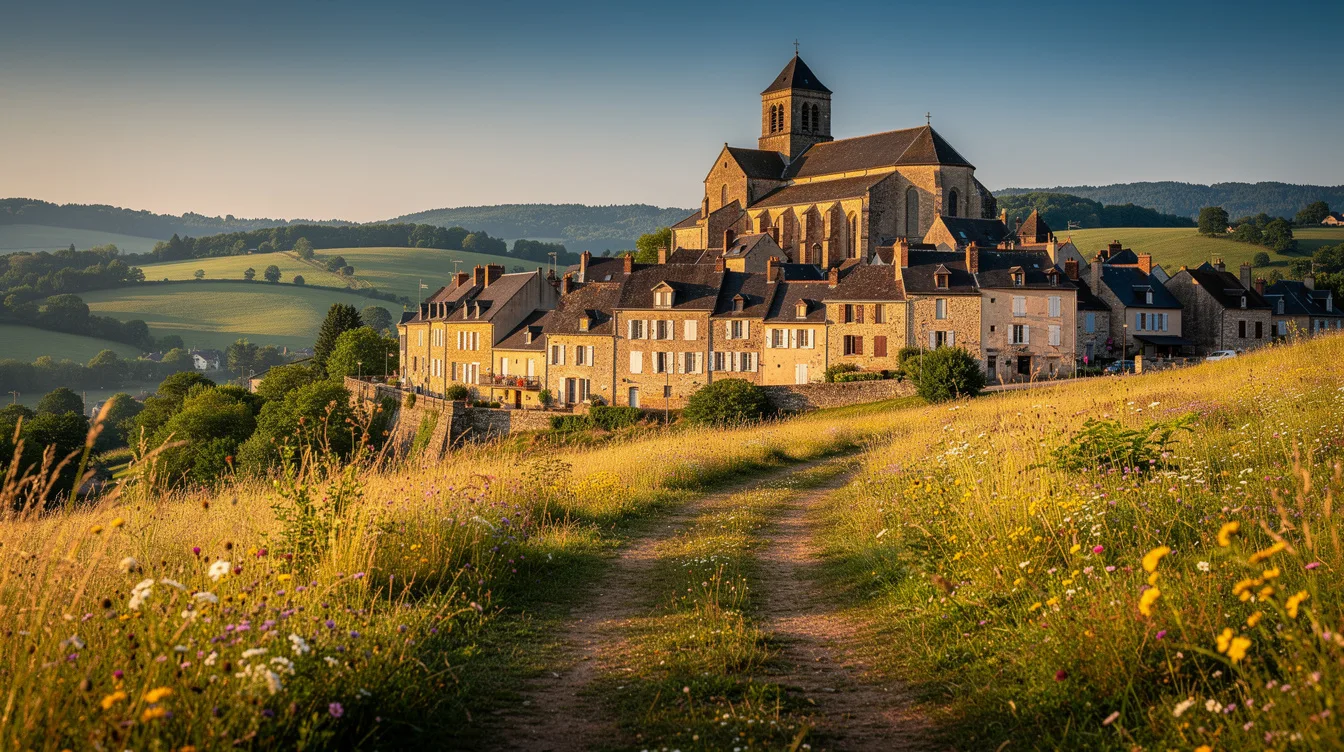
In France, Saint-Robert is a 12th-century village recognized among Les Plus Beaux Villages de France since 1982. That distinction fits because the historic center stays compact, the church anchors the hill, and old stone houses still shape the streets. You can reach it about 13.7 miles northwest of Brive-la-Gaillarde, then leave the car behind.
A medieval village with a real sense of place
And the first thing you notice is the height. Saint-Robert sits on a rise above the southern Corrèze countryside, with its highest point reaching about 1,148 feet. The view opens across the Yssandonnais, where rolling farmland replaces the busier rhythm of larger French destinations.
But the village earns its reputation through what remains close together. Ruelles, old houses, and noble residences in pale cut stone create a walk that feels coherent rather than arranged for visitors. You won’t need a checklist here.
My opinion is simple: Saint-Robert is best when you slow down enough to hear your own footsteps.
The church explains why the village grew here
And Saint-Robert’s Romanesque fortified church is the essential stop. Built in the 12th century, it is a remnant of the Benedictine priory around which the village developed. The heavy stone and fortified details give the building a quiet gravity, especially beside the smaller lanes.
But the church isn’t the only reason to wander. Houses with towers and defensive features point to the village’s medieval character, while the streets turn and narrow as they climb. You should expect some slopes, and you should wear shoes that handle uneven ground.
That small inconvenience is part of the experience.
Can you see the countryside without a long hike?
Yes, you can reach a broad rural panorama within the village itself. And the Jardin Philippe-Ranoux is the place to pause when you want open views without committing to a longer walk. The surrounding countryside is known for orchards, market-garden crops, and undulating farmland.
But this is not a lookout built for spectacle. The pleasure comes from the gradual change in view as you move through the old center. You may see pale walls, green fields, and the distant folds of Corrèze in one unhurried walk.
That modest scale is precisely why the village feels convincing.
What a half-day visit really looks like
And Saint-Robert is easy to cover in a half-day. The village has just 294 residents, so its compact center gives you enough time to explore without turning the visit into an endurance test. Park outside the tightest lanes, then continue on foot through the historic core.
But don’t mistake small for effortless. Some streets are narrow and steep, and circulation through the center is limited. Free parking is available year-round, while a camping-car area sits less than 15 minutes on foot from the village.
You’ll have more time to look up because you won’t be searching for a place to stop.
When to visit Corrèze’s quieter village
And Saint-Robert works in every season. Summer brings a music festival and a livelier atmosphere, although accommodation in the area may require advance planning. You can also visit outside the busiest period, when the stone streets feel calmer and the rural setting has more room to speak.
But there is no single perfect month here. The village’s appeal comes from its architecture and position, not from a narrow seasonal window. If you prefer a slower visit, choose a quieter day and arrive ready to walk.
The trade-off is that Saint-Robert has fewer services than a larger tourist town.
How to fit Saint-Robert into your route
And the village makes sense as a stop between Brive, Objat, Ayen, and the Périgord Noir. At about 13.7 miles from Brive-la-Gaillarde, it is remote enough to feel removed but close enough for a simple detour. You can check the [official municipal site](https://www.
Saintrobert. Fr/) before setting out.
But don’t rush through it on the way to a better-known destination. Saint-Robert has the kind of scale that rewards an unplanned extra hour, especially when the lanes empty and the countryside turns quiet. By the time you leave, the last sound may be your shoes on the old stone.