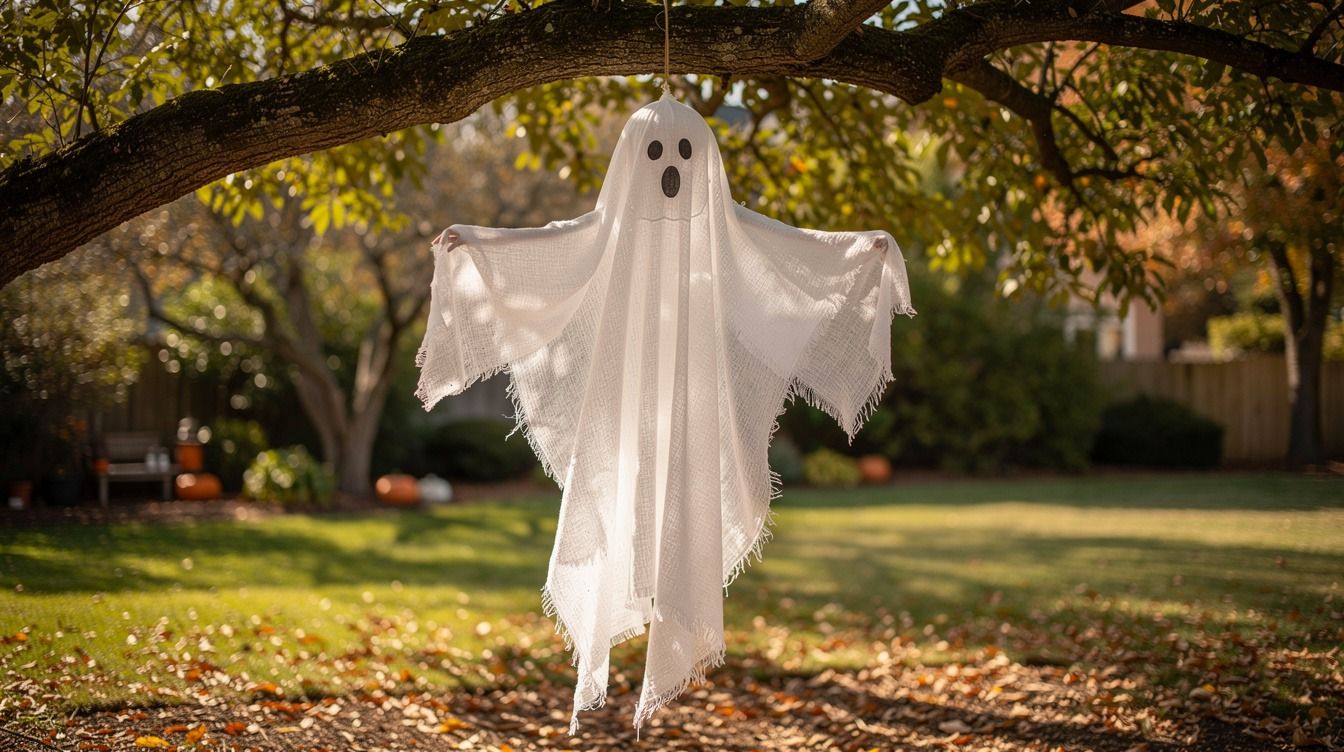
Hanging ghosts in trees stay put in wind with a weighted hem, two tie points, and room to move.
I’ve lost my first one before sunset on a single loop, so now I use unbleached cotton cheesecloth, hidden ballast, and a loose silhouette. That’s the correction behind these fifteen ideas.
Your yard can feel eerie, warm, and inviting with weatherproof nylon cord doing the hidden work. And yes, a little sway is the charm!
- Build the Wind-Safe Cheesecloth Body for Outdoor Ghost Decorations DIY
- Hang Three Heights With the Three-Height Ghost Stack
- Anchor Each Hem With the Pebble-Pocket Method
- Choose a Ghost Cluster Over One Tall Figure
- Frame a Limb With the Crescent Halo Method
- Float a Ghost Beside a West Elm Lantern
- Which Face Works Best for Tree Ghosts?
- Tear the Cheesecloth Edge for an Organic Ghost Silhouette
- Build a Porch-to-Tree Story With the Three-Point Welcome
- Mix White, Smoke, and Shadow With Benjamin Moore White Dove
- Keep the Face Sideways When the Wind Picks Up
- Choose a Grounded Mini Graveyard Instead of More Hanging Ghosts
- Can a Window Reflection Make Tree Ghosts Read After Dark?
- Store the Props in a Fall-Ready Ghost Station
- How Do You Make a Windproof Ghost Display on a Budget?
1Build the Wind-Safe Cheesecloth Body for Outdoor Ghost Decorations DIY
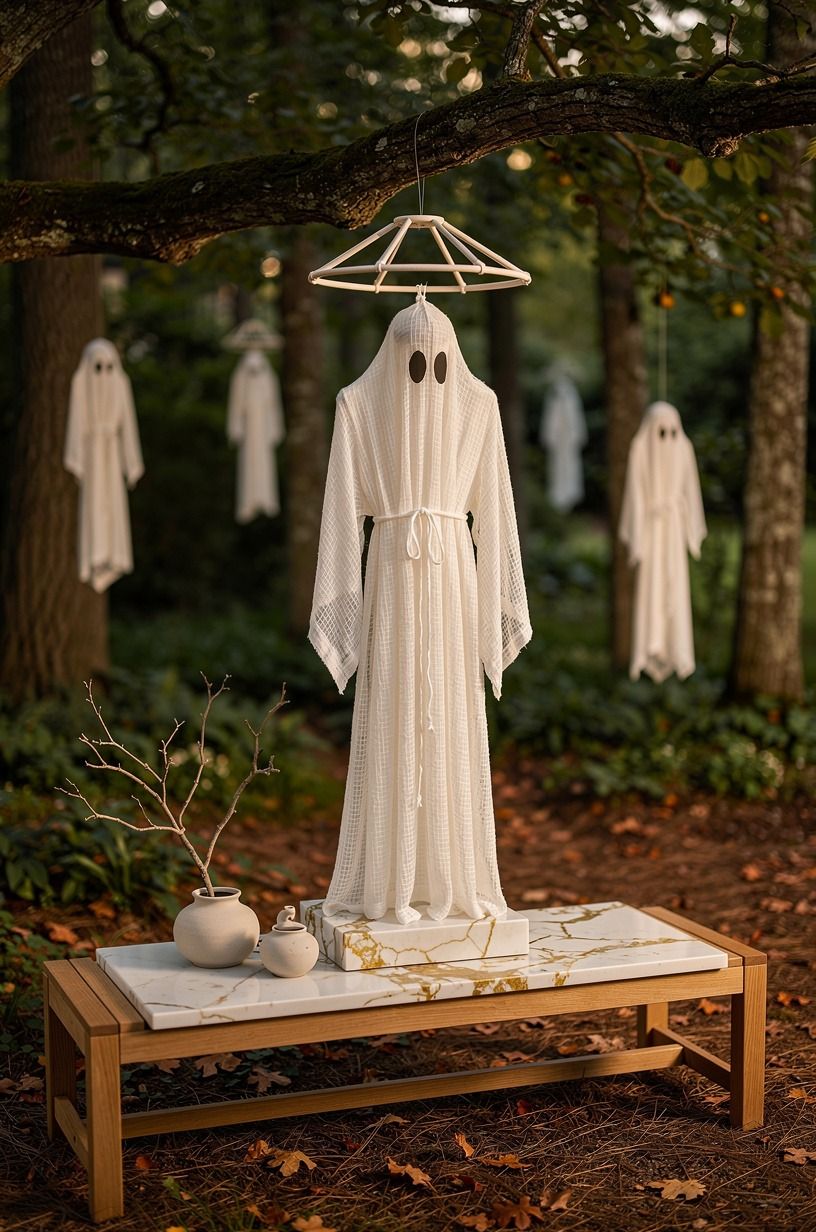
Start with an upside-down shape that gives your cloth shoulders, not a stiff mannequin. I like unbleached cheesecloth with a loose open weave because it keeps the ghost airy while the folds catch moonlight against forest green leaves, rust-colored accents, and natural oak.
If you’re using a foam head, skip the round balloon look. You’ll get a friendlier silhouette from a shallow oval and a long, uneven drape.
Gather the fabric at the neck, then bind it with weatherproof nylon cord before you hang it. Your knot should sit behind the head.
Tug the body gently to test it. I made the mistake of tying wet cloth directly to a branch once.
It slipped, dragged through the mulch, and came down looking like laundry.
Keep the bottom wide enough to breathe. A ghost that hugs the trunk looks limp; one with a little space reads as floating.
Hide a small Calacatta marble weight with gold veining inside the lower fold if your tree gets rough gusts. Leave enough slack for the figure to turn.
That’s what makes the movement soft instead of frantic.
2Hang Three Heights With the Three-Height Ghost Stack
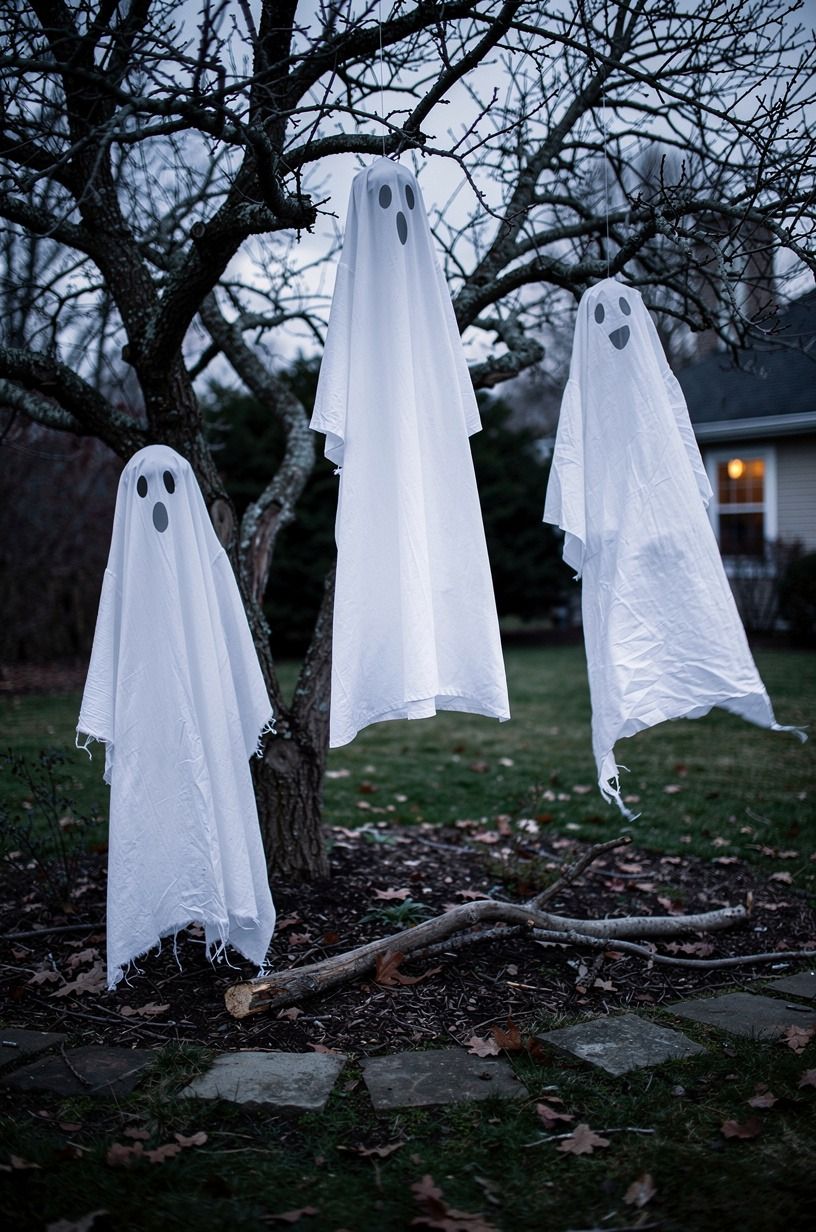
The Three-Height Ghost Stack gives your tree a little theater without needing more props. Put one figure near the outer branch, one closer to the trunk, and one where your eye catches it from the walk.
You won’t need matching sizes. The changing distance makes the group feel gathered rather than copied. Use white muslin cheesecloth for the farthest ghost so it fades gently into the leaves.
Before you knot anything, stand where guests will stand and look up. You’re checking what people notice first, not decorating from beneath the canopy.
I prefer the highest ghost partly screened by leaves because the reveal feels more charming than a full face at eye level. Your first glance should make you pause, then find the other two.
If you’re working with a porch tree in a small space, store the extra forms on a cerused white oak shelf indoors. Bring them out together when the season starts. For more help with a tight footprint, borrow the spacing logic in our studio apartment layout guide.
You’ll avoid the random-prop pile that makes seasonal decor feel noisy.
3Anchor Each Hem With the Pebble-Pocket Method
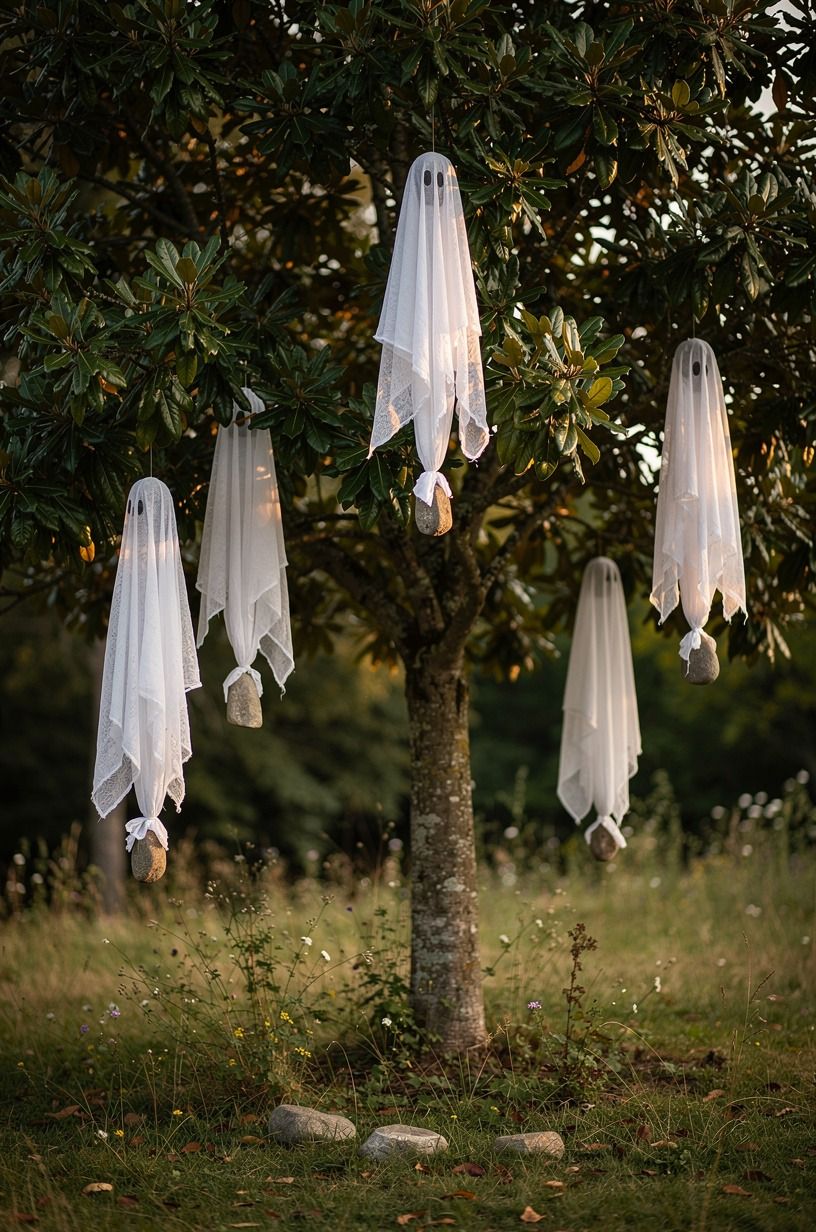
The Pebble-Pocket Method hides the ballast where nobody sees it.
4Choose a Ghost Cluster Over One Tall Figure

A cluster wins when your tree has low branches and a broad canopy. Instead of one large body swinging into the trunk, you get several small arcs moving at different speeds.
Make ivory double-layer cheesecloth the outer skin for the center ghost, then let the side figures stay thinner. Your display will look richer without becoming heavy.
I tried the oversized single ghost first, and it read more like a sheet caught on a fence than a spirit. The smaller forms are more charming because you can see leaves between them.
If your yard is narrow, place the cluster to one side of the trunk and leave the walking line open. That’s a small layout decision, but it changes your whole approach.
Give the ground a quiet echo with a copper lantern on a book-matched walnut board or a low basket of fallen leaves. You don’t need a matching set; that would make the arrangement too staged. For a compact porch, these small-space decorating ideas can help you protect negative space without crowding your door.
5Frame a Limb With the Crescent Halo Method
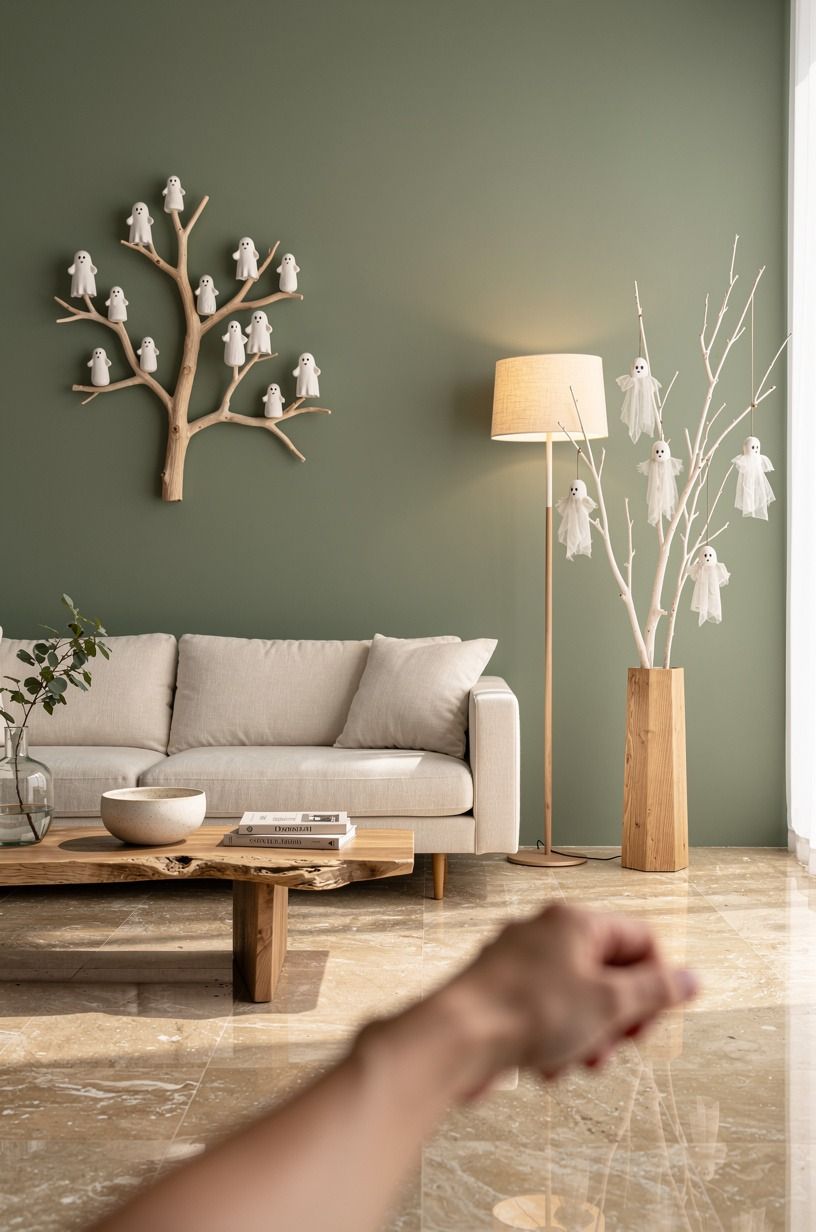
The Crescent Halo Method turns a bare branch into a frame. Bend warm-white LED string lights in a loose half-moon behind the ghost, never tight around the fabric.
The light outlines the shoulders without heating the cloth. You’ll see the edge first, then the face, which feels more dramatic than a bright figure staring from the tree.
Keep the glow low enough that your neighbors can still see the leaves. I don’t like blue bulbs here.
They flatten the cheesecloth and make the yard feel like a parking lot. If you’re lighting an entry, use three sources per room, overhead, task, and ambient.
Let the tree count as the ambient layer.
Your halo doesn’t need a perfect curve. A slightly lopsided sage-green paper lantern beside a warm travertine planter looks more handmade, especially beside a real branch with cracked bark.
And when the flame-like mood is missing, borrow the placement ideas from our natural candle-lighting guide, then translate them into safe outdoor LEDs. Simple. Very effective!
6Float a Ghost Beside a West Elm Lantern
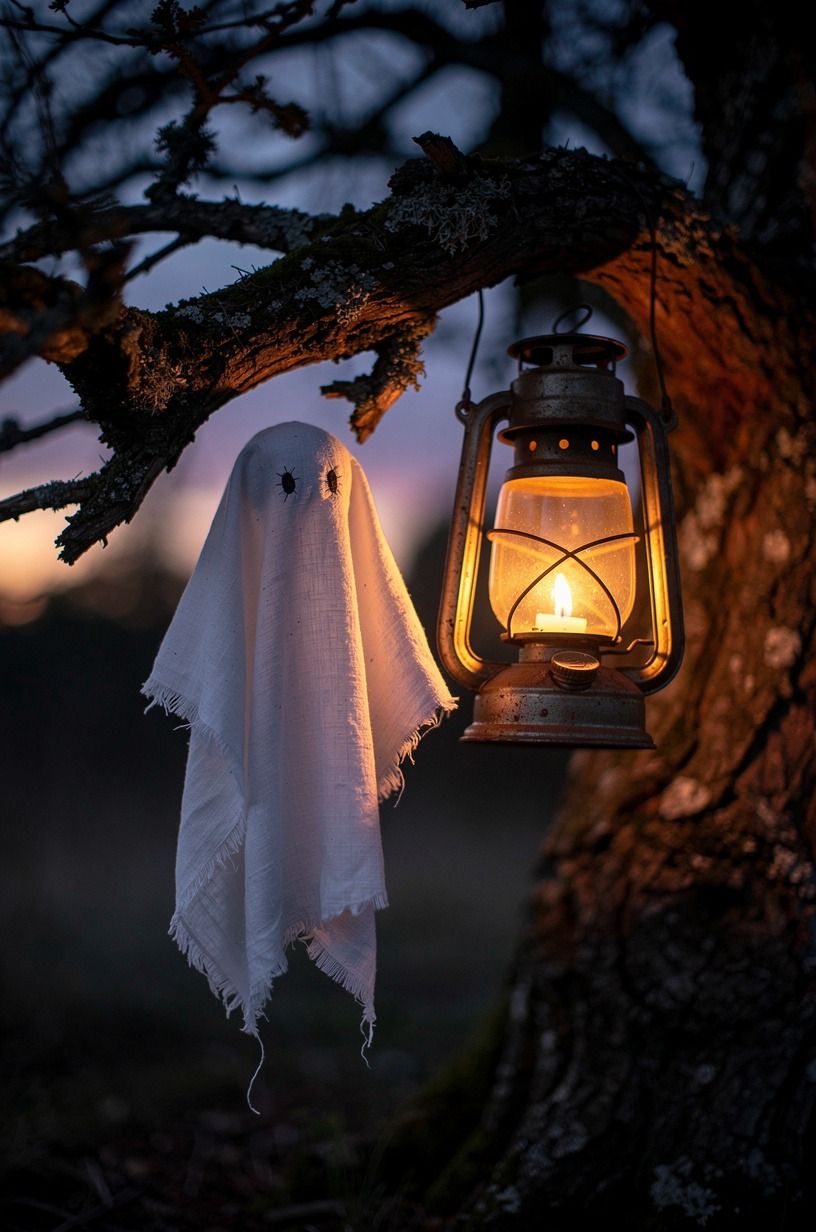
Hang one cheesecloth figure just outside a lantern’s pool of light, not directly in it. A West Elm lantern in unlacquered brass developing a soft patina gives you a warm anchor beside terracotta, stone, and olive notes while the ghost stays pale at the edge, where leaves and fabric can blur together. If your light sits too close, the face disappears into glare, and you’ll lose the quiet tension.
Use a short branch extension or a shepherd’s hook to place the ghost a little higher than the lantern. I tested a low placement beside a step, and every passerby saw the cord before the face.
Your eye needs a clean gap, even if the arrangement looks casual. That gap is the whole effect.
For safety, choose weather-resistant cotton rope and keep it away from any hot bulb or open flame. You don’t need a bright floodlight; it will wash out the shadows that make the display feel moody. If you’re styling a covered porch, the same layered-light thinking in our warm living-room texture guide can soften the indoor view.
7Which Face Works Best for Tree Ghosts?
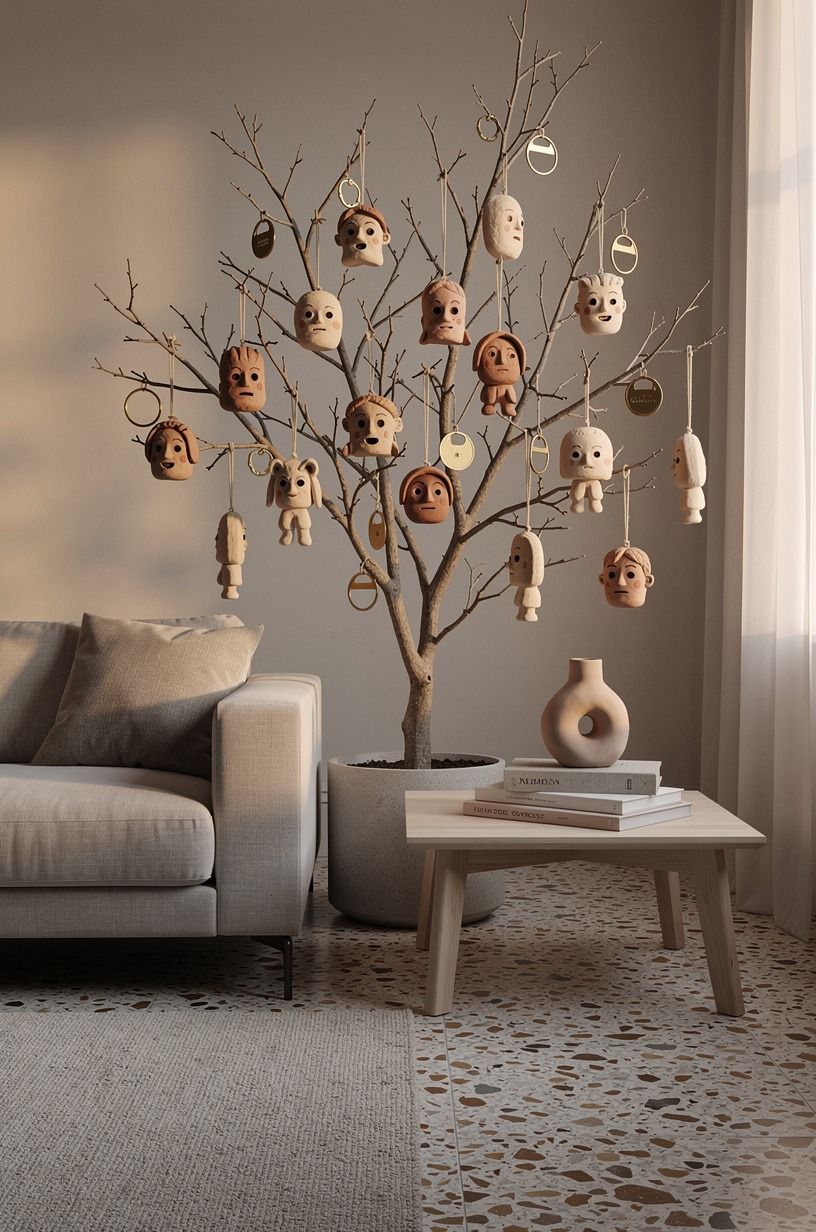
A simple face works best when your ghost is far from the path. Use two narrow eyes and a small mouth in clay-colored fabric paint, with space between each mark so the wind can bend the cloth.
You want the expression to read in a blink, not become a cartoon sign. I skip elaborate features because they turn muddy after dark.
For a nearby porch figure, soften the backdrop with Farrow & Ball Setting Plaster No.231 and an oversized-chip terrazzo ledge. Keep the cheesecloth face nearly blank.
If you’re painting a prop, test it beside the actual tree at dusk. Colors shift fast under green leaves, and your eye will thank you for restraint.
Bright white can feel harsh against bark, so a Benjamin Moore White Dove OC-17 panel gives the face a gentler field without competing with the ghost. And if you’re tempted to add glitter, don’t; it flashes in every gust and steals attention from the moving edge!

8Tear the Cheesecloth Edge for an Organic Ghost Silhouette

Cutting a neat rectangle is the fastest way to make your ghost look like a table cover. Tear the lower edge by hand so the strands finish in uneven wisps, then pull out a few long threads near the corners. Frayed cotton cheesecloth catches a side breeze in tiny ripples, and you’ll get movement without adding more fabric.
I once trimmed every edge with scissors because I wanted control. It looked tidy, flat, and oddly expensive in the wrong way. Your eye reads the irregular edge as age, especially when a hand-applied Venetian plaster wall behind it gives the ghost something firm to push against.
Don’t make the tear identical on both sides.
Keep the strongest fabric at the shoulders, where your knots pull. A soft plum mohair velvet ribbon around a nearby chair can echo the ghost’s drape, but skip a velvet bow on the tree. Rain and dust will turn it dull.
If you’re collecting fall textures, our velvet throw story has more ideas for layering softness without stuffing the porch.
9Build a Porch-to-Tree Story With the Three-Point Welcome
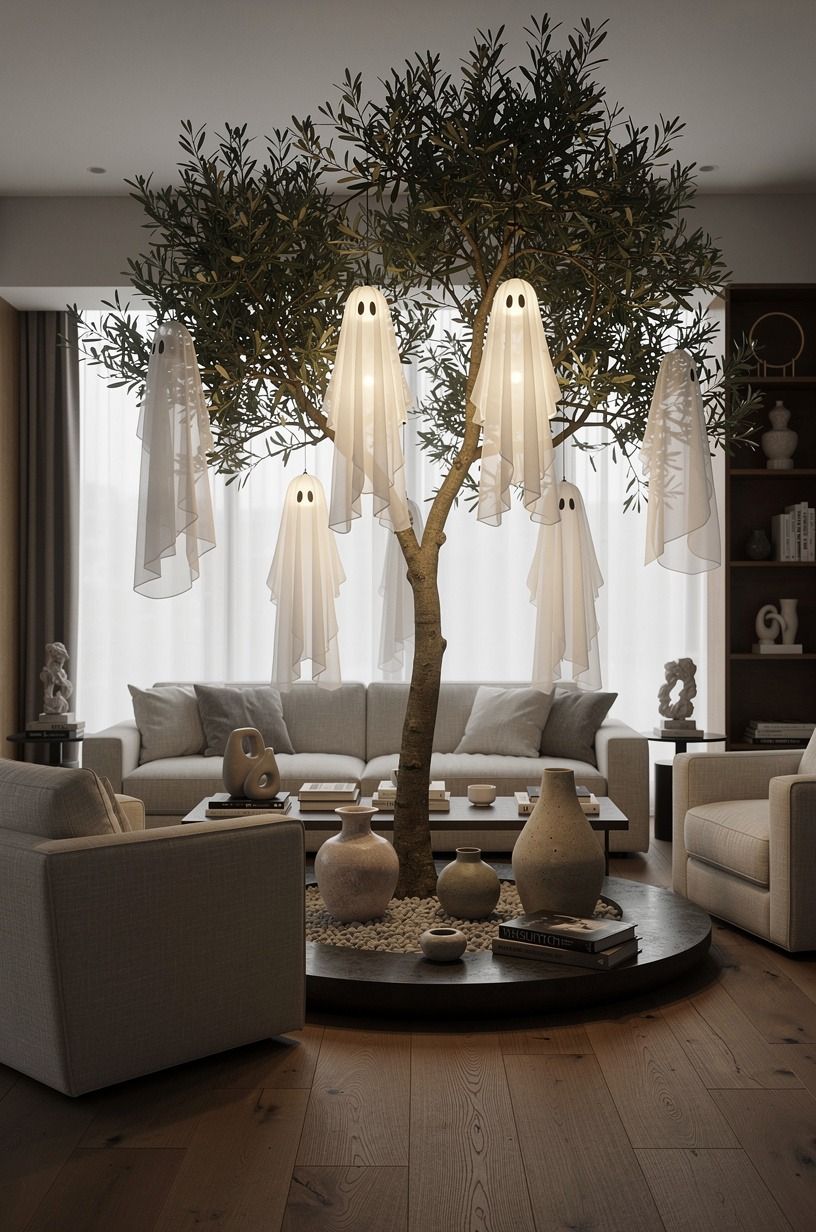
Think of the tree and porch as one scene, not two separate decorations.
10Mix White, Smoke, and Shadow With Benjamin Moore White Dove
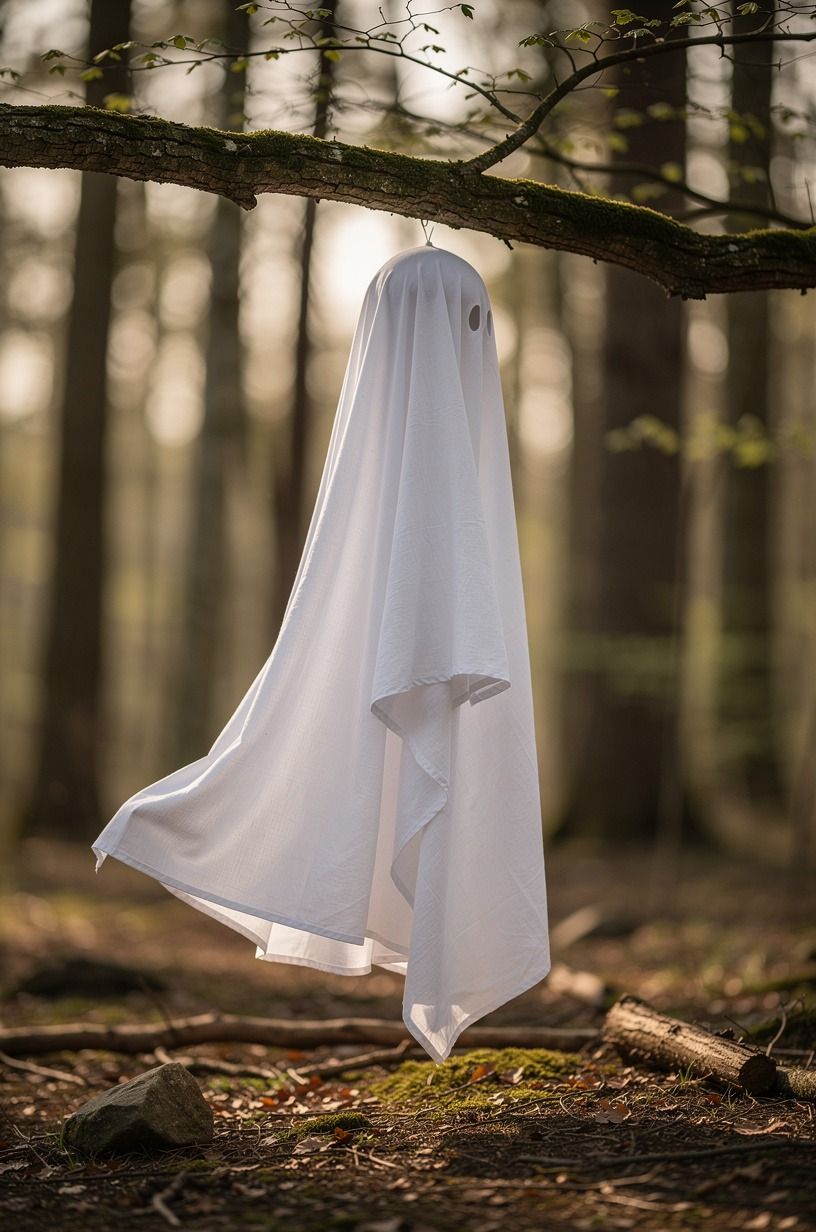
White cheesecloth disappears against a pale house, so give your display a richer field. Farrow & Ball Studio Green on a porch panel, fence board, or removable backdrop pulls the ghost forward without making the yard gloomy.
You’ll notice the fabric’s weave first, then the face. That’s exactly the order you want.
Pair that green with Benjamin Moore White Dove OC-17 on a small sign or planter, then add one aged-brass accent rather than painting every surface. I went back and forth on layering green, but a muted note behaves better beside brown bark. Your space will feel calming and earthy, while the white figure keeps enough contrast to read from the sidewalk.
Keep the shadow honest. A washed Belgian linen backdrop looks more convincing than glossy black plastic, and its soft cream tone won’t reflect a porch bulb into a guest’s eyes.
If you’re decorating a rental, hang the panel from a tension rod so your wall stays untouched. The result feels warm, not overworked.
11Keep the Face Sideways When the Wind Picks Up
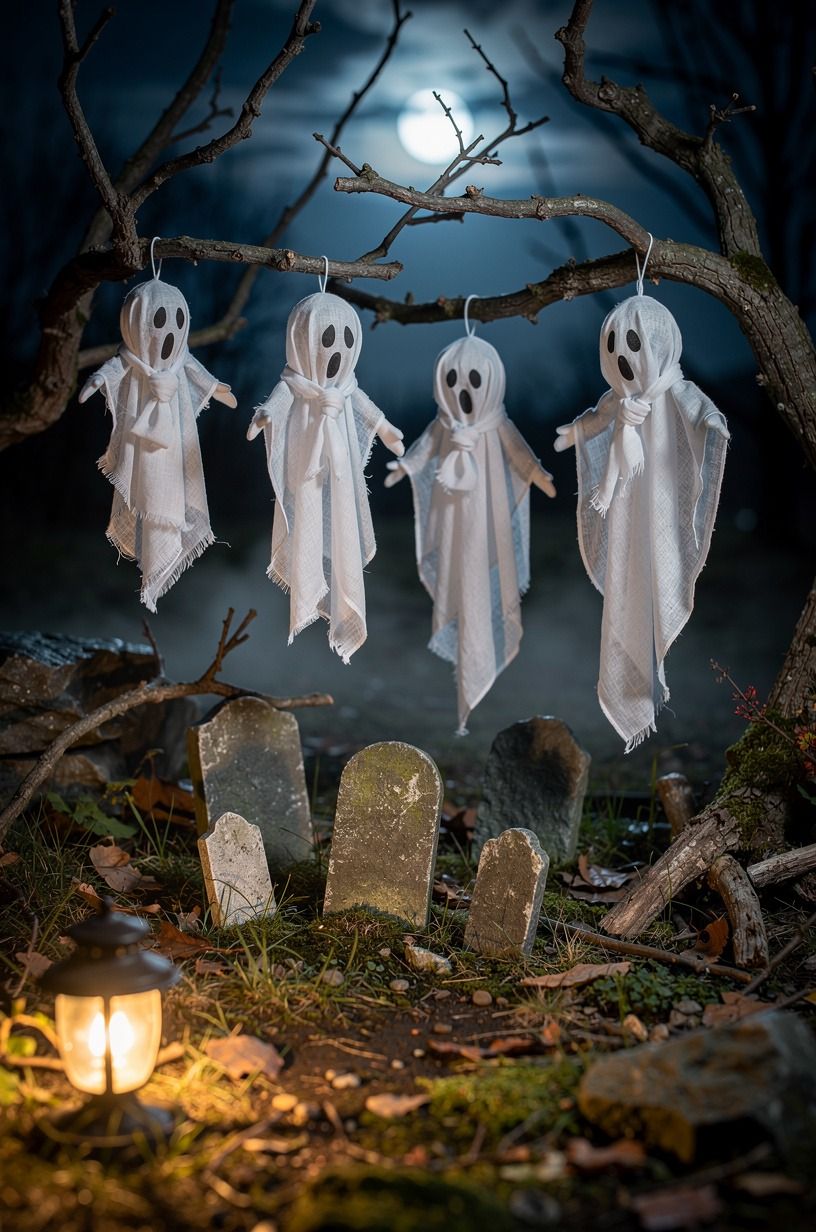
Wind rarely hits a tree straight on, so turn the ghost face slightly across the prevailing breeze.
12Choose a Grounded Mini Graveyard Instead of More Hanging Ghosts
When the canopy is already busy, ground the lower half with a tiny graveyard instead of hanging another figure. Use Nero Marquina black marble with white veins for one believable marker, a crooked stick, and a patch of charcoal cloth. Your upper ghosts will feel taller because the eye gets a quiet pause below them.
I’d skip plastic tombstone rows here. They read flat in daylight and crowd the roots, while one rough surface gives your arrangement a little history.
If you’re using a rental-friendly mat, tuck the edge under a planter rather than taping it to the walkway. Your guests should notice the ghost first, then the small ground story.
Store the marker and fabric together in an IKEA HEMNES drawer, away from damp branches and mulch. A label on the drawer saves you from rebuilding the whole idea next fall, and our closet decluttering method has a useful approach to keeping seasonal pieces visible. Don’t let one wet season decide the fate of good props.
13Can a Window Reflection Make Tree Ghosts Read After Dark?
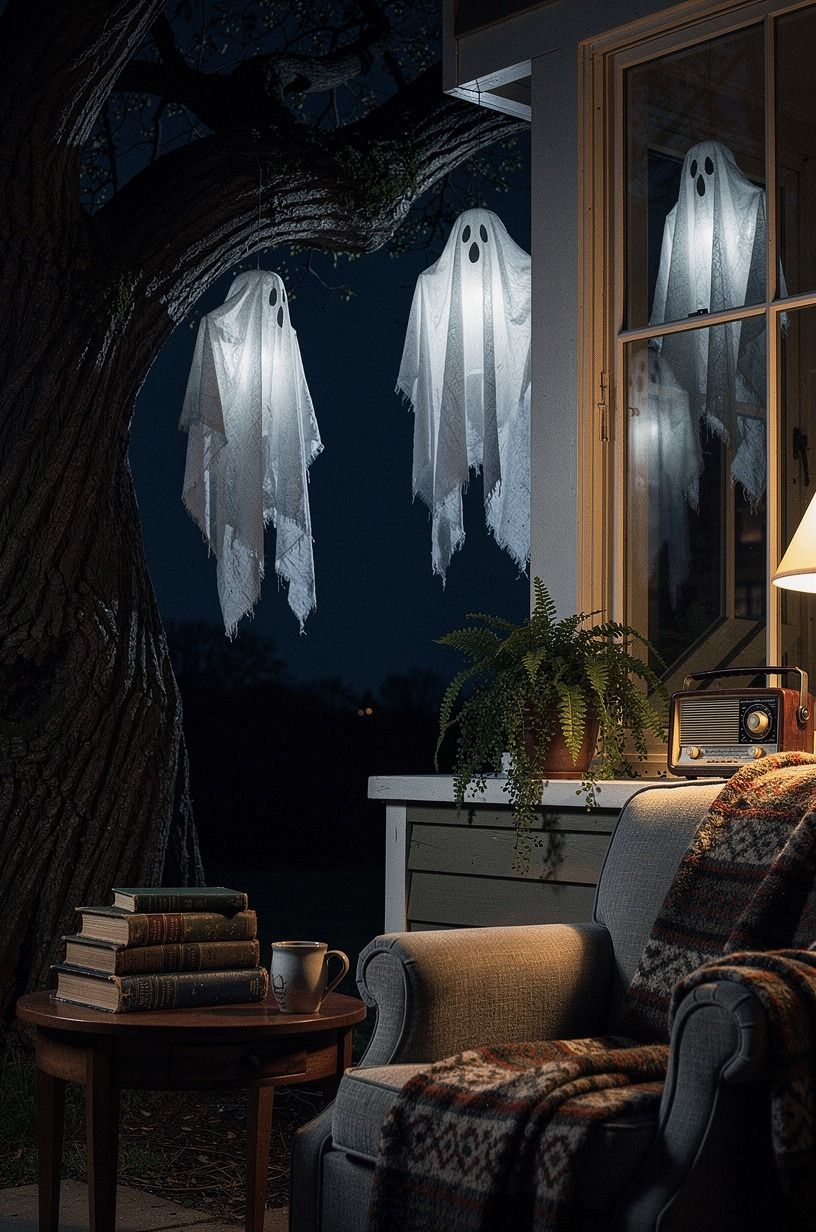
Yes, a dark window can give your outdoor ghost scene a second layer.
14Store the Props in a Fall-Ready Ghost Station
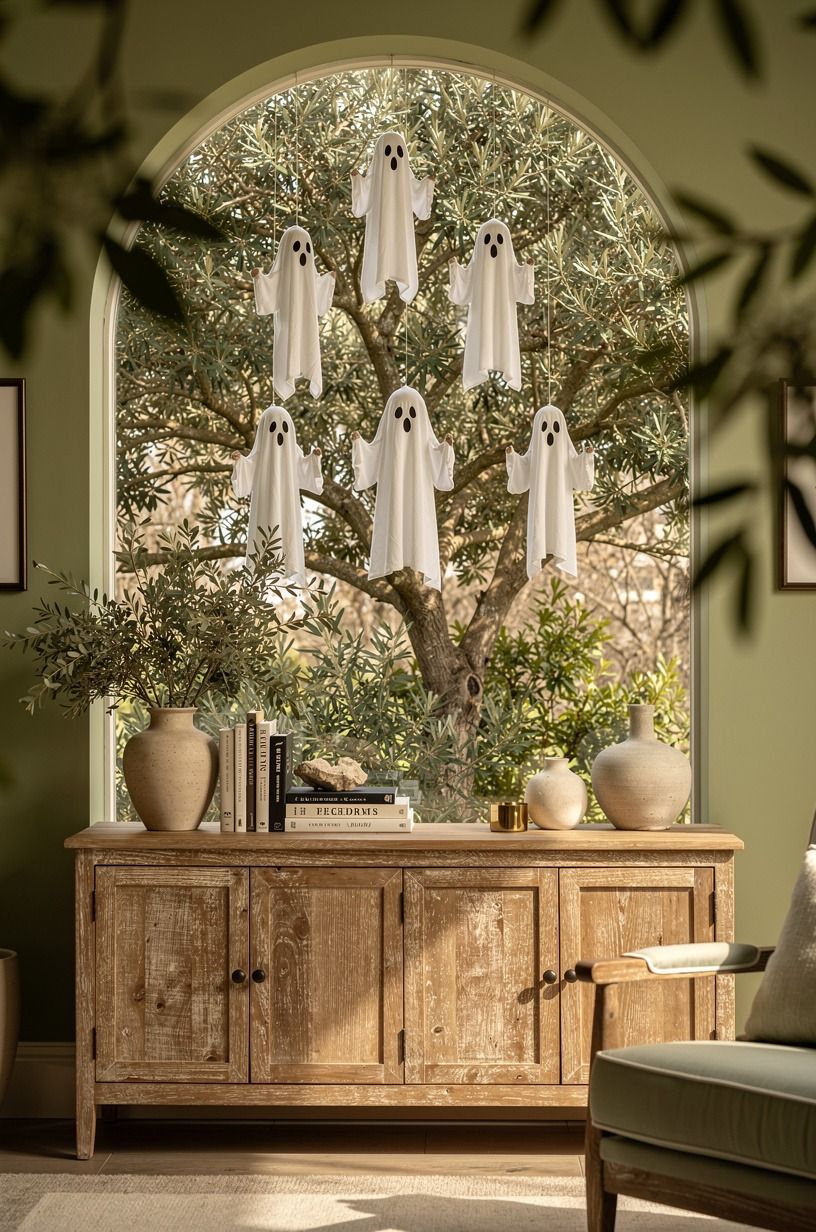
Good storage keeps a seasonal display from becoming a yearly argument with yourself. Fold dry cheesecloth loosely, tuck each face inside tissue, and keep the ivory storage cloth away from direct sun. Your fabric will crease less, and you won’t have to iron a ghost five minutes before guests arrive.
Use a shallow bin for cords, washers, copper clips, and the small branch forms. I like an IKEA KALLAX cube painted midnight blue with a Carrara marble tray with subtle grey veining for the visible pieces because I can see what survived the season without opening six boxes. If you’re short on room, reserve one cube and give every prop a home.
Add a note with the tree location, the best placement, and the one thing that failed. That tiny record matters.
And if you’re decluttering the rest of your seasonal closet, follow the low-stress closet reset before you buy another bin. You may find the missing hooks in a coat pocket.
15How Do You Make a Windproof Ghost Display on a Budget?
Start with the free parts: a branch, a cloudy evening, old cotton, and the shadow your yard already owns. Spend on the connections that keep your display safe, then decide whether a lantern or backdrop earns the next dollar. Weatherproof nylon cord matters more than a fancy face because a failed knot can ruin the whole scene.
These typical US room-refresh figures are broader than a small ghost DIY, but they give you a useful scale when you are planning a seasonal corner, porch furniture, or lighting alongside the display. If you’re staying lean, keep the ghosts handmade and let one strong light do the work.
Your own project can stay below that broader room budget when you reuse fabric and branches. I wouldn’t spend on matching props; spend on ballast, secure ties, and a light with a gentle spread. If you’re adding a chair, Article Sven is a named investment piece, but pairing it with reclaimed weathered teak keeps the natural-wood note grounded.
Save the money for the part guests use or notice first.
The Wind Changed My Opinion About Outdoor Ghosts
I used to think the best Halloween tree display was the one that looked crisp from the street. That idea lasted until my first ghost tore loose and landed in a hydrangea. The cloth was fine; the attachment was careless.
Since then, I judge unbleached cheesecloth by what it does in weather, not by how crisp it looks when the air is still. If your display can’t tolerate a little air, it isn’t ready for a real yard.
My second mistake was overbuilding the face. I painted wide eyes, a grin, and tiny brows on white cotton muslin, then watched them disappear into shadow.
A ghost needs a suggestion, not a portrait. You should recognize the expression for a second and then lose it as the fabric turns. That’s why I keep the marks narrow and let the branch do some of the storytelling.
I also bought more light than I needed. A floodlight made the tree look flat, while one warm-white LED strand around the limb left the bark, leaves, and cheesecloth with different depths. Your eye wants somewhere to rest.
If you’re tempted to brighten every corner, turn one light off first. The yard usually becomes more inviting, not less.
My strong opinion is simple: spend your patience on the hem and your money on reliable cord. I wouldn’t chase elaborate props, printed signs, or a matching ghost family. Weather-resistant cotton rope and a hidden weight will outlast a decorative flourish, and you’ll notice that every time a gust rolls through without a repair.
The display works because it has a little uncertainty in it. The face is incomplete, the body shifts, and the shadow doesn’t land in the same place twice.
Your job isn’t to control every inch. It’s to give the wind a safe range, then let the tree finish the story.
That balance is what makes the display feel warm, moody, and lived-in.
The Questions Worth Answering First
What cheesecloth works best for small hanging ghosts?
Loose-weave, unbleached cotton cheesecloth is the best choice because it moves without becoming heavy. Choose soft open-weave cotton for a gentle silhouette, and add a hidden hem weight. You’ll get better motion than you would from stiff craft fabric, especially beneath leafy branches.
Where can I buy budget ghost supplies?
Look at IKEA, Wayfair, Target, Facebook Marketplace, and local thrift shops for cloth, lanterns, baskets, and hooks. A Target Threshold lantern can anchor the display without custom work.
This site uses display ads and doesn’t earn commissions from those product mentions. Our small-space guide can help with placement.
How much does a hanging ghost makeover cost?
A small display costs about $100 to $300 when you buy fabric, cord, ballast, and safe lighting. Branches, leaves, and existing containers are free. If you already own the base materials, it’s possible to spend far less and still create a warm, inviting scene.
Can I create a hanging ghost display on a budget?
Yes, and you can start with scrap cotton fabric, reused branches, and stones from your yard. Tie two support points, tear the hem, and use one safe LED source. For more low-cost glow ideas, see these natural candle-lighting sources.
Is this worth it in a small space?
Yes, it’s worth it because vertical movement uses the air above your furniture and path. Choose vertical hanging space over a crowded ground display, then keep one clear walking line. A single tree branch can create a dreamy, calming focal point without taking floor area.
Is this a good idea for a rental?
Yes, it’s rental-friendly when you keep the tree display freestanding and use removable hardware indoors. A removable tension rod can support a backdrop, while peel-and-stick hooks handle lightweight cloth. Your lease stays safe, and our seasonal closet reset can hold the props afterward.
How do I keep cheesecloth ghosts from blowing away?
Use the pebble-pocket hem, two support points, and a little slack at the shoulder. The figure should pivot instead of pulling against one knot.
If the wind rises, lower the ghost or bring it inside. You won’t need bulky visible weights when the ballast sits inside the fold.
Where I’d Start First
If I had to pick one, I’d start with the pebble-pocket hem. It keeps the cloth moving without letting a gust turn your ghost into a flag, and it costs no visual bulk. Pin the pebble-pocket method for later and save our small-space layout guide too.