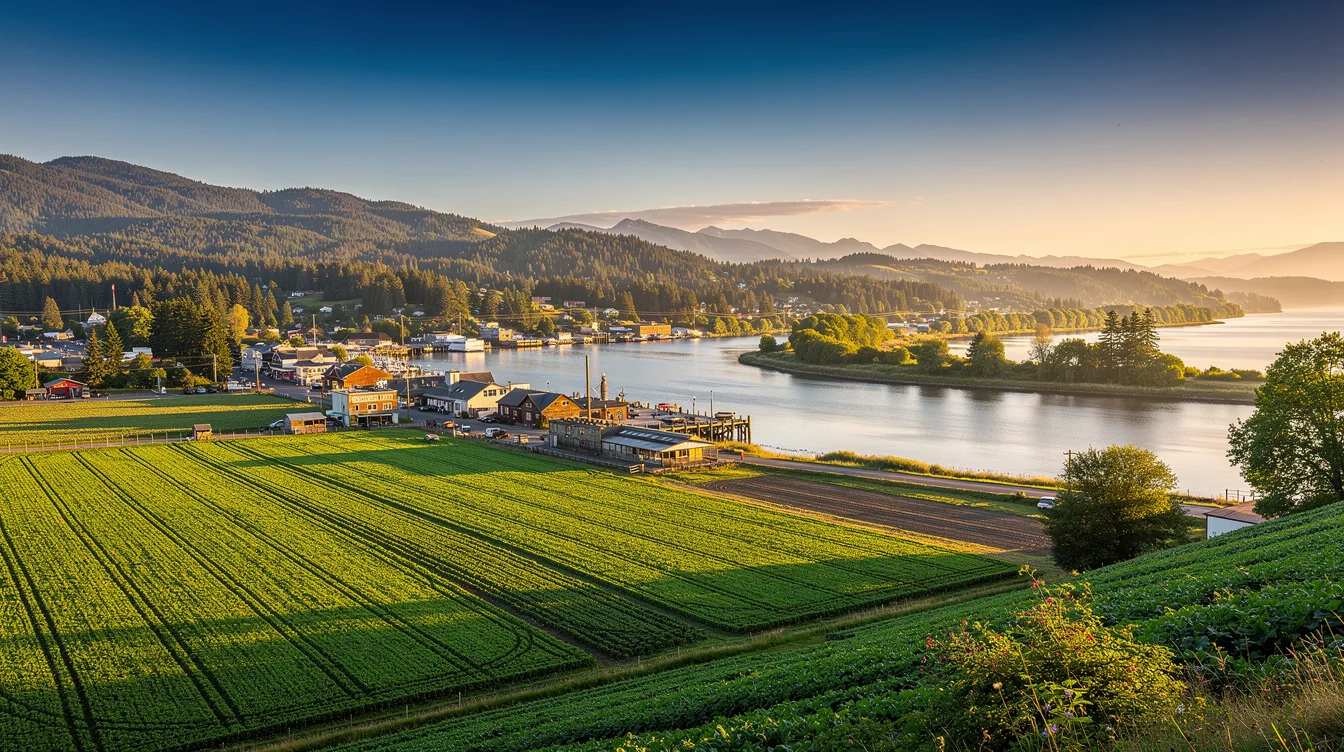
La Conner sits at the edge of the Skagit Valley, presented as the world’s largest tulip-growing region. The annual festival fills April with color, but the town itself gives the spectacle somewhere to slow down.
And that’s the appeal: fields outside town, boats along the Swinomish Channel, and a historic center compact enough to explore on foot. With 965 residents at the 2020 census, La Conner feels lived-in rather than manufactured for visitors.
But spring is busy, and roads and accommodations can fill quickly. Visit then for the flowers, or come later when the waterfront smells of salt and wet wood.
Why 1867 still shapes the waterfront
La Conner began as a trading post in 1867, when its position along the channel made a safe harbor for ships. The old center remains a historic district, with wooden buildings, independent shops, restaurants, inns, and galleries around First Street.
And the water is still the town’s best stage. Walk the waterfront and you’ll see small marinas, working docks, and the orange arch of Rainbow Bridge connecting La Conner with Fidalgo Island.
But this isn’t a place built around constant activity. My opinion is that La Conner works best when you leave room for a slow lunch, a gallery stop, and a few minutes watching boats turn with the tide.
What April changes in Skagit Valley
The Skagit Valley Tulip Festival runs throughout April, while the exact peak depends on the weather. Daffodils and tulips begin the seasonal show in March and April, making La Conner a practical base for exploring fields beyond the town.
And the contrast is sharp: the village stays calm in theory, while festival traffic can make nearby roads and lodging feel crowded. If you come for the flowers, start early and use La Conner as your pause between field visits.
But the town isn’t merely a flower-season stop. You can return to galleries and the channel when the afternoon crowds build.
Three museums give the town its texture
La Conner’s cultural life is concentrated but substantial. The Museum of Northwest Art, the La Conner Quilt & Textile Museum, and the Skagit County Historical Museum each offer a different reason to step indoors.
And the Museum of Northwest Art focuses on artists from the Pacific Northwest, while the quilt museum occupies one of the town’s oldest homes. The historical museum is prized for its view, so you get context and a window onto the water.
But don’t expect a major-city museum circuit. My take is that you should choose one or two visits, then spend the rest of the afternoon outside with coffee, gallery windows, and the channel moving quietly below.
Can you visit beyond tulip season?
Yes, and May through September is arguably the easier time to enjoy La Conner. Walks, kayaking, boating, restaurants, and municipal moorage all make sense when the weather supports time outdoors.
And from October through April, migrating trumpeter swans and snow geese bring a different rhythm to the surrounding area. The air turns cooler and wetter, but birdwatching feels more spacious once the flower crowds have gone.
But you should choose the season around your priorities. Use the Washington travel guide for a broader route from Seattle or Vancouver, then make La Conner the quiet stop where the road meets the water.
La Conner is close to I-5 without sitting directly on the highway, which makes it useful for a Seattle-to-Vancouver itinerary. It also works as an extension toward Deception Pass or the San Juan Islands.
And the town’s strongest moments are simple: the Rainbow Bridge above the channel, old houses catching late light, and the soft clatter of boats against the docks. By evening, the last color leaves the water before it leaves the fields.