“`html
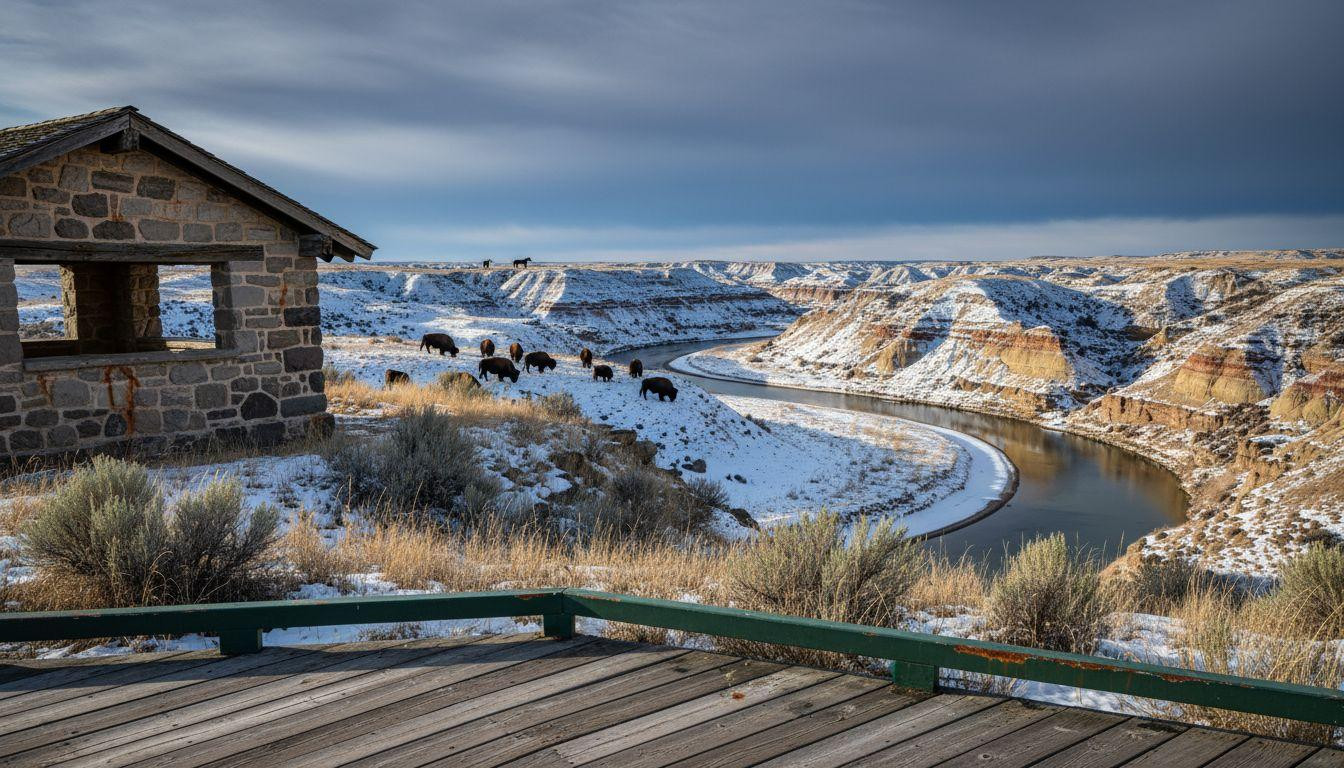
Badlands National Park pulls 1.1 million visitors annually to South Dakota’s striped walls. Most drive the 30-mile loop, wait for parking at Notch Trail, and pay $250 a night in Wall. 150 miles north, Theodore Roosevelt’s North Unit delivers the same geological drama to fewer than 100,000 people. River Bend Overlook sits at the end of a 14-mile drive where bison cross empty roads and wild horses appear against snow.
Why Badlands National Park lost its quiet
Summer crowds at Badlands peak between June and August. The park logged 1.1 million visits in recent counts. Parking fills by 9am at popular trailheads.
Wall, South Dakota charges $200-250 per night for basic hotels during high season. The scenic loop runs 30 miles but traffic slows at every pullout. Heat limits hiking to early morning or late evening.
Notch Trail requires ladders and draws lines of tourists by mid-morning. The famous Badlands Wall photograph appears on 10,000 Instagram posts daily. What was remote prairie 20 years ago now runs shuttle buses in summer.
Meet Theodore Roosevelt’s North Unit
The North Unit of Theodore Roosevelt National Park protects 24,070 acres of badlands along the Little Missouri River. The entrance sits 15 miles south of Watford City, North Dakota. Population: 6,500.
The landscape Badlands wishes it still had
River Bend Overlook anchors the park’s 14-mile scenic drive. The viewpoint sits at 2,000 feet elevation. Below, the Little Missouri curves through layered bluffs in red, gold, and gray.
The drive climbs gradually from prairie floor to mesa top. Oxbow Overlook shows the river’s horseshoe bends. Caprock Coulee displays striped cliff faces. Cannonball concretions, spherical rocks up to 3 feet wide, dot the hillsides like scattered marbles.
For a similar experience further east, this Maine pond freezes turquoise where twin peaks mirror through April ice offers another winter landscape escape.
What $110 buys versus Badlands’ $250
Watford City hotels range from $80-120 per night in 2025. That’s 40-50% below Wall’s summer rates. Park entry costs $30 for seven days, valid for both North and South Units.
The scenic drive requires no reservations or timed entry. Roads stay paved except one short gravel section. RVs and cars share the route without shuttle requirements.
Camping inside the park runs $14-30 per night. The park offers 127 campsites total, more than Badlands’ 118. Most North Unit sites sit empty even in July.
The experience that crowds erase
Theodore Roosevelt National Park recorded 732,951 total visitors in 2024. The North Unit sees roughly 20% of that traffic. Congestion scores rate it 6.6 out of 10 versus Badlands’ 6.9.
Wildlife on winter terms
Bison herds winter in the badlands. Dark shapes move across white hillsides between December and March. Wild horses gather on ridges where wind clears the snow.
The park stays open year-round but winter roads require checks. Call 701-623-4466 for current conditions. Snow and ice close sections temporarily but rarely for more than a few days.
Dark skies stretch unbroken above the overlooks. No towns glow on the horizon. The Milky Way appears clearly from April through October. Winter brings the clearest nights when temperatures drop below 10°F.
Travelers seeking more Midwest solitude can explore this Missouri spring that pumps 210 million gallons daily through a ravine that stays empty.
Overlooks you’ll have to yourself
River Bend Overlook draws the most visitors but rarely fills. The viewing shelter built by the Civilian Conservation Corps sits empty most mornings. Sunrise lights the canyon walls from 6am in summer, 7:30am in winter.
Oxbow Overlook sits 3 miles before River Bend. The pullout fits six cars. Most days, none are there. The river makes a perfect U-turn 400 feet below.
Caprock Coulee Nature Trail runs 0.8 miles through colorful badlands. The trailhead parking holds 10 vehicles. I walked it on a July afternoon and saw two other people. The path winds between clay formations striped like layer cake.
Practical details Badlands can’t match
Watford City sits 20 minutes from the North Unit entrance. Gas stations, grocery stores, and restaurants line Highway 85. The town serves oil workers and ranchers, not tourists. Prices stay local.
The scenic drive takes 90 minutes round-trip at a steady pace. Most visitors spend 2-3 hours stopping at overlooks. Cell coverage works at the entrance and visitor center but fades along the drive.
Best visiting windows run September through November and March through May. September brings warm days around 70°F and golden prairie grass. May delivers green hillsides and newborn bison calves. Both months avoid summer heat and winter ice.
The visitor center opens seasonally with rangers available for trail maps and road updates. Restrooms operate year-round at the entrance. No food services exist inside the park. Bring water and snacks from Watford City.
For comparison, Better than Badlands where 1M tourists cost $250 and this plateau keeps bison herds for $110 offers the original analysis of this quieter alternative.
Your questions about North Unit overlooks answered
When do roads close in winter?
The North Unit scenic drive stays open all year but snow and ice cause temporary closures. Heavy storms in December through February can shut roads for 2-5 days. March and November see occasional closures lasting hours. Always check current conditions at 701-623-4466 before driving from Watford City. Most winter days allow access with careful driving.
Why do so few people visit compared to Badlands?
Distance explains most of the gap. Badlands sits 60 miles from Rapid City, a regional hub. The North Unit requires driving through rural North Dakota with no nearby cities. Interstate 94 passes 50 miles south but most tourists stay on the highway. The park’s split into three units also confuses visitors who assume the South Unit near Medora offers everything.
How does this compare to other shoulder-season parks?
Theodore Roosevelt’s North Unit offers similar advantages to 5 alpine lakes where April snowmelt turns Rocky Mountain water emerald before crowds. Both deliver peak scenery before summer traffic. The North Unit adds wildlife and badlands geology. Alpine lakes offer mountain reflections and wildflowers. Costs run comparable at $80-120 per night nearby. The North Unit wins for solitude. Alpine lakes win for hiking variety.
The overlook at River Bend sits empty most afternoons. Wind moves through sagebrush below the viewing deck. The Little Missouri curves through striped bluffs that haven’t changed since Theodore Roosevelt rode here in 1883. No shuttles arrive. No crowds gather. Just badlands and silence stretching to the horizon.
“`