The parking lot off Highway 19 holds maybe eight cars. At 7am on a Saturday in late April, three spaces are taken. Mist rises from the valley below, thick enough to blur the trailhead sign. You can hear the spring before you see it. A low roar that grows louder with every switchback down.
Greer Spring pumps 210 million gallons daily into the Eleven Point River. That makes it Missouri’s second-largest spring. The hike is 1 mile downhill through Mark Twain National Forest. Most visitors to the Ozarks never hear about it.
Where the underground river surfaces
The trail drops through oak and hickory forest. Benches appear every quarter mile. The gradient stays gentle until the final descent, where wooden steps lead into a ravine 250 feet below the parking lot.
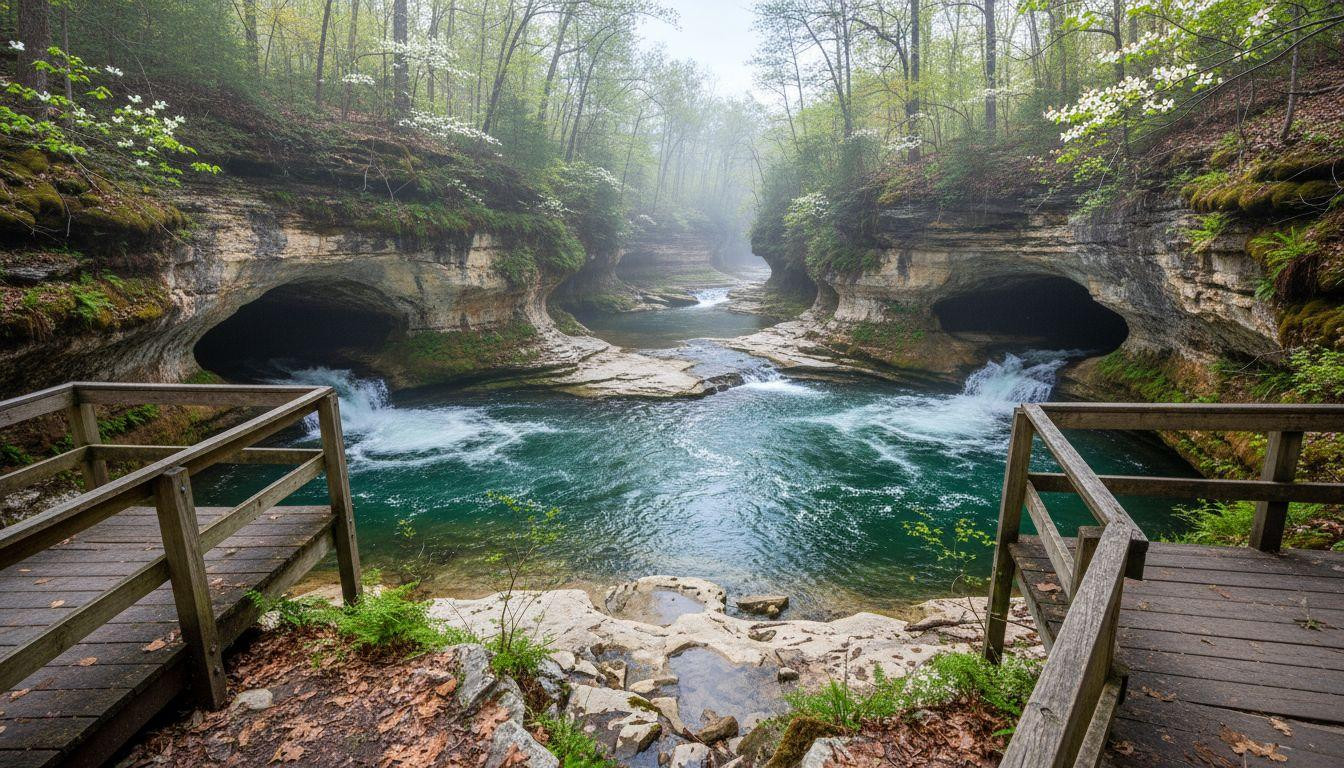
Two outlets emerge from cave-like openings in moss-covered rock faces. The water gushes from darkness into daylight, clear and cold at 58°F year-round. The outlets sit 250 feet apart. Between them, the spring branch forms pools over limestone bedrock before tumbling toward the river.
The water travels underground from sinkholes in the Ozark plateau. It surfaces here with enough force to double the Eleven Point’s size in 1.25 miles. Stand at the lower platform and you can see both outlets. The roar drowns out birdsong.
The ravine nobody talks about
Moss and mist in permanent shade
The ravine walls rise vertical on three sides. Moss grows thick on every surface the sun never touches. In April, dogwoods bloom white against the green. The air stays 10 degrees cooler than the forest above.
Mist forms where cold spring water hits warmer air. It hangs in layers through mid-morning. The light filters green through the canopy. By noon the mist burns off, but the shade holds.
Forest that keeps its distance
Mark Twain National Forest surrounds the spring with 1.4 million acres of oak-hickory-pine. The Eleven Point River runs 44 miles as a National Wild and Scenic River. No development crowds the spring. A vault toilet at the trailhead is the only facility.
The Forest Service maintains the trail but keeps infrastructure minimal. No gift shop. No paved paths. Just gravel parking and a dirt trail that gets muddy after rain. The wilderness designation protects this.
What you actually do here
The descent most people skip
The 1-mile trail takes 30 minutes down. Coming back up takes 45 to an hour if you stop at the benches. Dogs are allowed. Families with young kids manage it fine. The challenge is the return climb, not the descent.
Most hikers turn around at the upper overlook platform. They see the spring from above and head back. Walk the extra 200 feet to the lower platform and you stand at water level. You can follow the spring branch upstream past the waterfall to the cave outlets. Watch your footing on wet rocks.
No swimming or wading allowed. The spring feeds the Eleven Point’s trout population. Float trips launch from Greer Crossing 2 miles downstream, but kayaking the spring branch itself is prohibited.
Where locals go instead
Greer Crossing Recreation Area sits 2 miles north on Highway 19. Campsites run $10 to $20 per night. The Eleven Point River here is shallow enough to wade in summer. Canoe rentals operate from the crossing during float season.
West Plains, 40 miles east, has motels and diners. The town serves as base camp for exploring this section of the Ozarks. Most visitors to Missouri head to developed springs with easier access. Greer stays quiet because Highway 19 filters out casual tourists.
The spring that stays unknown
Big Spring State Park near Van Buren draws thousands of visitors. It pumps 286 million gallons daily. Paved paths lead to overlooks. A lodge and cabins sit on 3,000 acres. Tour buses arrive in summer.
Greer Spring pumps 76 million gallons less per day. The difference in crowds is greater than the difference in flow. On a busy weekend, maybe 30 people hike to Greer. Big Spring sees that many before 9am.
The Ozark Trail passes 29 miles of wilderness near here. Backpackers use Greer as a water source. Day hikers come for the dogwood blooms in April or the golden leaves in October. The trail stays empty compared to Arkansas waterfalls across the state line.
Your questions about Greer Spring answered
When does the spring flow strongest?
The flow stays constant at 210 million gallons daily year-round. Karst aquifer systems like this maintain steady discharge regardless of surface rainfall. Visit in April or October for wildflowers and fall color. Avoid July and August when humidity and ticks peak.
Can you camp near the spring?
No camping at the trailhead. Greer Crossing Recreation Area 2 miles north offers developed sites with vault toilets. The Ozark Trail allows dispersed camping 100 feet from the trail. Backpackers use this section for multi-day trips through Mark Twain National Forest.
How does this compare to other Missouri springs?
Big Spring ranks first in Missouri at 286 million gallons daily. Greer ranks second at 210 million. Rainbow Spring comes third. Big Spring has paved access and heavy visitation like popular desert canyons. Greer requires a 1-mile hike and sees a fraction of the crowds. The wilderness setting is the trade for harder access.
The mist clears by 10am. The spring keeps roaring. Three more cars pull into the lot. You pass them on the way up, still fresh, heading down. They have the ravine to themselves for maybe an hour.