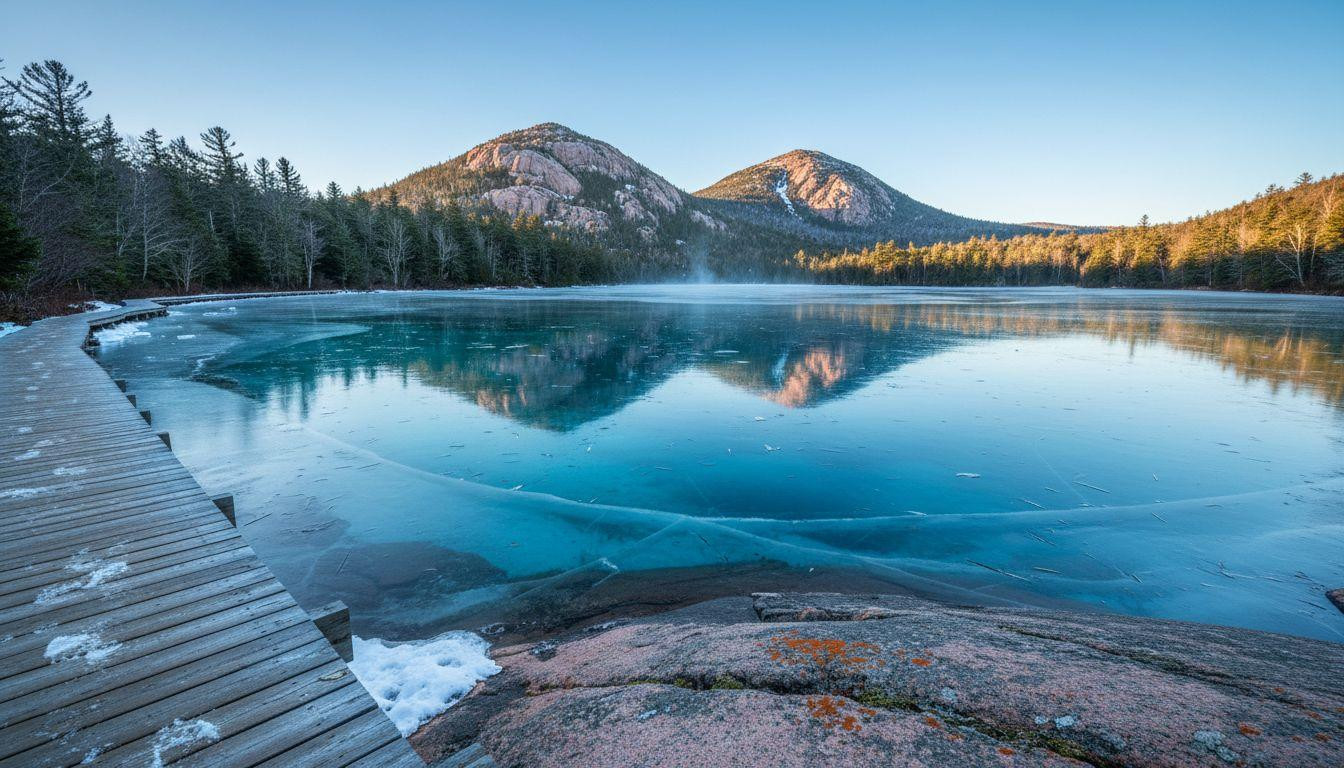
The pond freezes white in January. By late March the ice turns turquoise. Stand at the south shore boardwalk at 6:47am and you see North and South Bubble peaks doubled in frozen glass beneath your boots. Jordan Pond in Acadia National Park holds winter until mid-April when most visitors assume the trails stay closed.
The 3.3-mile loop circles a glacially carved basin 50 feet above sea level. Pink granite cliffs frame evergreen forests. The twin Bubbles rise to 872 feet and 768 feet on the north shore. Their rounded domes reflect in water so clear you count pebbles six feet down through summer surface. In winter that clarity locks into ice the color of tropical shallows.
Where frozen mirrors form
Jordan Pond sits on Mount Desert Island five miles south of Bar Harbor. Route 3 leads to Seal Harbor then Jordan Pond Road. The Park Service plows this section year-round to the south parking lot near Jordan Pond House. Most visitors skip Acadia between December and April assuming access closes. The road stays open. The lot stays empty.
Park entry costs $35 for seven days in 2026. Hancock County Airport sits 45 minutes away with flights from Boston around $250 round-trip. Bangor International runs cheaper at $150 but adds an hour of driving. The trailhead starts at the parking lot. No shuttle runs off-season. Bring snowshoes if visiting before mid-April.
The loop follows flat shoreline most of the way. East side runs gravel. West side uses a kilometer-long boardwalk built in the 1930s as part of John D. Rockefeller Jr.’s carriage road system. The boardwalk protects fragile marsh soils and keeps boots dry when spring melt turns the path to mud. In winter it creaks under snow.
The turquoise ice season
Ice forms in January. By late March the surface shows bands of white and turquoise where depth and glacial silt create color gradients. The Bubbles rise behind the frozen pond like sentinels. On calm mornings before wind textures the ice the peaks mirror perfectly in the surface. Photographers arrive at dawn for this shot.
Regional ice-out data from nearby lakes suggests Jordan Pond breaks up between April 10 and April 20 most years. Crystal Pond opened April 6 in 2026. Hopkins Pond went April 4. Jordan Pond typically follows within two weeks. The window for frozen turquoise reflections runs narrow. Miss it and you wait another year.
What the ice reveals
The pond formed when glaciers carved this valley 12,000 years ago. The same ice deposited Bubble Rock on South Bubble summit. That white granite erratic weighs 400 tons and came from Dedham 20 miles away. It perches on pink granite that formed here millions of years earlier. The contrast shows in the cliffs ringing the pond.
Water clarity comes from the glacial basin and mountain watershed. No major streams muddy the inflow. Depth reaches 150 feet in spots. When ice forms clear you see stones and logs beneath the surface near shore. The turquoise appears where sunlight penetrates deep ice over darker water. Similar to Opal Creek’s spring-fed pools but frozen solid.
Winter silence
Acadia draws four million visitors annually. Most arrive June through October. Winter sees fewer than 50,000 total. Jordan Pond Loop gets maybe 20 hikers on a good April morning. The boardwalk stays empty. No voices carry across the ice. Just wind through evergreens and occasional cracks as the surface shifts.
The quiet matters. Summer brings families and tour groups. The parking lot fills by 9am. Hikers pass every few minutes. In April you walk alone. The Bubbles reflect undisturbed. You hear your own breathing. For those seeking solitude similar to Echo Bay’s frozen wilderness this delivers without permit systems.
Walking the frozen shore
Start clockwise from the south lot. The east shore climbs over small granite outcrops. Nothing steep but ice makes footing tricky. Microspikes help. The trail gains maybe 50 feet total. Views open north to the Bubbles and west across the pond to Penobscot Mountain.
The boardwalk section begins halfway around on the west shore. Snow drifts pile here in sheltered spots. The wooden planks ice over. Walk slowly. Poles provide balance. This section takes 20 minutes in winter versus 10 in summer. The marsh beneath stays frozen. Reeds poke through snow along the edges.
What to do here
The loop takes 1.5 to 2 hours with stops for photos. South Bubble Trail branches off the east shore. That side trail climbs 0.6 miles and 400 feet to Bubble Rock. The summit offers views back down to the frozen pond. The climb runs steep. Snow covers roots and rocks. Snowshoes or traction devices required.
Jordan Pond House sits at the trailhead but closes for winter. Reopening happens in May. No popovers until then. The nearest food comes from Bar Harbor five miles north. Lodging there runs $150 to $250 per night in April. Prices drop 30 percent from summer peaks. The Maples Inn offers winter packages. Most restaurants stay open year-round.
April timing matters
Ice breaks early to mid-April most years. Once thaw starts the turquoise fades fast. Open water returns within days. The transition window lasts maybe a week. Check conditions before driving out. The Park Service posts updates but not daily ice reports. Local forums and recent visitor photos provide better real-time data.
Mud season follows ice-out. The boardwalk saves the west shore but east side trails turn sloppy. Late April through early May sees fewer visitors than any other time. The trade-off between ice clarity and trail conditions creates a narrow optimal window. Target the first two weeks of April for best chances at frozen reflections without deep snow drifts.
Peace before crowds return
The Bubbles looked the same when Rockefeller funded the carriage roads in 1930. The ice forms and melts on the same schedule. Acadia became a national park in 1919. Visitors came then too but in smaller numbers. The postwar boom brought millions. Summer now means traffic jams on Park Loop Road.
April offers what summer cannot. Space. Silence. The chance to stand on a frozen pond at dawn with no one else in sight. The Bubbles reflect in ice that will vanish in two weeks. You watch pink light climb the granite peaks. The moment feels unhurried. No schedule. No crowds pushing from behind. Just cold air and turquoise ice and twin mountains doubled in glass.
Similar to Carolina beaches wrapped in morning fog the emptiness creates the experience. The pond itself stays beautiful year-round. The solitude makes it memorable. That combination exists only in shoulder seasons. By Memorial Day the parking lot fills. The magic requires winter’s tail end.
Your questions about Jordan Pond’s frozen season answered
Can you walk on the ice?
The Park Service discourages walking on Jordan Pond ice. Thickness varies across the surface. Edges near shore may measure six inches while center sections stay thin. No official skating happens here. Stick to the shoreline trail. The boardwalk provides safe views of ice formations without risk. If the surface looks wet or shows dark patches stay off completely.
How does April compare to summer?
July brings 90 percent more visitors than April. Water temperature hits 72 degrees by August versus 45 degrees during ice-out. No boat shuttle runs in spring. Jordan Pond House stays closed until May. The trade gives solitude for services. Most visitors prefer summer warmth. Those seeking quiet accept cold and limited facilities. Similar to Acadia’s Cadillac Summit in winter the season defines the experience.
What gear do you need?
Snowshoes help before mid-April when drifts cover the trail. Bar Harbor shops rent them for $20 per day. Microspikes work for icy sections. Poles provide balance on the boardwalk. Layers matter more than heavy coats. Morning temps run 25 to 35 degrees. Afternoon sun warms to 50. Waterproof boots keep feet dry when crossing slushy patches. Bring a thermos. No facilities open at the trailhead off-season.
The ice breaks by late April. The Bubbles lose their frozen mirror. Spring mud replaces winter snow. By May the crowds return. But for two weeks in early April the pond holds turquoise glass beneath pink granite peaks. The boardwalk stays empty. The morning light turns the ice gold. You stand alone at the shore and watch mountains reflect in frozen clarity.