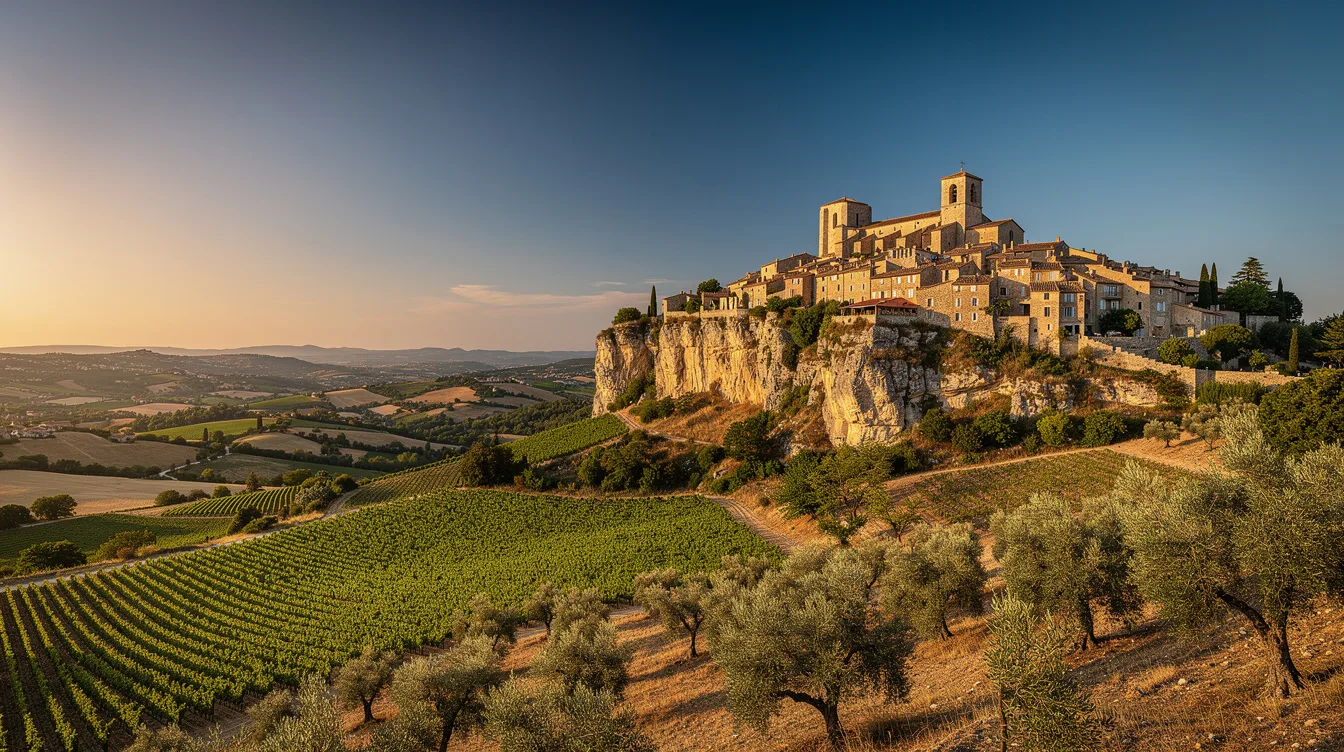
Venasque was the Comtat Venaissin’s capital in the High Middle Ages, before Carpentras took that role in 1320. That switch is the reason this hilltop village feels more substantial than its quiet lanes first suggest.
You arrive in a commune of Vaucluse, in Provence-Alpes-Côte d’Azur, about 6.8 miles southeast of Carpentras. The distance is short, but the mood changes quickly: stone walls, narrow streets, and views that pull your attention toward the valley.
A former capital that never feels grandiose
Venasque held the capital before Carpentras, and that is the story worth carrying through the village. It isn’t a place built around formal grandeur. Its appeal comes from seeing old authority reduced to human scale, with fountains and worn stone under your feet.
And the timeline is sharper than most Provençal history lessons. The Comtat Venaissin became a possession of the Holy See in 1271, then its capital moved to Carpentras in 1320. You can feel the contrast between a former center of power and today’s calm streets.
But don’t come expecting a museum district with every detail explained. Venasque asks you to look closely. That works in its favor, because the village’s strongest moments arrive between landmarks, when a wall turns a corner and the valley opens beyond it.
Stone, ramparts, and an unusually old religious site
The baptistery of Venasque is among France’s oldest religious sites, and it gives the village real weight. You should make it an early stop, before the lanes and viewpoints begin to distract you. Its age changes how you read everything around it.
Nearby, Notre-Dame de Venasque brings Romanesque heritage and older works into the same compact walk. The two sites make a convincing case that Venasque is more than a pretty pause between larger Provençal towns.
And then there are the three Saracen towers and surviving ramparts. The walls sit around the hill in varying states of repair, which is more affecting than a polished reconstruction. History here has rough edges, and you can still see them.
What the hill gives you, and what it asks back
Venasque looks over vineyards, garrigue, and cherry trees, with panoramas toward the Nesque valley, the Dentelles de Montmirail, and Mont Ventoux. The village’s raised position creates that long view, so even an ordinary stroll can turn into a stop-and-stare moment.
But the same perched setting means you should expect stone underfoot and a place best explored slowly. This isn’t a destination for rushing from one signed attraction to another. Give yourself room to wander, then pause when the light catches a fountain or a pale wall.
You’re also at the foot of Mont Ventoux, though Venasque has a softer register than a mountain-base stop might suggest. The air carries the dry, herbal feeling of garrigue. Lively enough to feel lived in, but never loud in the details provided here.
Why May and June make the strongest case
Spring, especially May and June, is the season to choose for Venasque. The cherry trees and surrounding fields give the village a fresher frame, while the views have more pull than they do in a hurried drive-by.
The cherries of the Monts de Venasque are a local specialty, and that matters because food gives this old capital a present-tense identity. You’re not only looking at stone from another era. You’re in a village tied to what grows around it.
And if your visit falls in summer, a Friday late-afternoon market adds a useful reason to linger. The trade-off is simple: spring is the more compelling season for the setting, while the market gives summer a practical draw.
Can you visit Venasque without overplanning?
Yes. Start with the baptistery and Notre-Dame, then follow the lanes toward the towers and ramparts. Because the village is only about 6.8 miles from Carpentras, it works well as a deliberate half-day rather than an exhausting expedition.
Still, don’t treat it as a checkbox. Venasque earns time precisely because its former-capital story is quiet. Papal control of the Comtat continued until the 1790s, and the papacy did not recognize France’s annexation until 1814.
By late afternoon, the village’s stone streets and distant ridges do the final work. You may leave without a dramatic finale, just the smell of dry vegetation and a view across the Nesque valley lingering longer than expected.