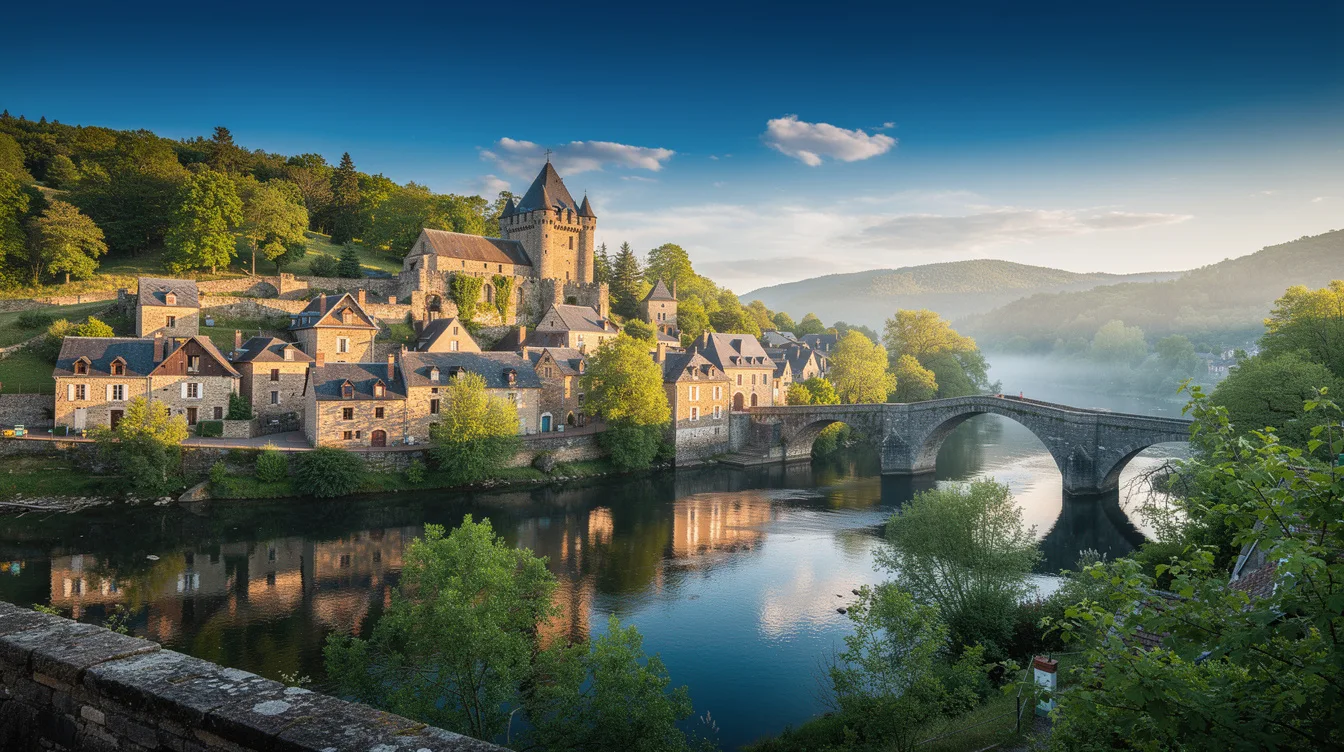
Estaing sits along France’s Camino route, where a Gothic bridge over the Lot carries UNESCO status. The village is a stop on the Via Podiensis, and the bridge is part of the UNESCO-listed Routes of Santiago de Compostela in France.
At about 15.5 miles north of Rodez, Estaing feels removed without demanding a complicated journey. Its castle rises above slate roofs, while the river gives the medieval center a clear sense of place.
The Gothic bridge explains why Estaing matters
But the bridge is more than a photogenic crossing. Its Gothic arches connect the village to a pilgrimage route recognized for its cultural history, so the first walk across it carries more weight than a quick photo stop.
And from the bridge, you get the classic view of Estaing, with stone façades leading toward the castle. The Lot runs below, adding a steady ribbon of movement beneath the old masonry.
Can you walk the Camino section?
Yes. The documented section connecting Saint-Côme-d’Olt, Espalion, and Estaing covers 10.6 miles of trail, making the village a practical stop for walkers on the GR 65.
And you don’t need to hike the full section to understand the setting. Walk the bridge, follow the riverbank, and spend time in the center before deciding how much farther your legs want to go.
But the trail is still a commitment if you’re carrying a pack. For a shorter visit, the village itself gives you the strongest concentration of heritage within an easy walking area. Read more about Estaing before building a longer route.
Look up from the river, and the castle takes over
But Estaing’s castle above the rooftops is the landmark that organizes the whole visit. It dominates the village, which means you keep finding new angles as you move through the narrow streets.
And the bridge is the best starting point for that view. The castle, slate roofs, and old stone buildings line up naturally, especially late in the day when the façades facing the Lot catch the light.
The historic center mixes medieval and Renaissance details, with stone houses and tight passages that reward slow walking. You won’t need a strict itinerary here, because the route keeps bending toward another glimpse of the river.
But don’t skip the church of Saint-Fleuret. Its relics connect Estaing to the village’s religious history and to the pilgrims who have passed through on their way toward Santiago de Compostela.
And the Renaissance former college adds another architectural stop, with a balustraded footbridge that changes the rhythm of the old center. The castle and historic center are best approached on foot.
The Lot valley makes a short visit feel longer
But Estaing isn’t a place to rush through between larger destinations. The riverbanks give you somewhere to pause, while the village’s compact streets keep the afternoon focused and manageable.
And if you like taking photographs, the Lot supplies the reason to linger. Stone walls, water, and the castle create the kind of composition that improves as the afternoon light moves across the valley.
How long should you stay?
Plan 1.5 to 3 hours for the village alone. A half-day makes more sense if you want to visit the castle, eat locally, and walk beside the river.
But there is a useful limit here: Estaing is small. You won’t find an endless run of attractions, and that’s part of its appeal when you want a quiet break from a packed road trip.
And practical details are unusually friendly. Parking is free year-round, while a camping-car area sits less than 15 minutes from the center on foot, according to the local tourism office.
The village also sits within the AOP/AOC Estaing wine area, one of France’s smallest appellations. The Lot Valley route pairs naturally with Espalion, Saint-Côme-d’Olt, and the Aubrac area.
July gives the village a different pulse
But the strongest date on Estaing’s calendar is the first Sunday of July, when the Saint-Fleuret procession moves through the streets. Residents wear costumes, a historical re-creation unfolds, and religious tradition remains part of the event.
And that procession gives the village a public energy that the quieter bridge views don’t provide. The streets become the setting, so visitors see Estaing as a lived-in place rather than a preserved backdrop.
The sources don’t specify a broader travel season, so plan around the procession only if that tradition is your reason for coming. Outside the event, the bridge, castle, church, and riverbanks still make a satisfying stop.
But Estaing works best when you leave room for an unplanned pause. Cross the Gothic arches, look back toward the slate roofs, and let the Lot carry the afternoon beneath you.