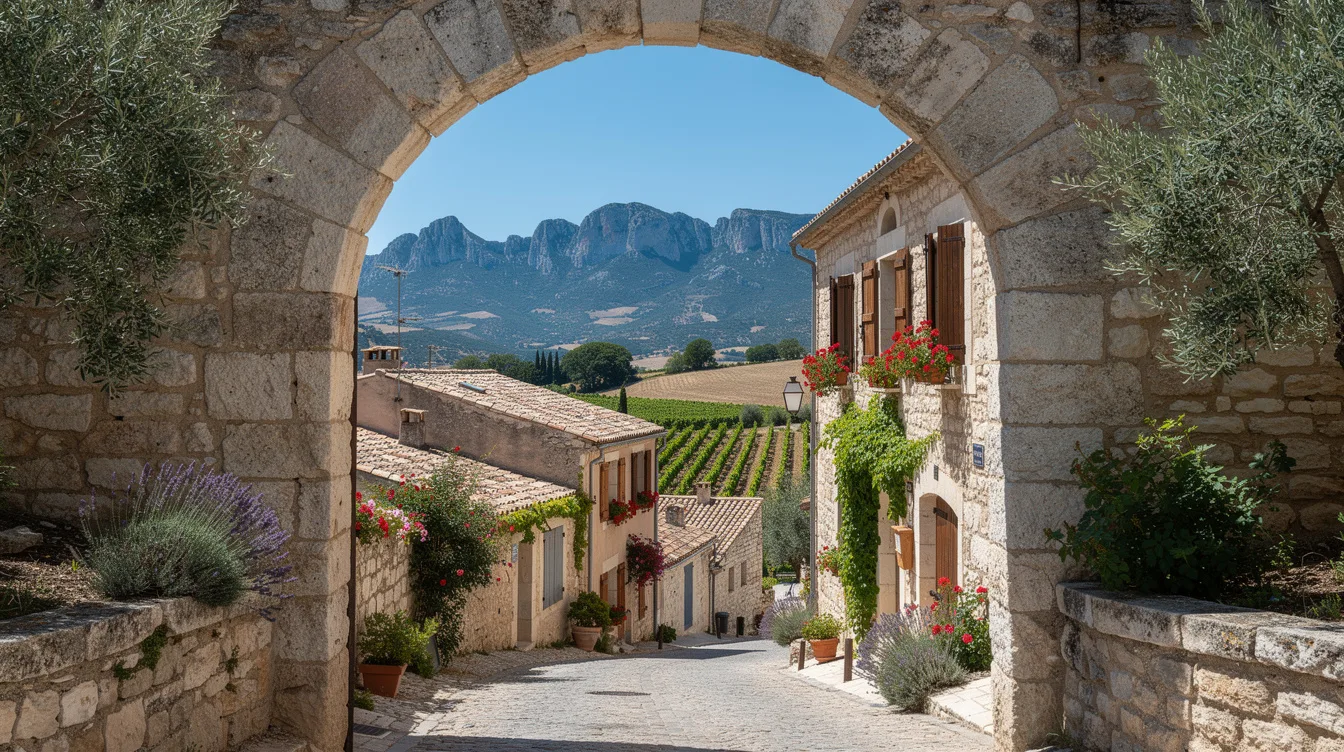
Séguret has the credential travelers often chase across Provence: it belongs to Les Plus Beaux Villages de France. But the real hook is more physical. A 12th-century Porte Reynier frames the old village, and once you pass through it, the streets pull you uphill.
This is a medieval village in Haut-Vaucluse, at the foot of the Dentelles de Montmirail and surrounded by vines. It’s small, with 769 residents in 2023, so it feels lived-in rather than arranged for a quick photograph.
The gate is the reason to slow down
Porte Reynier is a surviving piece of Séguret’s old fortifications. You’ll find narrow cobbled lanes beyond it, built into the hillside, with stone walls that catch the afternoon light and passages that turn without warning.
And that gate honors the title’s promise better than a viewpoint ever could. It gives the village a real threshold. You cross from the vineyard country outside into streets where the climb begins almost immediately.
The village is beautiful, but it isn’t flat or effortless. Wear shoes with grip as you explore the old upper quarter.
What should you look for after Porte Reynier?
Look for the bell tower, the washhouse, and the Fontaine des Mascarons as you wander. The Romanesque Saint-Denis church is another worthwhile stop, especially if you prefer places that still feel part of a town’s daily fabric.
But don’t try to turn every corner into a checklist. Séguret works best when you leave room to pause at a wall, follow a vaulted passage, then hear your footsteps fade on the stone.
The castle ruins earn the uphill walk
Above the village, the ruins of the feudal castle overlook the vineyards and the Rhône Valley. The climb is the point, because the village’s stacked roofs and the wide agricultural plain make more sense from above.
And the setting is lively in color, but never loud in scale. Vines and terraces meet the rugged forms of the Dentelles de Montmirail, giving Séguret a harder edge than the soft-focus version of Provence.
That change in elevation is why the streets feel folded into the slope rather than laid out on a convenient grid.
You can see why this place rewards a slower stop. The castle is in ruins, not a polished monument, and that makes the view feel less staged once the village falls away below you.
Wine country begins at the village edge
Côtes-du-Rhône Villages Séguret is the local wine appellation, and the vines aren’t a decorative backdrop. They shape the approach, the views from the upper lanes, and the logic of making this village part of a wider northern Vaucluse route.
Nearby wine villages include Gigondas, Sablet, Rasteau, and Vacqueyras. That proximity gives you options, but Séguret is the one to choose when you want medieval stone along with the vineyard setting.
From there, you can make a compact loop through the area rather than rushing between famous names. Sablet is about 1.9 miles away, while Gigondas is about 4.3 miles away and Rasteau about 5.6 miles away.
Still, the trade-off is simple. Séguret is better as a pause of a few hours or an overnight stop than a place packed with big-ticket attractions.
Is Séguret easy to add to a Provence itinerary?
Yes. It is about 6.2 miles from Vaison-la-Romaine and about 13.7 miles from Orange, which makes it an easy detour if you’re moving through Vaucluse by car.
But arrive with a loose plan. The appeal isn’t speed or a single landmark. It’s the short distance between a fortified gate, a church wall, a stone fountain, and the vines visible through an opening in the lane.
A small village with a clear sense of place
Séguret sits between Mont Ventoux and the Rhône Valley, though its own identity feels more intimate than either grand reference point. The village has only one main claim worth carrying with you: the old streets still lead somewhere.
And because it is part of Les Plus Beaux Villages de France, it will draw visitors. Yet its hillside layout breaks up the crowd, so a turn beyond the bell tower can feel surprisingly quiet.
Save the castle ruins for when you have time to linger. By the time you descend through Porte Reynier again, the air carries the dry scent of stone and vines, and the village is behind you like a folded map.