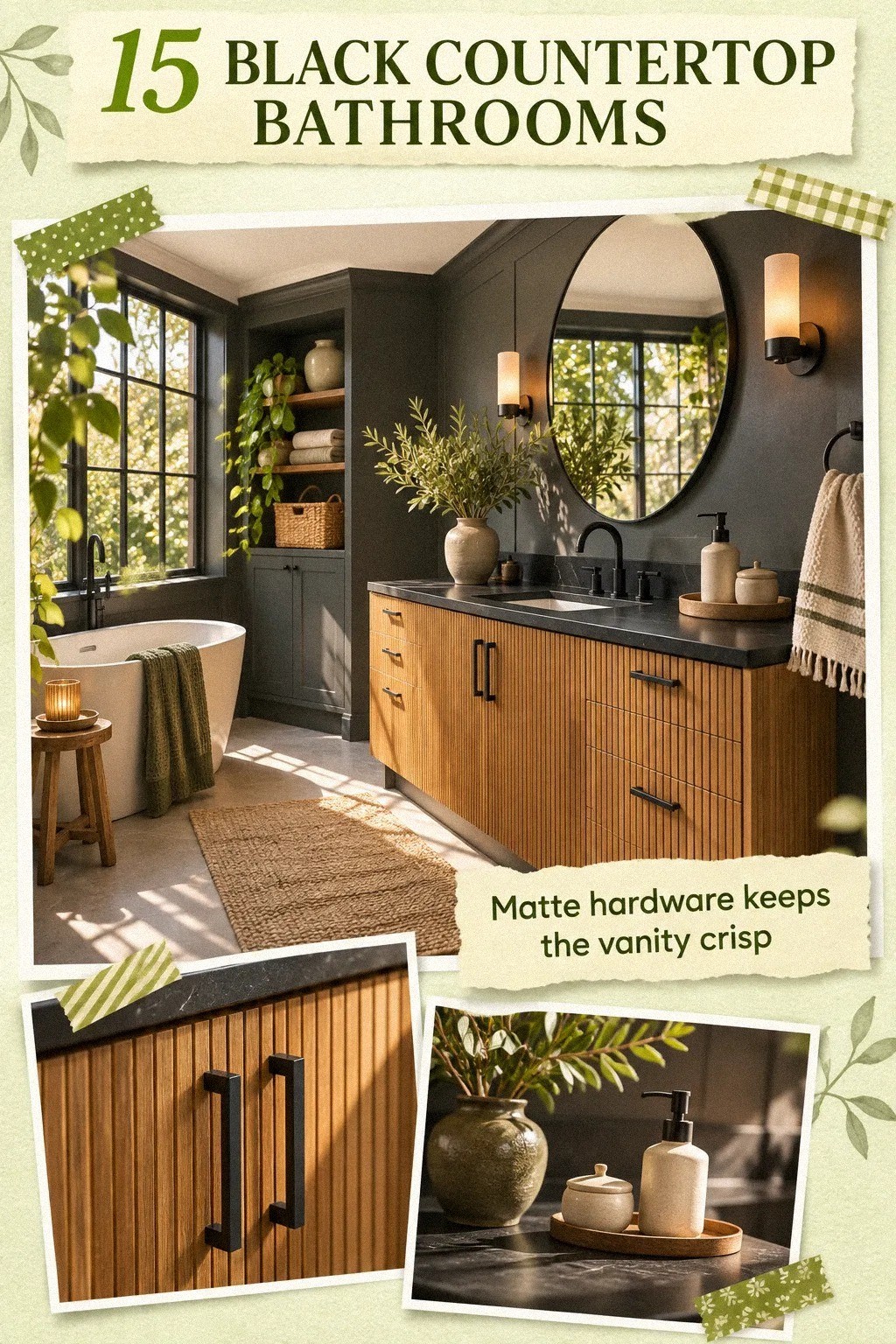
Black countertop bathroom designs work best when warm material balances the dark slab. Oak, brass, stone, plaster, and linen can keep the room inviting without weakening the counter’s visual authority. You’ll get a more refined result when each finish has a clear role. Start with the surface, then let every surrounding choice support it.
- Pair a black countertop with fluted oak vanity (The Two-Wood Rule)
- Frame the black slab with warm brass fixtures (The Warm Metal Halo)
- Layer veined backsplash tile behind black countertop (The Book-Match Principle)
- Float a black countertop over ribbed cabinetry (The Shadow Gap Rule)
- Echo the counter in a matte black basin (The Single-Note Basin)
- Illuminate black stone with under-shelf LED strips (The Three-Height Light Stack)
- Contrast black quartz with blush plaster walls (The Soft-Wall Counterpoint)
- Wrap the countertop edge in waterfall stone (The Waterfall Line)
- Style the black counter with sculptural ceramics (The Quiet Object Rule)
- Ground a tiny bathroom with glossy black granite (Can a small room carry dark stone?)
- Install a vessel sink above the dark surface (The Lifted Basin Effect)
- Balance black counters with checkerboard floor tile (Black Over White)
- Highlight charcoal veining through directional sconces (The Vein-and-Glow Method)
- Use open shelving to lighten black cabinetry (The Air Gap Strategy)
- Cap a double vanity with one continuous black slab (The One-Slab Rule)
1Pair a black countertop with fluted oak vanity (The Two-Wood Rule)
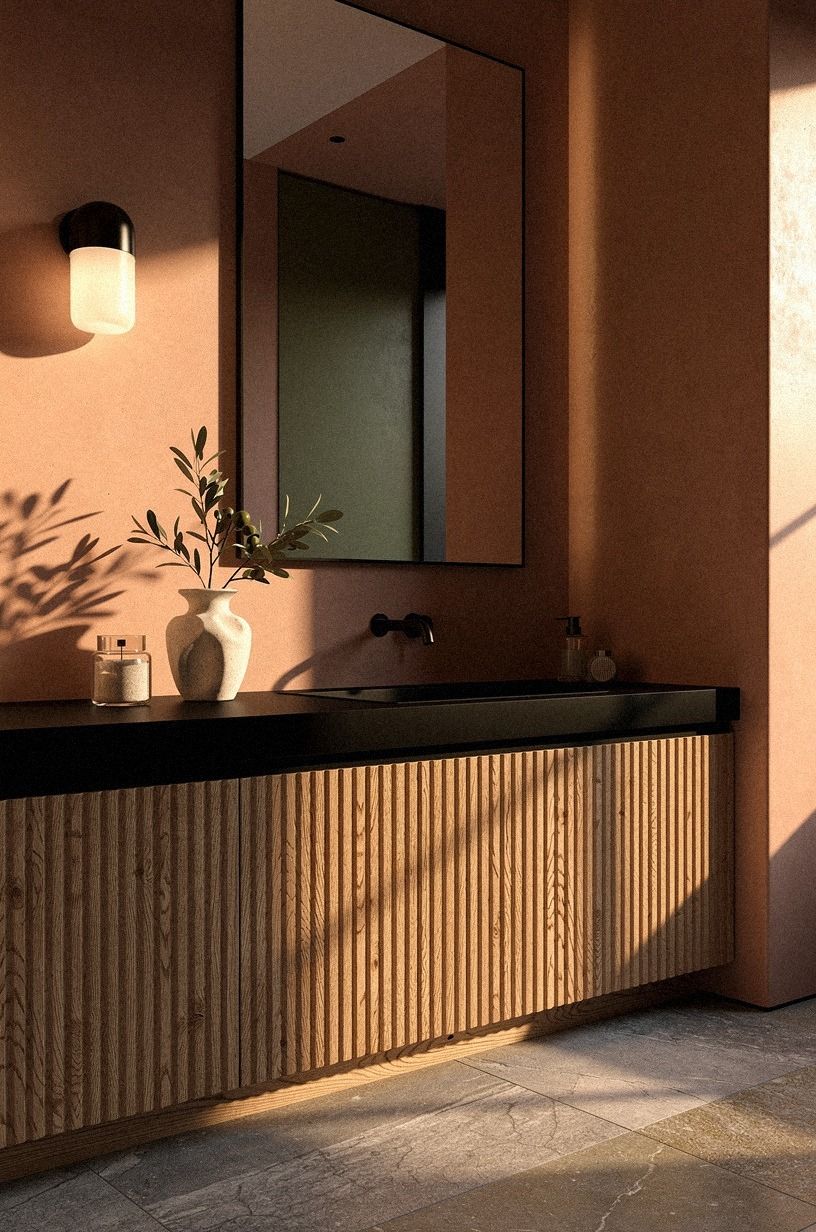
A black countertop against fluted cerused white oak gives a bathroom immediate structure without making the room feel heavy. The vertical grooves catch daylight in narrow stripes, while the dark surface creates a crisp horizontal line. You’ll want the vanity between 32 and 36 inches high, so the proportions feel comfortable rather than furniture-like.
Keep the rest of the palette earthy: terracotta accessories, honed stone, and muted olive paint. Benjamin Moore Chestertown Buff HC-9 can soften the wall around the oak without competing with the counter. Skip orange-toned wood, because it can make the black surface look harsher.
The relationship between the fluted doors, countertop, and floor should remain easy to read. You’ll get warmth, structure, and a finish with real presence. The contrast feels settled rather than overly coordinated!
For an adjacent patterned direction, these black hexagon tile bathroom ideas for geometric edge show how a dark shape can stay controlled beside wood.
2Frame the black slab with warm brass fixtures (The Warm Metal Halo)
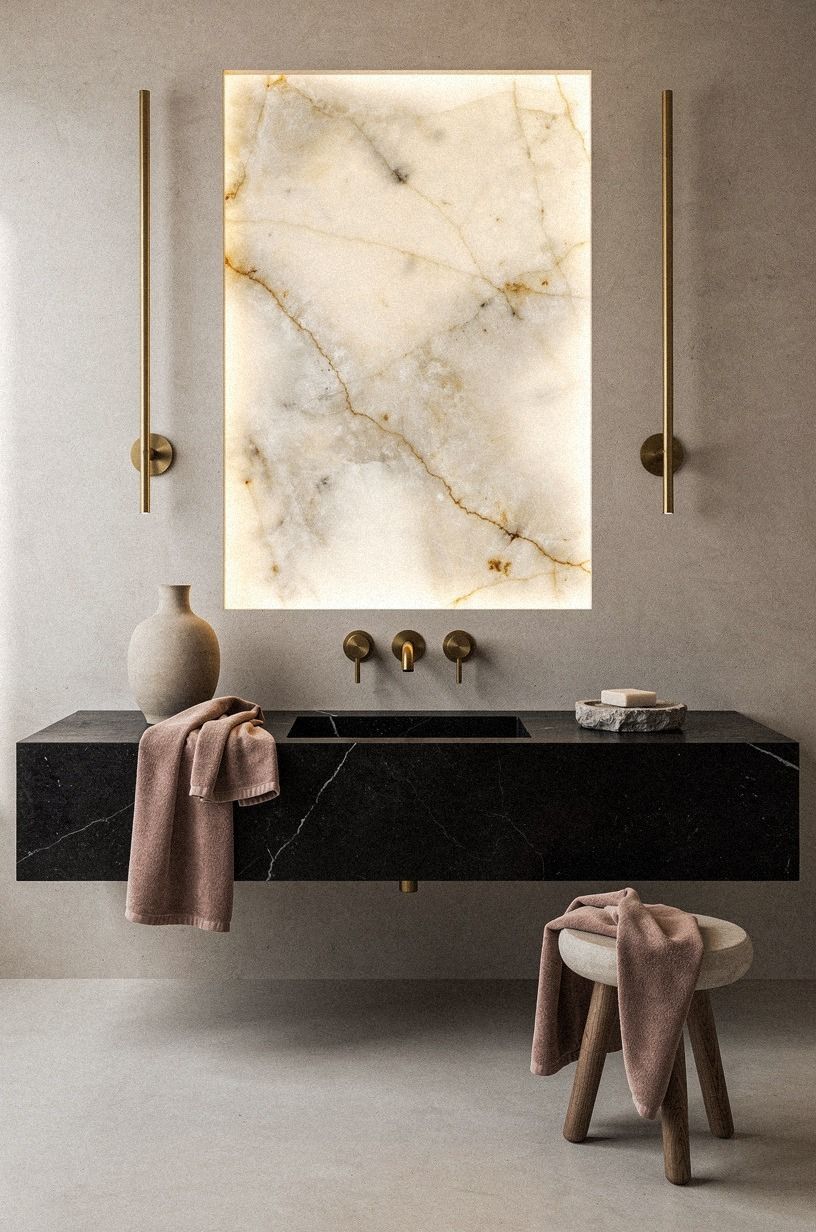
Warm brass fixtures keep a black countertop from looking flat, especially when the bathroom uses clay and linen tones.
3Layer veined backsplash tile behind black countertop (The Book-Match Principle)
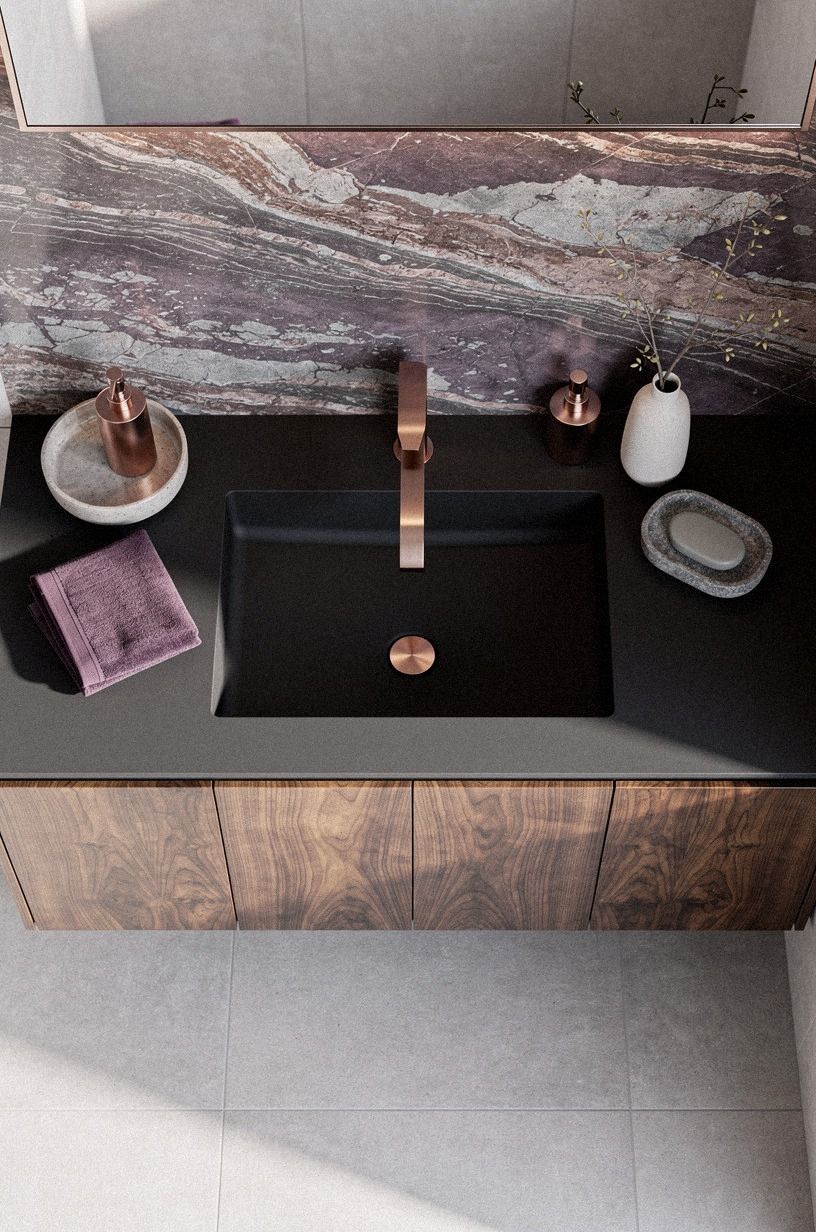
A veined backsplash gives the black countertop a vertical partner, which helps the vanity wall feel intentional instead of visually cut in half. In a plum, grey, and rose gold palette, choose book-matched walnut panels so the grain moves horizontally while the dark surface stays grounded. You’ll get layered direction without visual clutter.
Use large-format book-matched walnut with a clear protective finish, keeping the joins tight so the grain reads as one continuous pattern. Rose gold works best in small doses, perhaps on a mirror edge or single pendant.
You shouldn’t pair busy tile with ornate cabinet doors, because the eye won’t know where to rest. Calm walnut grain, restrained joins, and one metallic detail will give your bathroom a more editorial finish. For another geometric route, these black hexagon tile bathroom ideas for geometric edge offer controlled pattern and useful scale references.
4Float a black countertop over ribbed cabinetry (The Shadow Gap Rule)
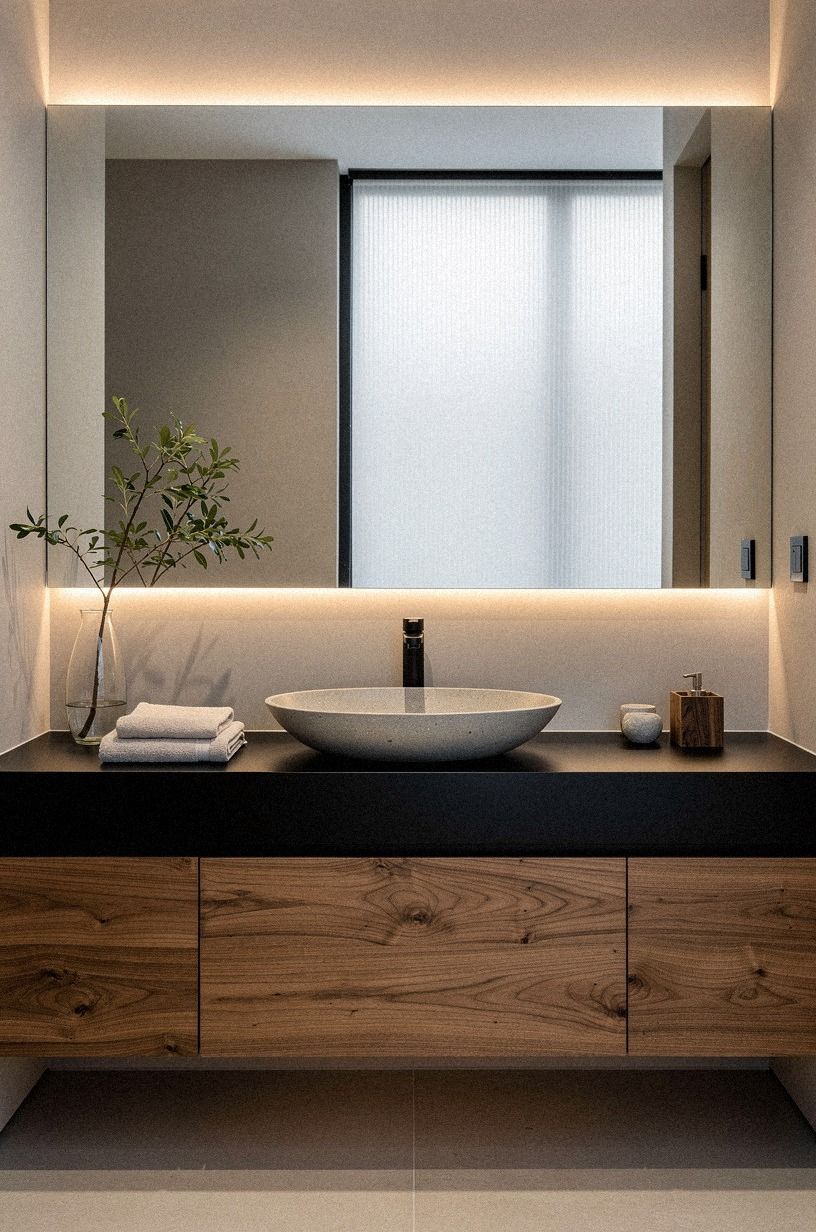
A floating vanity makes a black countertop look lighter because the eye can see beneath it. You’ll want a recessed toe-kick or clear shadow gap below the cabinet so the slab doesn’t appear grounded directly on the floor.
Ribbed cabinetry adds vertical texture without competing with the dark surface. Choose a muted taupe, smoked oak, or soft mushroom finish when the room needs warmth. A pale floor will emphasize the gap, while a dark floor can make the vanity appear more substantial.
Keep the plumbing visually quiet. Wall-mounted fixtures can preserve the open line beneath the vanity, but they’ll require careful planning before installation. If a floor-mounted setup is already in place, a slim cabinet base can still create an airy effect.
A floating form works especially well in a compact bathroom because visible flooring gives the room more breathing space. You don’t need a large vanity to create impact. One continuous counter, one clear floor line, and one textural cabinet front can carry the entire design.
5Echo the counter in a matte black basin (The Single-Note Basin)
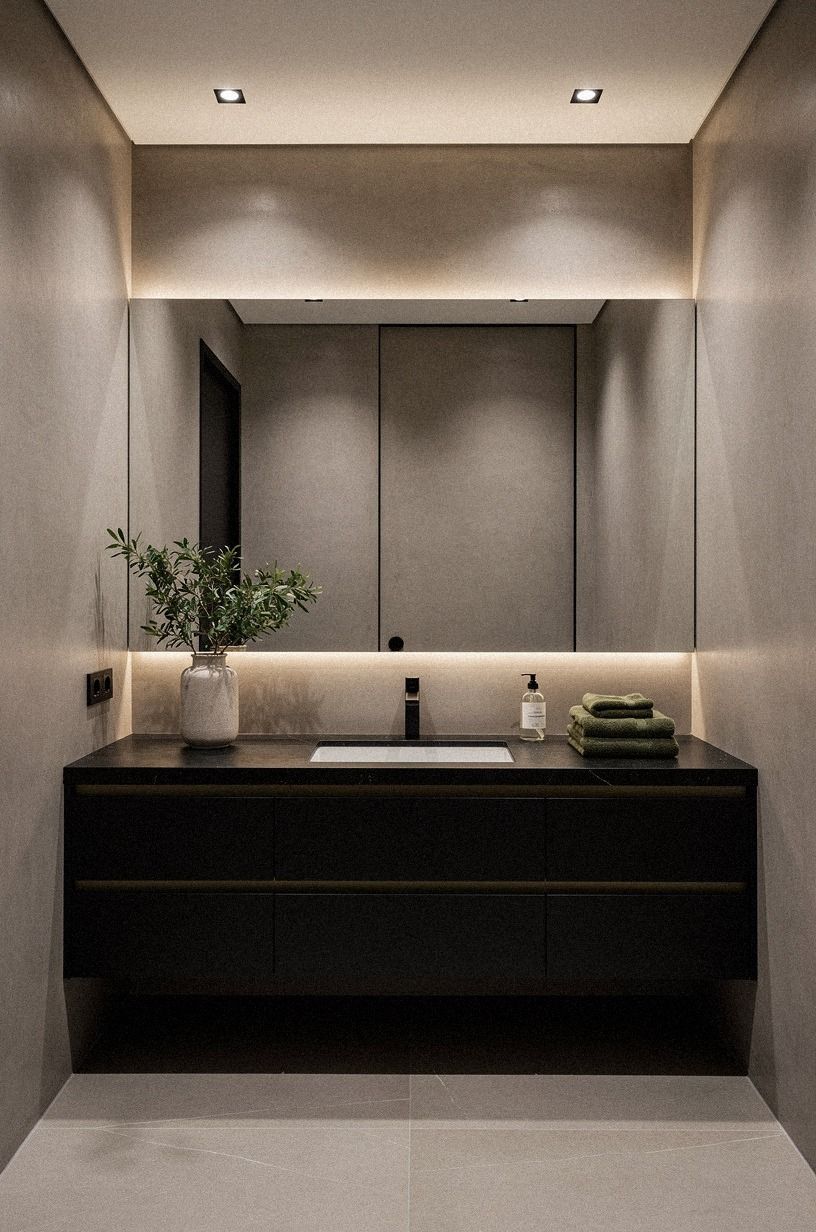
A matte black basin makes the countertop feel deliberate because the two dark forms speak to each other.
6Illuminate black stone with under-shelf LED strips (The Three-Height Light Stack)
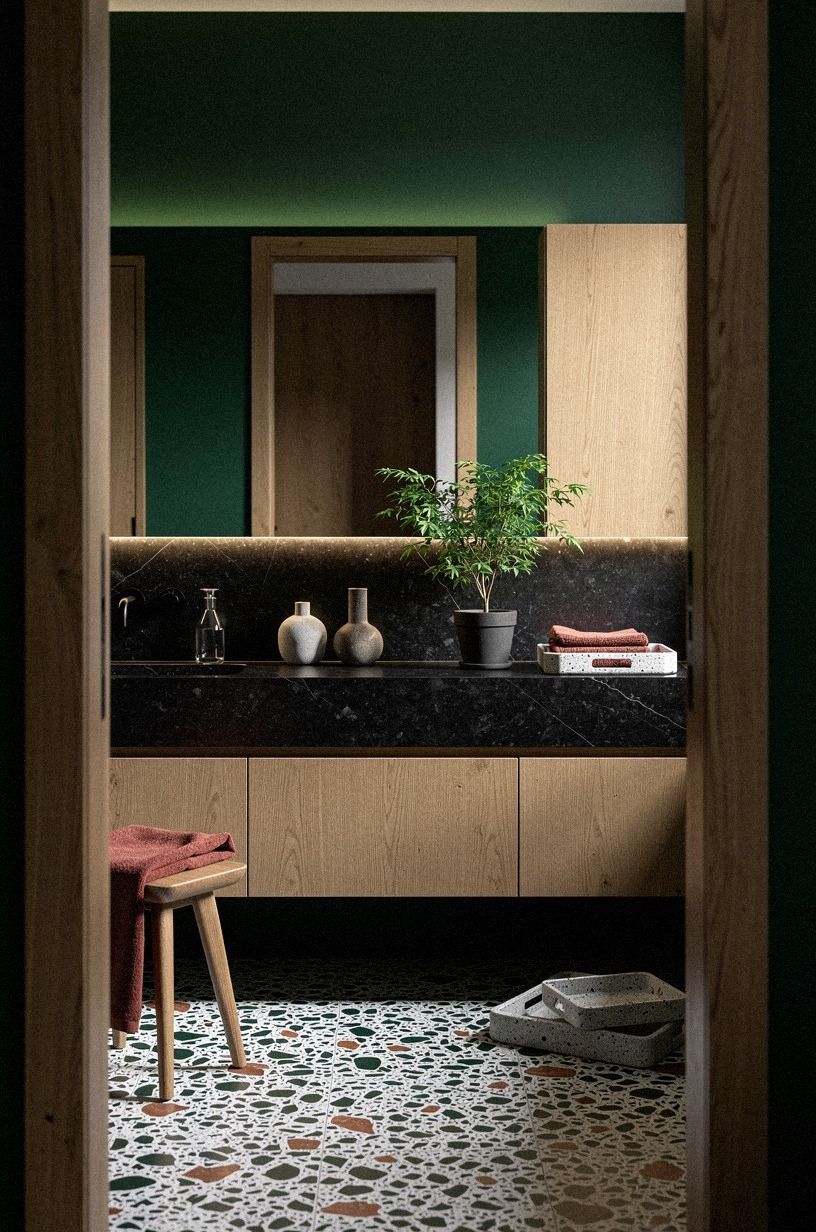
Under-shelf LED strips can make a black oversized-chip terrazzo countertop glow instead of disappear. You’ll want a warm color temperature, usually between 2700K and 3000K, so the terrazzo retains depth rather than turning blue or grey.
Place the light beneath a floating shelf, behind a slim backsplash ledge, or below the vanity if the cabinet design allows it. A concealed channel will look cleaner than an exposed strip. Choose dimmable lighting, because the same brightness won’t suit morning grooming and evening use.
Layer the illumination at three heights: face-level sconces, a soft vanity glow, and gentle ambient ceiling light. You don’t need every level to be equally bright. The lower glow should support the countertop, while the sconces provide practical light.
If the terrazzo has varied stone chips, grazing light will reveal their different tones gradually. You’ll see more depth without adding another material. This approach is especially effective with dark oversized-chip terrazzo and natural oak surroundings.
7Contrast black quartz with blush plaster walls (The Soft-Wall Counterpoint)
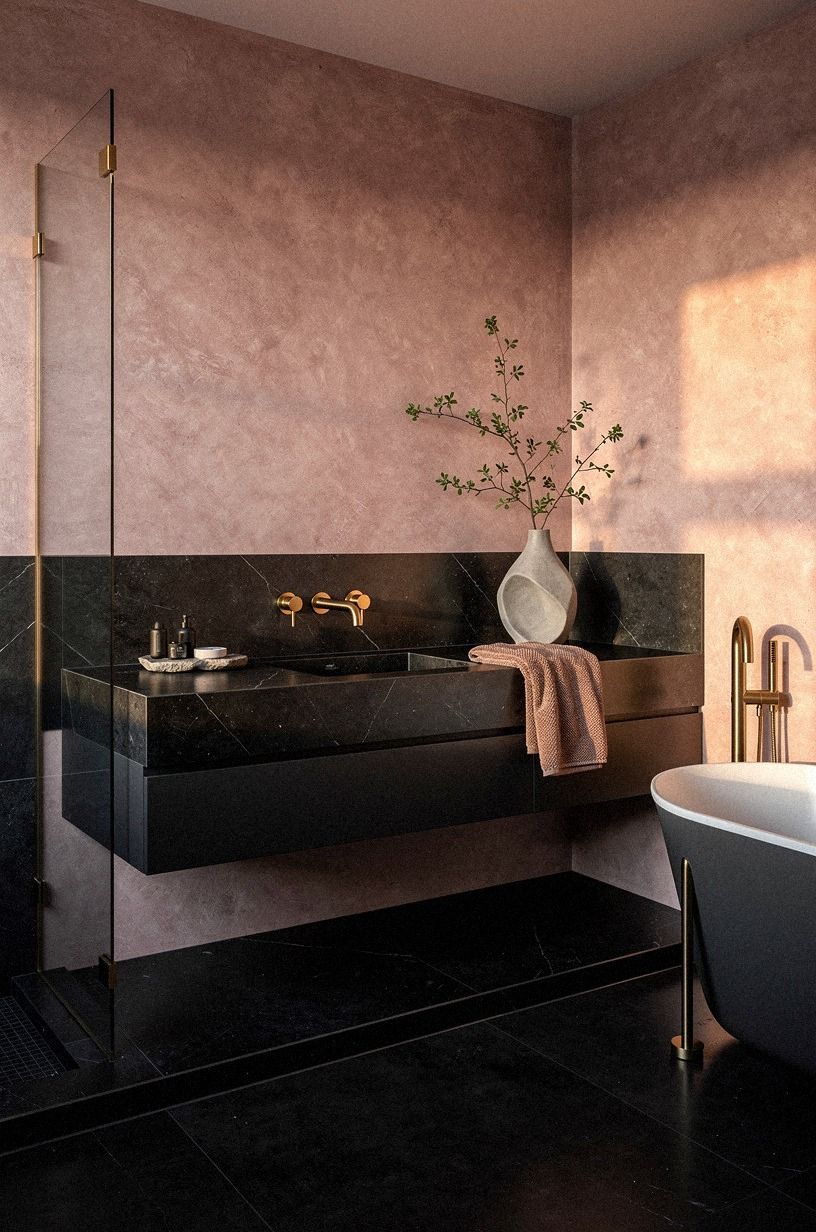
Black quartz looks especially elegant beside blush plaster because the wall absorbs light while the counter reflects a controlled amount. The dusty rose, charcoal, and brass palette feels intimate and sophisticated without turning sugary. You’ll want the plaster to show slight movement, with cloudy areas rather than a uniform painted finish.
Use hand-applied Venetian plaster with a low-sheen seal, then select a quartz slab with restrained charcoal flecks. Brass hardware can be aged or brushed, but polished yellow gold can make the combination feel too loud.
Don’t add a patterned floor unless the pattern is very small. Your eye needs one quiet surface.
For a paint alternative, Sherwin-Williams Sea Salt SW 6204 can shift the room toward a softer green-grey when blush plaster isn’t practical. It’s a calmer choice for a rental or quick refresh. You’ll still get contrast, but the room will feel cooler and more coastal.
A black quartz counter also gives blush walls a firm edge. Without that anchor, plaster can look overly soft. Add one pale stone accessory and a linen hand towel, then stop before the palette becomes decorative.
8Wrap the countertop edge in waterfall stone (The Waterfall Line)
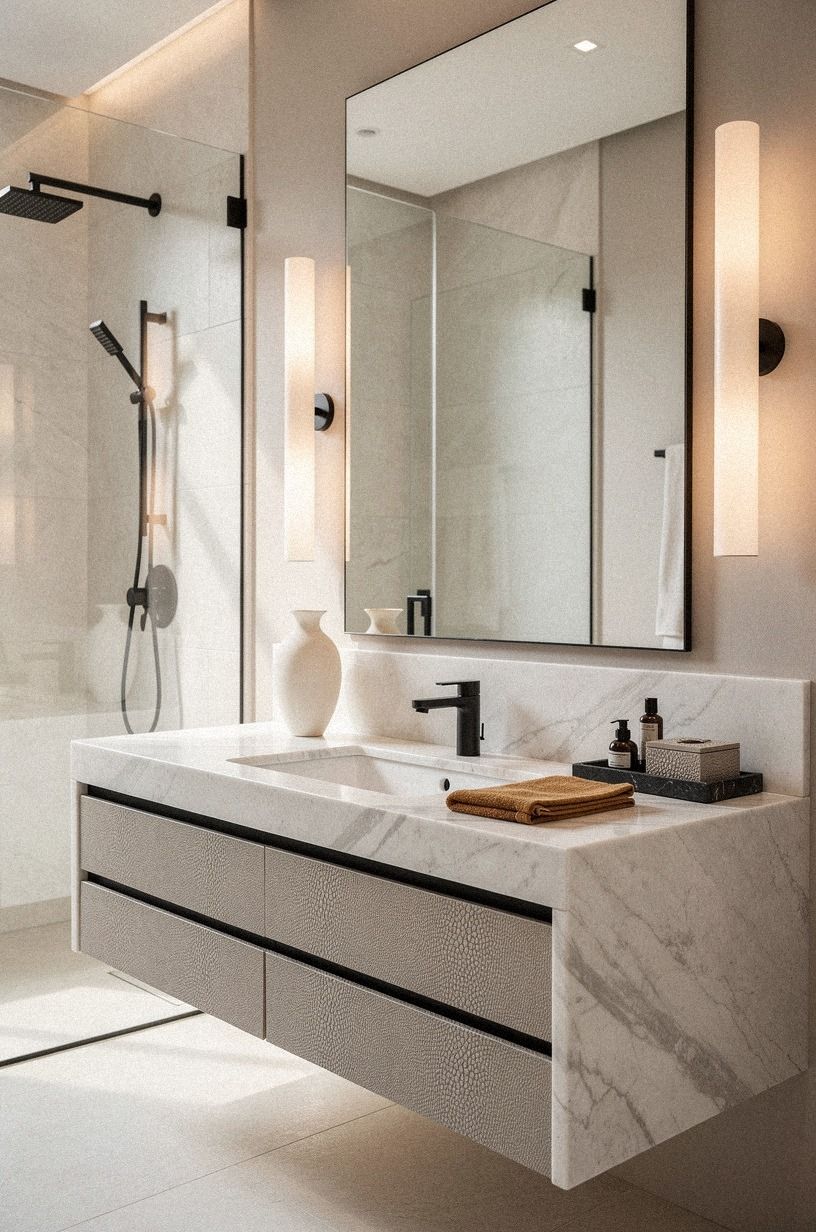
A waterfall-style edge makes the black countertop feel architectural because the dark surface drops cleanly along the vanity side. Add shagreen accents to a drawer front or tray for tactile contrast without interrupting the line.
Keep the edge profile slim and let the shagreen texture remain subtle. The combination works best when the counter supplies visual weight and the accent adds softness through texture.
9Style the black counter with sculptural ceramics (The Quiet Object Rule)
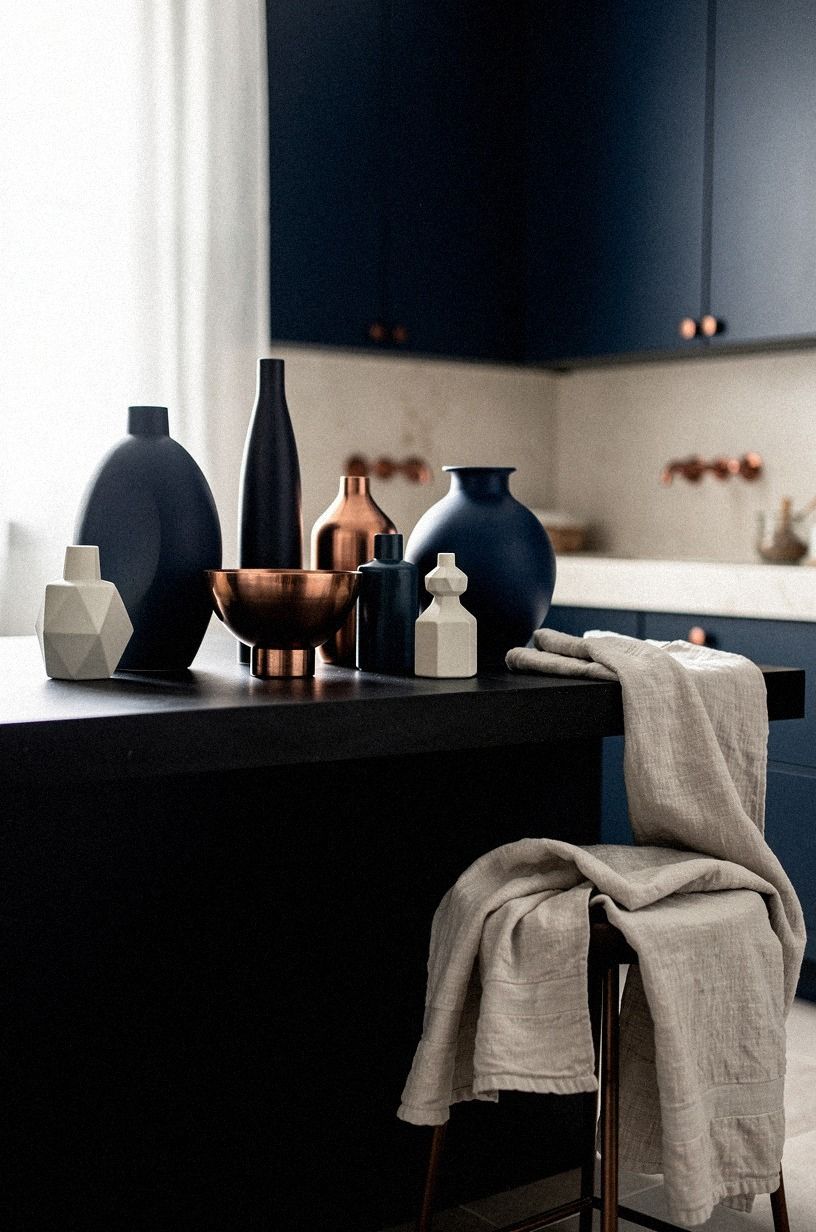
Sculptural ceramics keep a black countertop from looking like an empty strip while preserving the midnight blue, copper, and ivory palette. Choose one rounded vessel, one narrow soap dish, and one low object with a rough surface. You’ll create interest through shape and texture instead of adding more color.
Washed Belgian linen towels make the room feel lived-in, while 18 oz cotton velvet on a small stool adds a soft note near the vanity. Keep the ceramics ivory or pale stone so they show clearly against the dark counter.
Don’t line up six accessories across the slab, because the eye will read them as a display shelf. Three objects have more presence. You’ll get a calmer arrangement when each piece has space around it.
If the bathroom has a tall mirror or another strong vertical element, let the counter support the room rather than dominate it. A low ceramic vessel near one corner can balance a tall mirror on the opposite side. The difference is subtle, but it’s what makes the styling feel sophisticated.
10Ground a tiny bathroom with glossy black granite (Can a small room carry dark stone?)
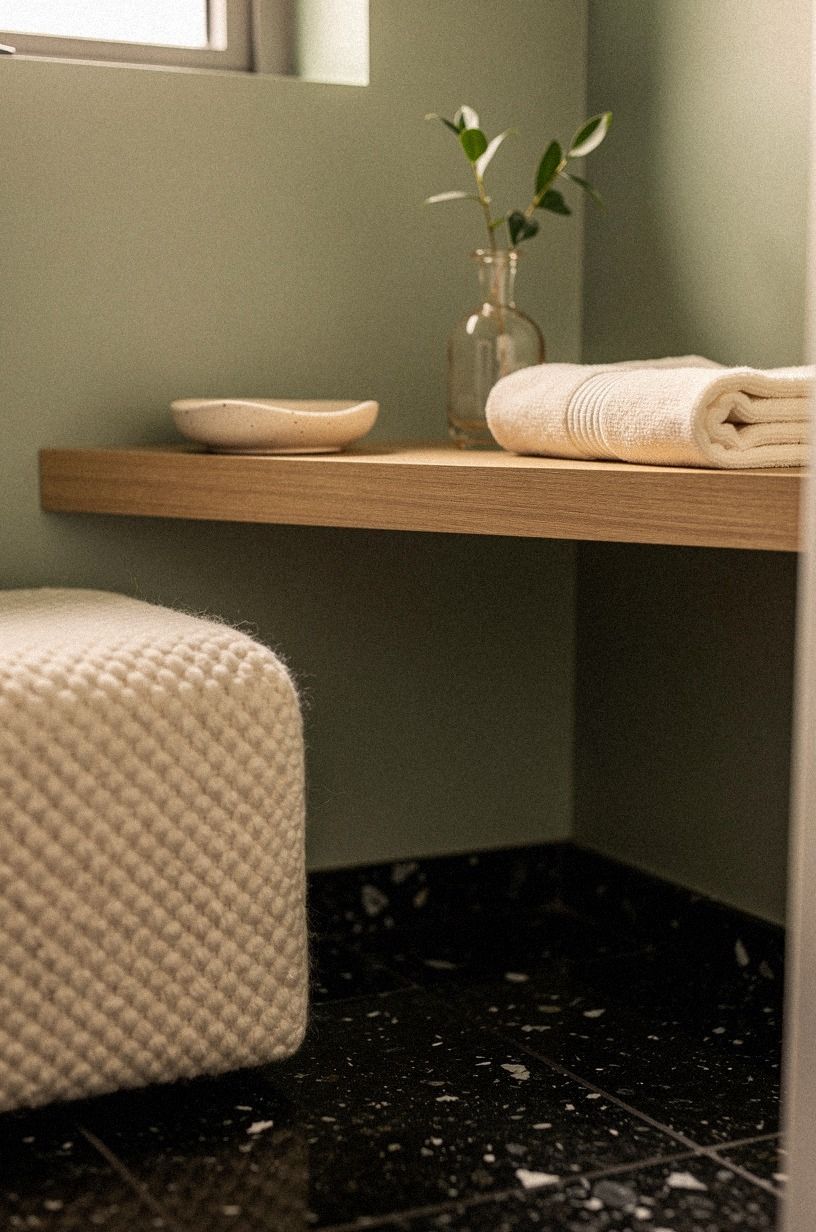
Yes, a small bathroom can carry glossy black granite when the surrounding finishes stay light and warm. An organic bouclé stool, natural wood, and warm cream walls can keep the dark surface from dominating.
11Install a vessel sink above the dark surface (The Lifted Basin Effect)
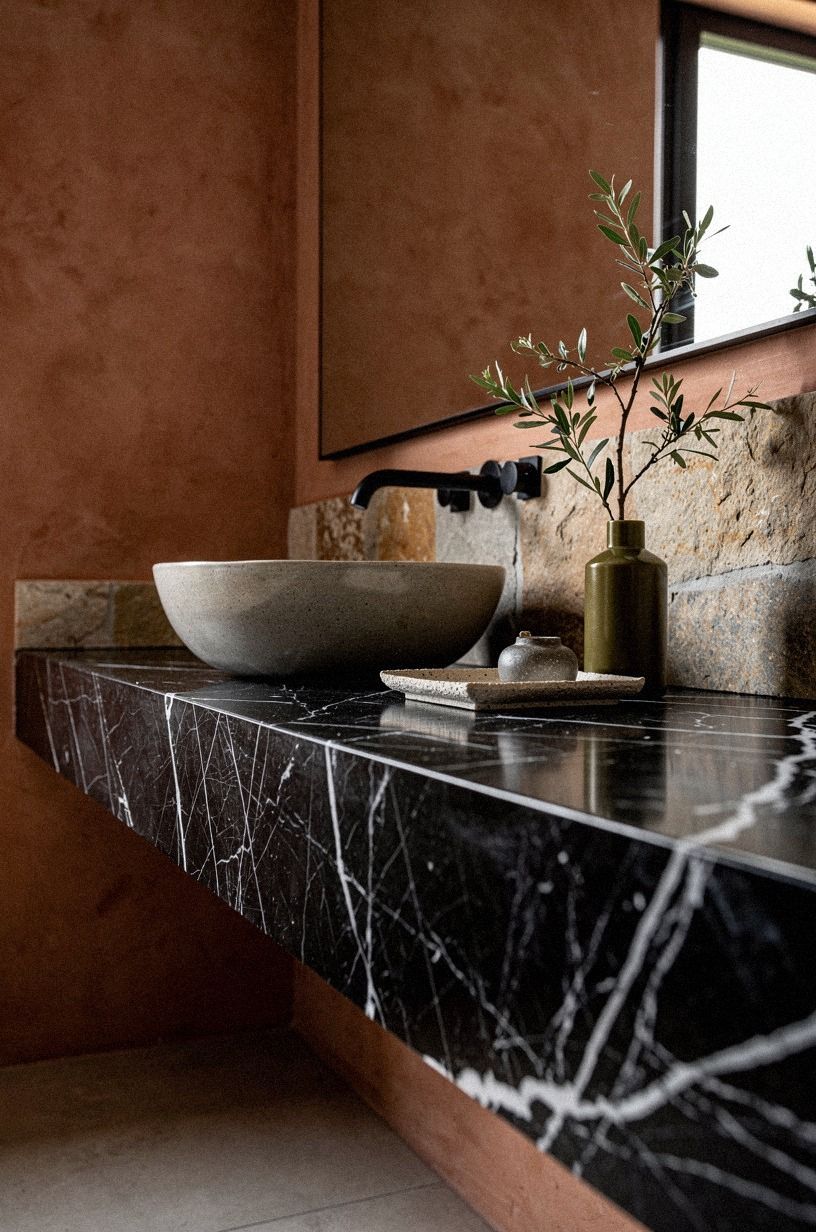
A vessel sink creates a visible gap between the black countertop and the basin, which makes the vanity feel taller and more sculptural. Terracotta, stone, and olive tones give the arrangement an earthy character. You’ll want the combined counter and sink height to remain comfortable, since a tall bowl can push the rim too high.
Choose Nero Marquina black marble with white veining for the countertop and pair it with a pale stone vessel. A short wall-mounted faucet can keep the composition clean, while an aged bronze mirror adds warmth. Don’t place a deep vessel on a shallow vanity, because splashing will become irritating fast.
Your faucet height and reach need to suit the bowl, not only its appearance. Measure the basin depth, spout projection, and surrounding clearance before ordering fixtures. That small planning step can save an expensive replacement.
For related contrast, these travertine black bathroom ideas for bold modern contrast offer useful material pairings. Additional travertine and black stone pairings show how pale mineral texture can soften a dark vanity.
12Balance black counters with checkerboard floor tile (Black Over White)
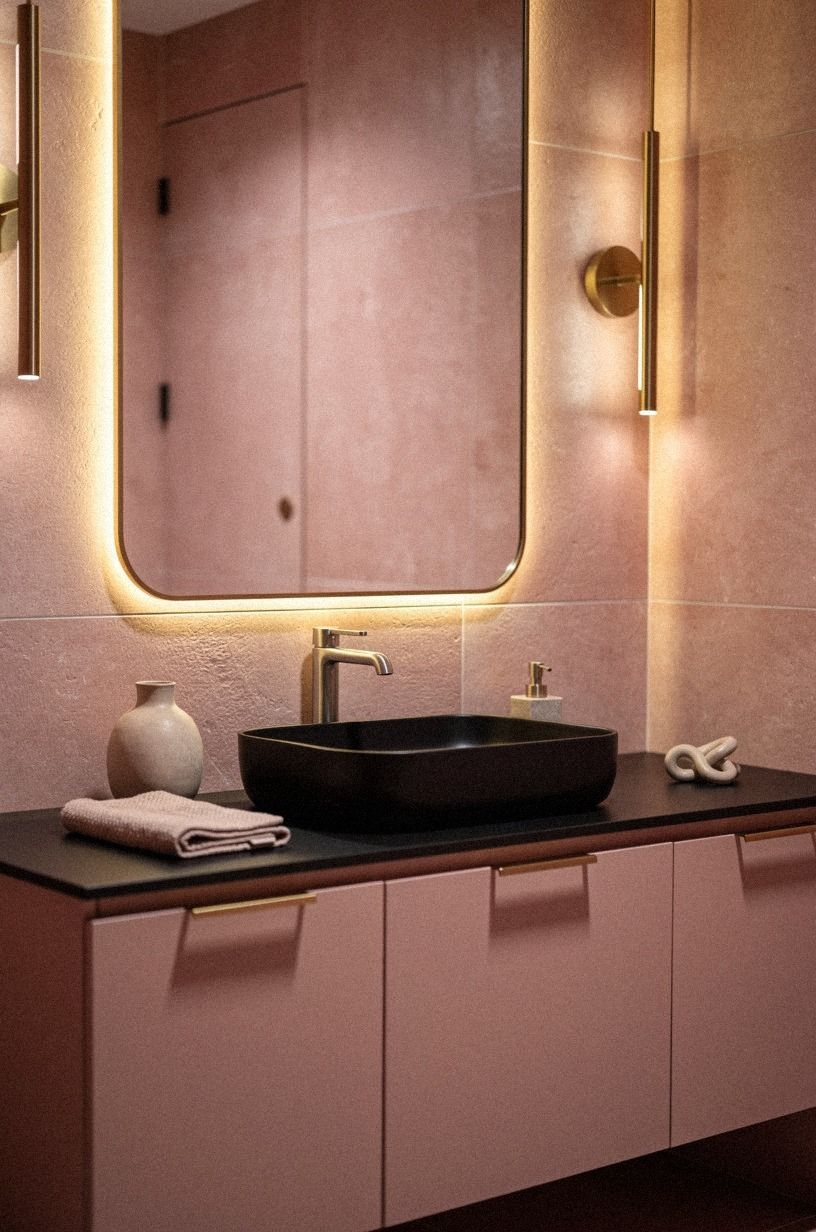
Checkerboard floor tile gives a black countertop a graphic partner, but the pattern needs breathing room. In a clay, linen, and aged brass bathroom, use warm white and soft black squares rather than stark optic white. You’ll want the vanity wall to remain calmer so the floor can carry the rhythm.
A deep-pile mohair velvet stool adds softness near the cabinet, while 600gsm Turkish cotton towels make the space feel substantial. Keep the countertop mostly clear, because the floor already supplies strong movement.
Don’t introduce another geometric backsplash unless the room is unusually large. A standard 60 by 30 inch tub can coexist with this floor pattern, but tight layouts need careful tile alignment. You’ll want grout lines to relate to the vanity edges rather than stop randomly at the cabinet.
For proportion ideas, explore the checkerboard floor that makes a black and white bathroom. A second direction using black and white checkerboard proportions can help when the room needs a softer scale.
13Highlight charcoal veining through directional sconces (The Vein-and-Glow Method)
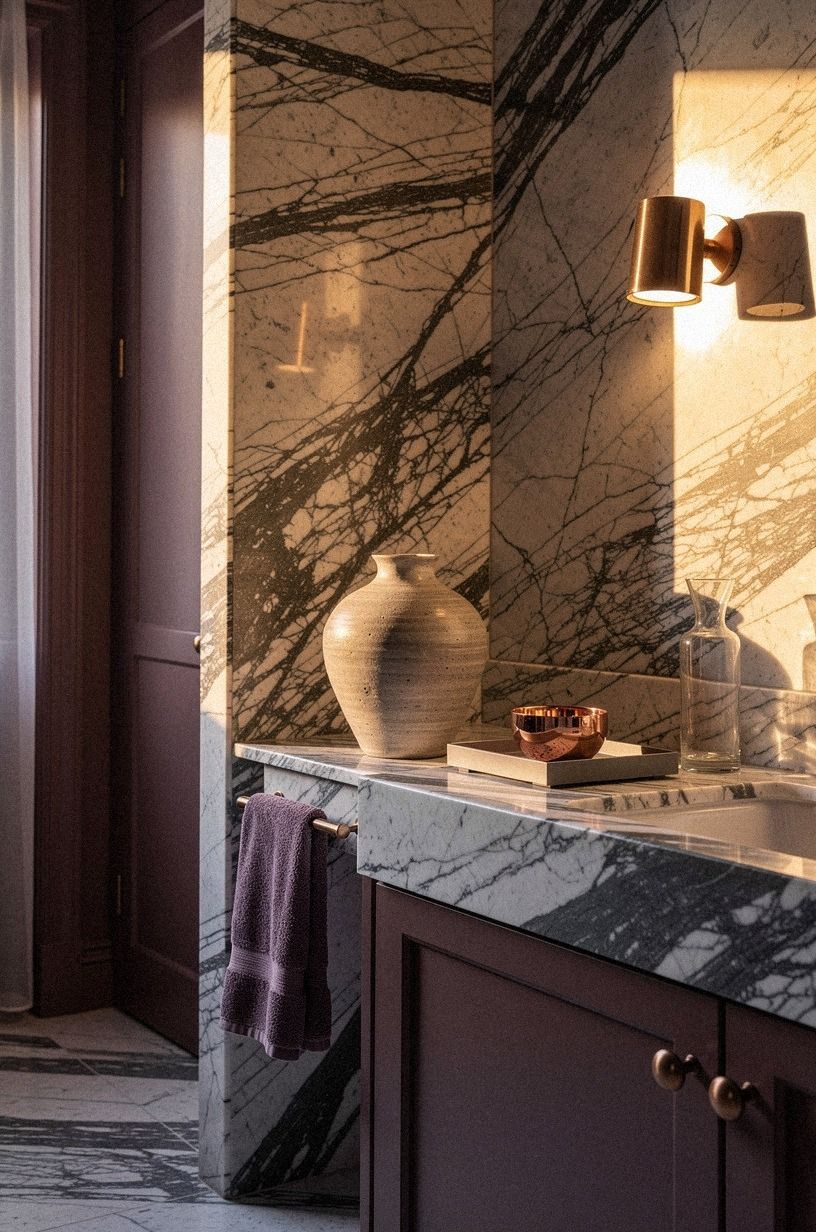
Directional sconces can reveal charcoal veining that disappears under flat overhead light. In a plum, grey, and rose gold bathroom, aim the light across the surface rather than straight down. You’ll see the stone shift as the day changes, which gives the vanity wall a quiet sense of movement.
Choose Carrara marble with subtle grey veining and place the sconces at face height, leaving enough room for the mirror between them. Rose gold belongs in a small detail, such as a thin frame or cabinet pull. Don’t use cool blue bulbs, because they can make the grey stone look metallic and the plum look dull.
A dimmer gives your bathroom a more relaxing evening setting. Black fixtures can also work here, and these black fixtures for a quick bathroom update explain why the finish remains useful beyond this countertop style.
For another application, these black fixture finish ideas help coordinate sconces, taps, and cabinet hardware. You’ll get more cohesion when the fixture finish repeats without appearing on every surface.
14Use open shelving to lighten black cabinetry (The Air Gap Strategy)
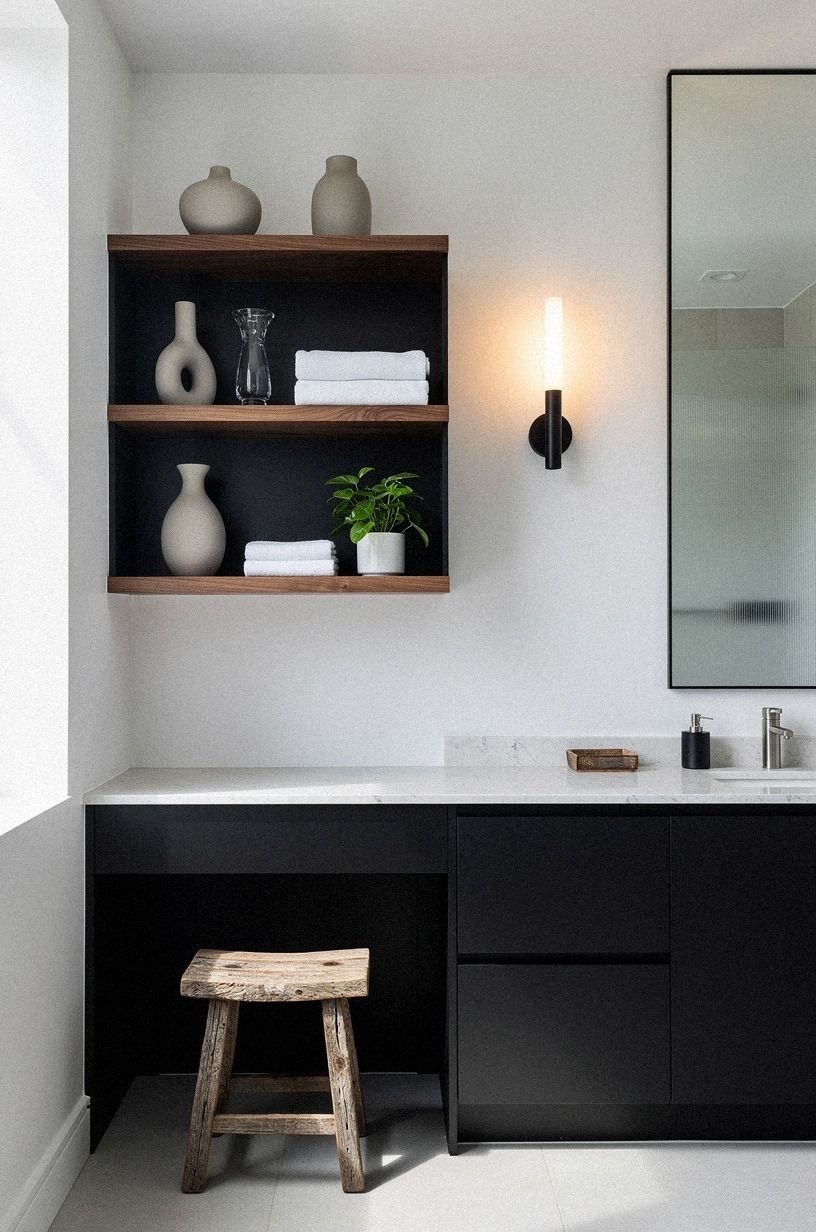
Open shelving breaks up black cabinetry by introducing visible wall space beneath or beside the countertop. You’ll want the shelves to hold only practical items, such as folded towels, a ceramic cup, or one small storage box.
Reclaimed weathered teak shelves soften a black cabinet through irregular grain and a sun-worn finish. Keep the brackets visually quiet so the air gap remains the main feature.
You don’t need open storage everywhere. One narrow shelf beside the mirror may be enough to keep the vanity from feeling closed in. If the room is already busy, choose a single floating ledge rather than several stacked shelves.
Use baskets sparingly. Woven storage can add warmth, but too many containers will make the wall feel crowded. A black counter benefits from visible breathing room, and the open shelf should preserve that quality.
15Cap a double vanity with one continuous black slab (The One-Slab Rule)
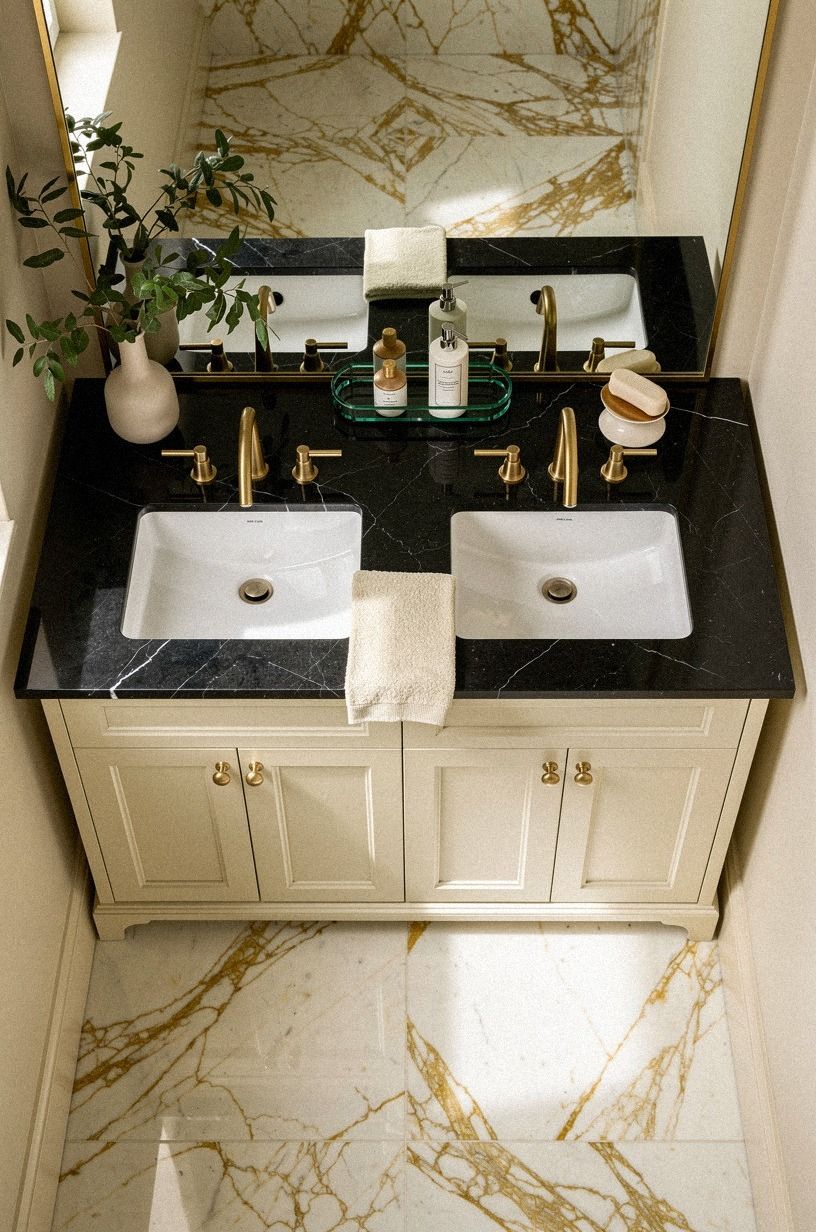
A continuous Calacatta marble slab with gold veining gives a double vanity a strong visual anchor, especially with emerald, gold, and cream around it.
The Quiet Edge Principle
Black countertops work because they create visual gravity. The mistake is treating that gravity as a command to make every other finish darker, glossier, or more dramatic.
A successful bathroom gives the dark surface something generous to hold: oak grain, pale plaster, aged metal, soft textiles, or stone with restrained movement. That contrast is what makes the counter feel expensive.
The most convincing rooms also keep practical choices visible. A vanity height between 32 and 36 inches supports everyday comfort.
A 36 by 36 inch shower remains a useful minimum for a comfortable shower footprint. Storage matters just as much as the slab, because clutter makes even premium materials look accidental. You’ll get more impact from one concealed drawer than from another decorative object.
The strongest approach is selective repetition. Repeat black in the basin or mirror frame, but stop before the room becomes a collection of matching surfaces.
Repeat brass in two or three places, then let the metal age naturally. Pair a polished counter with matte ceramics, or a honed stone with a softly reflective mirror.
That tension keeps the space sophisticated instead of over-designed. When the room feels too formal, add linen, bouclé, or a small wood element. When it feels too rustic, remove one texture before adding another.
The quiet edge comes from restraint, and restraint is what lets the expensive details breathe.
A Few Things Worth Answering
What is the best black countertop bathroom design for a small bathroom?
A floating vanity with a glossy black granite top works well because the visible floor beneath it keeps the room airy. Pair it with flat-pack cabinetry, warm cream walls, and one wide mirror. The open floor line creates a spacious effect without requiring a full renovation.
Where can you buy black countertop bathroom pieces on a budget?
Accessible vanities, mirrors, and lighting are available through major home retailers, local outlet stores, and resale platforms. Facebook Marketplace and thrift shops can supply solid wood cabinets for less. Look for clean lines, then refinish the cabinet while keeping the existing plumbing location.
Matching pieces are not required for a polished result.
How much does a black countertop bathroom makeover cost?
A small cosmetic refresh may fall within the typical $200-$1,200 budget range for paint, a mirror, a faucet, and textiles. A mid-range project with a new vanity, partial wall tile, and lighting can reach $3,000-$9,000.
Larger renovations involving shower tile, flooring, and plumbing can exceed $12,000. Cleaning, decluttering, and rearranging existing accessories cost nothing.
Can you create a black countertop bathroom on a budget?
Yes, and the first low-cost moves are simple. Paint the walls, replace cabinet pulls, and style the counter with items already available.
A second-hand wood vanity, removable mirror, and inexpensive matte basin can create a warmer look without moving plumbing. You’ll save most by keeping the layout.
A new faucet and one well-chosen light can change the room quickly!
Is a black countertop bathroom worth it in a small space?
Yes, because a dark countertop can give a small vanity a clear focal point. Keep the walls light, choose a floating cabinet, and limit the palette to three main finishes. Your small bathroom will feel more intentional when the counter, mirror, and lighting share one strong visual line.
Is a black countertop bathroom a good idea for a rental?
Yes. Use removable peel-and-stick backsplash, a tension shelf, freestanding storage, and hardware that can be swapped without drilling new holes.
A black vessel bowl or countertop accessory can suggest the look without permanent changes. You’ll get the contrast while keeping the original vanity intact. Check the lease before changing fixtures or adhesives.
Where to Start First
When one change deserves priority, start with the black countertop. A continuous dark slab gives every lighter finish something to contrast against, so oak, brass, plaster, and linen won’t look disconnected. Save that surface idea, then choose one warm material to soften it.
A single confident contrast can shape the entire bathroom!