
Christmas village display ideas for a coffee table or console work best when you build one clear street, vary the heights, and leave breathing room around it. I once packed every house onto one tray, and the scene looked like a crowded parking lot. Now I use fewer pieces, warmer light, and one strong backdrop. It’s much more inviting!
- Anchor a Narrow Christmas Village Setup to One Side
- Layer the Three-Height Rule for a Christmas Village Table Display
- Frame the Village with Greenery Instead of More Buildings
- Float a Mirror Behind the Christmas Village Decor
- Build the Two-Wood Rule for a Warm Console
- What Makes the Three-Height Light Stack Feel Warm?
- Paint the Backdrop with Hague Blue for a Moody Christmas Village Setup
- Group Small Houses into a Three-Zone Christmas Village Display
- Swap a Full Table for the Console-Edge Christmas Village Layout
- Use a Low Basket to Hide the Wiring and Spare Pieces
- Let the Tabletop Breathe with the Five-Object Rule
- Finish the Christmas Village Decor with One Personal Landmark
1Anchor a Narrow Christmas Village Setup to One Side
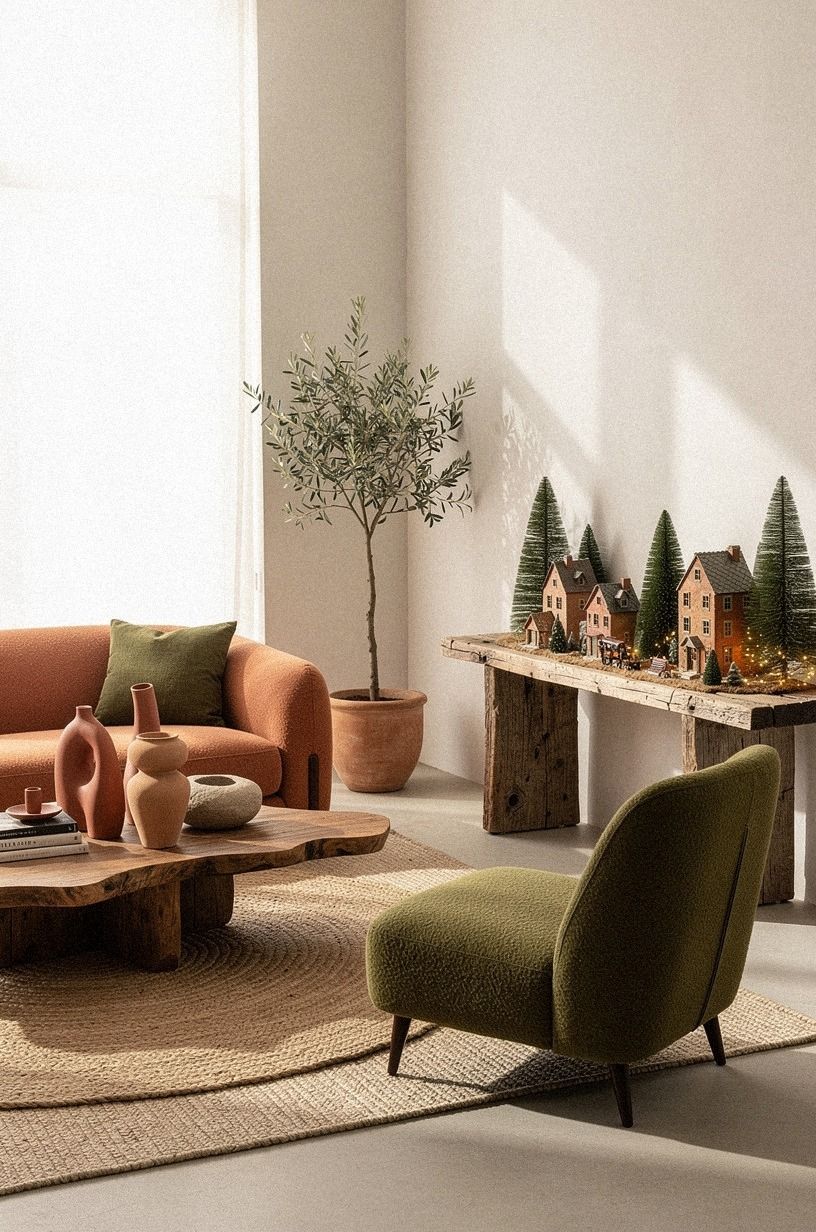
A one-sided layout gives your coffee table a visual direction. Set the tallest house toward the back corner, then let two or three smaller buildings step toward the center.
You’ll still have room for a mug, a stack of books, or a small bowl without making your display feel busy. I like a terracotta village house here because its warm clay color works beautifully with stone and olive accents.
Your table doesn’t need to be huge. A coffee table that’s 16 to 18 inches tall usually works well with a low village base, especially if your seating has a standard sofa height.
Keep the display on a reclaimed weathered teak board or runner so you can lift it when you’re cleaning. And don’t push the tray flush against the edge, because your eye needs a little quiet space around the buildings.
For a warmer look, pair the houses with olive greenery and one brass bell. The greenery softens the hard ceramic edges, while the bell gives you a small glint when you walk past.
You’ll want to skip a second tall object on the opposite side. It competes with the village instead of giving your eye somewhere to rest.
If your table is especially narrow, use the proportions in these five-object coffee table ideas as a loose guide. The principle is simple: concentrate the height, then let the empty surface do some of the decorating.
2Layer the Three-Height Rule for a Christmas Village Table Display
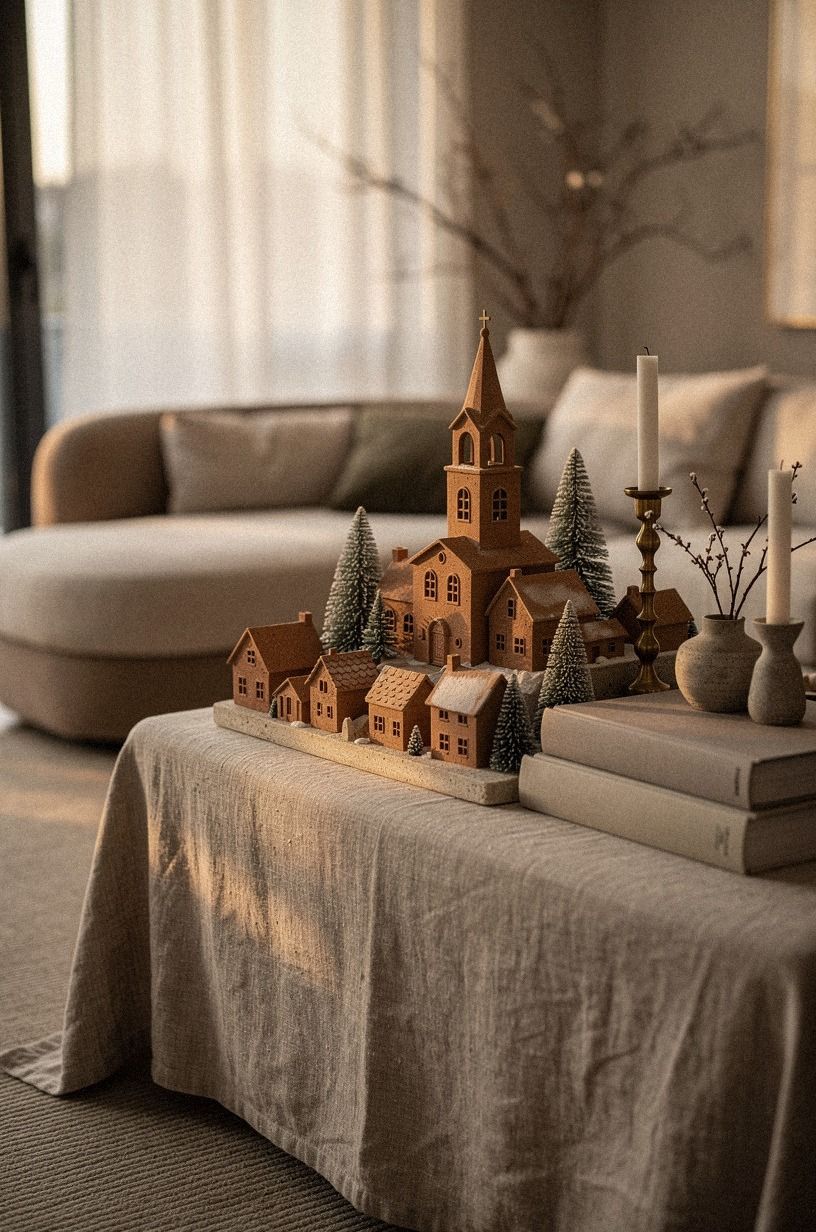
The Three-Height Light Stack keeps a village from looking like a row of identical ornaments. Start with one tall clay house or church at the back, add a middle-height group of homes, and finish with low trees or a path in front. Your eye can move through the scene without getting stuck on one flat line.
The tallest piece should usually sit behind the others, but it doesn’t have to be centered. Place it slightly to one side, then balance it with a low cluster on the opposite side.
I’ve found that this small shift makes the display feel collected over time. It also leaves a practical landing spot for keys or a drink.
Use warm-white micro lights at the lowest level, an aged brass votive in the middle, and one softly glowing lantern behind the tallest structure. A strip of washed Belgian linen beneath the arrangement adds softness without introducing another building. If you’re arranging several small objects, this four-zone coffee table layout can help you decide where the visual pauses should go.
The three heights don’t need to be mathematically exact. A tiny aged-brass lantern, a medium house, and a taller church will read clearly even when the proportions are relaxed. Your goal is movement, not measurement!
3Frame the Village with Greenery Instead of More Buildings
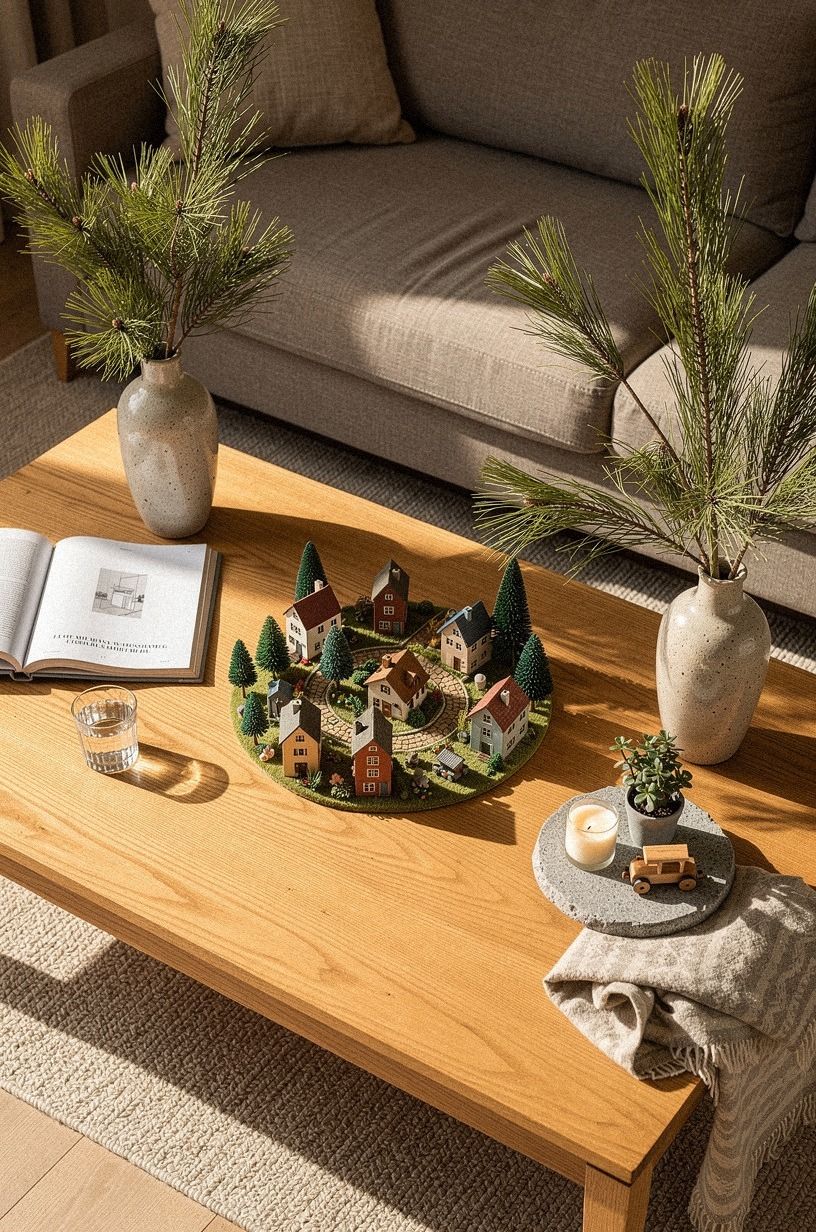
More houses won’t always make your Christmas village decor richer.
4Float a Mirror Behind the Christmas Village Decor
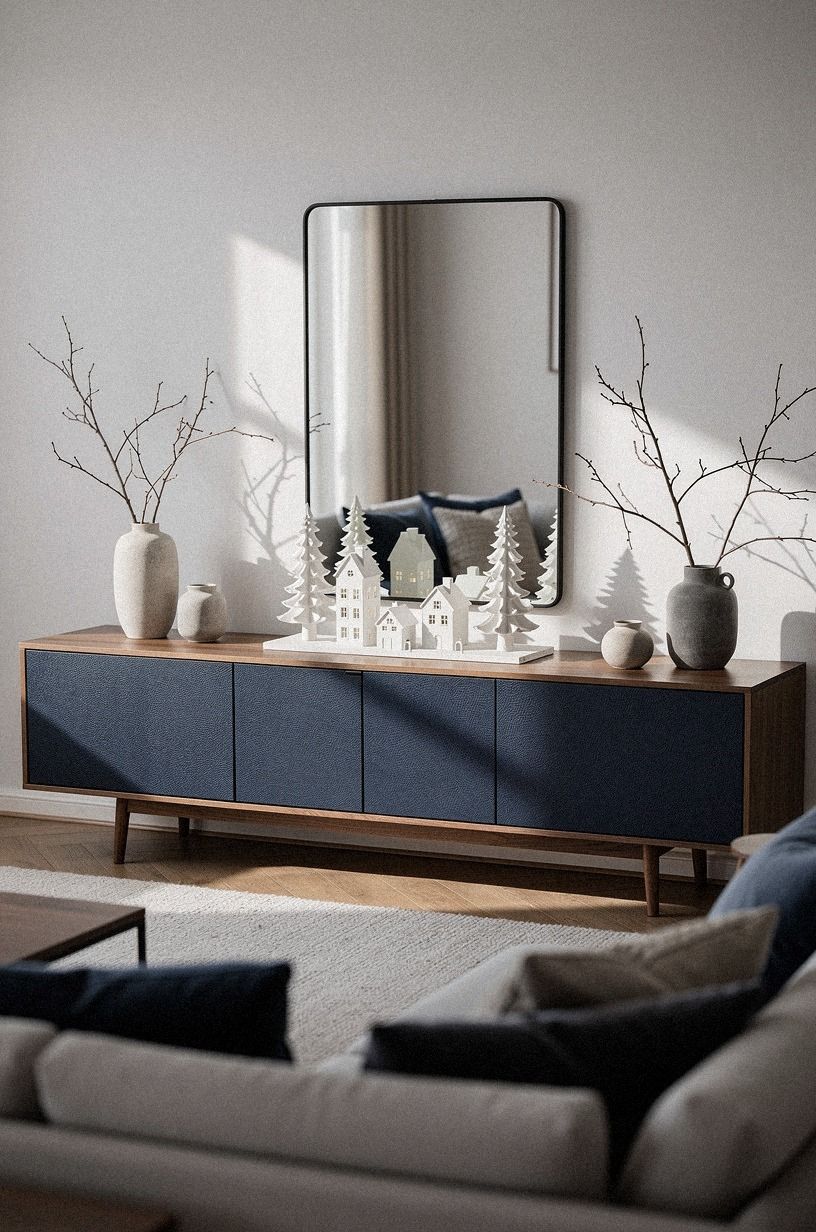
A mirror can double the glow and make a small coffee table display feel deeper. Set a narrow mirror behind the tallest house, or lean a walnut-framed piece against the wall behind a console. Its reflection will catch the lights as you move through the room, which gives the village a gentle flicker after dark.
Choose a mirror with a thin walnut frame. A chunky frame can overpower the buildings, while walnut adds warmth without stealing attention.
If you’re styling a rental, lean it rather than hanging it. You’ll avoid wall damage, and you can move the whole arrangement when the season ends. The mirror should reflect lights or greenery, not a television or a doorway full of clutter.
I made the mistake of placing the mirror directly behind a bright LED string once. It reflected every point of light and looked sharp instead of warm.
Use fewer bulbs, and hide the wire under a shagreen tray or behind the console. You can also borrow proportions from this narrow living room coffee table guide before choosing the mirror width.
A mirror works best when it adds atmosphere without becoming the main event. Keep its edges quiet, and let the small reflected windows do the visual work.
5Build the Two-Wood Rule for a Warm Console
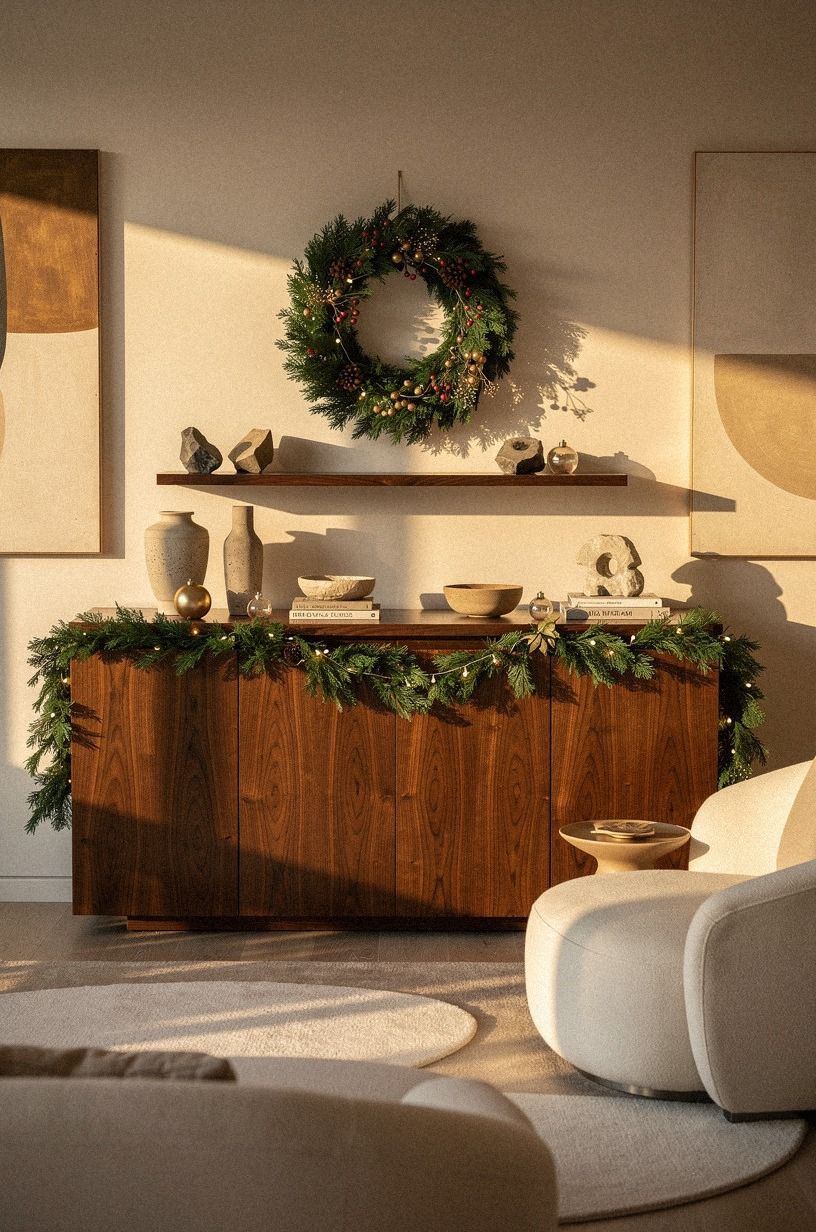
The Two-Wood Rule gives a console display a collected look without making it rustic in a forced way. Choose one primary wood for the tray or console, then repeat a second wood in a small riser, frame, or architectural detail. The difference should be visible, but the colors should still feel related.
A book-matched walnut tray can sit on a painted console, while a walnut riser can warm an emerald cabinet. Add one restrained gold accent and a cream-colored house so the arrangement feels layered without becoming overly bright. You don’t need a matching set of wooden accessories.
Keep the richer walnut near the middle of the arrangement, where it can catch the glow. Put the cream buildings behind it and use emerald greenery to bring depth. I’d avoid adding a third wood unless it’s very small, such as a single natural branch or miniature fence.
If you’re deciding how much surface to leave open, compare the setup with these five-object coffee table ideas. A console needs a little daily breathing room, especially when it also holds mail, lamps, or a bowl for keys.
6What Makes the Three-Height Light Stack Feel Warm?
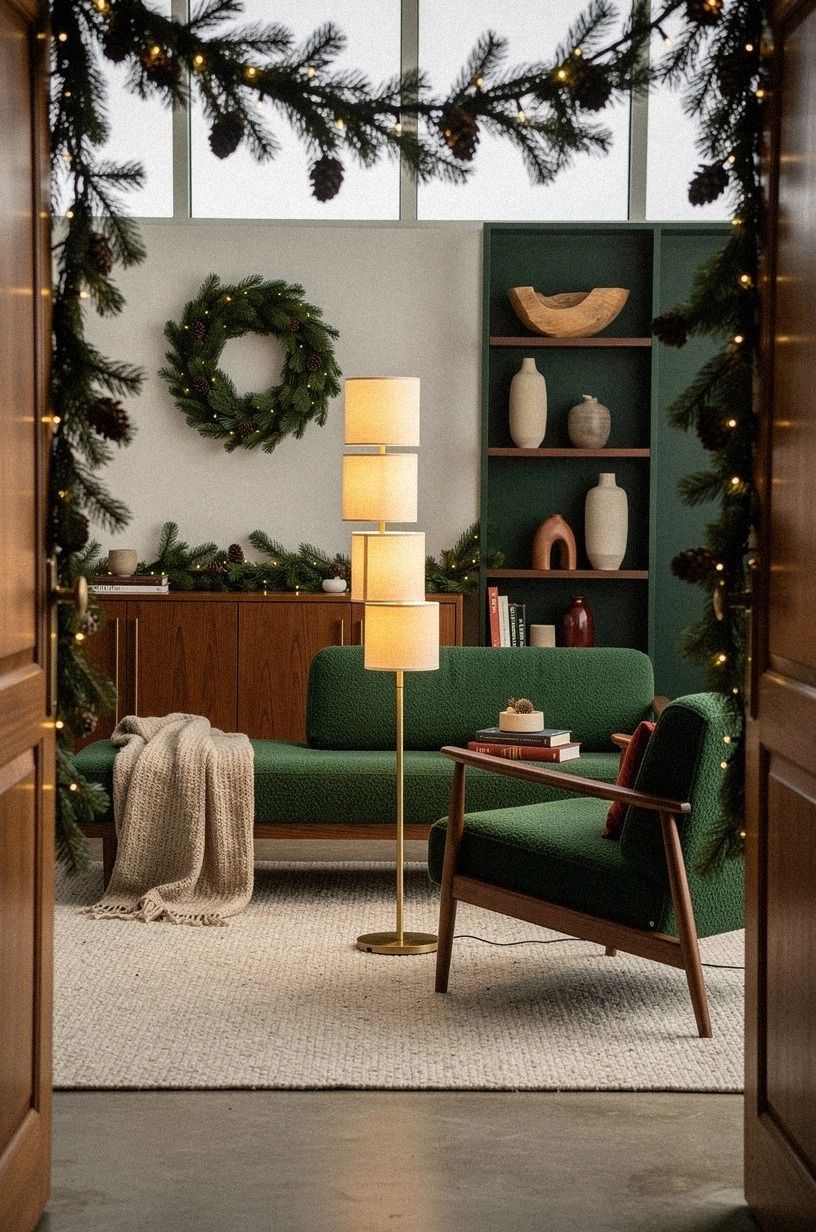
The Three-Height Light Stack works because your eye notices light at different levels. Put one small lantern behind the tallest house, a strand of warm lights through the middle, and a candle-height glow near the front.
You’re creating depth without adding more buildings. I like warm-white micro lights because they disappear in daylight and sparkle after dinner.
Keep the bulbs tucked behind houses and under the edge of the base. If you can see the wire before you see the village, the arrangement needs editing. Battery packs can sit inside a low natural-oak box under the console, while an organic bouclé accent nearby softens the harder wood and ceramic surfaces.
Your setup should be easy to turn on, because nobody wants to rebuild the display every evening.
And don’t use three identical lanterns. That repetition makes the scene feel commercial.
A glass votive, a small metal lantern, and hidden micro lights have different shapes, so the glow feels more natural. For another way to organize several small points of interest, browse this four-zone coffee table rule. It’s a useful starting point for your own layout.
Dimmer light usually feels more inviting than maximum brightness. Test the display from the sofa, the hallway, and the doorway before you decide that it needs more bulbs.
7Paint the Backdrop with Hague Blue for a Moody Christmas Village Setup
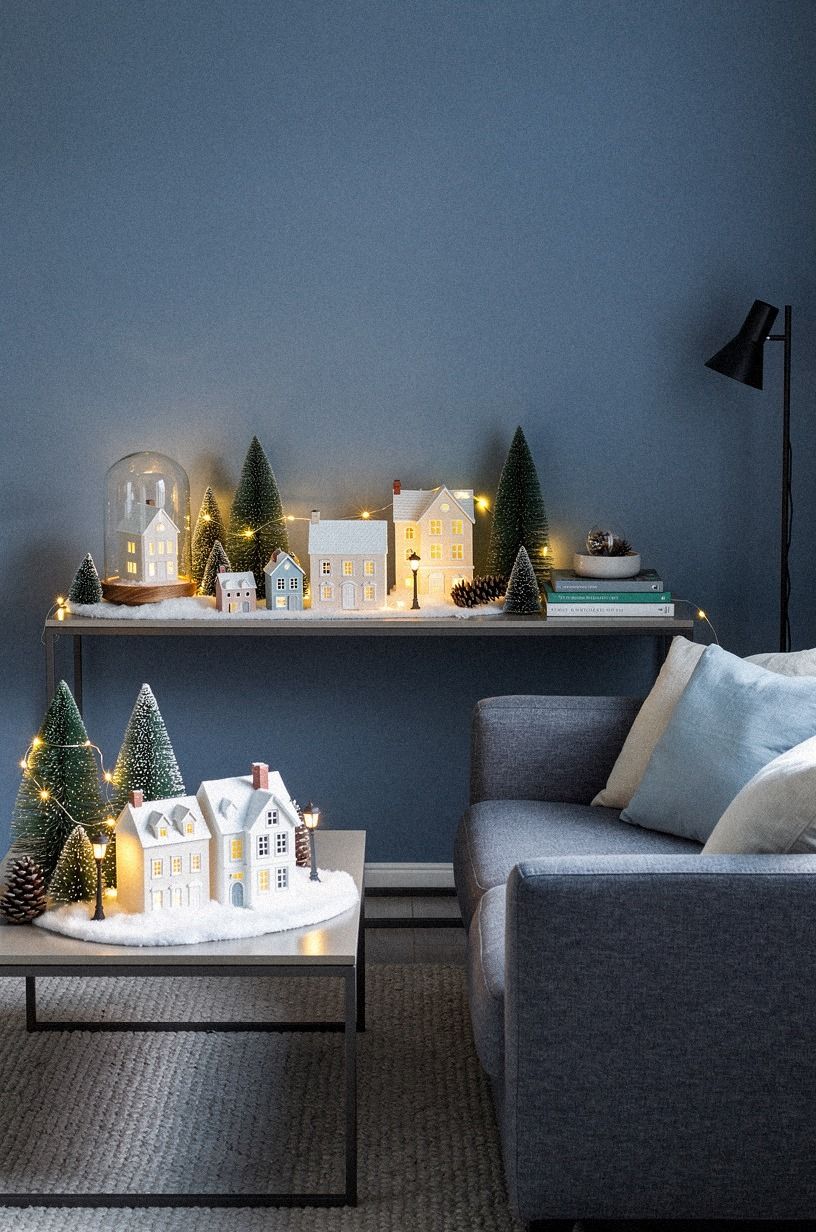
A dusty-rose backdrop can make a Christmas village feel luminous while charcoal accents give it weight. Add touches of unlacquered brass for warmth, especially when the houses are cream or soft white.
You don’t need to repaint the whole room for the season. A painted backdrop board behind the console can create the same effect and store flat afterward.
The backdrop should be wider than the village but lower than the tallest house. That proportion will support the arrangement without becoming a second focal point.
If you want the deeper blue suggested by the title, Farrow & Ball Hague Blue No.30 is dramatic and atmospheric. For a softer result, Farrow & Ball Setting Plaster No.231 brings in the dusty-rose tone without making the room feel heavy.
A small sample board is enough to test the color near your lamps. Paint looks different beside warm bulbs, daylight, and evergreen branches.
You’ll want to see it at 4 p.m. and again after sunset before committing. This is one of those changes that costs less than new furniture but can make your whole living room feel more welcoming!
If you’re working with a narrow room, check the proportions in this narrow living room coffee table guide before making the backdrop wider. The board should support the display, not make the furniture feel smaller.
8Group Small Houses into a Three-Zone Christmas Village Display
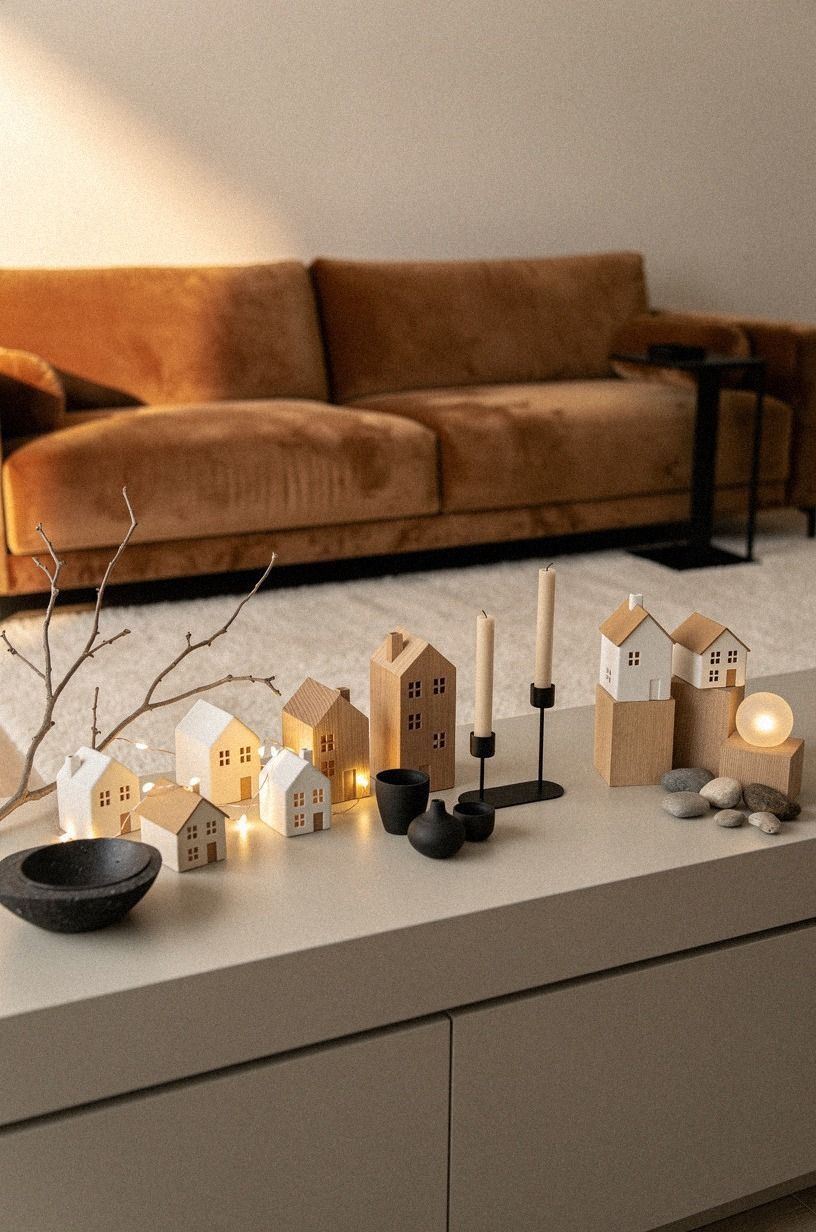
Divide your Christmas village display into three zones: a residential cluster, a community building, and a little landscape edge. Your residential zone might have three small houses.
The community zone could hold a church, school, or shop. The landscape edge gets trees, a fence, and a small path.
This arrangement gives each piece a job.
Use warm-white ceramic houses in the residential group, then add one black accent for contrast. A strip of camel deep-pile mohair velvet can soften the base beneath the buildings.
You don’t need every house facing forward. Turn one slightly toward the center so the scene feels inhabited rather than overly arranged.
I’ve found that a small angle makes the display more picturesque, especially when your table is viewed from several seats.
Keep the zones close enough to read as one village. A gap of a few inches can suggest a road, but a wide empty stretch looks accidental.
If your table is long, the zones can follow its length. If it’s square, use a shallow triangle.
You can study this four-object small living room rule for a similar approach to spacing your pieces.
Add bottlebrush trees in different heights along the landscape edge. A narrow strip of faux snow can connect the groups, but keep it irregular so the scene doesn’t look like a model railway display.
9Swap a Full Table for the Console-Edge Christmas Village Layout
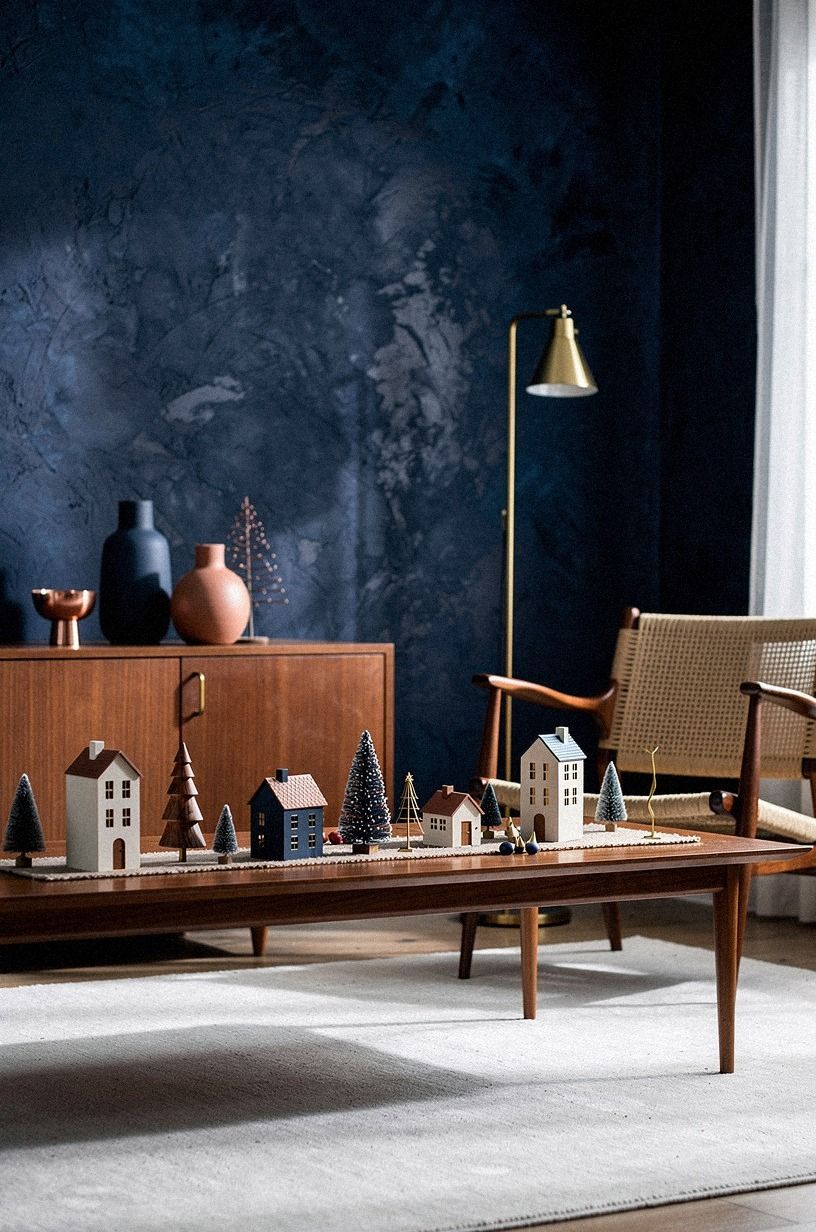
A console-edge layout is ideal when your coffee table already carries books, remotes, or a large tray.
10Use a Low Basket to Hide the Wiring and Spare Pieces
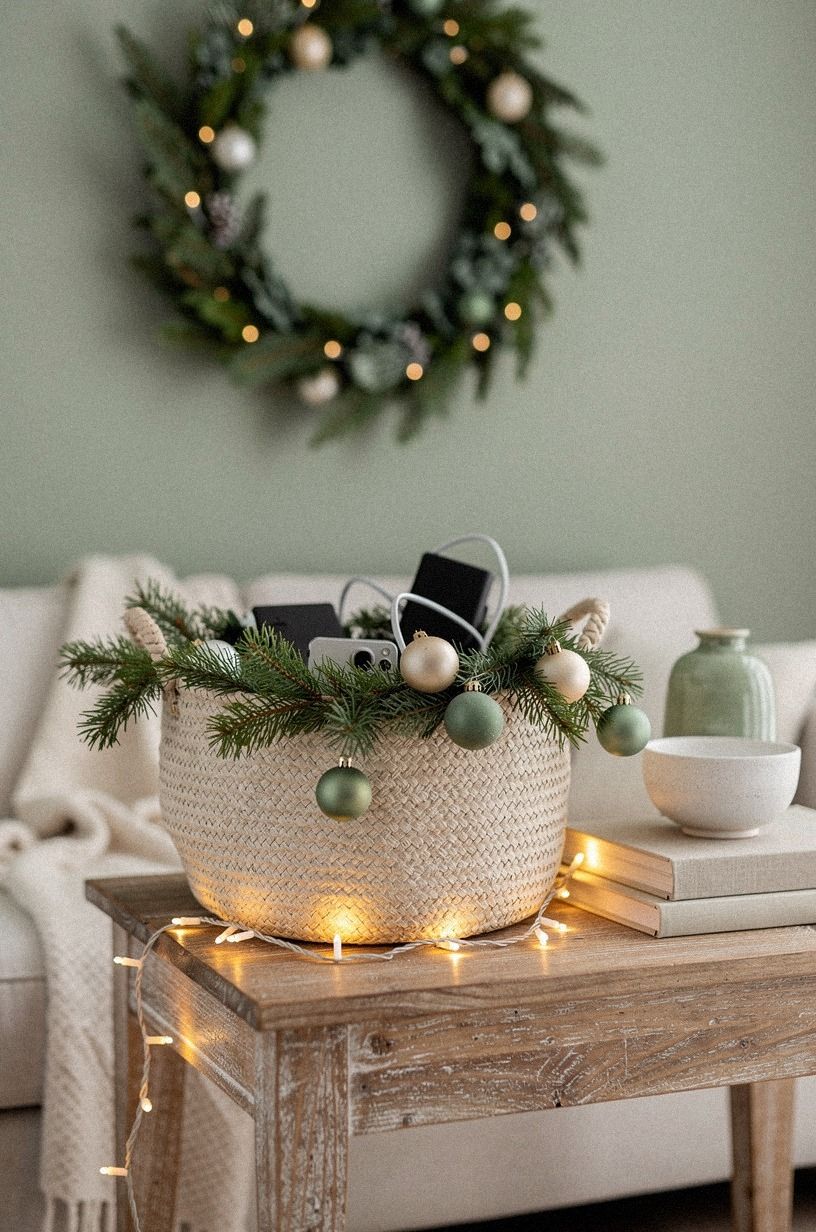
A low basket solves the practical part of a Christmas village setup. Put the battery packs, extra trees, spare bulbs, and remote control inside it, then slide it beneath the console or beside the coffee table. You’ll keep the display tidy while making the seasonal pieces easy to reach.
Choose a low basket with reclaimed weathered teak slats when the room already has natural textures. A sage-green and warm-cream basket works better beside painted furniture, while a small linen-covered box can disappear under a console shelf. The container doesn’t need to match the houses.
It only needs to look intentional when someone notices it.
Leave enough room for the battery packs to breathe, and don’t bury a warm power unit beneath blankets or paper. If you’re using wired lights, coil the cord loosely and label the end before storage. That small habit will save you from testing every strand next December!
For a compact arrangement, the storage logic in this four-object small living room rule can help you decide what belongs on the surface and what belongs below it. The display should stay calm even when the basket is doing a lot of work.
11Let the Tabletop Breathe with the Five-Object Rule
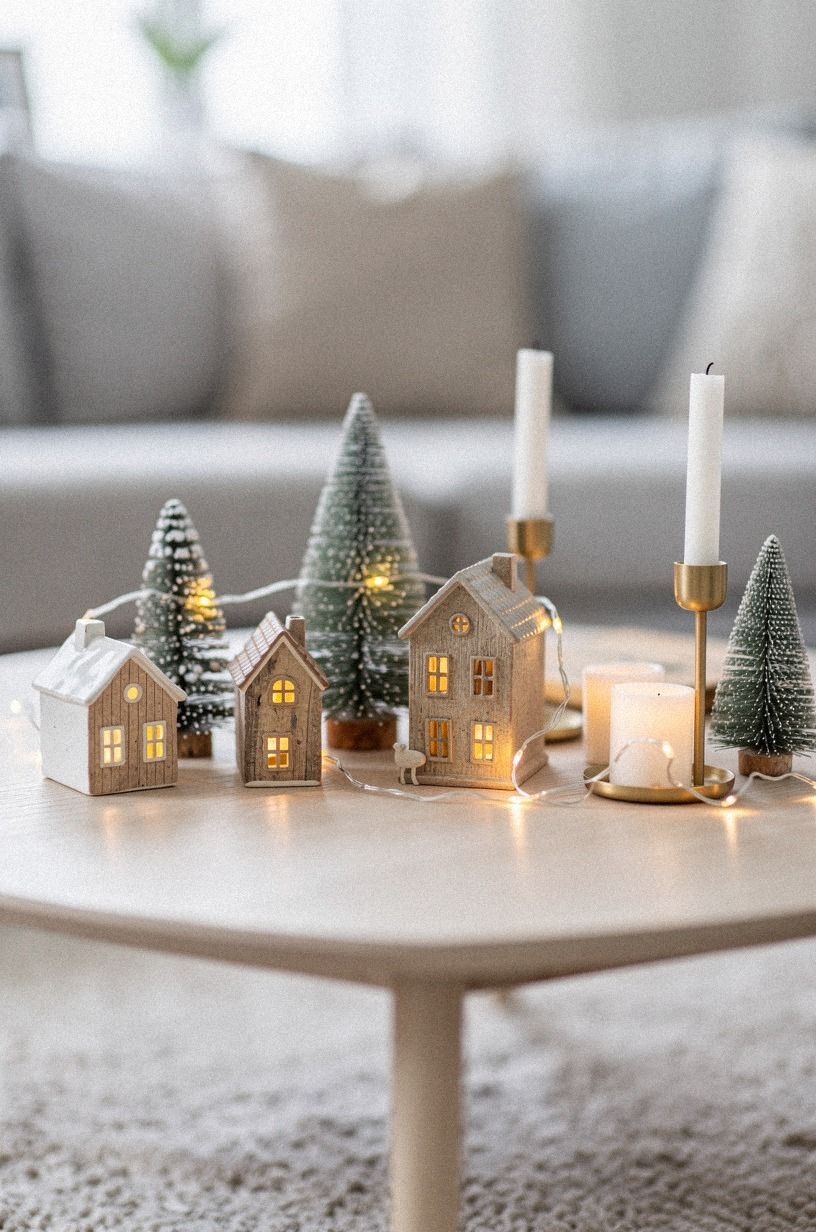
The Five-Object Rule is a strong edit for a small coffee table: one village base, one tall building, one low house cluster, one natural element, and one light source.
12Finish the Christmas Village Decor with One Personal Landmark
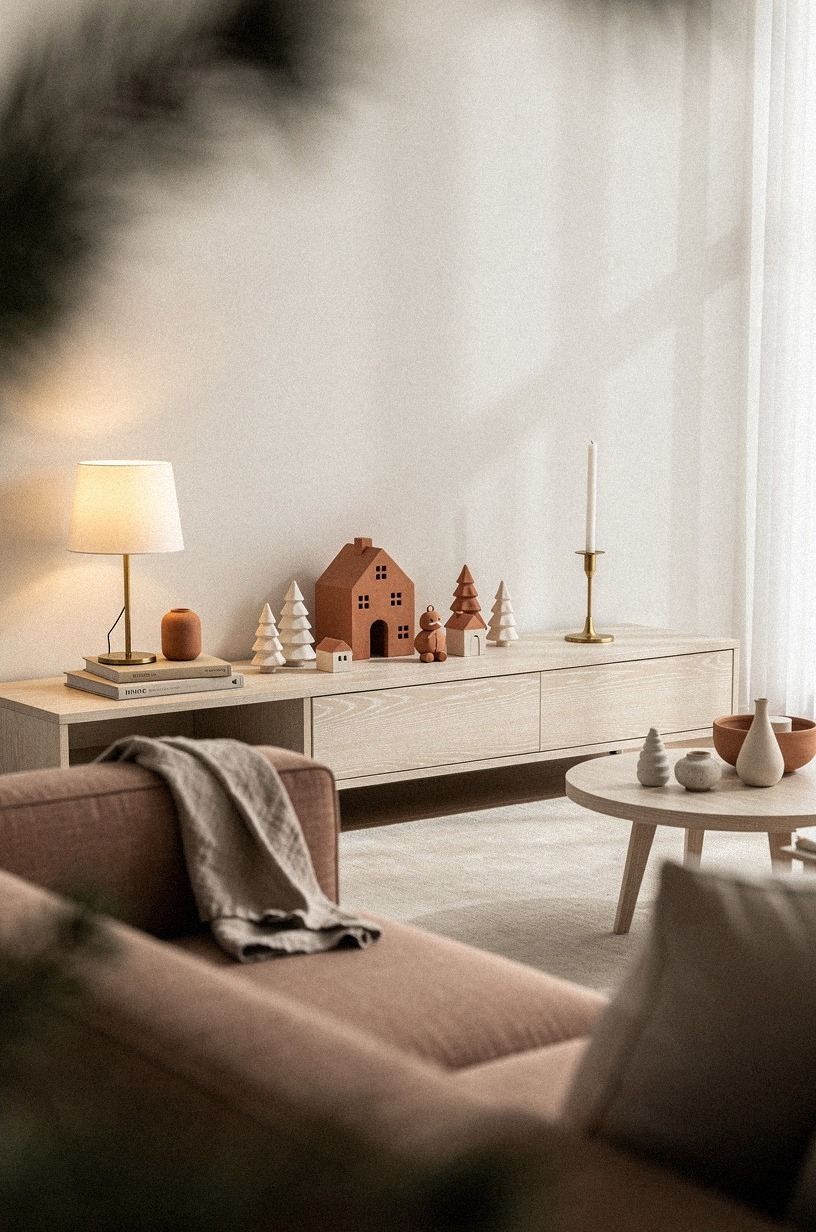
Every village needs one detail that feels like yours. It might be a miniature version of your childhood church, a tiny bakery that resembles a favorite local shop, or a small clay ceramic landmark from a holiday collection. Place that landmark on a cerused white-oak riser where you’ll see it first.
Your display becomes more memorable when one object carries a story.
Keep the personal piece slightly separate from the main cluster. A narrow path of faux snow or a line of bottlebrush trees can connect it without making it look identical to the other buildings.
You don’t need a large collection. One meaningful landmark beside neutral houses often feels more intimate than a full set bought all at once.
If you’re short on space, let the landmark sit on a small side table instead of forcing it into the main layout. Your Christmas village decor can travel through the room in small scenes. I love pairing a little building with aged brass, washed linen, and a sprig of fresh rosemary because the metal adds warmth while the greenery brings a fresh scent.
For a related approach to distributing small vignettes, browse these five-object coffee table ideas. The same idea works across a console, bookshelf, and side table when you want the holiday story to move through the room.
The Honest Cost of a Living Room Village Display
A village display itself can be inexpensive if you already own houses, greenery, a tray, and lights. The larger expense usually comes from the surrounding living room, especially if you decide to replace the rug, sofa, or console at the same time. Your display doesn’t need a full room makeover, but these typical US figures help you separate a seasonal refresh from a furniture project.
For a more focused refresh, use the smallest changes first. A warm lamp, a painted backdrop, and greenery can alter the mood without touching the sofa. A performance-fabric sofa typically falls in the $1,200-$4,000 range, while a wool rug in a 9×12 size runs about $600-$2,500.
You’ll get more seasonal impact by editing the tabletop before investing in a major piece.
If you’re comparing furniture proportions before spending, this narrow living room coffee table guide can help you think through scale. A seasonal display rarely needs the most expensive item in the room. It needs a surface that gives it a clear home.
For additional layout ideas, this four-zone coffee table rule is useful when you’re refreshing what you already own. Rearranging the objects can change the mood before you buy anything.
Why This Simple Display Still Feels Personal
I’ve come around to the idea that holiday decorating works best when it leaves some room for ordinary life. A coffee table should still hold your tea. A console should still catch the keys.
The village becomes more inviting when it shares the room with the things you use, rather than demanding that the entire space become a themed set.
The displays I remember aren’t the ones with the most buildings. They’re the ones with one warm window, a slightly crooked tree, and a road that disappears behind a house.
That imperfection matters. If every piece is evenly spaced and perfectly centered, your eye has nowhere to wander. A little irregularity makes the scene feel lived-in.
I once bought an entire matching village set because I thought consistency would make styling easier. It didn’t. The buildings were the same height, the same white finish, and the same visual weight, so the arrangement looked flat.
I kept the bakery and traded the rest into smaller clusters. Your own collection may work better when you stop treating it as one set.
For your room, I’d choose the layout based on how you move through the space. If you see the display from the sofa, create a low foreground. If you approach it from the hallway, give the tallest building a strong silhouette.
And if you’re styling a rental, use leaning pieces, removable hooks, and a freestanding board. The most successful arrangement is the one that still feels warm when you walk past it at midnight.
You can borrow the editing approach from this four-object small living room rule when the room feels visually tired. Remove one object, shift one light, and check the arrangement from the places where you actually live.
If you want a final checklist for the surface itself, these five-object coffee table ideas offer a practical way to judge balance. The best village display is the one that still leaves room for your real evening.
The Questions I Get Asked Most
What is the best Christmas village display idea for a small living room?
The best choice is a narrow, one-sided layout with one tall house and a low greenery frame. Your display will feel more spacious because the center of the table stays open. An IKEA KALLAX console or slim coffee table can hold the scene without blocking your walking path.
A shallow tray, warm micro lights, and one landmark are enough. You don’t need a full collection to make the corner feel charming. Start with the proportions in this narrow living room coffee table guide if you’re unsure how much clearance to leave.
Where can I buy Christmas village pieces on a budget?
You can find affordable pieces at IKEA, Wayfair, Target, thrift stores, and Facebook Marketplace. Look for ceramic houses with intact lights, shallow trays, and small trees. Secondhand brass can add warmth without requiring a full new collection.
Your best savings usually come from buying mixed pieces instead of a matching set. Check the base and wiring before you bring anything home. A thrifted wooden tray and a few branches can also create a convincing foundation.
How much does a Christmas village makeover cost?
A small display can cost about $100 to $300 if you need a tray, greenery, lights, and a few buildings. Existing books, bowls, branches, and fabric can bring your cost down. Warm micro lights often create more impact than another house.
If you’re also changing the room, typical living room refreshes range from $300-$1,200 for budget updates. Your seasonal display doesn’t require that full investment. These five-object coffee table ideas can help you decide what to edit before you shop.
Can I create a Christmas village display on a budget?
Yes, and you can start with three free changes: rearrange books into a riser, gather branches from your yard, and use a bowl as a hidden platform. A thrifted wooden tray can hold the whole scene.
Your lowest-cost upgrade is usually better spacing. Remove one or two pieces, raise the tallest house, and hide the wires.
The village will look more intentional without buying anything. The four-object small living room rule is helpful when you’re working with only a few objects.
Is a Christmas village display worth it in a small space?
Yes, because a small space gives you natural limits. A compact display can feel intimate when you use one surface, one light source, and one clear direction. A narrow console is often better than a deep table because it keeps the floor open.
Keep your village below eye level if it sits behind a sofa. You’ll preserve sightlines and still get a warm glow from the seating area. This four-zone coffee table rule can help you leave a clear path around the display.
Is a Christmas village display a good idea for a rental?
Yes. Lean a painted board against the wall, use removable hooks for greenery, and keep your houses on a freestanding tray. Peel-and-stick hooks can hold lightweight garlands without permanent damage.
Your rental display should be easy to lift and store. Avoid drilling for a backdrop, and use a tension rod for a small fabric panel if you want a seasonal wall behind the console. Keep the whole arrangement portable so you can move it when the room’s function changes.
Where I’d Start First
If I had to pick one, I’d start with the one-sided tray layout. It leaves your table usable, makes a small collection look intentional, and gives every light a clear place to glow. Pin the layout for later and browse these five-object coffee table ideas before you style yours.