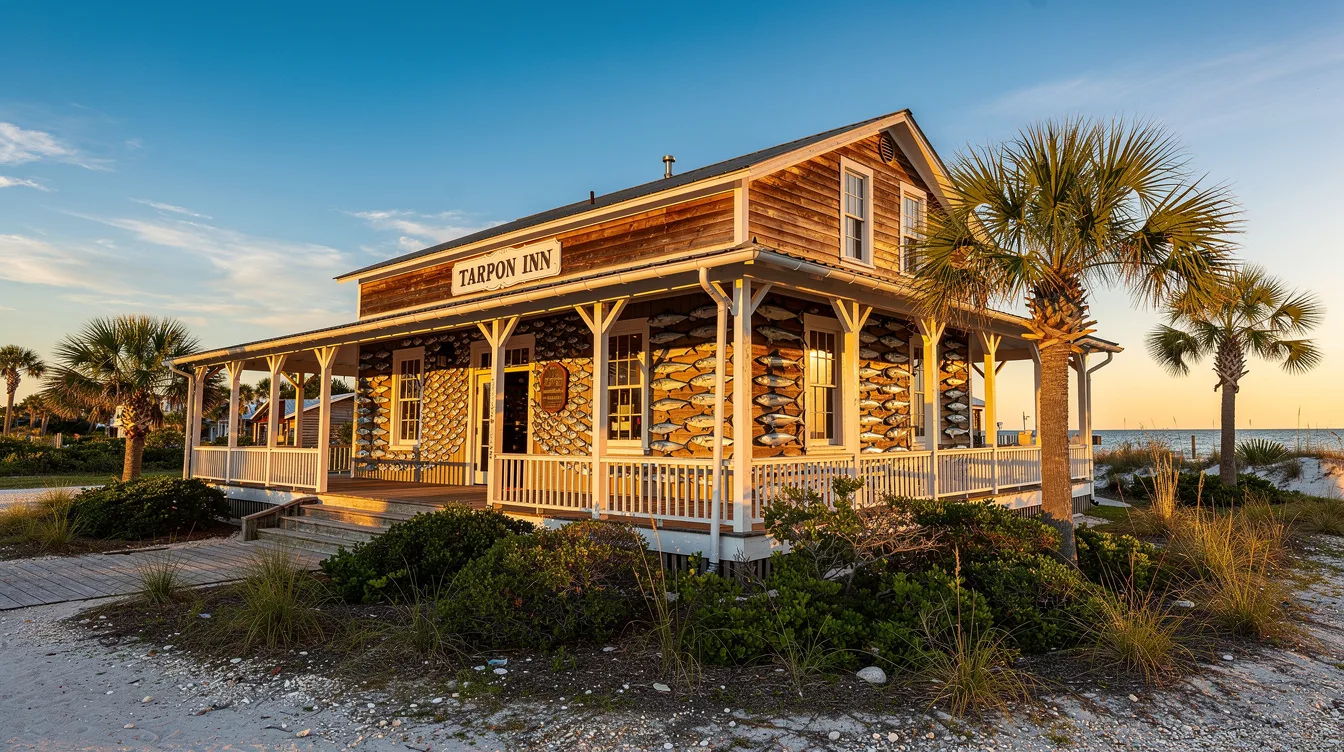
But in Port Aransas, Texas, the Tarpon Inn is more than an old coastal hotel. It dates to 1886, yet its strangest detail is indoors: two walls covered with signed tarpon scales.
And each scale carries a record of its fish and its angler. You’ll find the signature and hometown of the person who caught it, along with the tarpon’s length, weight, and capture date.
Two walls turn fishing into a local archive
The scales make the inn feel less like a conventional hotel and more like a room-sized fishing ledger. Every entry fixes one catch to a person, a place, and a moment.
And that’s the part I find most compelling. You don’t need to know the anglers or care about fishing records to understand what these walls préservé: ordinary people marking an extraordinary day.
The display also gives the building its own rhythm. Pale scales cover the walls in overlapping rows, while each small inscription adds another piece of coastal history.
Why 1886 still matters on Mustang Island
The inn began with surplus lumber from Civil War barracks. It was built to house workers constructing the south jetty, then became a hotel after the jetty was finished.
But the first purpose still explains the building’s character. You can picture a rough work camp becoming a place where travelers stayed, fished, and watched ships move through the pass.
Port Aransas is the only established town on Mustang Island. That setting keeps the inn tied to working water, even as its walls préservé stories from a much older Texas coast.
The 1919 hurricane changed the building
And the inn’s survival story has a hard break. The 1919 hurricane destroyed the main structure, so the building was sold and rebuilt in 1923 to resemble the old barracks.
The rebuilt structure received serious reinforcement. Many new pilings were set in concrete, with their ends extending through the building and into the attic.
That construction allowed the inn to house people during storms. It also became a headquarters for relief organizations and military units. My opinion is simple: the walls matter because the building earned them.
San Antonio is 180 miles away, but the coast feels separate
Port Aransas sits on Mustang Island in Nueces County, about 180 miles southeast of San Antonio. You’re surrounded by Corpus Christi Bay, the Gulf of Mexico, and shipping channels.
And that distance changes the mood. The town is remote, but not hard to place, with its identity shaped by water on nearly every side.
You can think of the Tarpon Inn as a meeting point between island life and Texas history. It carries the marks of storms, construction crews, anglers, and visitors without smoothing them into one tidy story.
What the inn’s 1979 recognition says
In 1979, the Tarpon Inn joined the National Register of Historic Places and received recognition as a Texas Historic Landmark. That status acknowledges the building’s history, but it doesn’t explain its appeal by itself.
But the scales do. You notice the inn’s past through small handwritten records, not a grand display or polished timeline.
If you visit, give the walls time. Read a few entries, look at the dates, and notice how a fish can connect an angler to a hometown far beyond Mustang Island.
And when you step back, the room becomes almost quiet in your mind. The tarpon scales remain fixed to the walls, carrying old signatures beneath the salt air.