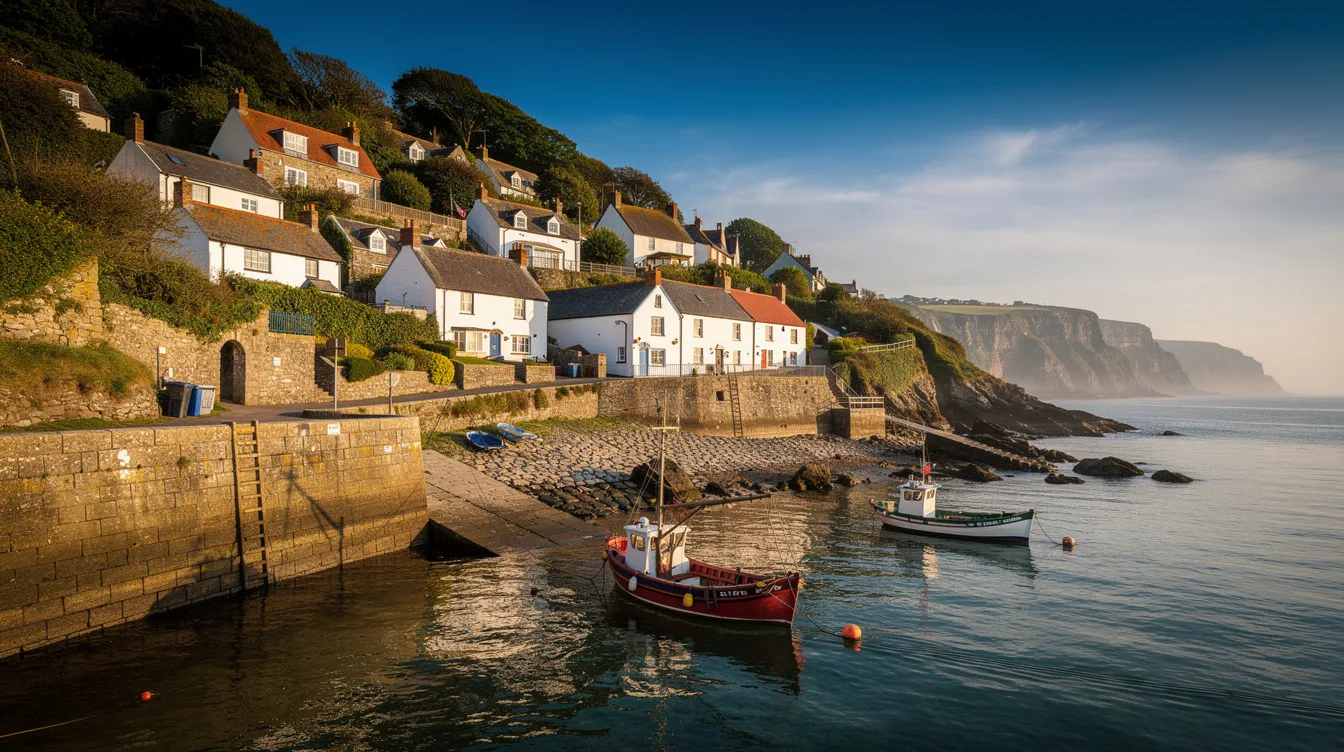
Clovelly is an English harbor with a hard story behind its postcard shape. On October 28, 1838, 12 fishing boats left with 26 men. A violent storm in the Bristol Channel returned only one vessel and its crew, helping inspire a society for mariners’ families.
The Shipwrecked Mariners’ Society formed early the following year to support widows, orphans, and sailors after shipwrecks. Later, Clovelly’s lifeboat station recorded 158 lives saved between 1899 and 1931. That is the fact that gives this harbor its weight.
You can still walk down through the village toward the water, but the route isn’t gentle. I think Clovelly works best when you treat the descent as part of the story, not as a quick stroll between photographs.
The 1838 storm still explains Clovelly’s character
The village sits on wooded sea cliffs along the north Devon coast. Its steep street drops toward Clovelly Bay, where fishing once shaped daily life and the harbor offered shelter along this stretch of coast.
If you follow the north Devon coast toward the harbor, the cobbles make every step deliberate. The street is narrow, sloped, and full of visual turns, so you notice the buildings before you reach the water.
That steep approach also explains why deliveries come down by sledge rather than vehicle. It sounds quaint until you imagine moving supplies and refuse along the same gradient, day after day.
And the village feels lively without feeling loud. My opinion is simple: Clovelly’s physical difficulty is its best feature, because the effort keeps the harbor from becoming just another easy coastal stop.
A car-free street with a practical catch
The pedestrianised main street is inaccessible to motor vehicles. More than 50 of the village’s 71 main-street buildings are architecturally listed, and only seven buildings there are not listed.
You should expect a walk that is easy downhill and demanding on the return. The cobbles can slow you down, especially if your knees dislike steep gradients, but that pace gives the place room to register.
Clovelly is privately owned, and entry through the visitor centre includes parking, museums, gardens, and an audiovisual history guide. You can also reach the village free on foot from public highways, including Clovelly High Street.
That arrangement is a trade-off. The fee and private management help maintain the setting, while the public approaches mean you aren’t entirely dependent on the visitor centre.
The lifeboat story continues beyond 1931
Clovelly has had an RNLI lifeboat station since 1870. It cost £175 to build, then became part of a longer rescue history that connected the harbor’s fishing past with organized coastal aid.
In 1988, the RNLI closed the station. Villagers responded by operating their own rescue service, which tells you more about the harbor than any polished heritage label could.
The RNLI reopened the station in 1998, and an Atlantic 85-class lifeboat arrived in 2014. If you care about maritime history, this is where Clovelly feels most substantial.
The village is not simply preserved scenery. It has repeatedly had to decide how much of its old working identity can survive tourism, ownership changes, and modern safety needs.
How do you reach Clovelly without driving?
You can use Stagecoach bus 319, which connects Clovelly with Barnstaple and Bideford. The route also reaches Hartland, making public transport a realistic option for a day along the coast.
From the top of the village, the South West Coast Path continues beyond Clovelly. If you arrive by bus, you can make the descent part of a longer walk, though you should plan around the steep return and your preferred pace.
The English village is remote in feel but not difficult to identify on a map. You don’t need a car to reach it, yet you do need patience once you arrive.
That distinction matters for older travelers. Bring shoes with reliable grip, leave time for the climb, and don’t build a tight schedule around the harbor.
Why Clovelly rewards a slower visit
Clovelly became a tourist destination long ago. In the 1930s, 50,000 cars visited each year, while the village had around 150,000 visitors annually in the 2020s.
Those numbers explain the tension. You may share the street with plenty of other visitors, but the steep route still prevents the place from feeling frictionless.
The Devon coast is full of easier viewpoints, yet Clovelly asks more from you. In return, the harbor feels connected to its history rather than arranged around it.
By the time you reach the water, the street behind you has become a long sloping ribbon of stone. The walk back is uphill, and that is exactly why the harbor stays in your mind.