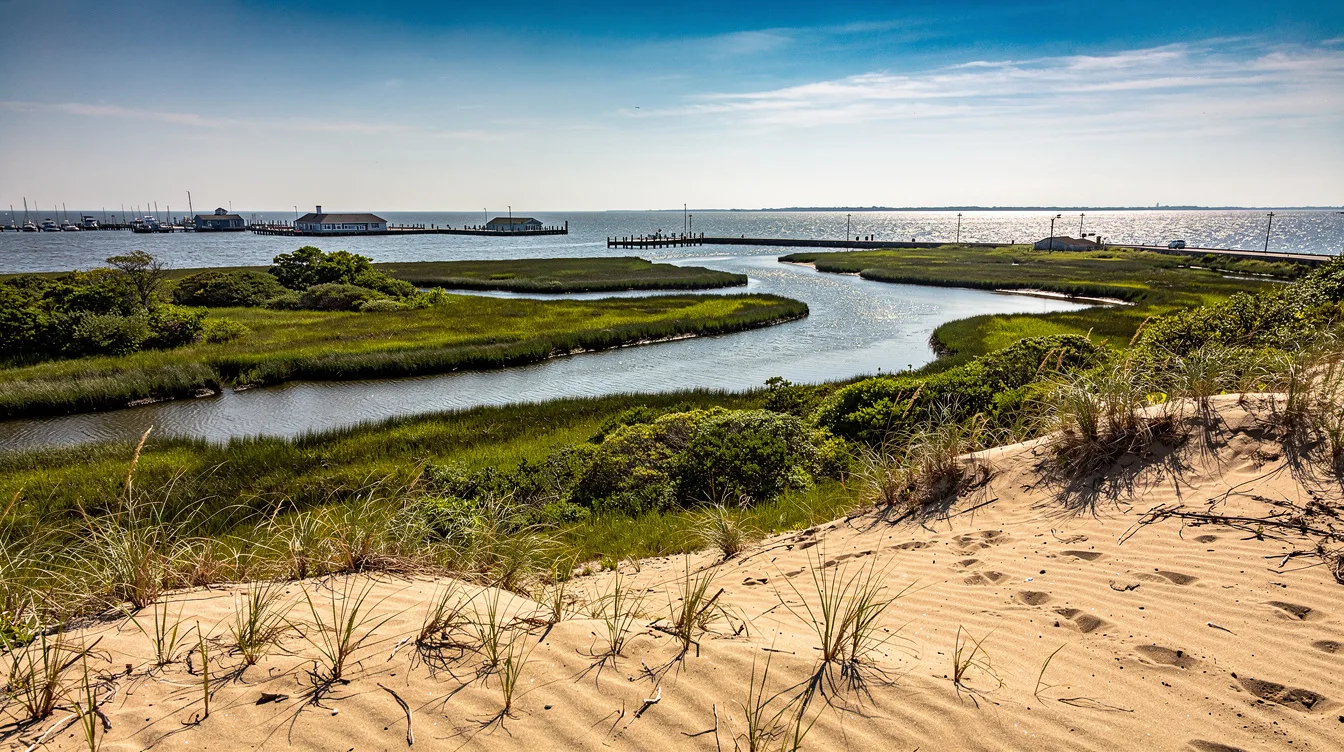
Lewes traces its story to Zwaanendael, the Dutch colony founded in 1631. That claim gives this Delaware town a different rhythm from nearby Rehoboth Beach, where the boardwalk and nightlife take center stage. Here, the bay, maritime history, and compact center shape the day.
And the location explains the appeal. Lewes sits in Sussex County where Delaware Bay meets Cape Henlopen, with Rehoboth Beach about 20 minutes away. You can reach the busier resort quickly, then return to quieter streets and the sound of water along the shore.
Why 1631 still matters in this Delaware town
Lewes calls itself “The First Town in the First State” because it claims Delaware’s first European settlement. The Dutch established Zwaanendael here in 1631, and that fact is the town’s strongest opening chapter.
But Lewes isn’t preserved as a single historical scene. Its past also runs through fishing, maritime pilots, shipbuilding, and coastal defense. That mix gives the town more texture than a simple colonial story.
And the Delaware travel story becomes easier to understand when you walk Second Street and Savannah Road. Independent shops, galleries, restaurants, and older buildings keep the center active without turning it into a full-time resort.
You’ll want to begin at the Zwaanendael Museum, a small museum devoted to Dutch colonization and local history. Its building draws on the design of a Dutch town hall, so the subject starts before you reach the exhibits.
Cape Henlopen makes the coast feel bigger
Cape Henlopen State Park spreads across roughly 5,000 acres near town. And because it includes bay beaches, ocean beaches, dunes, trails, and bike routes, you can change the day’s pace without changing your base.
The park is a good fit if you want room to move. You can ride toward Gordons Pond, walk near the water, or spend time fishing. The scale feels expansive, but Lewes remains close enough for an easy return.
But summer is the busiest season for the beaches. Spring and fall suit you better if your priorities are cycling, walking, and museums rather than long afternoons in the sand.
Can you swim in calmer water?
Yes, Lewes Beach and Savannah Beach sit on the bay, where the water is often calmer than the Atlantic-facing beaches. Savannah Beach is especially practical because it has parking and facilities.
And that convenience comes with a trade-off. You won’t get the full oceanfront resort atmosphere, but you may find the bay more comfortable for an unhurried swim.
Fort Miles adds a harder edge to the visit
Lewes also remembers the coast as a place that needed defending. Fort Miles was a World War II military complex with a museum and coastal defense structures, making it the right stop for anyone interested in military history.
But the story doesn’t end with the fort. The Cannonball House, a maritime museum operated by the Lewes Historical Society, recalls the British bombardment during the War of 1812.
You can pair those visits with a walk through the historic center. And because the museums sit within a town built for strolling, the transition from exhibits to shops and restaurants feels natural.
That combination is Lewes at its best: serious history beside a relaxed waterfront town. It’s quieter than Rehoboth Beach, but not isolated, and you can reach the livelier resort when you want more activity.
A ferry ride turns Lewes into a coastal base
The Cape May-Lewes Ferry crosses Delaware Bay to Cape May, New Jersey. And the boat changes your sense of distance, especially when the shoreline opens up and the town becomes a smaller shape behind you.
The crossing works well as an excursion when you’re building a road trip around both towns. You can also stay closer to Lewes with a sunset cruise, wildlife outing, fishing trip, kayak, or paddleboard session on protected water near the canal.
But you’ll need to check ferry and park conditions before leaving. Coastal storms can cause temporary closures, and late September 2026 brought flooding and damage that affected some trails and campgrounds.
Summer is best for the beach. Spring and fall are better for bikes, museums, and long walks when the town’s historic details have room to breathe.
Plan for a town with limits
Lewes isn’t the place for a constant boardwalk buzz. And that’s precisely why I’d choose it for a few days if you want history, bay water, and a slower coastal base.
You can stay near the center, explore Cape Henlopen, then drive to Rehoboth Beach for more shops and nightlife. The contrast is useful: Lewes feels historic and calm, while Rehoboth feels more touristy and lively.
Give yourself time to look closely. You’ll notice old buildings, maritime references, the quiet pull of the bay, and the practical beauty of a town shaped by water.
By evening, the ferry route fades across Delaware Bay, and Lewes settles back into its smaller rhythm.