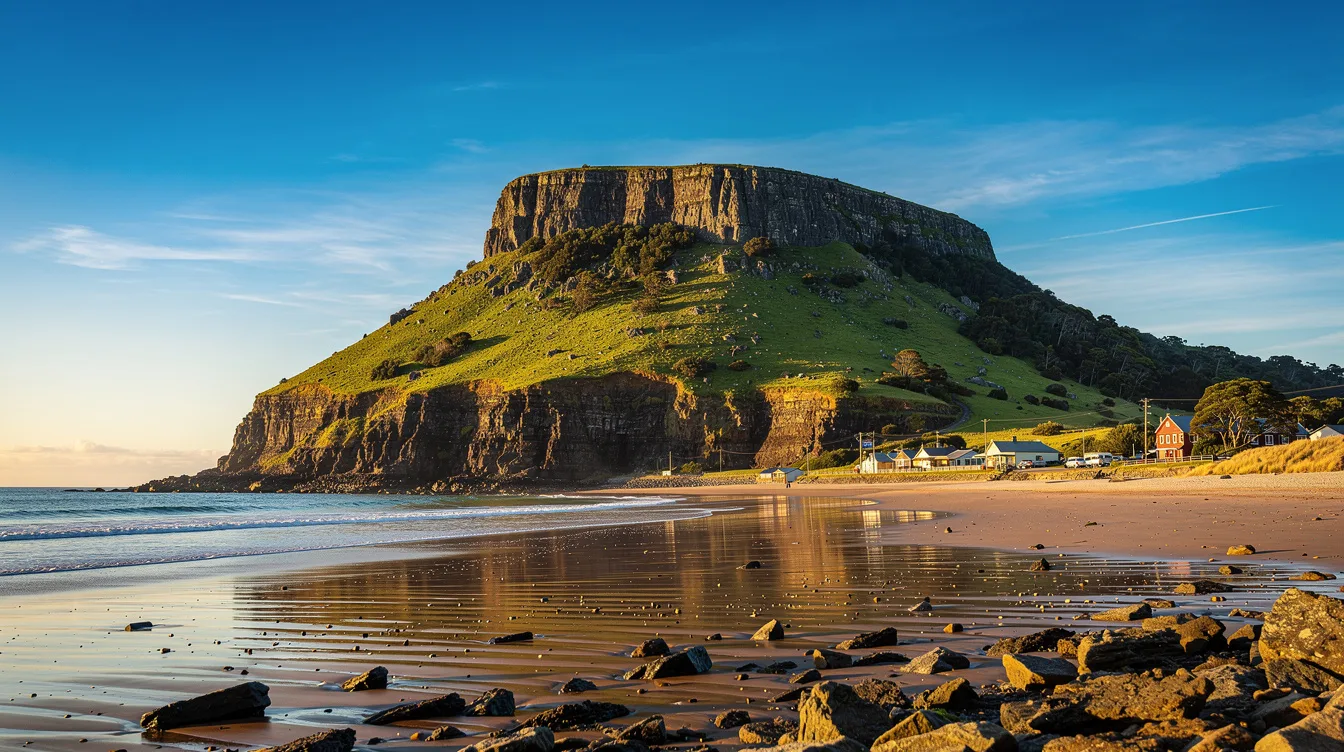
Stanley sits beneath The Nut’s 469-foot volcanic bluff, a flat-topped mass rising above the town and Bass Strait. The profile is so dominant that your first afternoon can disappear simply by walking toward it, camera in hand, while fishing boats move below.
And this is a small coastal village, not a resort built around one attraction. But the bluff gives Stanley a sense of drama that its quiet streets don’t have, which is why it works best as a one- or two-night stop.
The Nut gives Stanley its vertical edge
And the climb to The Nut takes about one to two hours when you include the summit loop. You can walk up or, depending on operations and weather, take a chairlift, then follow the plateau above the village.
But the summit is where Stanley makes its case. The views reach across Bass Strait, over the town, and toward Rocky Cape, while the wind gives the flat top a properly exposed feel. The climb is steep, so start early if you don’t enjoy walking uphill under direct sun.
If you want the essential view of Tasmania’s northwest coast, this is it. The Nut is touristy in the briefest sense, but the harbor below stays calm and working, with fishing activity continuing beyond the lookout.
Stanley’s 45-90-minute history loop feels lived in
And Stanley has more to offer than a dramatic outline above the water. The village was established in the early 1830s by the Van Diemen’s Land Company, and its older streets still carry cottages and colonial buildings from the 19th century.
But the history is easiest to understand on the self-guided Stanley Heritage Walk. You can spend 45-90 minutes moving through the old center, where the quiet streets and weathered buildings feel practical rather than staged.
For a deeper visit, drive to Highfield Historic Site. The former estate includes a Regency-style house, convict barracks, stables, a chapel, and gardens, with The Nut visible beyond them. My view is that Highfield earns its time because the history remains physical.
And if you prefer to keep walking, follow the waterfront toward Wharf Road and the port. You’ll hear rigging and gulls instead of traffic, and the town’s identity as an active fishing port becomes clear. That quiet working quality is Stanley’s best contrast.
Can you see little penguins after dark?
Yes, little penguins come ashore at Godfreys Beach after nightfall. And the dedicated viewing platform lets you watch without stepping onto the beach, where the dark water and low surf make the arrival easy to miss.
But you need to keep your distance and stay on the marked facilities. Don’t use flash or white lights, and keep your voice low. If you want a simple evening activity, this is better than a busy attraction because the waiting is part of the experience.
During the day, Godfreys Beach and Tatlow’s Beach are good places for a coastal walk and photographs of the bluff. You’ll feel the wind coming off Bass Strait, especially when the beach is empty. The scenery is open, but it isn’t gentle in bad weather.
And Stanley fits neatly into a wider Rocky Cape National Park itinerary. You can add short walks, longer hikes, swimming, or snorkeling there, with the park less than half an hour away by car.
Stanley is remote, but access is straightforward
And from Devonport, Stanley is about 77.7 miles and one and a half hours by car, depending on stops. Devonport is also where the Spirit of Tasmania ferry arrives from the Australian mainland, making the town a practical first or final stop.
But you’ll want a car once you arrive. Launceston is about 139.8 miles away, Hobart takes roughly four and a half hours, and nearby sights such as Dip Falls, The Big Tree, Woolnorth, and Arthur River spread across the region.
As of late September 2026, safety work has started along 1.7 miles of Stanley Highway and is expected to continue through late 2027. Allow extra time near Stanley, especially if your plan depends on a tight arrival.
How long should you stay?
One night covers the Heritage Walk, a beach, the penguins, and The Nut. And two nights feel better if you want Highfield and a nearby excursion without turning the visit into a checklist.
But the finest moment may come after the last activity ends. By then, the harbor is quiet, the bluff is only a dark shape above town, and Bass Strait keeps breathing beyond the cottages.