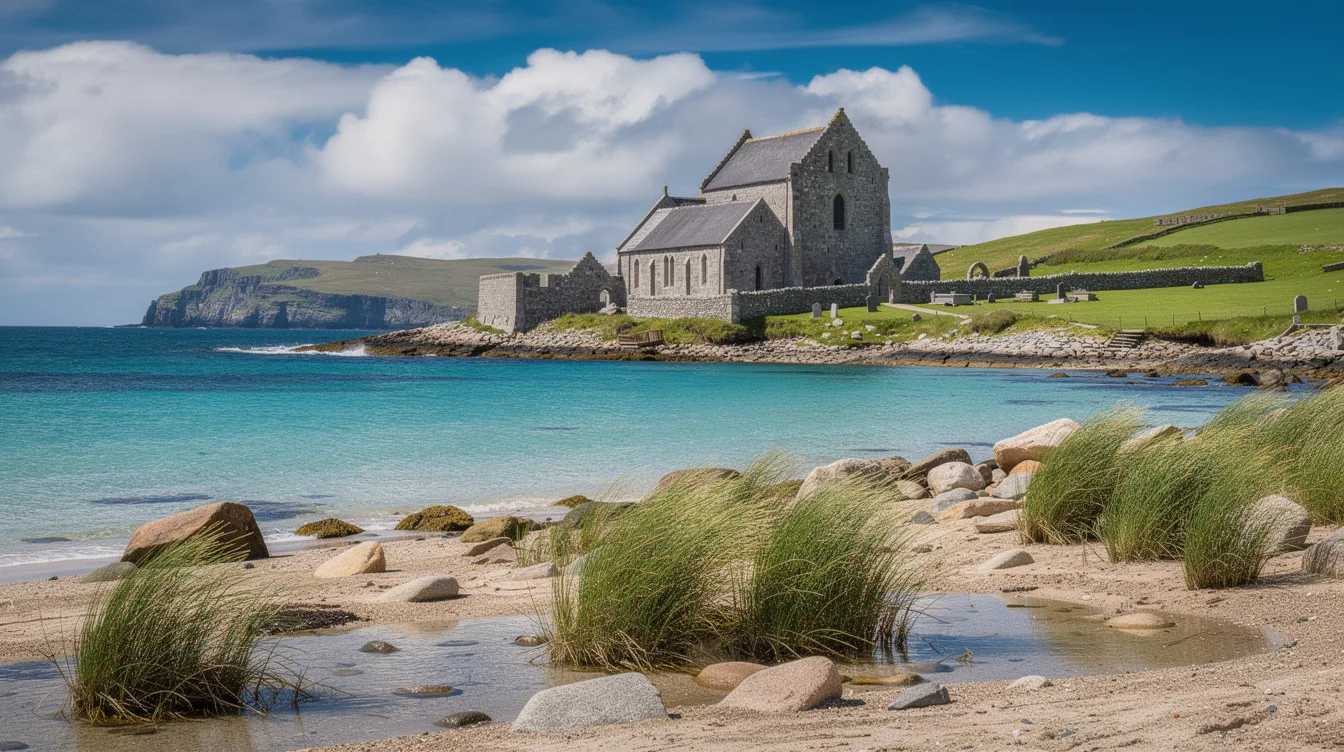
Founded around 563 by St Columba, Iona became a major centre of Celtic Christianity and is considered Scotland’s Christian cradle. That claim feels weighty until you reach the island, where wind moves through the grass and the sea keeps the setting spare.
Iona sits off the Ross of Mull in Scotland’s Inner Hebrides, separated from Mull by the Sound of Iona. It’s small, largely treeless, and quiet, with white-sand beaches, rocky ground, and clear water. You come for the history, but the island’s silence may stay with you longer.
Why 563 still matters on Iona
St Columba arrived from Ireland in 563 and established a monastery here. The community became a centre of learning, manuscript production, missionary work, and Gaelic Christianity, giving Iona an influence far beyond its size.
And that history isn’t sealed behind glass. At Iona Abbey, you can walk through the church and cloister on the site of Columba’s original foundation. Nearby, the ruins of Iona Nunnery and the historic burial ground at Reilig Odhráin keep the island’s religious story close at hand.
For me, this is where Iona earns its reputation. The island isn’t loud about its importance, and that restraint makes the visit feel more serious. You notice the wind against the stone before you start thinking about medieval Scotland.
The abbey is the anchor, not the whole island
Iona Abbey is the obvious starting point, but stopping there would flatten the experience. The wider monastic area includes carved crosses, the nunnery ruins, and paths leading toward open shore. Each site adds another layer without overwhelming you.
But Iona is also a place of beaches and open horizons. The Bay at the Back of the Ocean reaches the western coast with white sand and turquoise water, while the eastern side faces Mull across the sound. It’s remote, but walking between these shores is straightforward.
Can you walk to the best views?
Yes. The highest point, Dùn Ì, rises to 331 feet and gives broad views across Iona, Mull, Staffa, and the Atlantic. The climb is modest, but wind and exposed ground can make it feel less casual than the number suggests.
And you don’t need a packed itinerary here. Walk slowly, pause often, and let the weather decide the pace. Iona rewards attention more than ambition, especially when the clouds lift and the water turns silver.
Getting to Iona takes patience
The usual route begins in Oban, where you take the ferry to Craignure on Mull. From there, continue by bus, car, or tour to Fionnphort, then cross the Sound of Iona on a passenger ferry.
The final crossing takes about 10 minutes, but the journey can feel longer because it requires several connections. That’s part of the island’s character. You can reach Iona, but you can’t rush your way into it.
Can you bring a car?
Private visitor cars are generally restricted on Iona, so most people explore on foot or by bicycle. That rule helps préservé the island’s peaceful, walkable feel, although it means you should plan around ferry connections and carry what you need.
Stay overnight for the quietest Iona
Iona has a year-round community of around 170 residents, alongside crofting, small-scale local life, and tourism. A day trip gives you the landmarks, but an overnight stay lets you see the island after ferries and tours have left.
And that is when Iona becomes most convincing. Morning light settles over the grass, the shore grows quiet, and the sound of the sea replaces the day’s foot traffic. You’ll find fewer conveniences than on the mainland, but that limitation is precisely the point.
Plan for weather, space, and time
Iona suits travelers interested in spiritual heritage, coastal walking, photography, and a slower Scottish-islands itinerary. You’ll want practical shoes and patience, since the terrain is rocky and exposed in places.
The island is small, roughly 3.7 miles long and about 1.2 miles wide, yet it doesn’t feel hurried. Read about [Scotland’s Inner Hebrides](/scotland-inner-hebrides/) before you go, then leave room for weather, silence, and an unplanned walk toward the sea.
By evening, Iona’s stones hold the last pale light, and the Sound of Iona darkens beyond the shore.