
Wrap the book, hide the cover, and let the first line do the selling. That’s the whole idea, and it costs about $2 a copy in kraft paper if you already own scissors. I ran my first blind date with a book night with printed Amazon blurbs taped to the front, and nobody opened a single one. Turns out the mystery dies the second you name the genre.
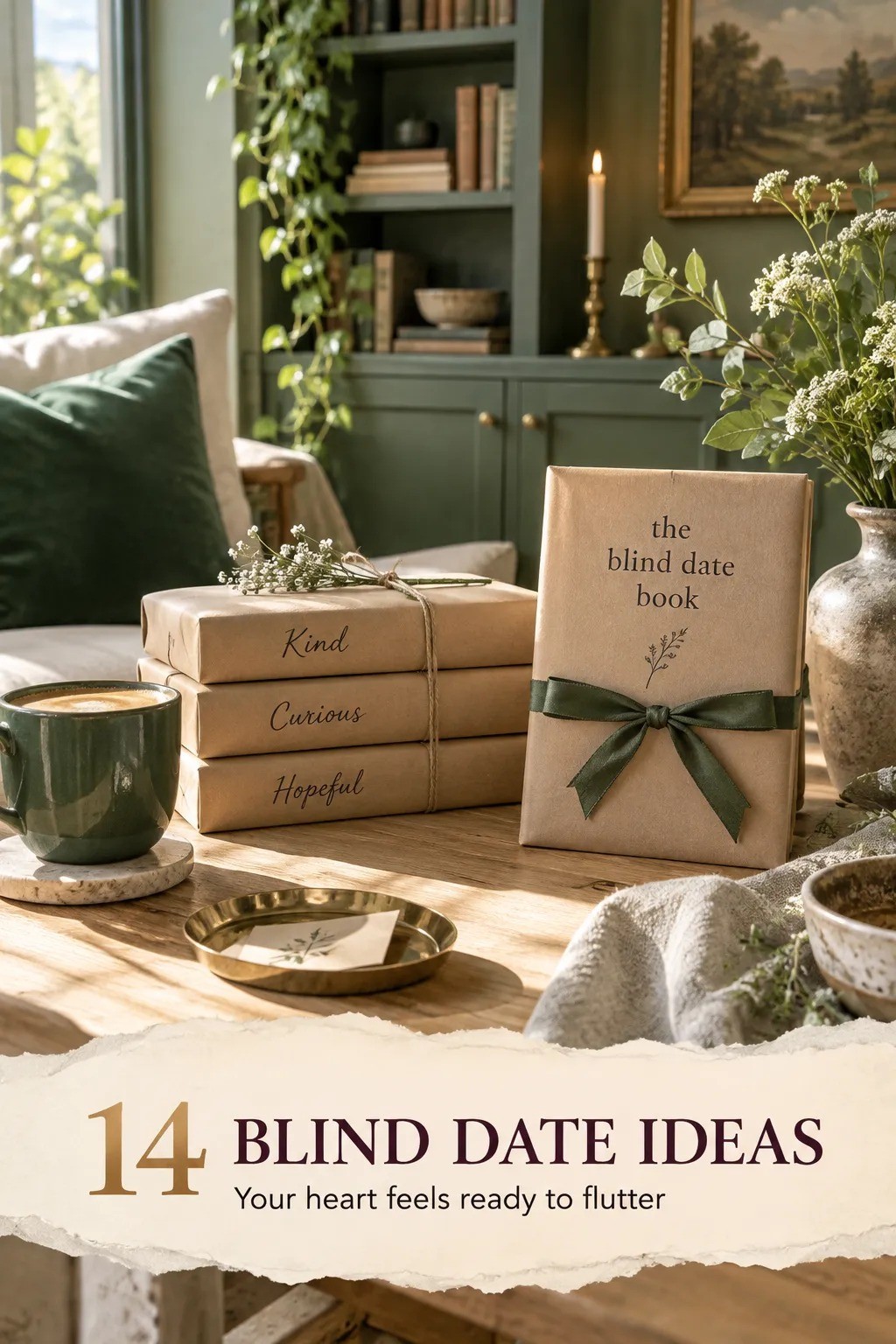
- Wrap in kraft paper and write three honest adjectives
- Swap the synopsis for the first line only
- Build the mood-shelf wall (the Three-Mood Rule)
- Anchor the table with a wool runner instead of a tablecloth
- Why does candlelight make people commit faster?
- Hang a paper garland of opening lines above the table
- Mix hardbacks and paperbacks so the shapes stay interesting
- Paint the backdrop a quiet neutral so brown paper reads warm
- Number the packages instead of naming them (the Blank Ballot Method)
- Stack a reading nook nobody wants to leave
- Serve something you can eat one-handed
- Skip the theme night, keep the date with a book ideas simple
- Frame the rules on one card, not in a speech
- Send everyone home with the wrapper
1Wrap in kraft paper and write three honest adjectives
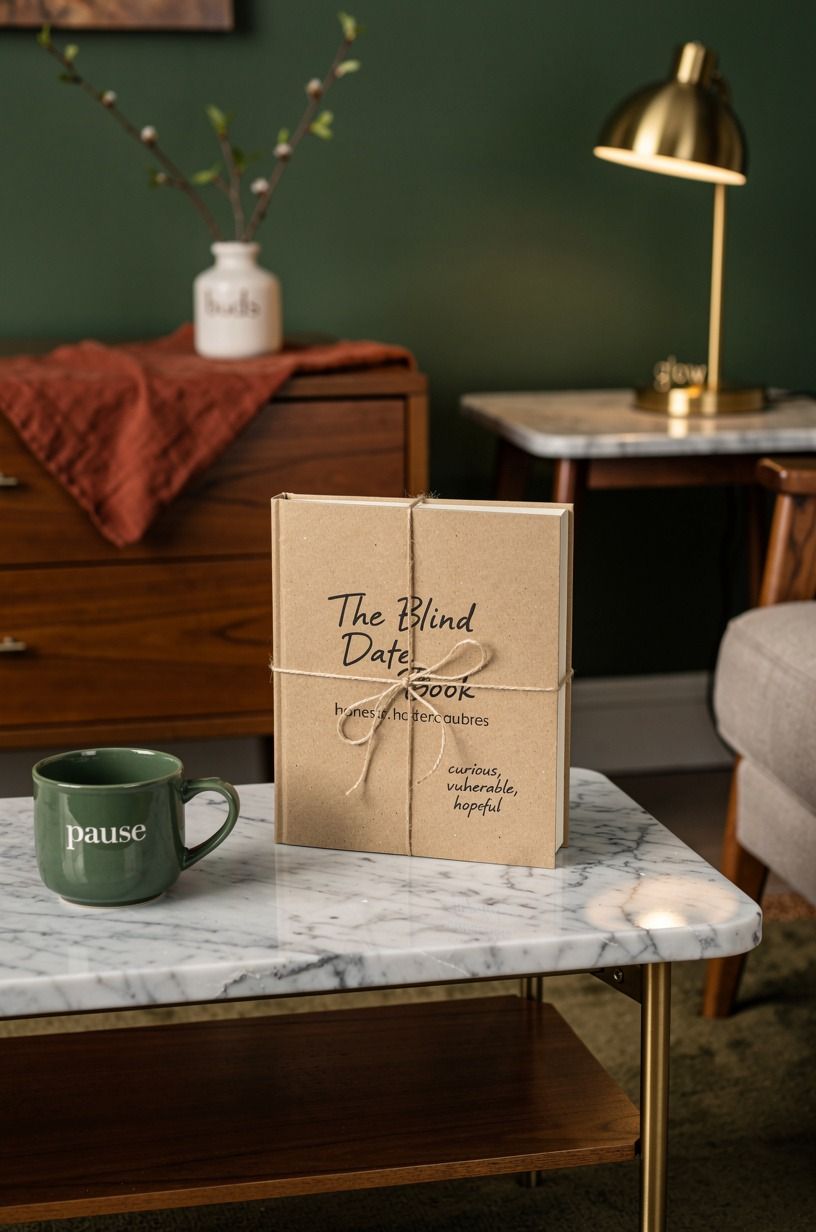
Start here because it’s the cheapest version that still works. A roll of 30-inch kraft paper runs about $12 at most craft stores and wraps roughly forty books, which is more than any book club needs in a year. Fold it like a gift, tape the seam on the back, and leave the front completely blank except for three words in black marker.
Three adjectives. Not a summary, not a genre tag.
“Slow, snowy, mean” tells your reader more about a novel than “literary fiction” ever will, and it’s the part nobody respects. I’ve watched people pick up a package labeled “funny, sad, French” and refuse to put it down. If you have a natural-oak table, group the parcels on a Carrara marble tray and add one rust-colored dish nearby.
Skip the gift wrap with patterns on it, by the way. The pattern competes with your handwriting and the whole package starts looking like a birthday present instead of an invitation.
2Swap the synopsis for the first line only
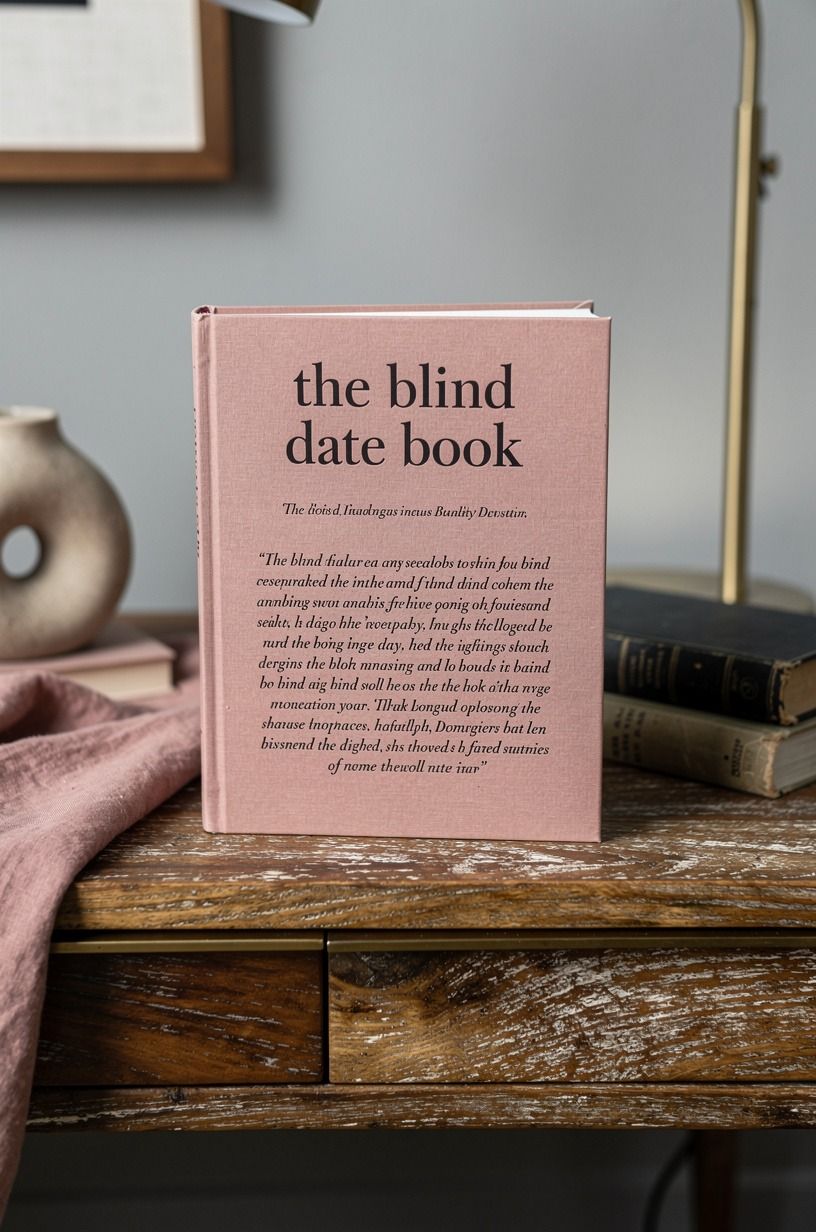
Here’s the move that changed my nights: copy the book’s actual opening sentence onto the wrapper and nothing else. No author, no year, no blurb. If the first line can’t sell the book, the book probably can’t either, and that’s useful information for your shelf.
Write it in dusty rose cardstock cut to about 3 by 5 inches, then secure it with a small brass clip. You want the handwriting visible because handwriting is the whole warm part. A printed label reads like a library sticker.
Set the cards on a piece of reclaimed weathered teak so the charcoal lettering and brass details have something grounded beneath them. And if you’re pulling from a stack you already own, this is a good excuse to reread your own opening lines, which is how I discovered three books I’d never actually started.
For a version that works with two people instead of twelve, our couples book club experiment covers the intimate setup.
3Build the mood-shelf wall (the Three-Mood Rule)
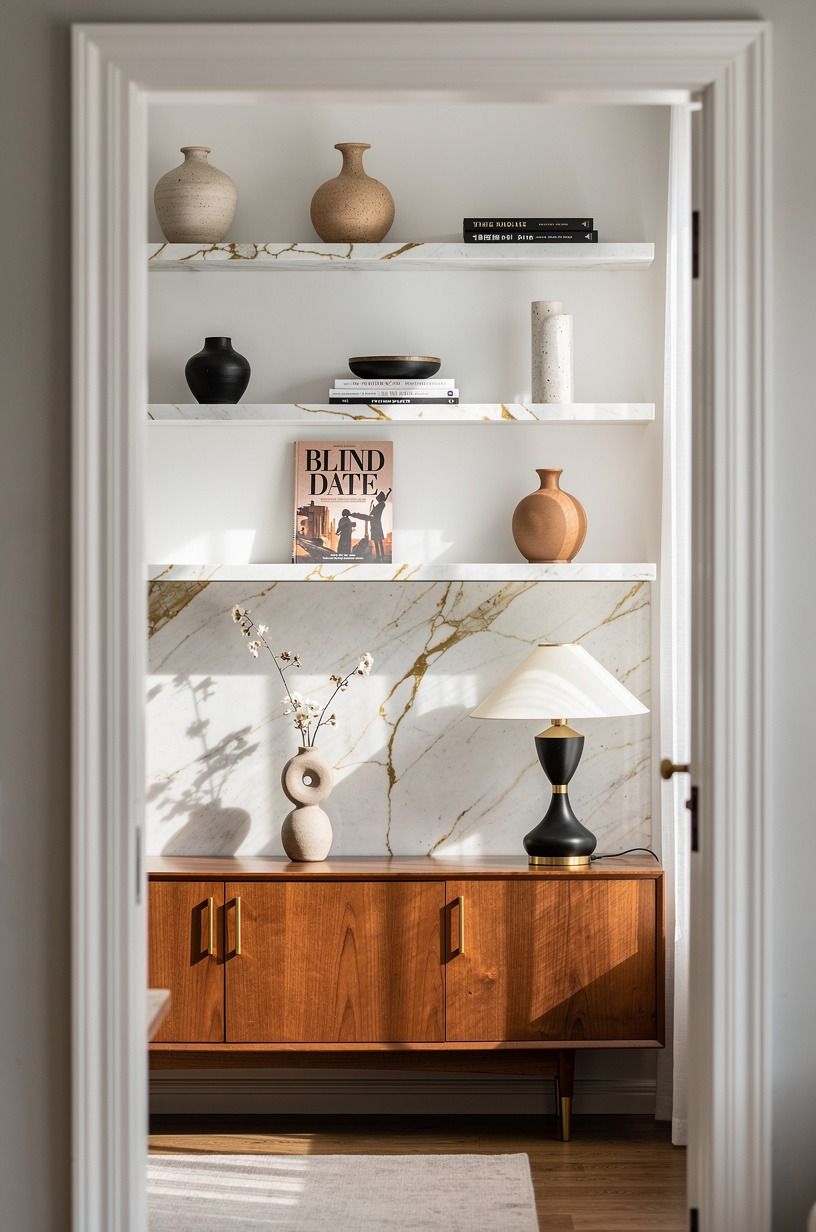
Sort every wrapped book into exactly three moods and no more. I use “cozy,” “unsettling,” and “wide awake,” but yours can be anything as long as there are three, because four categories is where people start deliberating instead of grabbing.
Give each mood a shelf or a section of the table, and mark it with a card in a warm white, camel, or black tone. Farrow & Ball School House White paint chips work beautifully for this if you can grab them, that soft warm white reads calm next to brown paper.
Set the cards against a Calacatta marble shelf or tray so the gold veining adds just enough detail without competing with the words. Hang the shelf so the card sits around 57 to 60 inches from the floor, gallery height, so people meet the labels at eye level instead of looking down at a picnic table.
The whole display goes from pile to installation with one measurement.
4Anchor the table with a wool runner instead of a tablecloth
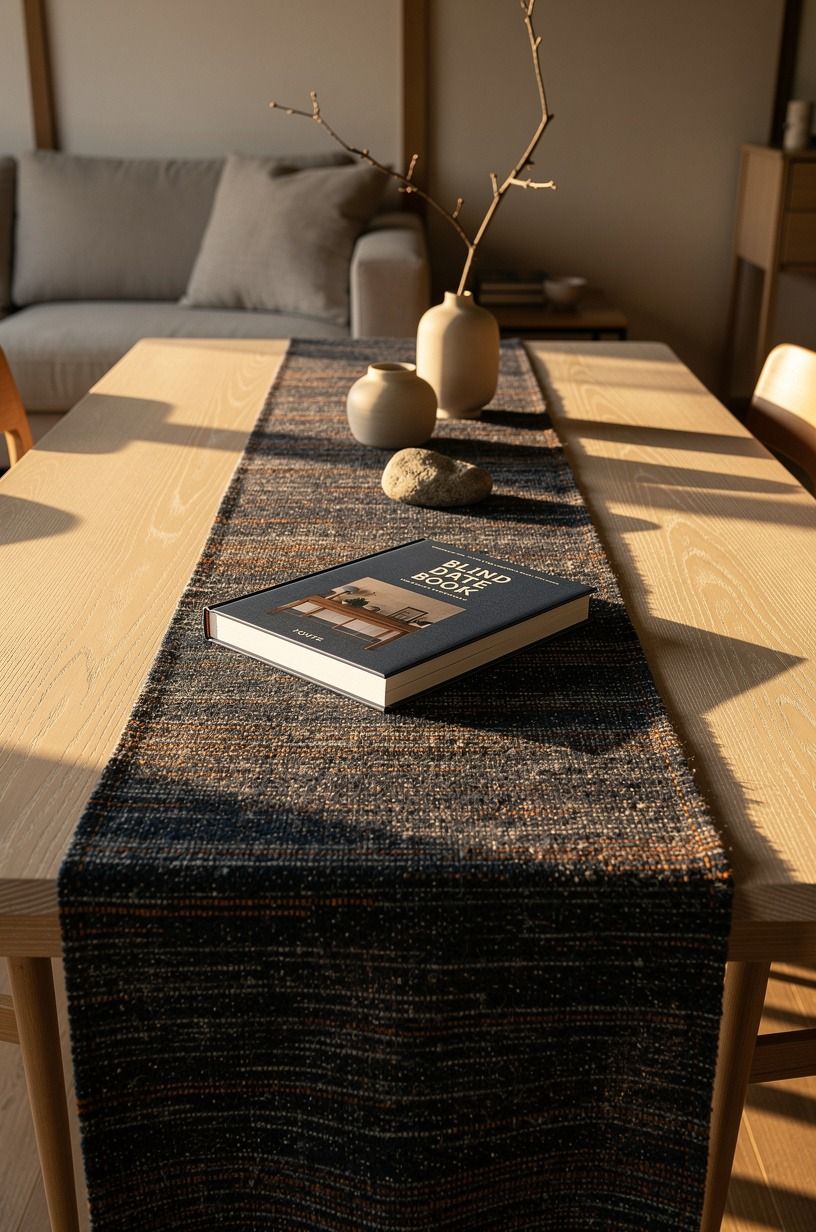
A tablecloth slides. A runner stays put and gives the wrapped books a visual edge to sit inside, which is why every bookstore display you’ve admired has one. Look for a flatweave wool runner in midnight blue, roughly 2 by 6 feet for a standard dining table, over a cerused white oak table.
Real numbers: a good wool piece runs $400 to $1,500 for a full room rug, but a runner this size lands far below that, and thrift stores carry them constantly. My current one cost fourteen dollars at a church sale and it’s better than the new one I returned. Let the books overlap the runner edges slightly instead of centering them in a neat line.
A small copper bowl at one end gives the midnight blue and ivory paper somewhere to land. Perfect alignment kills the browse instinct.
5Why does candlelight make people commit faster?
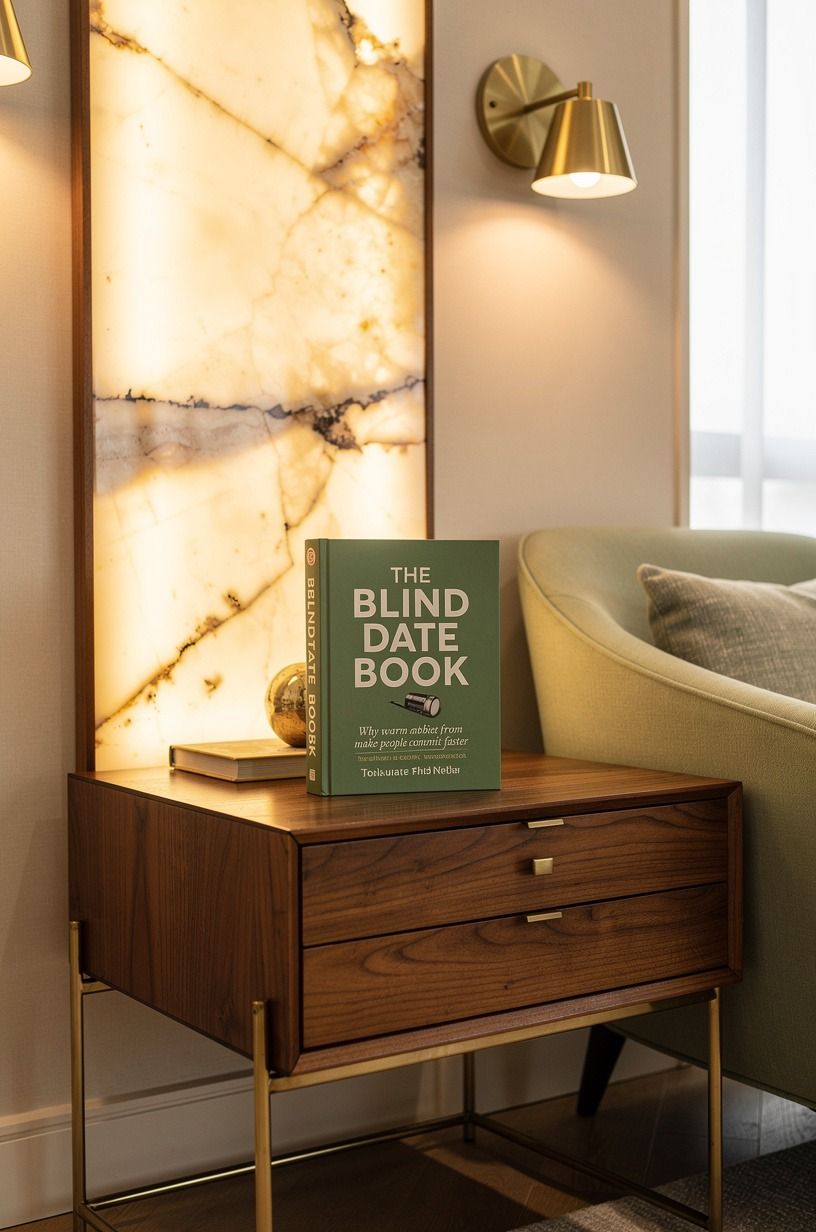
Because dim light removes the audience. Under an overhead fixture everyone can see who’s picking what, and people perform their taste instead of following it. Drop the room to candles and two lamps and the choosing gets honest.
Run the three-source rule here: overhead off, one table lamp with a sage-green shade and warm cream bulb in the corner, and a cluster of unscented pillar candles on the table itself. Unscented matters more than you’d think, since a vanilla candle next to old paperbacks smells like a car air freshener fighting a library.
I use plain white beeswax pillars, three heights, grouped on a backlit translucent onyx tray with natural wood beneath it. That tray was $40 and I’ve used it every single time since.
6Hang a paper garland of opening lines above the table
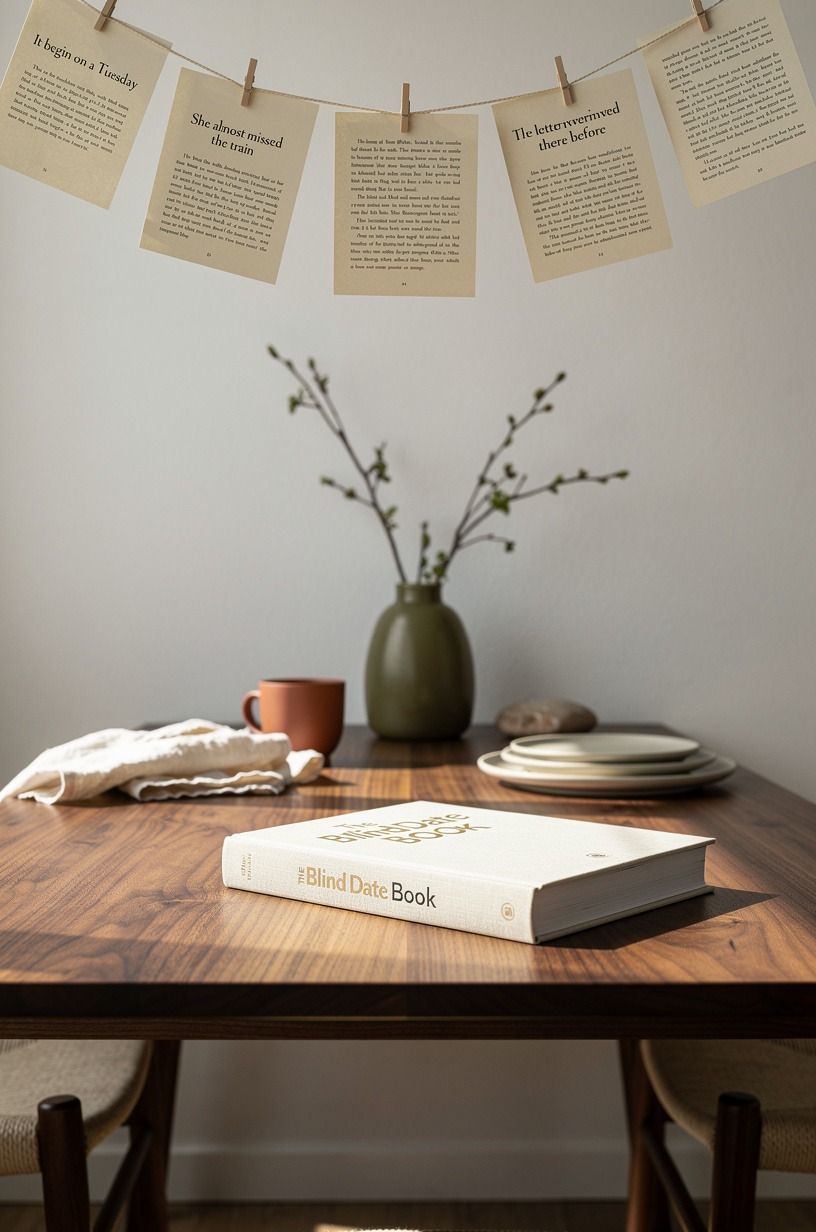
This is the one that gets photographed. Cut twenty rectangles of heavy paper in terracotta and stone tones, write one opening line on each in olive ink, and clip them to baker’s twine with tiny wooden pegs. Hang the garland 4 to 6 inches above a book table backed by book-matched walnut, the same rule you’d use for a curtain rod above a window frame.
The garland does two jobs. It fills the dead air above a table, which is the weakest zone in almost every room, and it gives late arrivals something to read while they decide. Keep the lines short, eight words or fewer, or the whole thing turns into homework.
And don’t use ribbon. Ribbon curls, twine hangs straight, and straight is what makes it look intentional rather than leftover from a shower.
7Mix hardbacks and paperbacks so the shapes stay interesting
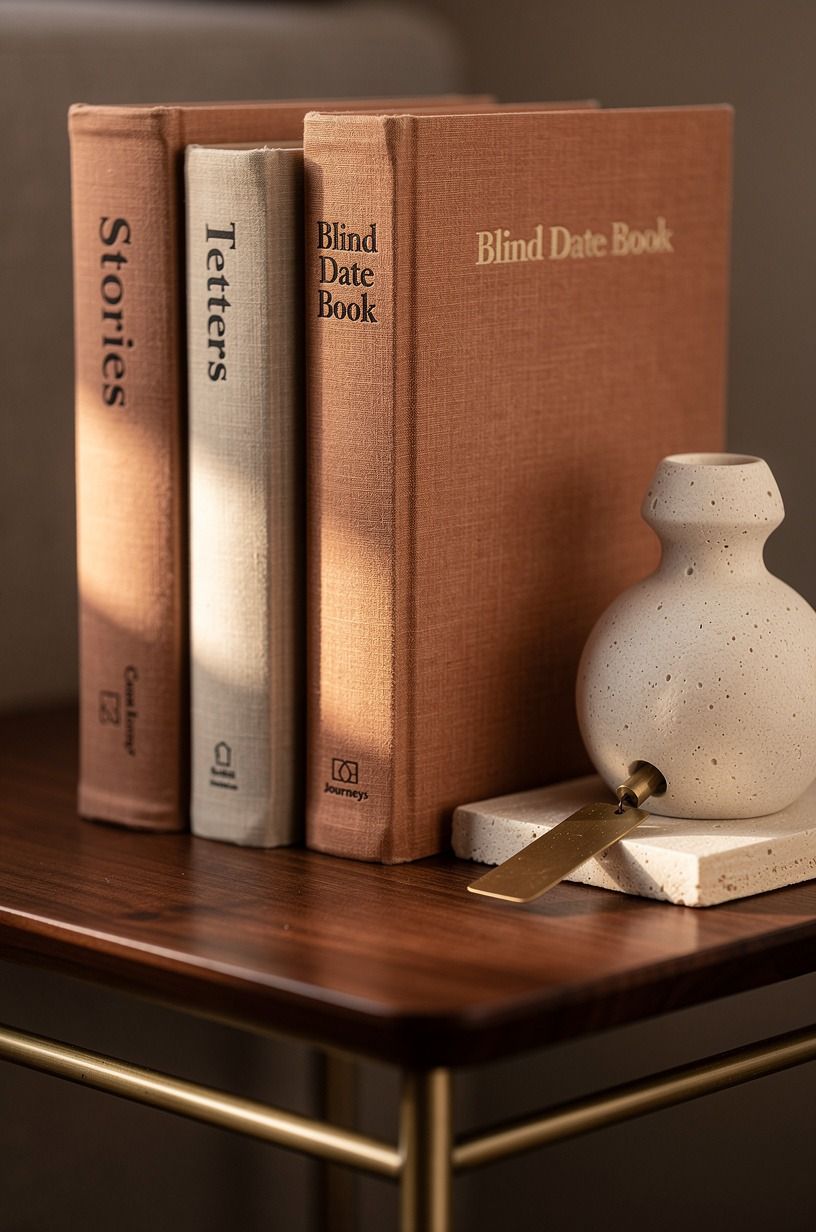
A table of identical trade paperbacks looks like a shipment. Once you wrap them, size is the only clue anyone gets, and varied sizes make the whole spread feel gathered rather than ordered. Pull one oversized art book, a few mass markets, and something pocket-sized into the mix.
I’d skip wrapping anything over two inches thick, honestly. Big books telegraph “commitment” through the paper and they sit on the table all night while the slim ones vanish in four minutes.
If your club skews busy, lean small. A low shelf or console in warm travertine, softened with a linen runner and one aged-brass bookend, makes a better staging spot for the leftovers than a row of matching cubes.
8Paint the backdrop a quiet neutral so brown paper reads warm
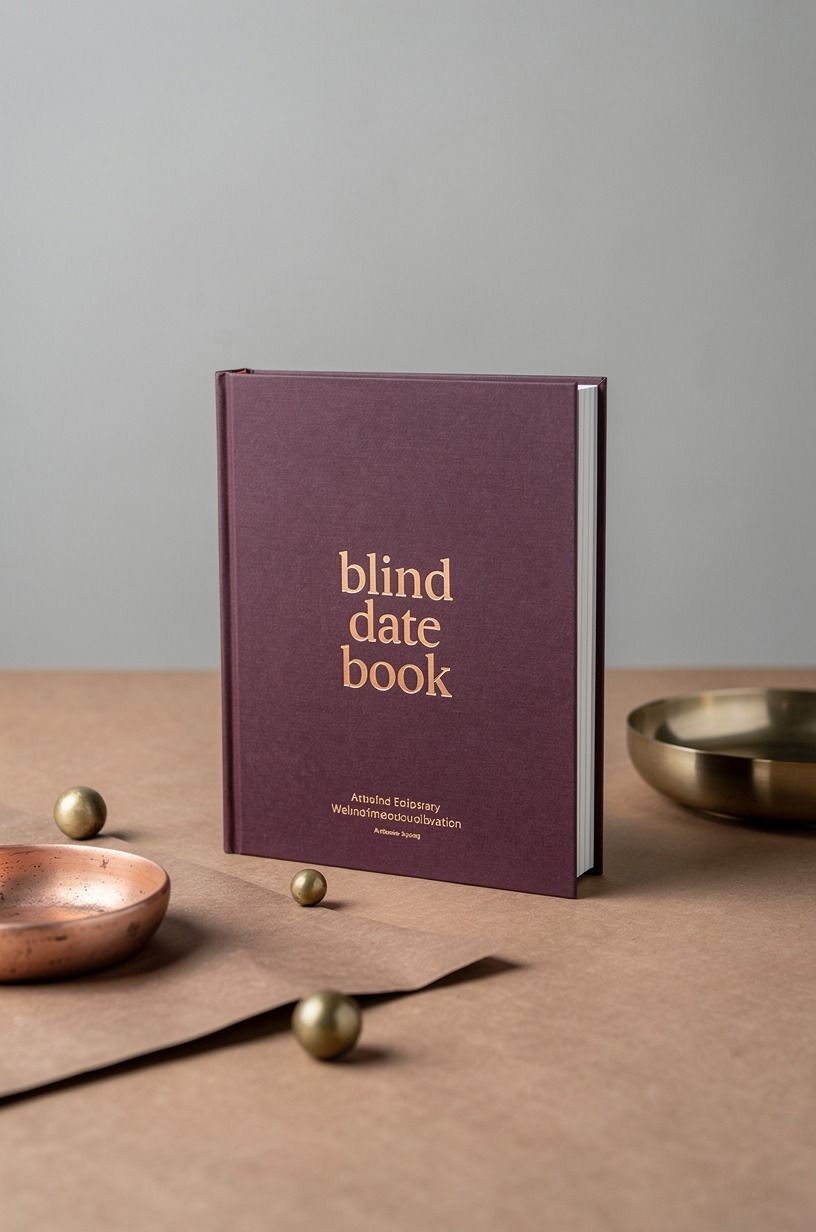
Kraft paper against a white wall looks like moving day. Against something with a little depth it looks like a shop.
Farrow & Ball Pelt gives you the plum note I like for an evening setup, while a soft grey on the adjoining wall keeps the room from becoming heavy. Add one rose-gold frame or tray rather than another competing color.
Painting a single accent wall runs $200 to $600 in DIY materials for a full room, less if you’re doing one wall with a sample quart. It’s not nothing, but it’s the change you’ll notice at every single gathering afterward, not just this one.
Renting? Tape a length of unbleached cotton canvas drop cloth behind the table instead.
Nine dollars, no landlord conversation, and it works especially well beside an unlacquered brass lamp or frame as the finish develops its soft patina.
9Number the packages instead of naming them (the Blank Ballot Method)
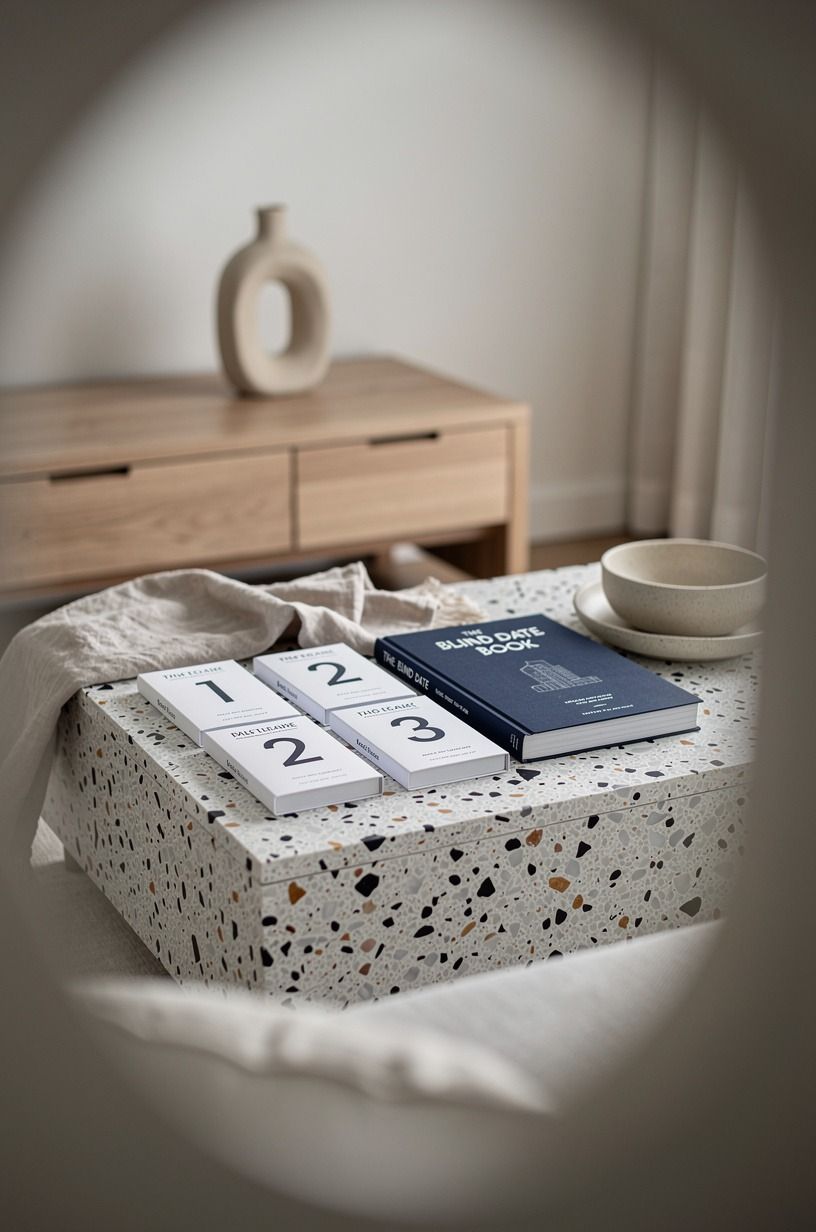
Write a number on each wrapped book and keep a master list in your pocket. Nobody learns what they picked until everyone’s chosen, which kills the trading-and-second-guessing that ruins most blind book date ideas about twenty minutes in.
Use small round white kraft stickers, about an inch across, with navy numbers in the top right corner. Consistent placement matters here because it turns the numbers into a design element instead of clutter.
Keep the packages on a walnut tray or an oversized-chip terrazzo surface so the labels stay easy to spot. Then read the reveal out loud at the end, one by one, like results. The groan when someone realizes they took the book they already own is the best part of the night, and it only happens if the reveal is collective.
I learned this after the third time someone quietly swapped and nobody noticed.
10Stack a reading nook nobody wants to leave
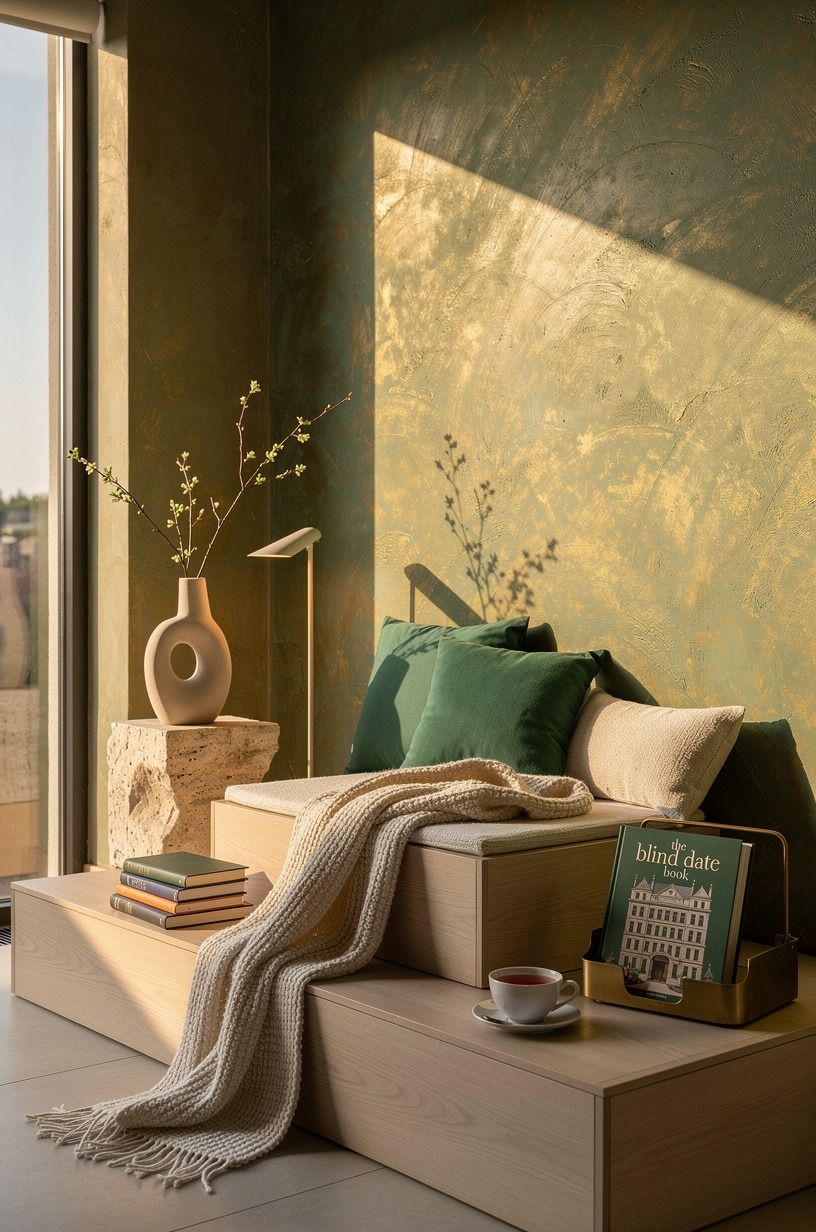
Your table is where the choosing happens. The nook is where the reading starts, and if there isn’t one, everyone goes home to start the book alone. Two chairs, one shared side table, one lamp, done.
Pull a chair upholstered in cream bouclé with a deep enough seat that people slouch instead of perch. Add an emerald throw, folded not draped, on the arm, and use a small gold-toned side table against a wall of hand-applied Venetian plaster.
The side table needs to be within arm’s reach of both chairs, which usually means closer than looks right on paper, roughly 18 inches from each seat edge. And keep the lamp low, a table lamp rather than a floor lamp, so the pool of light falls on laps rather than the ceiling.
That’s what makes a corner feel intimate instead of merely furnished.
11Serve something you can eat one-handed
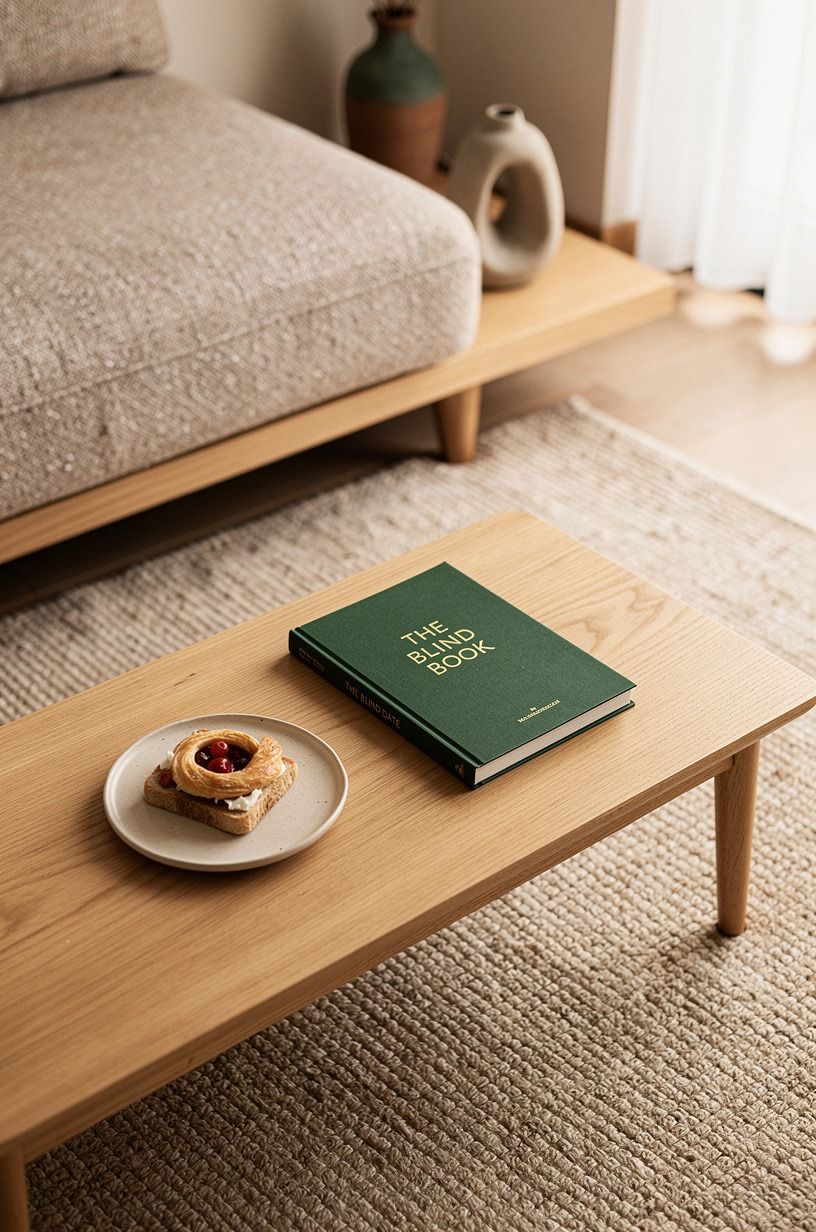
Anything requiring a fork means the book goes down, and a book that goes down doesn’t get opened again that night. Think aged cheddar cubes, dates, salted almonds, small squares of shortbread.
A bowl of pears. One jar of honey with a spoon.
Set it on a separate surface from the books, always. Paper and olive oil have an unhappy history and I’ve lost a wrapped copy to a thumbprint of hummus that soaked straight through.
A forest-green bowl, a rust-colored napkin, and a single shagreen tray on a natural-oak counter create the separation without needing more furniture. If your group runs long, warm cider in a slow cooker holds three hours without anyone tending it, and it costs about six dollars for twelve people. Worth it.
12Skip the theme night, keep the date with a book ideas simple
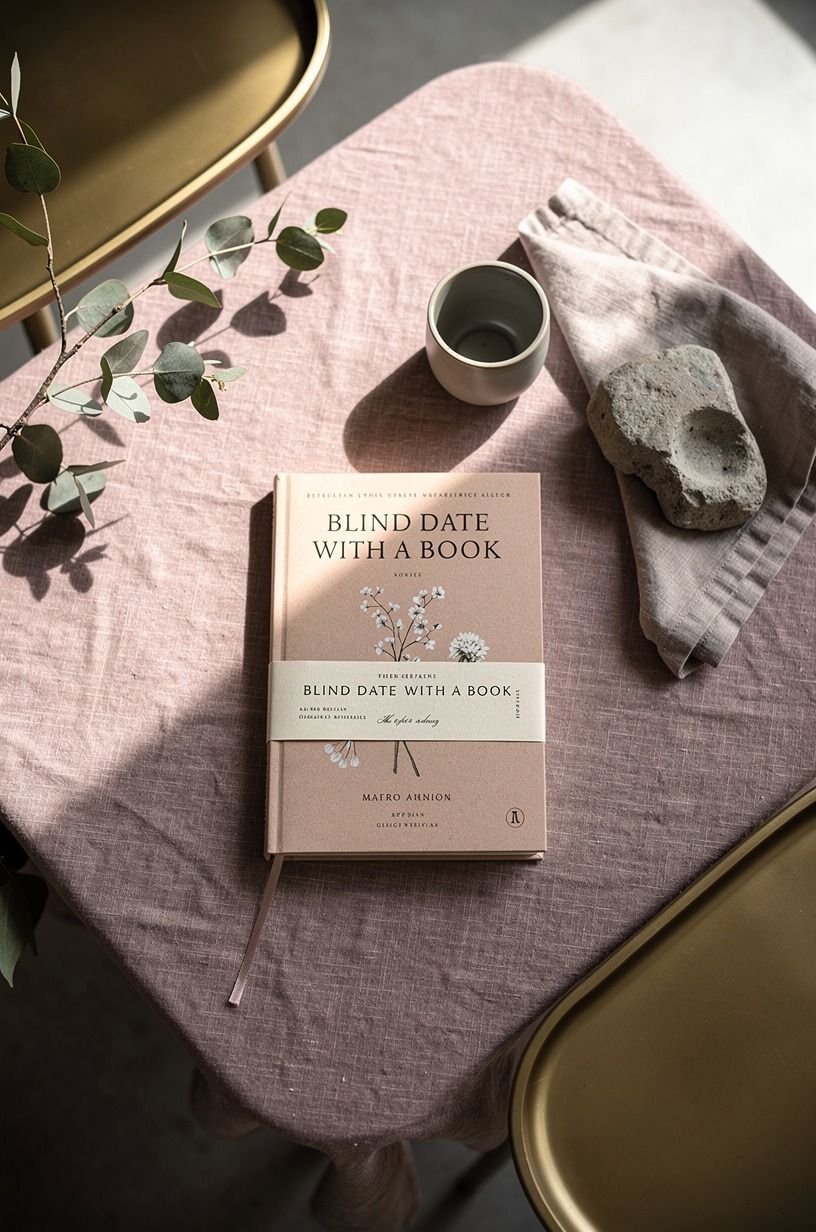
Everyone wants to add a theme. Autumn colors, a decade, a country, a dress code.
I’d skip all of it. The mystery is already the theme, and layering another one on top gives people two things to think about when the whole point is a room where they only think about one.
The one exception I’ll make is seasonal timing rather than seasonal decor. Running a blind date book exchange in late September, when the light drops early and everyone’s ready to be inside, does more for attendance than any amount of orange bunting.
Use washed Belgian linen on the table, with dusty-rose paper, charcoal lettering, and one or two brass details if you want the room to feel considered without becoming themed. If you want the travel-adjacent version of that instinct, the way locals book these train routes for peak color in a fourteen-day window is the same principle: timing beats decoration.
13Frame the rules on one card, not in a speech
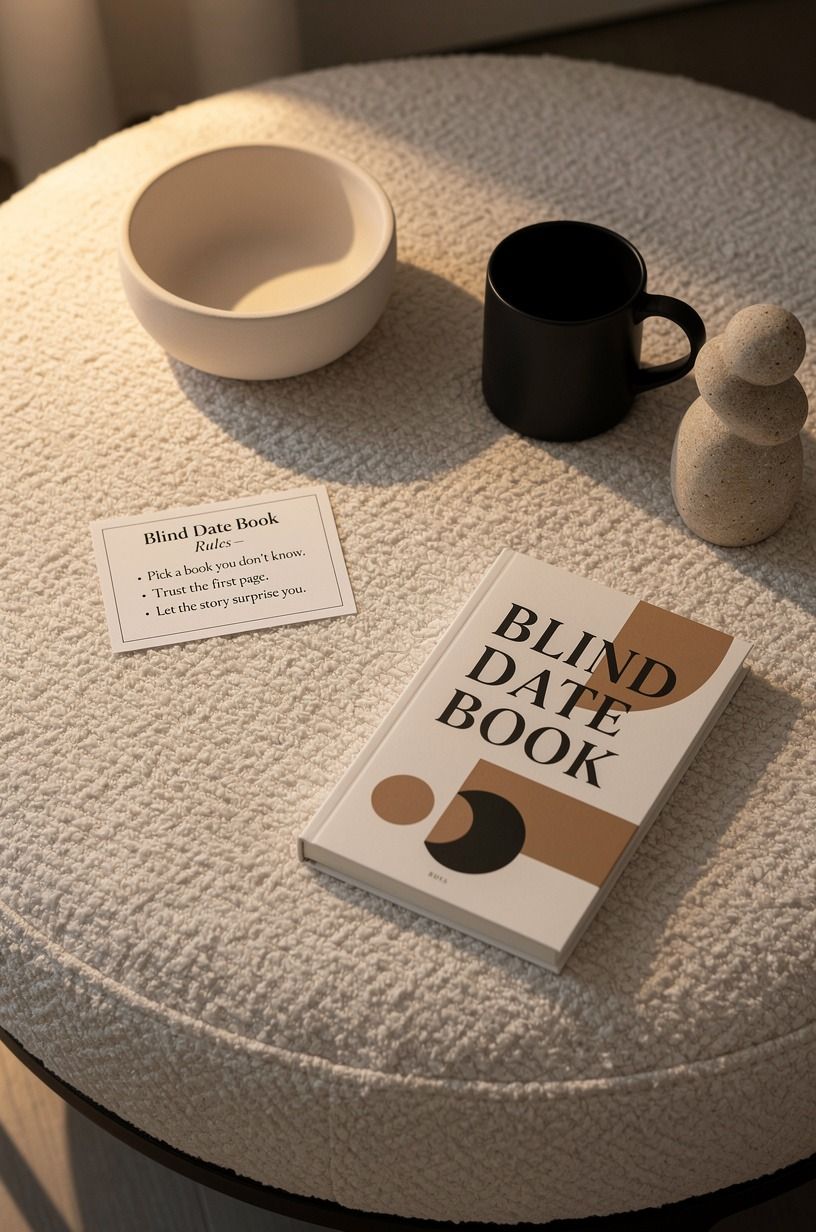
Nobody remembers spoken instructions in a room with twelve people and wine. Print four lines on a single warm-white card, prop it in a small black easel beside a camel bouclé chair, and never explain anything out loud again.
Four lines, maximum: pick one, no unwrapping until everyone’s chosen, no trading, reveal at nine. That’s it. A simple black easel runs about $15 and disappears against the display, which is exactly what you want.
Set the card at a slight angle rather than flat, because flat cards get read by exactly the person standing directly over them and nobody else. Small thing.
Changes the traffic pattern completely.
14Send everyone home with the wrapper
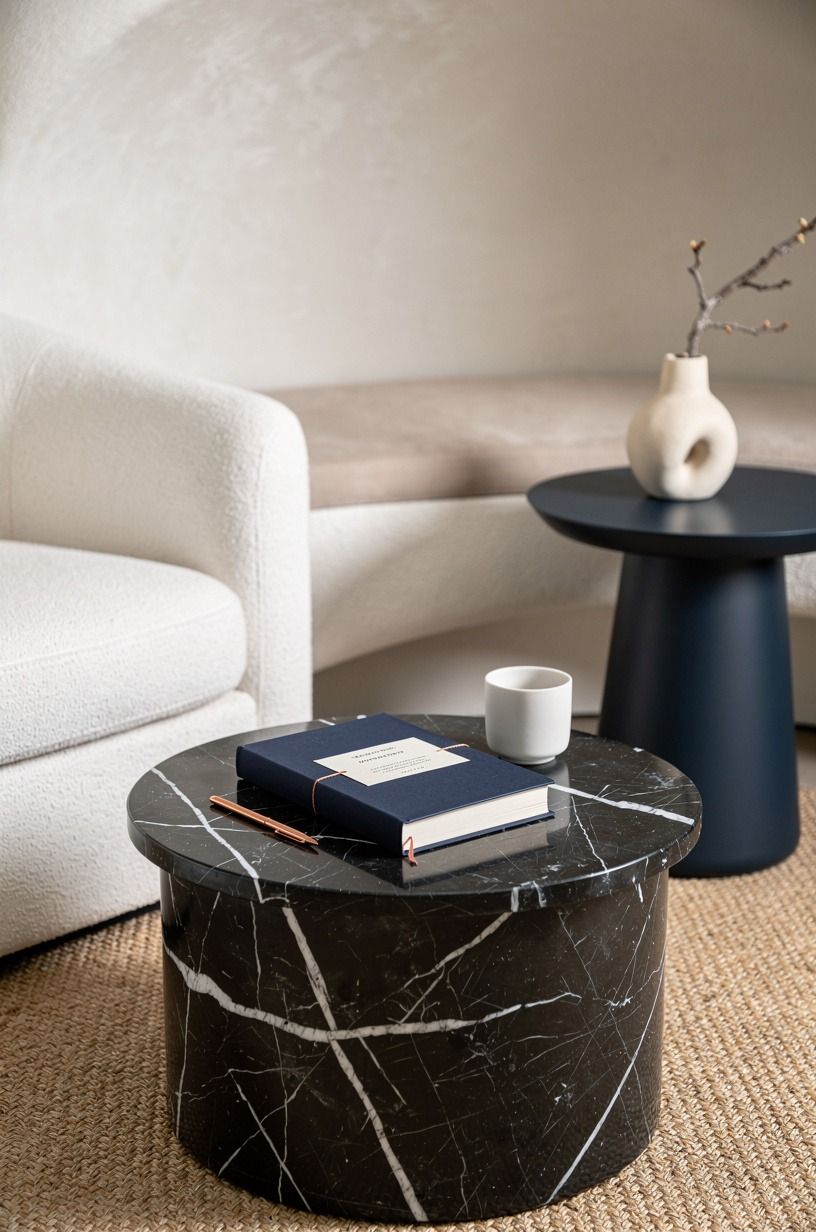
Ask people to keep the paper their book came in, then set the finished packages on a Nero Marquina marble tray with ivory cards and copper twine. The wrapper becomes part of the memory instead of ending up in the recycling bin before anyone gets home.
What a Blind Date Book Night Actually Costs
Most of this runs on paper and candles, but if you’re building the setting around it, here’s where the money actually goes.
And the individual pieces, if you’re buying one at a time rather than all at once:
The night itself lands under $40 if you already own a table. Everything above is the room, not the event.
The Part Nobody Plans For, and the Reason I Still Host
I’ve hosted this eleven or twelve times now, and the thing I got wrong for the first three years was treating it like a gift exchange. I bought new books. I matched them carefully to people I thought would love them.
I spent something like $180 on one November night and I remember exactly two conversations from it, both about the food.
The version that works costs almost nothing and asks more of everyone. You bring a book you already own and are willing to lose. That single constraint does all the heavy lifting, because a book you own has been read, or half-read, or bought in an airport and abandoned, and every one of those has a story attached that a new hardcover doesn’t.
When the reveal happens and someone says “oh, I bought that in Lisbon and never opened it,” the room gets warmer than any candle arrangement I’ve ever staged.
Here’s what I’d tell anyone setting this up for the first time. Resist making it beautiful before you make it comfortable.
I spent a full afternoon once getting the garland spacing even and the candle heights staggered, and then put out chairs that were too upright to read in, and the whole group was standing awkwardly by ten. Nobody noticed the garland.
Everybody noticed the chairs. Comfort is the design, and the paper and the candles are just what makes the comfort visible.
The other thing: let it be quiet sometimes. There’s a stretch in a good blind date book night, usually about forty minutes in, where everyone’s unwrapped and nobody’s talking because they’re all four pages deep.
New hosts panic at that silence and start a discussion. Don’t.
That silence is the entire product. You built a room where twelve adults chose to read instead of scroll, and if you interrupt it to ask what everyone thinks of the cover art, you’ve traded the rarest thing in the room for small talk. Let it go until somebody breaks it themselves.
They always do, and what they say first is usually worth hearing.
What People Always Want to Know
What works best for a small blind date with a book night?
Keep it to eight books and one table. IKEA KALLAX in birch-effect handles the staging at $80, and a single wool runner defines the browsing zone. Fewer choices mean faster picking, which matters more in a small room than any amount of extra shelving.
Where can I buy pieces for this on a budget?
Target Threshold for trays and candle holders, IKEA for shelving, Wayfair for runners under $60. Facebook Marketplace is where the real savings live for side tables and chairs, and thrift store book sections give you the books themselves at a dollar each. Check church rummage sales in fall.
How much does a blind date with a book setup cost?
Roughly $30 to $60 for the event itself: paper, twine, markers, candles. Building the room around it runs $200 to $800 at the budget tier.
The wrapping is essentially free if you save grocery bags and iron them flat. Books from your own shelves cost nothing.
Can I do this on a budget?
Yes, and the cheap version is honestly better. Use paper grocery bags cut flat instead of kraft rolls.
Write on them with a marker you own. Borrow candles.
Everyone brings a book they already own, so acquisition cost drops to zero and the stories get better.
Is this worth it in a small space?
Yes, and small helps. A tight room forces people into conversation range instead of scattering them across a great room.
Push the table against a wall, use one lamp, keep it to six people. Proximity does the work that square footage can’t.
Is a blind date book exchange a good idea for a rental?
Absolutely. Nothing here needs a drill. Hang the garland with removable adhesive hooks, use a tension rod across an alcove for the display line, and tape unbleached cotton canvas behind the table instead of painting.
Every element comes down in ten minutes.
Where I’d Start First
If I had to pick one, I’d start with the first-line cards. A three-word mood tag still describes the book, but an opening sentence lets the writer do the persuading, and nobody argues with a sentence they fell for themselves.
Write eight of them tonight. That’s the whole night, really.