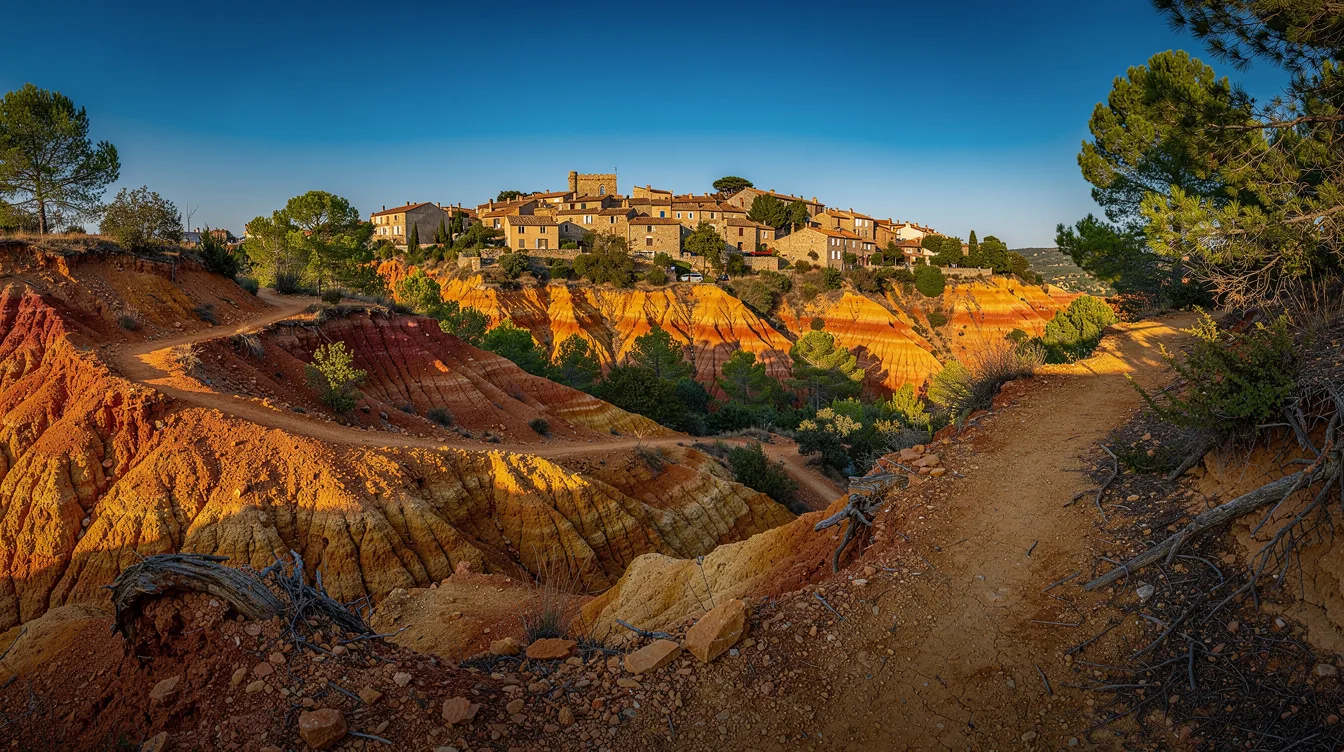
But Roussillon turns a short walk into a vivid lesson in Provence. The village’s old ochre quarries open directly from the center, and the longer loop takes about 50 minutes.
And the color starts before you reach the trail. Red, orange, and yellow façades line narrow lanes, while terraces and small galleries keep the village lively without making it feel loud.
The 50-minute loop earns its place
But the Sentier des Ocres is the reason to come here first. Its paths cross former quarries where intense sands rise into cliffs and narrow formations shaped by old extraction.
And you can choose between two loops, one lasting about 30 minutes and the other about 50 minutes. Take the longer route if you want the full effect, because the changing walls make the walk feel larger than its clock time.
The ground is dusty and uneven, so closed shoes make sense. Ochre also marks clothing and soles easily, which is a small price for walking through such strong color.
Two centuries still show on the walls
And this color isn’t merely decorative. The quarries supported about two centuries of extraction and pigment production, leaving the village with a history you can see underfoot.
But don’t expect a museum-style visit to explain everything for you. The best introduction comes from following the trail slowly, noticing how the sand shifts from warm yellow to deeper orange and red.
You can understand why the façades look the way they do after seeing the source nearby. That connection gives Roussillon more character than a village dressed only for photographs.
Roussillon rewards an unhurried village walk
But the quarries shouldn’t end your visit. The historic center climbs through narrow streets and small squares, with ochre-colored façades, terraces, and galleries opening onto the lanes.
And the village sits above the Luberon, so higher streets bring broad views across the surrounding area. You won’t need a packed schedule here, since about two to three hours covers the village and the trail at a comfortable pace.
My view is simple: walk the quarry first, then return for lunch and photographs. The contrast works, because the trail feels raw while the center feels carefully lived in.
Can you visit without rushing?
Yes, and the best plan is to arrive early or come in the late afternoon. The light grows warmer on the quarry walls then, while the paths are often calmer.
But parking near the village fills quickly in high season. Set aside enough time for the walk, a meal, shops, and photographs, because squeezing Roussillon into a brief stop would miss its strongest rhythm.
The entrance costs 3.50 euros per adult, and children under 10 enter free. Reservations normally aren’t necessary, since payment is made at the ticket desk.
When should you go to Roussillon?
And April through June and September through October are generally the most comfortable periods. The village is still active, but the experience is often easier than during the busiest summer weeks.
In September, the trail normally opens every day from 9:30 a. M. To 6:30 p.
M., weather permitting. Check the hours on the day you visit, because conditions can change access.
But September also makes a late-afternoon visit especially appealing. After the ochre cools into shadow, you can return to the village for dinner while the last light catches the walls.
How do you reach the trail?
And access is unusually straightforward: the Sentier des Ocres begins from Roussillon 84220, in the Luberon. You don’t need a separate excursion to reach the quarries, since the path starts from the village itself.
But don’t confuse this site with the Colorado Provençal at Rustrel. Both connect to the area’s ochre history, yet they’re separate visits with different settings and time commitments.
Roussillon also pairs naturally with Gordes, the Abbaye de Sénanque, Rustrel, or Apt. Keep the day flexible, though, because the village is at its best when the dust settles on your shoes and the façades begin to glow.