
The short answer: fifteen good book club discussion questions will carry a two hour meeting, and you don’t need a single one of them to be clever. I ran a club for six years and spent the first two asking “did you like it?” That’s the question that kills the room. Here’s what works instead.
- Open With the Page-One Gut Check
- Ask “Who Deserved Better?” Instead of “Who Was Your Favorite?”
- Run the Three-Sentence Summary Round
- Pin the Book to One Object
- What Did the Ending Cost the Author?
- Layer in the Two-Timeline Test
- Swap the Setting and See What Breaks
- Anchor the Night With a Read-Aloud Passage
- Build the Unreliability Ladder
- Skip the Rating, Ask the Recommendation
- Mine the First and Last Lines
- Ask What the Book Is Embarrassed About
- Hand Out a One-Page Prep Sheet Before the Meeting
- Set the Room With Three Light Sources
- Close With the One-Sentence Verdict
1Open With the Page-One Gut Check

Start here, always. Before anyone argues theme or ending, ask everyone to name the exact moment they knew they were in (or knew they were out). Page four, page forty, the line about the dog.
It’s a warm-up that nobody can answer wrong, and that matters more than you’d think when half your group is nervous about sounding dumb.
The reason it works: it’s a memory question, not an opinion question. People who didn’t finish the book can still answer it honestly. I keep a stack of Field Notes ruled memo books on the coffee table so folks can jot the page number while they read, and the ones who do always talk more.
Put your snacks out before this question, not during. Once the room is chewing and talking at the same time, the meeting runs itself.
2Ask “Who Deserved Better?” Instead of “Who Was Your Favorite?”
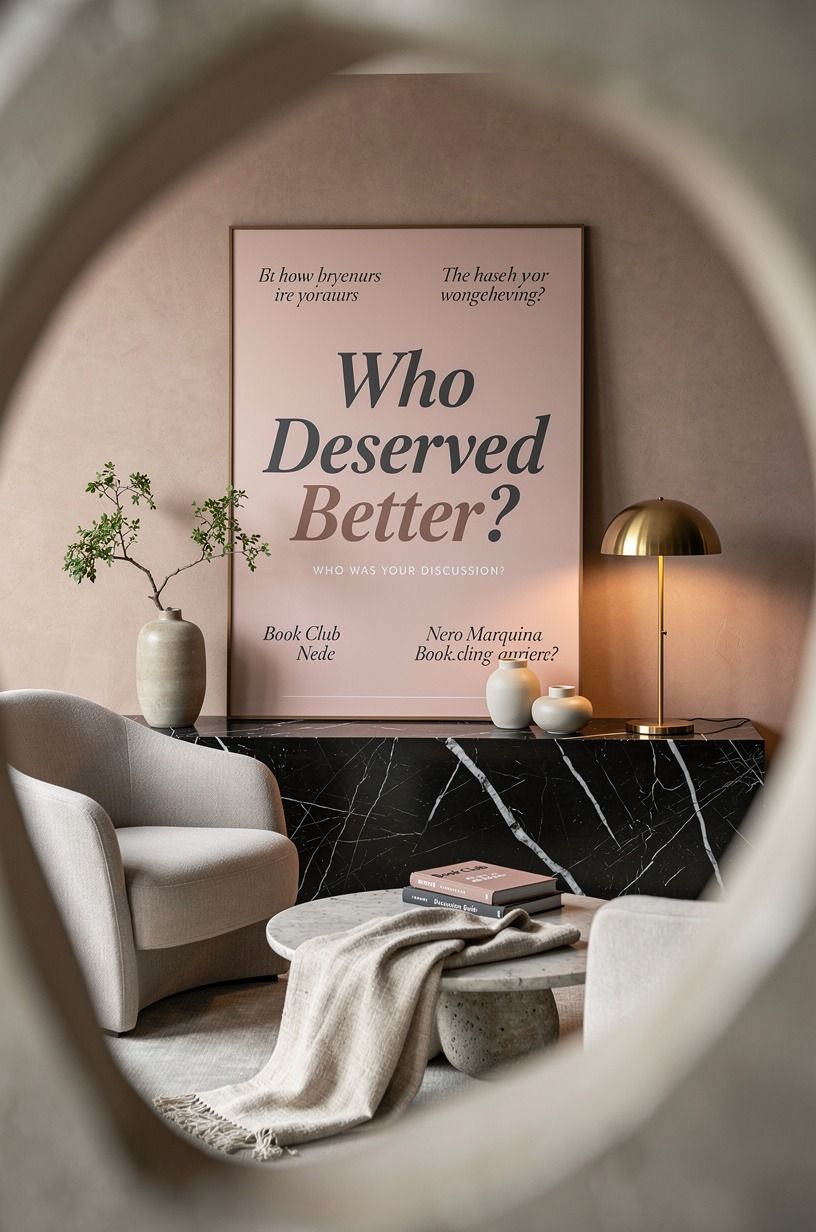
Favorite-character questions get you a round of names and then silence. Deserved-better questions get you an argument, and an argument is the whole point of a book club.
It reframes the story as a set of choices the author made, not a cast list. Somebody will defend the villain.
Somebody will get weirdly heated about a side character with nine lines. That’s the good stuff.
I’ve watched this single swap turn a polite forty minute meeting into a two hour one, which is why it sits second on my list of book club questions and never moves. The trap to avoid: don’t let it collapse into moral scoring of characters.
If it drifts, pull it back with “what would the book lose if they’d gotten what they deserved?”
3Run the Three-Sentence Summary Round
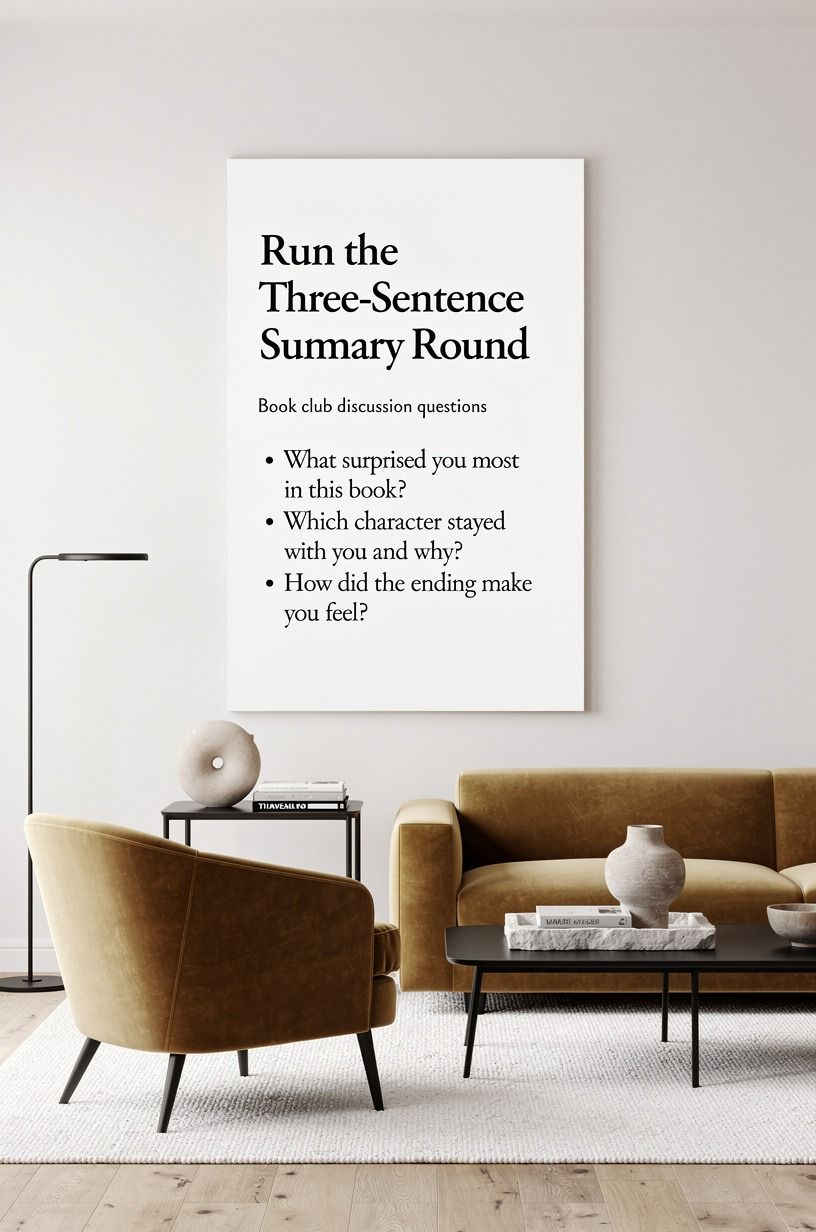
Everyone summarizes the plot in exactly three sentences, out loud, going clockwise. No notes.
Sounds like a school exercise. It isn’t, and here’s why: the gaps between the summaries are the actual discussion.
One person’s three sentences are about a marriage. The next person’s are about a war. Same book.
You’ve just found your night’s theme without anyone having to say the word “theme,” and that’s worth more than any printable worksheet you’ll download. Time it loosely, about ninety seconds a person, so a group of eight gets through the round in under fifteen minutes. If someone freezes, let them pass and come back.
4Pin the Book to One Object
Pick the single object that carries the most weight in the novel and talk about it for ten minutes.
5What Did the Ending Cost the Author?
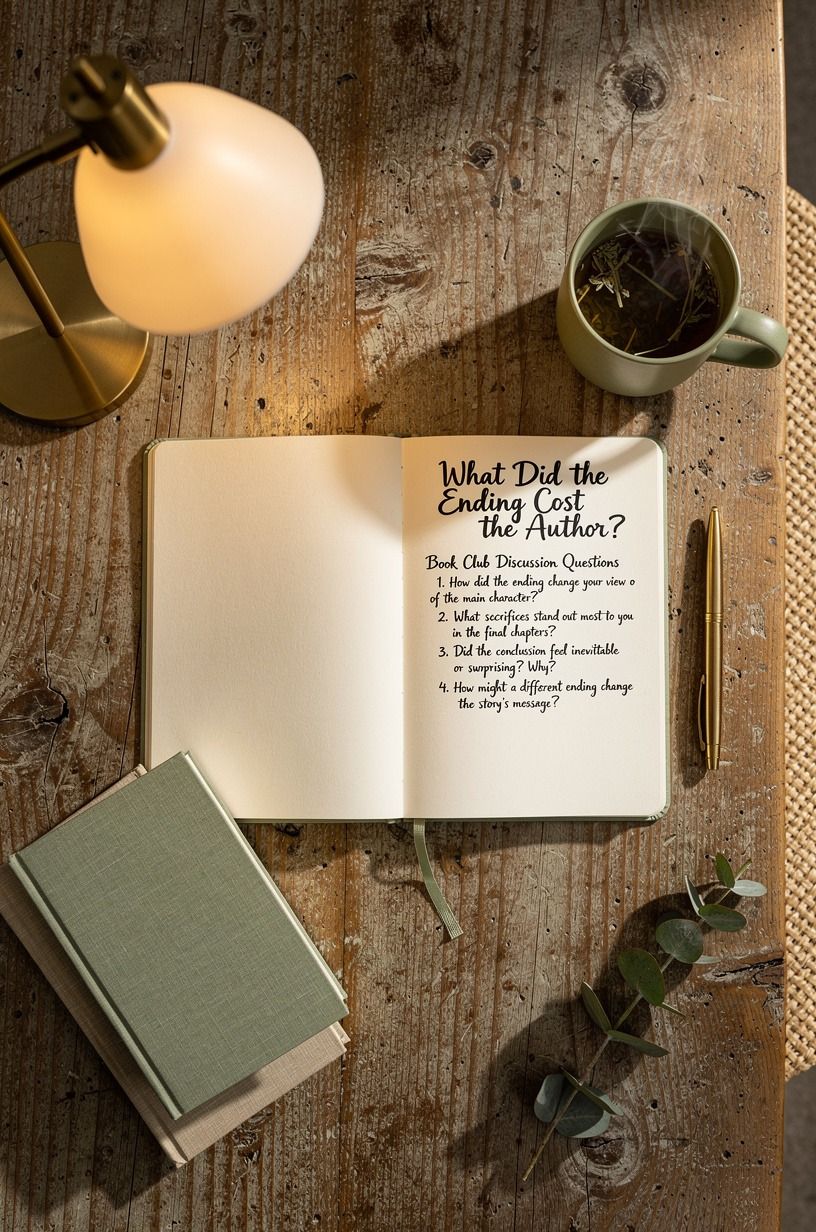
This one’s a question, and it’s the one I reach for when a group has gone quiet and comfortable.
Ask what the writer had to give up to end the book that way. A happier ending they clearly could have written. A character they liked.
An easier sell. It moves the table from consuming the story to watching someone build it, and that shift makes even a weak novel interesting to discuss.
I use this as my rescue question maybe once every four meetings. Don’t overuse it, or the club starts sounding like a writing workshop, and a writing workshop is a different hobby with different snacks.
6Layer in the Two-Timeline Test
Ask: what happens to this book if you read it ten years from now, or if you’d read it ten years ago?
7Swap the Setting and See What Breaks
Move the novel somewhere else. Different city, different decade, different income bracket. What survives the move and what falls apart?
This is the structural question in disguise, and it’s the one I’d keep if I could only keep three. A book whose plot works anywhere is often a book about people.
A book that shatters the second you move it is usually a book about a place or a moment, and that’s not a flaw, it’s a different project. Your group figures out which one they just read without you ever using the word “structure.” Give it ten minutes, no more. It gets silly fast, and silly is fine but it isn’t the whole meeting.
8Anchor the Night With a Read-Aloud Passage
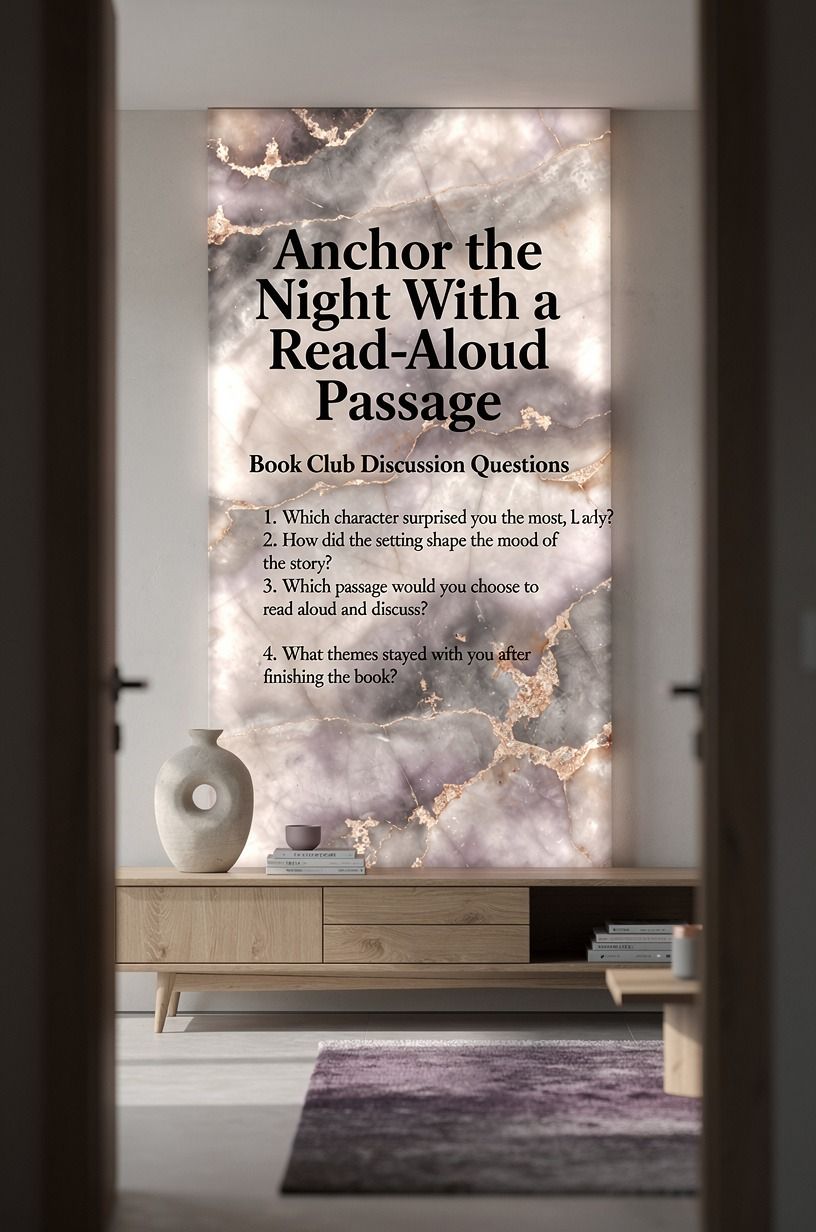
Everyone brings one passage, marked in advance, and reads it out loud.
9Build the Unreliability Ladder
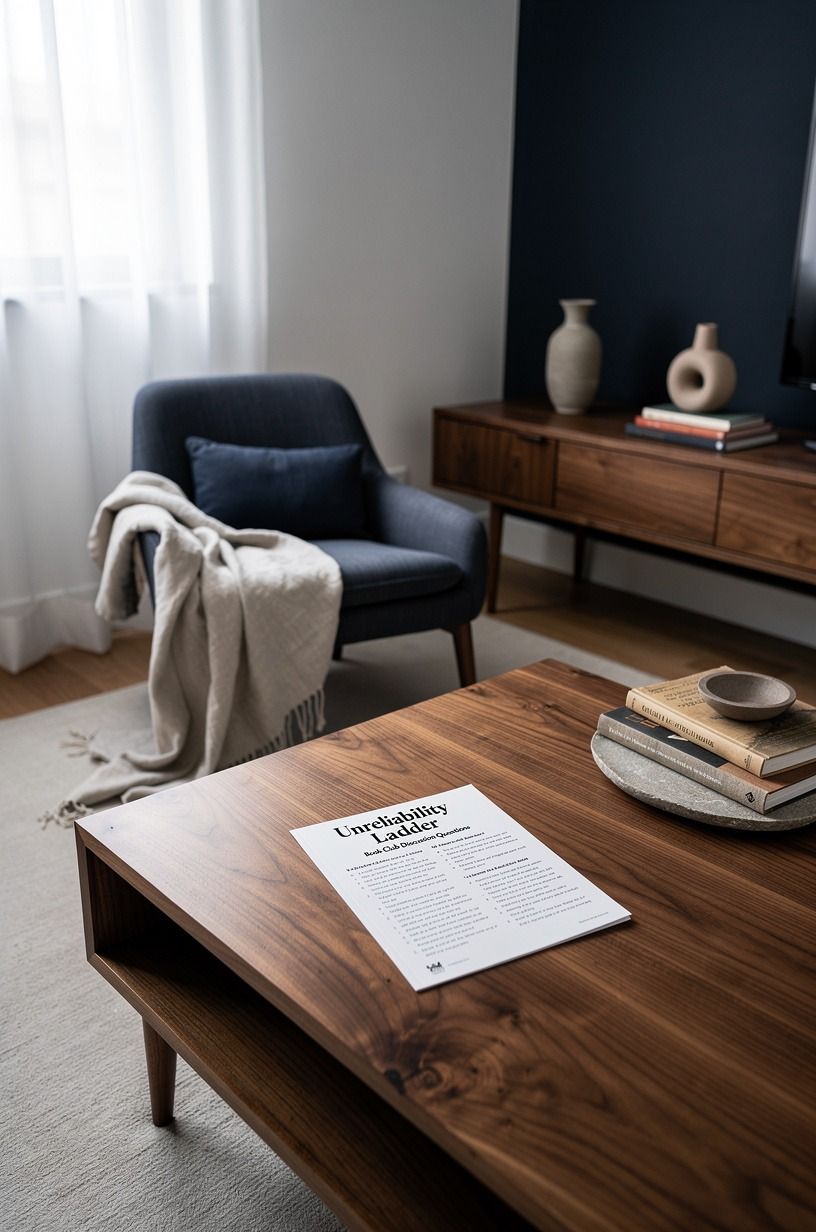
Rank every narrator and major character from most to least trustworthy, and make the group defend the order.
Here’s the thing about this one: it only takes off if you insist on a strict ranking. Allow ties and you get a gentle, agreeable conversation that ends nowhere. Force a single order and people start citing pages.
That’s when it gets good. I’ve seen a group spend fifty minutes on whether a first-person narrator’s mother was lying in chapter three, and nobody checked their phone once.
It works on books with an obvious unreliable narrator and, surprisingly, even better on books without one, where the whole table has to decide what counts as a lie.
10Skip the Rating, Ask the Recommendation
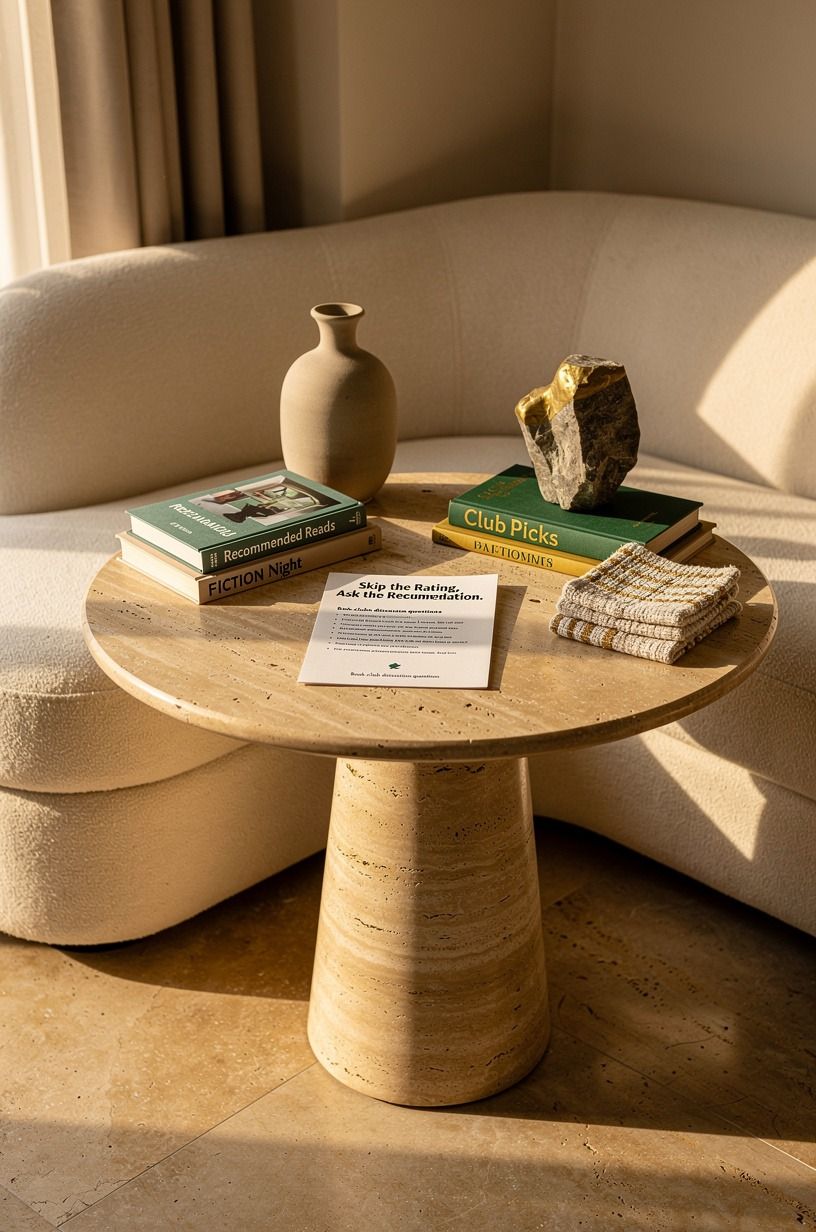
Star ratings flatten a discussion. Instead: who specifically would you hand this to, and who would you warn off?
Naming a real person forces precision. “My sister, because she’s the only one who’d sit with the slow first hundred pages” tells you more about a novel than four out of five stars ever will.
And the warn-off half is where the honesty lives. I’d put this near the end of the night, after opinions have loosened up.
These are the book club discussion questions people repeat to their friends afterward, which is how clubs grow. Related, if your group skews toward pairs, one couple tried a joint book club and wrote up what happened, and the honest parts are worth stealing.
11Mine the First and Last Lines

Read the opening line and the closing line back to back, out of context. What’s the distance between them?
Every novel is an argument about change, and those two sentences are the two ends of it. Sometimes they rhyme on purpose.
Sometimes the gap is the whole story. It takes ninety seconds to set up and it’s the most efficient literary question I know.
Pair it with a slow pour of something and let people sit with it for a beat before anyone talks. Silence isn’t failure here, it’s the question working.
12Ask What the Book Is Embarrassed About

Every novel has a soft spot it’s covering for. A plot convenience.
A character who exists to deliver information. A subplot that got away from the writer.
Naming it isn’t cruelty, it’s reading closely. And a group that can say “the middle sags” out loud is a group that can also say “the last forty pages are perfect” and mean it.
I went back and forth on including this one because it can curdle if your club skews toward polite. The fix: ask it about a book everyone loved, not one everyone hated.
Affection makes criticism safe. Try it on the group’s favorite read of the year and watch how careful and generous the answers get.
13Hand Out a One-Page Prep Sheet Before the Meeting
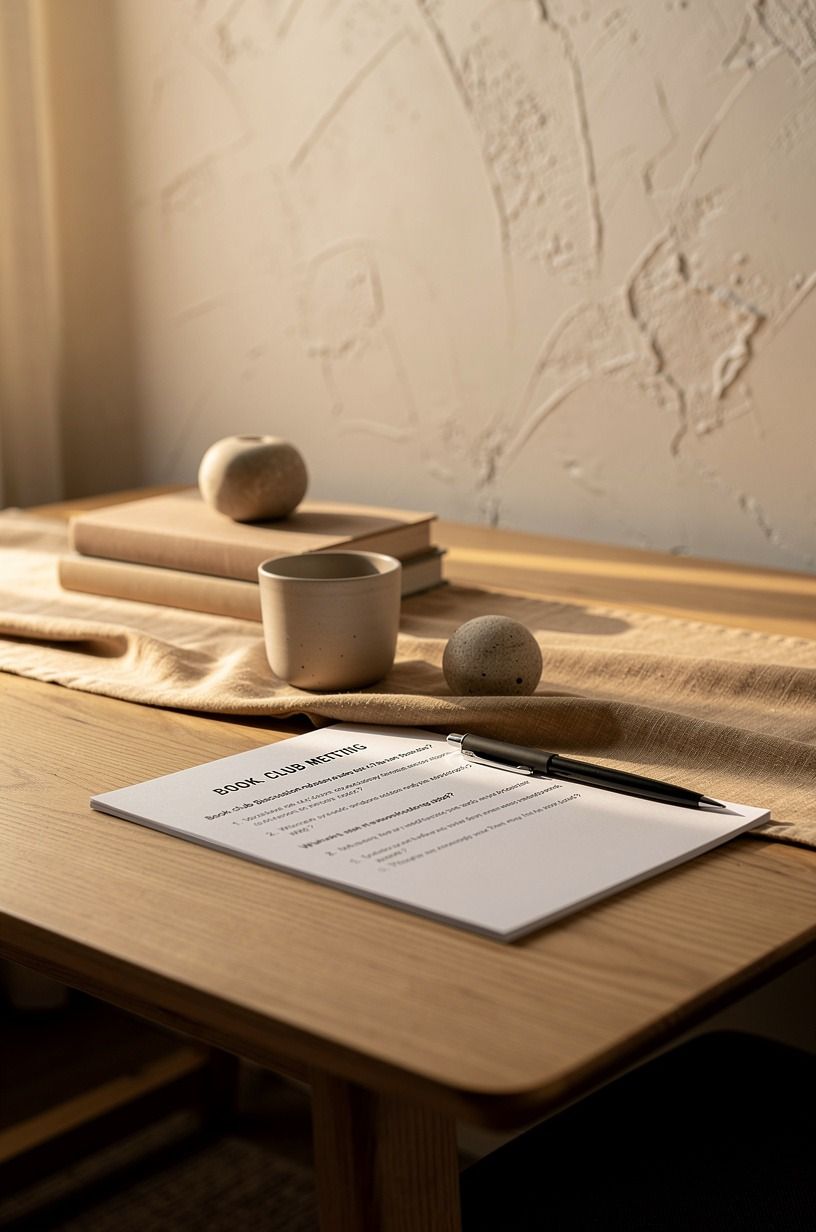
Send three questions a week ahead. Not fifteen, three. People who prep talk more, and people who talk more come back.
Keep it to a single page: the three questions, the meeting time, and one line about the snack situation. I print mine on Hammermill 24 lb premium paper because a flimsy handout gets recycled the second someone walks in the door, and a sturdy one ends up on the fridge. If you’re building book club printables you actually reuse, keep the layout identical month to month so nobody has to relearn it.
Digital works too, but a physical sheet on the table gives quiet members something to point at, and pointing at a page is a lot easier than raising your hand.
14Set the Room With Three Light Sources

The lighting rule from every decent living room applies here: three sources per room, a ceiling fixture plus task plus ambient. Switch off the ceiling fixture and the conversation drops half a register within ten minutes, in a good way.
Hang any art in the room with its center at 57 to 60 inches from the floor so nothing floats above people’s heads, and keep your rug big enough that the chairs actually sit on it, because chairs half-on a rug wobble and wobbling chairs end discussions early. Paint matters more than you’d guess for an evening group. Benjamin Moore White Dove OC-17 stays gentle under lamplight where a cooler white goes gray after dark.
If your candles keep underperforming in the warmer months, here’s why they stop working in May and what to use instead. A soft, welcoming room is doing quiet work on your discussion all night.
15Close With the One-Sentence Verdict

End every meeting the same way: each person gives one sentence, final, no hedging, no “well it depends.”
Rituals do something to a group. The closing round is how people leave feeling like the night had a shape, and shape is what makes them show up next month.
I’ve used the same closer for six years and it still lands. Write the verdicts down in a shared notebook if you’re the organizing type, and reading last January’s verdicts aloud in December is one of the most charming nights you’ll have.
Nobody remembers what they said. Everybody stands by it anyway!
What It Costs to Set Up a Room People Want to Sit In
You can host a book club for the price of coffee, and most nights that’s exactly what you should do. But if you’re making a corner of your home into the place the group meets, here’s the honest range in US dollars.
Most clubs live happily in the budget tier forever. Here’s where individual pieces tend to land.
If you spend anywhere, spend on seating and lamps. A wool rug is lovely and it won’t make anyone stay an extra hour.
Why Everybody Suddenly Wants Better Questions
Book clubs got big again, and the reason isn’t nostalgia. It’s that the reading itself moved onto screens and the talking didn’t. People will read a novel on a phone at 11pm and still drive across town to argue about it in a room with other bodies in it, which tells you what the club is actually for.
It was never a content delivery system.
The question sets that circulate online mostly haven’t caught up. They’re written for a classroom: theme, motif, author’s purpose. Fine questions, wrong room.
A group of adults with jobs and a glass of wine needs prompts that give permission rather than demand performance, which is why the “who deserved better” style keeps spreading while the theme-and-motif sheets sit unread in inboxes.
What Six Years of Bad Questions Taught Me
I ran our club badly for a long time, and I want to be specific about how, because the failures are more useful than the wins.
The first mistake was preparing too much. I’d show up with twelve pages of notes, and twelve pages of notes turns a host into a teacher.
People answer teachers differently than they answer friends. They’re careful.
They wait to be called on. I’d get through maybe five of my twelve pages and feel like the night had underperformed, when what had actually happened is that I’d built a classroom in my own living room and then wondered why nobody was relaxed.
Now I bring three questions on an index card and I don’t mind losing all three to a better tangent.
The second mistake was chasing consensus. I thought a good discussion ended with the group roughly agreeing, so I’d smooth over disagreements, find the middle, summarize a position nobody actually held.
That’s the opposite of what a club is for. The meetings people still bring up years later are the ones where two friends couldn’t get to the same place about a novel and had to just live with it.
Disagreement is the product. Agreement is the byproduct nobody asked for.
The third mistake took the longest to see. I picked books I wanted the group to have read rather than books they’d want to be reading.
There’s a real difference, and the tell is attendance. A book chosen out of duty gets you six people and four of them skimmed.
A book chosen out of appetite gets you eleven people, three of whom finished it twice. I stopped curating upward, started asking what people were already drawn to, and attendance roughly doubled inside a year.
What I’d tell anyone starting out: your job isn’t to have the best reading in the room. It’s to make the room safe enough that somebody else’s best reading comes out. Those are completely different jobs, and only one of them requires you to be right.
A Few Things Worth Answering
What are the best book club discussion questions for a small group?
Go with “who deserved better” and the three-sentence summary round. Small groups need questions with no wrong answers because there’s nowhere to hide when it’s five people.
Skip ranking exercises until everyone’s comfortable. A shared IKEA LACK side table for drinks helps more than a perfect question list does.
Where can I buy book club supplies on a budget?
Check Target for notebooks and serving trays, IKEA for seating and side tables, and Wayfair when you need one specific thing in a specific size. Facebook Marketplace is where the real value sits for armchairs, especially in spring. Thrift stores for mismatched mugs, which look better anyway.
How much does setting up a book club space cost?
About $200 to $800 for the budget tier: paint, textiles, art, a bit of organization. Hosting itself is free. You need chairs, light, and a surface for drinks.
Everything past that is preference. Rearranging what you already own costs nothing and usually does most of the work.
Can I run a good book club on a budget?
Yes, and the cheap version is often better. Rotate houses so no one person absorbs the cost. Ask everyone to bring one thing.
Use the library’s book club kits, which are free in most US systems and include multiple copies. Free beats fancy every time here.
What makes a question work for any novel?
It asks about the reader’s experience, not the book’s content. Experience questions can’t be failed, so nobody stays silent out of fear they misread something. Content questions reward whoever read most carefully, and that’s one person while the rest listen politely.
Is a dedicated book club corner worth it in a small space?
Yes, and small rooms help. Bodies close together produce better conversation than a formal living room ever will.
Hang curtains with the rod 4 to 6 inches above the window so the ceiling reads taller. Tight spaces feel intimate, not cramped, once the lighting’s warm.
Is this a good idea for a rental?
Absolutely. Peel-and-stick wallpaper on one wall, a tension rod for curtains, and clip-on picture lights that need no wiring.
No-damage swaps do the same job as permanent ones. Your deposit stays intact and the room still feels soothing by evening.
Where I’d Start First
If I had to pick one, I’d start with “who deserved better.” It’s the only question on this list that turns a polite room into an argumentative one in under a minute, and polite rooms don’t make people come back. Pin it for later and try it next meeting.