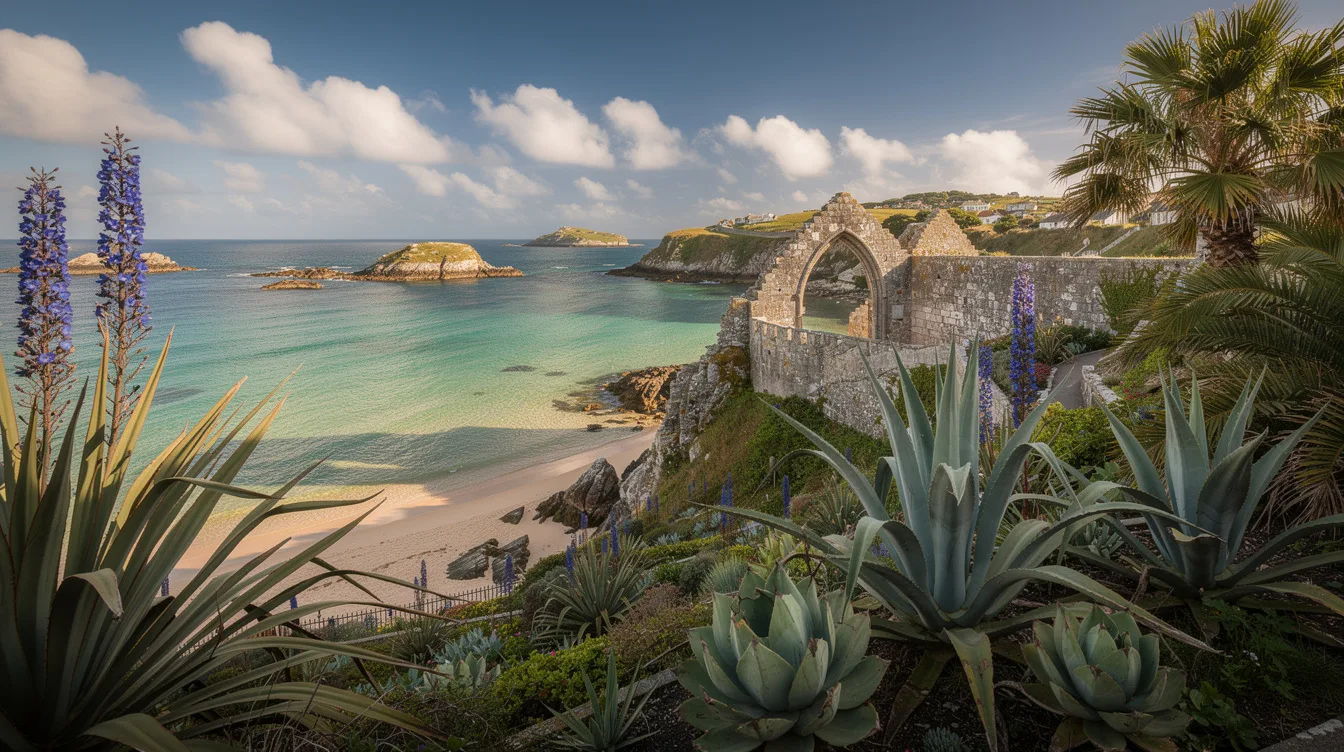
Tresco sits 28 miles off the tip of Cornwall, and only 152 people live there. No visitor cars. No traffic lights.
Just a two-mile strip in the Atlantic.
And the strange part isn’t the quiet. It’s the plants.
A 19th-century garden growing 20,000 subtropical plants in England
Tresco Abbey Garden was built in the 19th century on the ruins of an old priory. The Scillies have a maritime microclimate, so species from New Zealand and Australia grow here in the open air, with no glass over them.
More than 20,000 subtropical and exotic plants fill the terraces. You walk past things that have no business surviving a British winter, and they’re thriving.
It’s an English island. But the light through those leaves feels borrowed from somewhere much further south.
Small enough to walk, varied enough to surprise you
The island runs 2.2 miles long and 1.1 miles across at its widest. You can cross it on foot in a morning.
And the two halves don’t match. The northwest is exposed and rugged, while the southeast turns soft and beachy, which is unusual for a place this small.
Two villages hold most of the life: New Grimsby and Old Grimsby. That’s the whole settlement map.
Can you swim there?
Yes, and the beaches are the reason many people come. Pentle Bay is the big pale-sand stretch, good for a long walk and a cold swim.
Appletree Bay sits more sheltered, with a clear view across to St Martin’s. Rushy Bay is wilder, better for rock pools and watching the tide work.
The water turns turquoise when the weather cooperates. But this is the Atlantic off Cornwall, and the weather doesn’t always cooperate.
A 17th-century castle on the western shore
Cromwell’s Castle stands on the west coast, a 17th-century fortification tied to the English Civil War. It’s a short walk from the water, and it still reads as what it was: a gun position watching a channel.
The island also keeps traces of its monastic past, around the old priory that the Abbey Garden grew out of. Two very different centuries, on one small island.
How do you get there without a car?
You fly or take the ferry from Cornwall to St Mary’s, the main island, then board an inter-island boat to Tresco. A direct helicopter link from Penzance also runs, depending on the service and the season.
From there, you’re on foot or on a bike. And the crossing is part of it. By the time you step off the boat, the mainland already feels like a different country.
The catch: it’s private, polished, and not cheap
Tresco is run as a private destination by one family, under a lease from the Duchy of Cornwall. That’s why everything looks so kept, and it’s also why the island sits at a higher price point than St Mary’s.
Budget travelers will feel it. Beds are limited, demand spikes in good weather, and you need to book well ahead.
For couples and walkers, it’s close to ideal. For a cheap week away, it isn’t.
How long to stay, and what to pair it with
One day gets you the garden and a beach. Two to four nights gets you the island’s actual rhythm, which is the point of coming.
At low tide, the sand flats between Tresco and Bryher open up into something worth planning a day around. Inter-island trips widen the whole experience.
A workable plan: land on St Mary’s, spend a night or two on Tresco, then head back for more restaurants and boat excursions.
When to come
There’s a practical window when the boats run reliably and swimming makes sense. Check the marine forecast before you commit to anything on the water.
That said, the microclimate keeps the garden interesting well outside that window. It’s one of the few English attractions that doesn’t shut down emotionally in winter.
Check boat times twice. They answer to the sea, not to your schedule.
And that’s the trade. You give up cars, easy access, and a low bill. You get 152 neighbors, an Atlantic horizon, and a garden full of plants that shouldn’t be there at all.