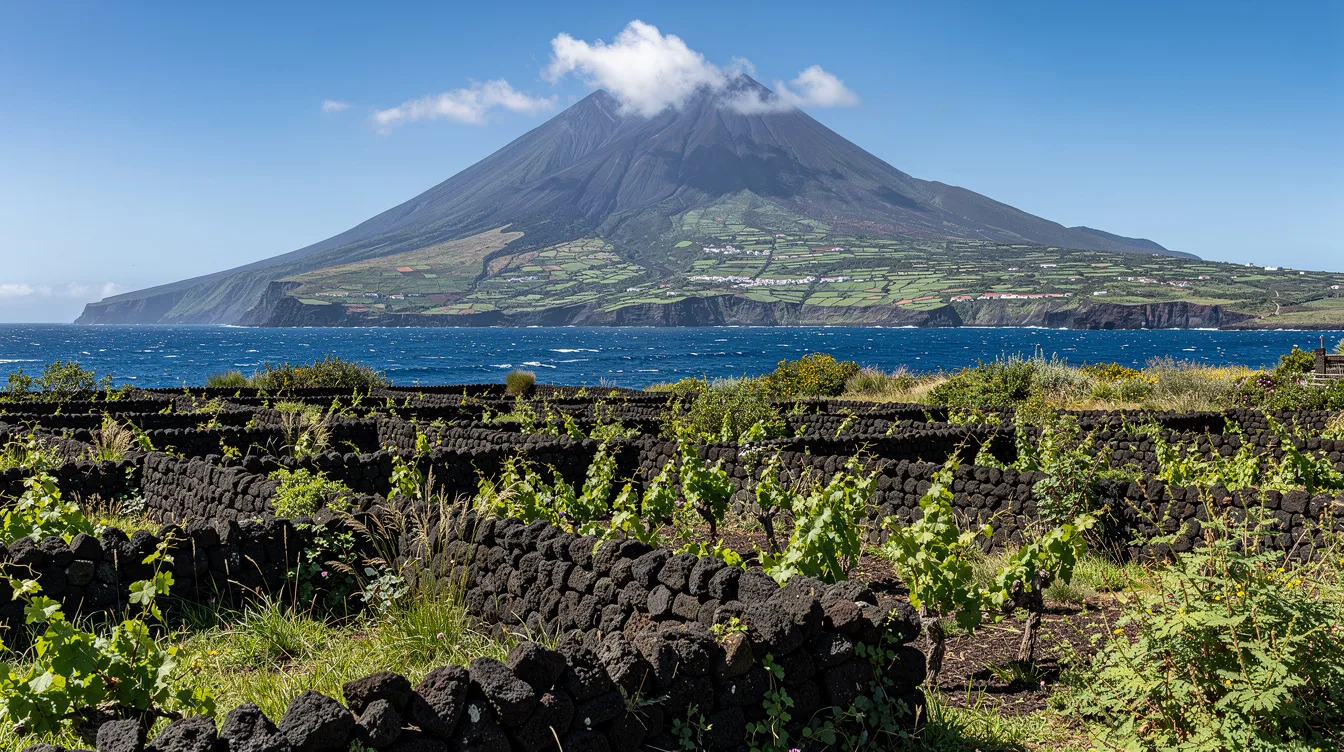
Pico rises from the Atlantic with one fact that changes the whole trip: its summit reaches 2,152 feet above the sea. That makes Mount Pico Portugal’s highest point, and it’s why this Azores island feels less like a beach break than a place with a mountain weather system of its own.
And the number matters because the volcano is never background scenery. It dominates roads, vineyard walks, and the view from Madalena. You can be under bright coastal light, then watch its upper slopes disappear into cloud before lunch.
Mount Pico is the reason the island feels vertical
Mount Pico gives the island both its name and its urgency. The cone rises above a rural coast of black basalt walls, damp vegetation, and grazing cattle, so even a slow drive can feel like you are circling a much bigger force.
But this is not a summit to treat casually. The ascent is about 4.3 miles one way and usually takes three to four hours uphill, depending on conditions and your fitness. Wind, rain, and fog can erase the view completely.
If the weather holds, the reward is unusually direct: the Atlantic below and, at times, Faial and São Jorge visible beyond it. That’s why active travelers come. The climb is demanding, but it answers the title’s promise better than any overlook could.
Can you climb Mount Pico without planning ahead?
Not wisely. Check conditions with local operators and authorities before committing, because visibility is the deciding factor here. Bring warm waterproof layers, too, since a clear coast does not guarantee a clear summit.
And if fog closes in, skip the idea of forcing it. Pico has enough volcanic ground-level drama to fill the day, including Gruta das Torres, a large lava tunnel, and Lagoa do Capitão, where the mountain may appear and vanish behind low cloud.
Madalena puts the sea just 3.7 miles from Faial
Madalena, on Pico’s west coast, faces Faial and the harbor town of Horta across roughly 3.7 miles of water. That short gap makes island-hopping practical, while Pico itself remains quieter and more rural than a conventional Portuguese resort.
But close does not mean interchangeable. Faial gives you Horta’s harbor energy. Pico gives you coastal roads, lava fields, and the blunt silhouette of the volcano.
A ferry crossing can change the mood of your day without changing the horizon very much.
You can arrive through Pico Airport or use inter-island ferries. A rental car is strongly recommended once you are there, because weather and photo stops stretch what look like short distances on a map.
And don’t rush through on a single overnight if you can help it. Three nights gives you room for a summit attempt, a weather backup, and time beside the water without turning the island into a checklist.
Criação Velha explains how people live with the wind
Near Madalena, Criação Velha shows another consequence of Pico’s exposed Atlantic setting. Vines grow in small plots enclosed by dark volcanic-stone walls called currais. The walls shield them from salty wind, so the vineyard pattern looks engineered by weather as much as farming.
And this is the island’s most persuasive walk, especially if you prefer a glass of local wine to another steep trail. The UNESCO-listed vineyard area meets the ocean in hard black lines, with Mount Pico hovering behind it when the clouds allow.
Try a local Verdelho and visit the Pico Wine Museum for context. The experience is earthy rather than polished, which suits the island. You are looking at working walls and growing vines, not a decorative wine route.
But plan around the elements. Rain can arrive fast, and the same moisture that keeps the island green can flatten a planned cycling or walking day. That is part of Pico’s character, not a flaw to outsmart.
Choose the sea when the summit disappears
Pico’s waters are known for whale watching, and boat outings offer a useful alternative when the mountain is hidden. You can also visit Lajes do Pico and São Roque, then find natural swimming pools along the volcanic coast.
Beyond the harbor, the island keeps its maritime history close. These are quieter towns, with a less resort-driven feel than many European island destinations. You will notice salt in the air and black rock underfoot more than beach-club polish.
May through October is the practical window for hiking, sea time, and more reliable transport. July through September generally brings steadier conditions, though demand and prices rise too. May, June, September, and October can offer a calmer compromise.
And that trade-off is Pico in miniature: you come for a high summit, but the weather decides whether you get it. By evening in Madalena, Faial sits across the channel, the volcanic walls darken, and the mountain may still be holding its cloud.