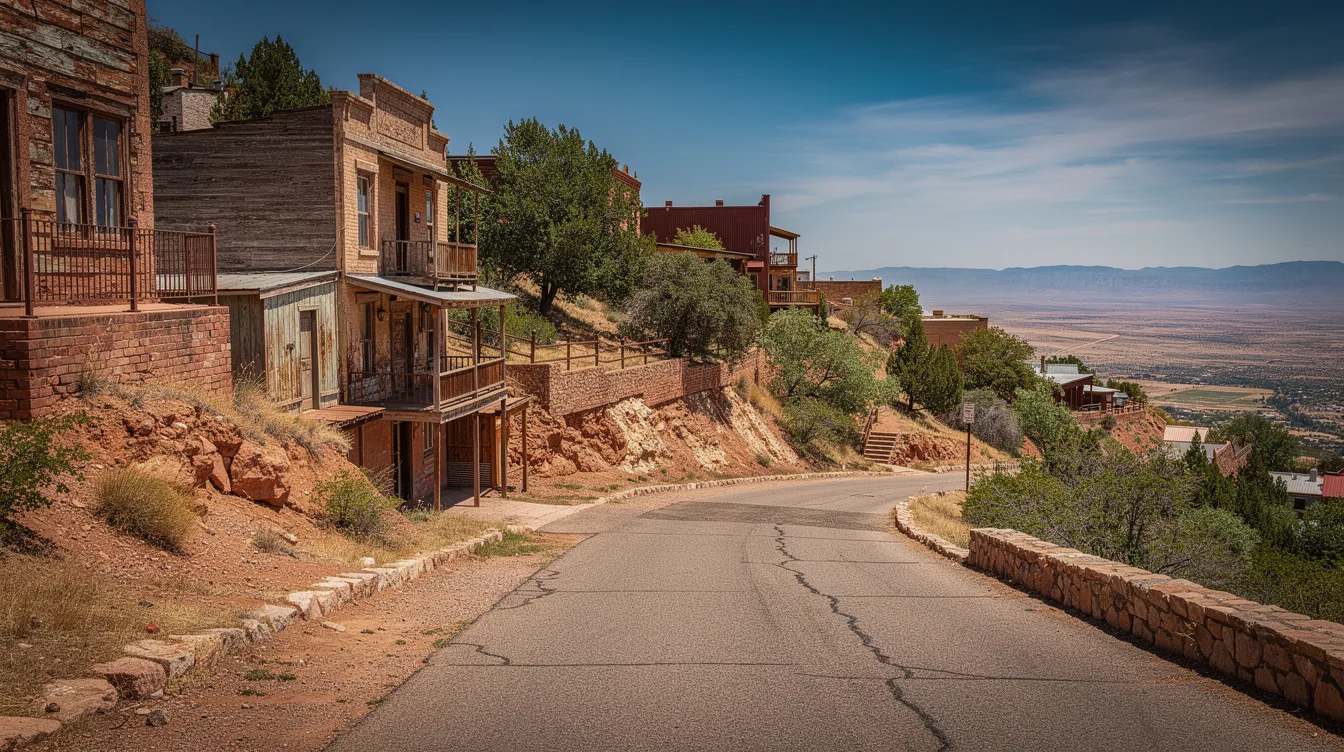
Jerome once held more than 10,000 residents in the 1920s, when copper pulled workers, shops, and saloons up the slopes of Cleopatra Hill. The mines closed in the 1950s, so the people left and the boomtown became a near-ghost town.
That reversal is still the point of visiting. You can feel it in the steep streets, where old mining buildings lean into an artsy present and the Verde Valley opens below like a wide, dry horizon.
Copper made Jerome big, then took its reason to exist
At the end of the 19th century, major copper deposits drew miners and businesses to this part of Yavapai County. Jerome grew into one of Arizona’s larger towns by the 1920s because the mines supplied the work that made everything else possible.
But a company town has little room for a second act when its industry stops. After the mines closed in the 1950s, the population fell to only a handful of residents, and vacant buildings became part of the town’s identity.
And that is the direct answer to Jerome’s near-ghost-town story: copper built it, then the loss of copper work emptied it. It’s a sharper history than the usual Old West fantasy, because the town’s decline was economic and visible.
Today, Jerome had 464 residents in the 2020 census. That’s tiny beside its 1920s peak, but it also means you’re walking through a place that survived rather than a preserved set built for visitors.
Cleopatra Hill makes every errand a climb
Cleopatra Hill gives Jerome its drama and its inconvenience. The town sits on steep ground above the Verde Valley, so you’ll want good shoes for narrow, uneven streets that can turn a casual browse into a real uphill walk.
But the grade is why the views land so well. From the historic center, you can look toward Sedona, the San Francisco Peaks near Flagstaff, and broad stretches of northern Arizona when the air is clear.
And Jerome is lively, but never smooth around the edges. Some old buildings are tilted or shifted because of unstable ground, which feeds the town’s haunted reputation without needing to be your main reason for stopping.
That folklore is best treated as tourist seasoning. The stronger draw is the odd collision of mining-era structures, galleries, cafés, restaurants, and the dry, high-country light that changes the mood of the streets by late afternoon.
The 89A approach is part of the visit
Jerome is on Arizona State Route 89A between Sedona and Prescott. A car is practically essential, because there is no useful rail service for visitors and the town’s terrain does no favors for quick arrivals.
And the drive earns its place in the day. Route 89A is a mountain road, so Jerome works naturally as a pause between Sedona and Prescott or as part of a route through Cottonwood and Clarkdale.
But don’t expect parking to feel effortless, especially on weekends. Arrive early if you can, then give yourself time to walk slowly, since the views and old façades reward looking up as often as you look ahead.
You can see Jerome in a half-day, and that’s enough for its main streets and atmosphere. Still, an overnight has a real advantage: after day visitors leave, the town quiets down and sunset softens the hard angles of the hillside.
Go for the story, not one headline attraction
Jerome State Historic Park, set in a former mining-era mansion, is the clearest place to get the copper story straight. Start there if you want context, because the galleries and bars make more sense once you understand what paid for the town.
And don’t rush past the historic center afterward. You’ll find old hotels, saloons, galleries, studios, and cafés in buildings that carry their industrial past without pretending every door is a museum.
Jerome is touristy in its busiest moments, but it never feels interchangeable with a larger Arizona stop. It is a town for people who like a strong sense of place, photographic streets, and a detour with some friction built in.
But bring a layer if you stay late. The elevation can make evenings cool, and winter may bring frost or a little snow, while the last light settles over the Verde Valley below.