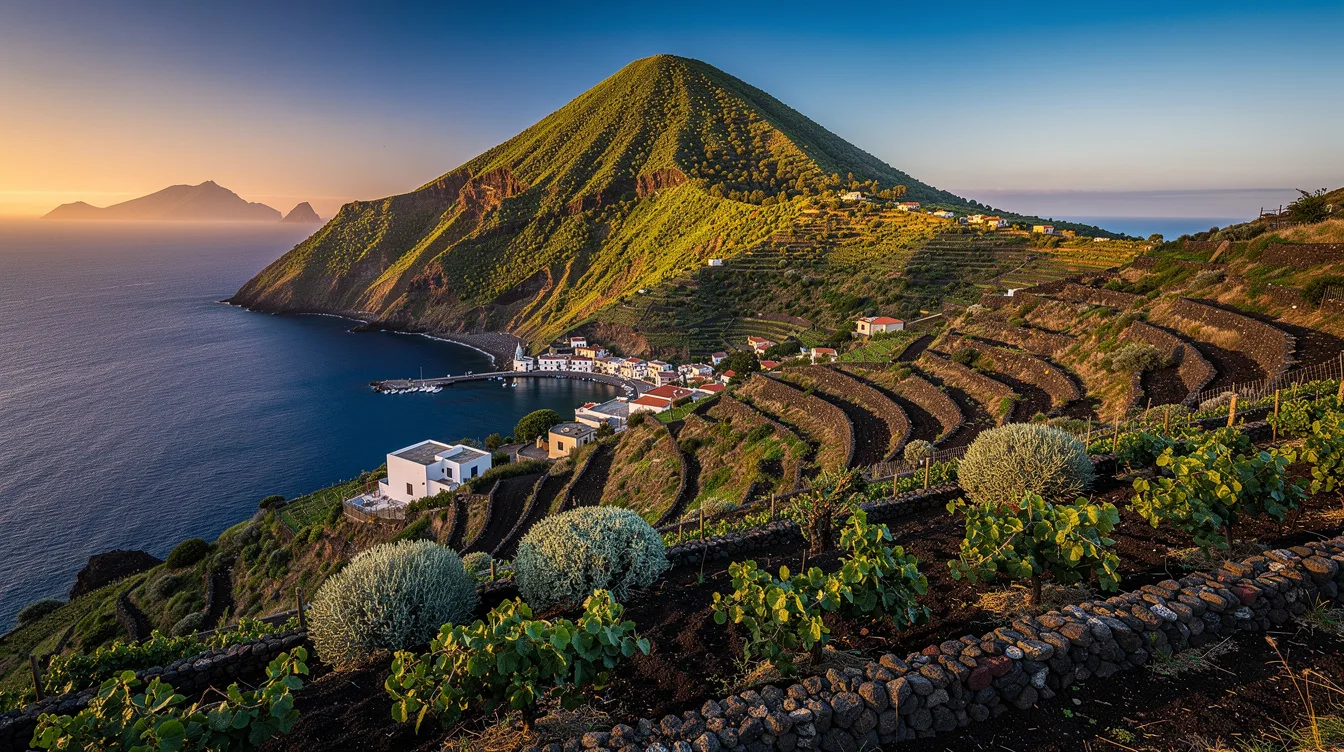
Salina is the one Aeolian island that stays green when the others go the color of ash. Fresh water springs feed it, which is why the slopes hold vineyards and fern instead of scrub. And the capers that grow in that soil are the island’s real signature.
The name locals use for it is simple. The green one. You’ll understand why about ten minutes after the hydrofoil pulls in.
Two dead volcanoes, one very alive island
Salina is built from two extinct cones, Monte Fossa delle Felci and Monte Porri. The higher one tops out at 3,156 feet, the highest point on the island. From up there you see the rest of the archipelago laid out on the water.
The climb is the main event here. Start early, wear real shoes, carry water, and check the forecast before you commit. There’s no shade waiting for you at the top.
But the trail is worth the sweat for one reason. The vegetation you walk through is genuinely rare in these islands, and you can smell it as you go.
Why the capers matter more than the beaches
Salina is not a perfect-sand destination, and it doesn’t pretend to be. What it has instead is food that comes from the ground under your feet. The island is known for its salted capers and for cucunci, the caper fruit.
Then there’s the wine. Malvasia delle Lipari is sweet, local, and poured at the end of most meals here. Order it with something simple and you’ve had the island in one sitting.
Fish, granita, capers, Malvasia. That’s the shortlist, and it holds up for a week.
Where you sleep changes the whole trip
Santa Marina Salina is the practical choice. It’s the main arrival port, the central street stays quiet, and the restaurants and shops are all within walking distance. If you’re coming without a car, stay here.
Malfa is the prettier call. More residential, more elegant, and the sunsets over the water are the reason people book it. It costs you a little logistical convenience and gives you back atmosphere.
And then there’s Pollara, out on the west coast. Cliffs, deep water, near-total quiet. Go for the isolation, not for the errands.
The swim, the salt lake, and the black sand
Rinella has the most usable beach on the island, dark volcanic sand and pebbles on the southwest coast. It’s the one place where you can plan an actual day at the sea rather than a quick dip.
Lingua sits by the old salt basin, and the island’s name traces back to the salt once worked near that lake. It’s a fishing village, best walked late in the day when the light goes flat and gold.
Can you get around without renting anything?
Yes, in summer. There’s a bus network that works in season, and taxis and boats fill the gaps. But if you want to string together Pollara, Malfa, Lingua and Rinella on your own clock, a scooter or a small car makes more sense.
Getting there takes effort, and that’s the filter
There’s no airport on Salina. Ferry or hydrofoil only, and the usual departure is Milazzo on Sicily’s northeast coast, landing at Santa Marina Salina or Rinella. Count on 1.5 to 2 hours by hydrofoil depending on the stops and the operator.
From abroad, the chain is straightforward. Fly into Catania or Palermo, transfer overland to Milazzo, then take the boat. Seasonal links also run from Messina, Palermo, Naples and the other Aeolian islands.
When should you go?
May and June, or September into early October. The sea is comfortable, everything is open, and the crowds haven’t landed. July and August are beautiful and expensive, and even Salina gets busy.
From November through April, plenty of places close and rough seas can cut or cancel crossings. That’s the trade-off for an island with no runway.
An island of three towns and no rush
Salina runs as three separate comuni: Santa Marina Salina, Malfa and Leni. It’s the second largest island in the archipelago, and much of it falls inside a nature reserve. Lively, but never loud.
Three to five nights is the right length. Longer if you actually want to slow down, and Salina is one of the few places that rewards it.
The volcanic landscape of the Aeolians carries UNESCO World Heritage status, and Salina is the green outlier inside it. Sit with a glass of Malvasia as the light drops behind Pollara’s cliffs, and the capers on the table start to make sense.