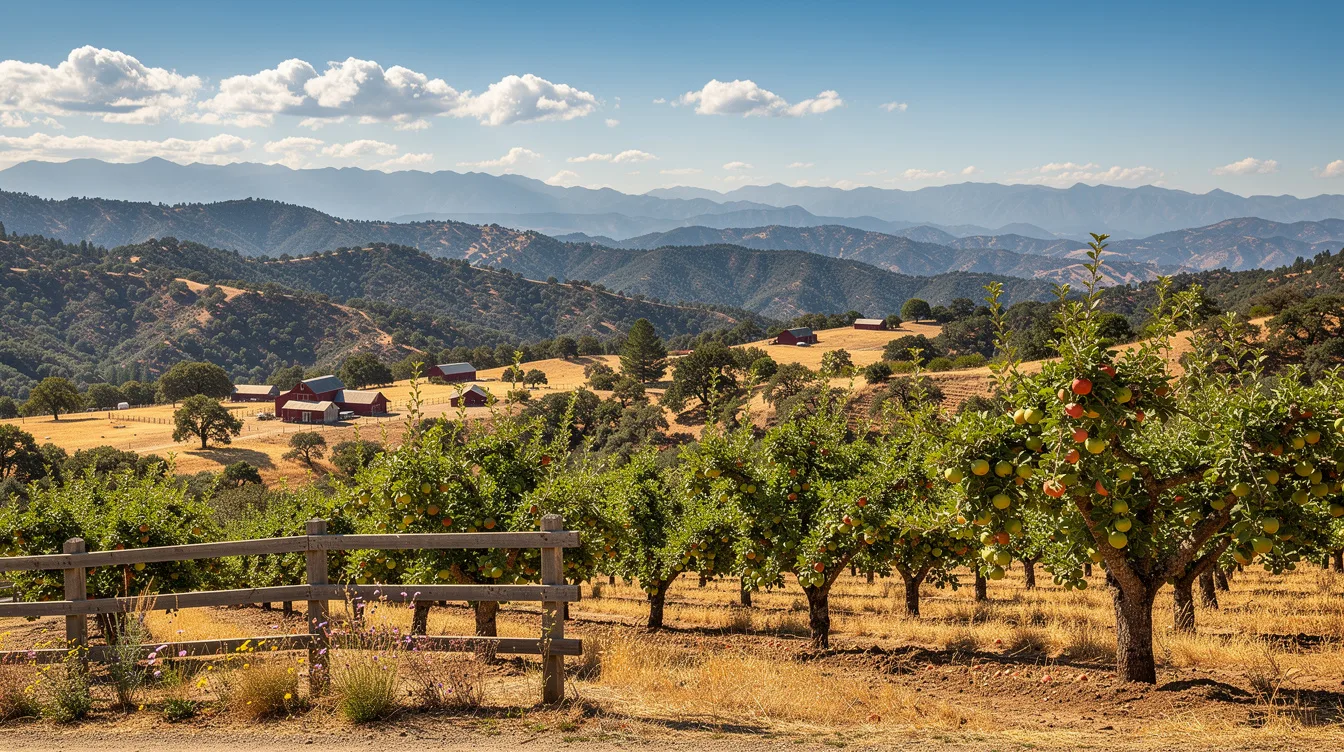
The apple orchards start at 4,226 feet, which is the whole point. Cold nights, warm days, and fruit that never had a chance on the coast. Julian sits about an hour east of San Diego, and in fall it is the only place in the county that smells like cider instead of salt.
You go up for pie. You stay because the air is cooler than the beach.
Gold came first, apples paid the bills
Miners found gold here in the 1870s, one of the rare southern California rushes. It didn’t last, the way rushes don’t.
What replaced it was farming. The altitude and the cooler climate suited apples in a way the coastal valleys never could, so the orchards stayed after the ore ran out.
And that history is still standing. Main Street keeps its Victorian storefronts, independent shops, galleries, and rustic restaurants. The town is a California Historical Landmark, and the core falls inside the Julian Historic District.
Fall is the crowd, and it’s worth it anyway
Apple season runs from September into mid-November. That’s harvest, cool air, and seasonal color, and it’s also when everyone else has the same idea.
Some orchards and fruit stands open up for pick-your-own. But if you want the town quiet, come in spring instead, when the wildflowers are out and the trails are empty.
The pie is the thing people drive up for. You’ll see it served plain, with ice cream, or with a slab of cheddar on top, depending on the counter you’re standing at.
You can still go underground
The Eagle Mining Co. runs tours down into the old tunnels. And there’s gold panning at the surface, which sounds like a gimmick until you’re crouched over a pan with cold water running through your fingers.
It is a mining town that leaned into being a mining town. That’s honest, not cynical.
Is there anything to do besides eat pie?
Yes, and most of it involves walking uphill. Trails climb Cuyamaca Peak and Volcan Mountain, and there’s more ground in Cuyamaca Rancho State Park and William Heise County Park.
Spring is the better hiking window if you want the trails to yourself. Fall gets busy on the weekends, and the parking lots tell you that before the trailheads do.
The sky is the reason to stay past dinner
Julian became an International Dark Sky Community in 2021. That designation is not decoration. It means the town controls its lighting, so the stars actually show up once the shops close.
Most day-trippers drive back down before dark and miss it entirely. That’s their loss and your window.
Winter is the wild card
Some years it snows here. Snow, an hour from San Diego, is strange enough that it draws its own crowd when it happens.
But it doesn’t happen every winter, and it isn’t something you can plan around. Check road conditions before you commit to the drive, because mountain roads and snow are a combination that ends weekend plans.
The village feel in winter is real, though. Fewer people, colder air, woodsmoke instead of orchard dust.
How far is it, really?
About an hour by car east of San Diego, into the Cuyamaca Mountains. It also works as a longer day trip from Palm Springs if you’re coming from that side.
You need a car. This is not a place you reach by accident.
A town of 1,768, and it acts like it
1,768 people lived here at the 2020 census. That number matters, because it explains why Main Street feels like a street and not a strip.
Busy in October, close to empty on a Tuesday in April. Both versions are the same town, and both are worth the drive.
Go up for the pie, the mine, the trails, whatever gets you in the car. Then find a dark patch of road after the last shop turns off its lights, and look up.