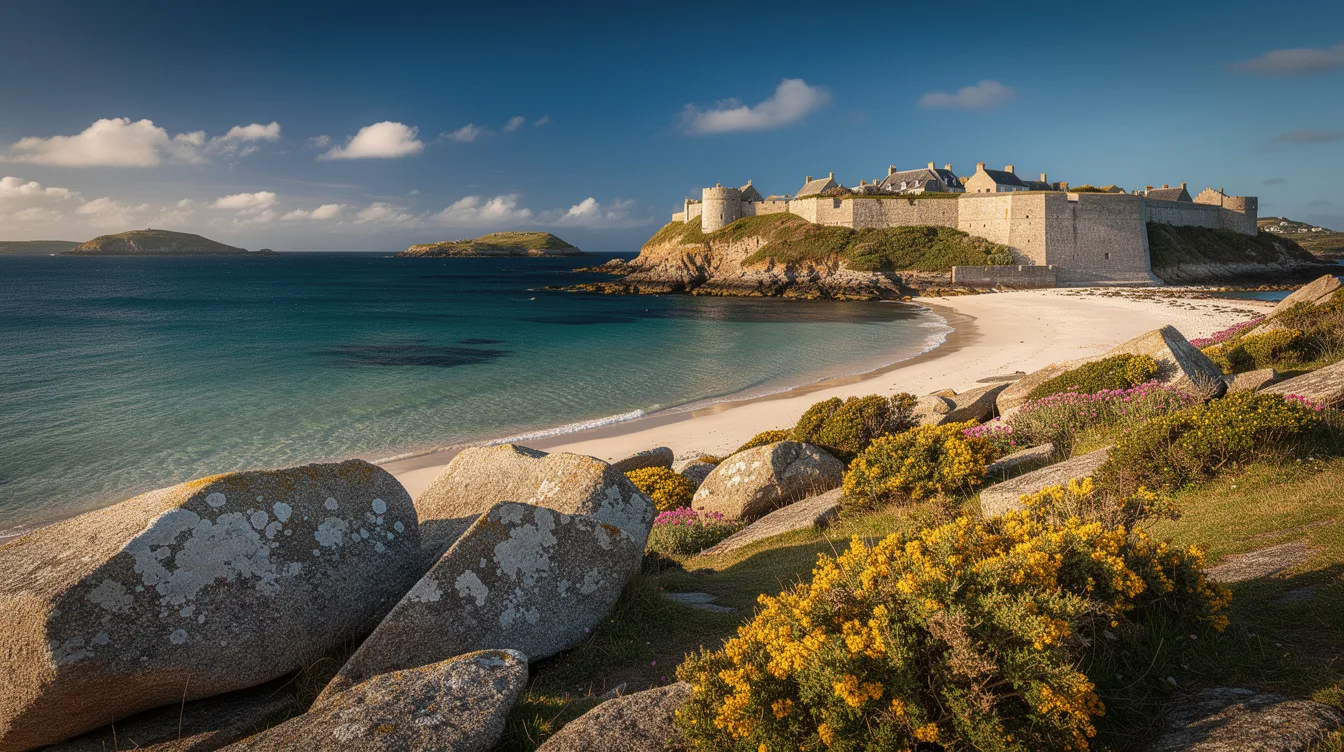
The Isles of Scilly sit out in the Atlantic, southwest of Land’s End, and most American travelers never think to go. That’s the first thing worth fixing. St Mary’s is the largest island in the group, and above its only town stands a star-shaped fort finished in 1593.
Star Castle crowns the Garrison, a fortified headland that rises straight out of Hugh Town. You can walk to it in minutes from the harbor. And the walk up is steep enough that you’ll notice it.
A star fort from 1593, and everything the army built after it
The castle is the oldest piece, but not the only piece. The Garrison holds a continuous defensive landscape running from the Tudor period all the way to the Second World War. Walls, gun positions, and lookouts, all on one headland.
That layering is what makes the walk interesting instead of just scenic. You pass centuries of military thinking on a single short walk. And you’re looking down at turquoise water the entire time.
Below the ramparts, Hugh Town sits on a thin sandy isthmus with a shore on either side. It’s an odd, exposed piece of geography. Sand on your left, sand on your right, and the Atlantic beyond both.
An island of 1,800 people that still feels remote
St Mary’s has roughly 1,800 residents, which makes it comfortably the most populated island in Scilly. It’s also the arrival point: the airport, the main harbor, and the boats all start here. Busy by Scilly standards.
Empty by anyone else’s.
Hugh Town gives you cafés, pubs, galleries, shops, and the island’s easiest places to sleep. Beyond the town, that infrastructure disappears fast. Within minutes you’re on heath, granite, and open sea.
Can you get around without a car?
Yes, and most people do. You can cover much of St Mary’s on foot, though the coastal paths and scattered beaches spread out more than the map suggests. A bike, an electric cart, a taxi, or the local bus helps if you want to see the whole island in a day or two.
Where to swim, and where to go when you want nobody around
Porthcressa, Town Beach, and Porthmellon all sit close to Hugh Town, with white sand and water clear enough to make the swim worth it. They’re the convenient ones. They’re also the ones other people find.
For a more remote feel, head for Bar Point and the eastern coast. Quieter beaches, wider views, fewer footprints. The trade-off is obvious: you walk farther, and there’s nothing to buy when you get there.
Swimming here depends entirely on the weather, and the sources are honest about that. Clear-water swimming and long coastal walks are a fair-weather proposition. Spring through early autumn is your window.
Burial cairns on the high ground, older than the castle by millennia
The Garrison isn’t the island’s oldest history. St Mary’s carries Iron Age and Bronze Age burial cairns, including sites on the higher ground and along the coastal routes. You come across them while walking, which is the right way to meet them.
The Isles of Scilly Museum fills in the rest: local archaeology, shipwreck history, and how island life actually works. It’s a small stop, and a useful one before you start walking.
Why it works as a base for the other islands
Boats leave Hugh Town harbor for Tresco, St Martin’s, Bryher, and St Agnes. That makes St Mary’s the logical home for a first Scilly trip. Sleep in one place, wake up somewhere different each morning.
Scheduled air and sea connections link the island to the mainland, with St Mary’s Airport handling the flights. Remote, but not hard to reach. That combination is rarer than it sounds.
Is this the right kind of trip for you?
It depends on what you want from an island. This is coastal walking, landscape photography, clear water, granite headlands, and military architecture. It is not nightlife and it is not shopping.
The Cornish name for the island is An Nor, or Ennor, meaning roughly “the land.” Plain, and accurate. There’s no grander claim being made here.
The case for going in the shoulder season
St Mary’s takes up about 40% of the archipelago’s land area, packed into 2.54 square miles. Small enough to learn in two days. Large enough that you won’t.
Come in spring or early autumn and the weather is a gamble, but the coves are yours. Come in high summer and you trade solitude for a better chance at swimming. Both are defensible.
Neither is crowded the way an American beach town is crowded.
Climb the Garrison late in the day, when the light goes low across the water and the ramparts throw long shadows over Hugh Town. From up there you can see both of the town’s shores at once, sand on either side of the isthmus, and the Atlantic closing in around all of it.