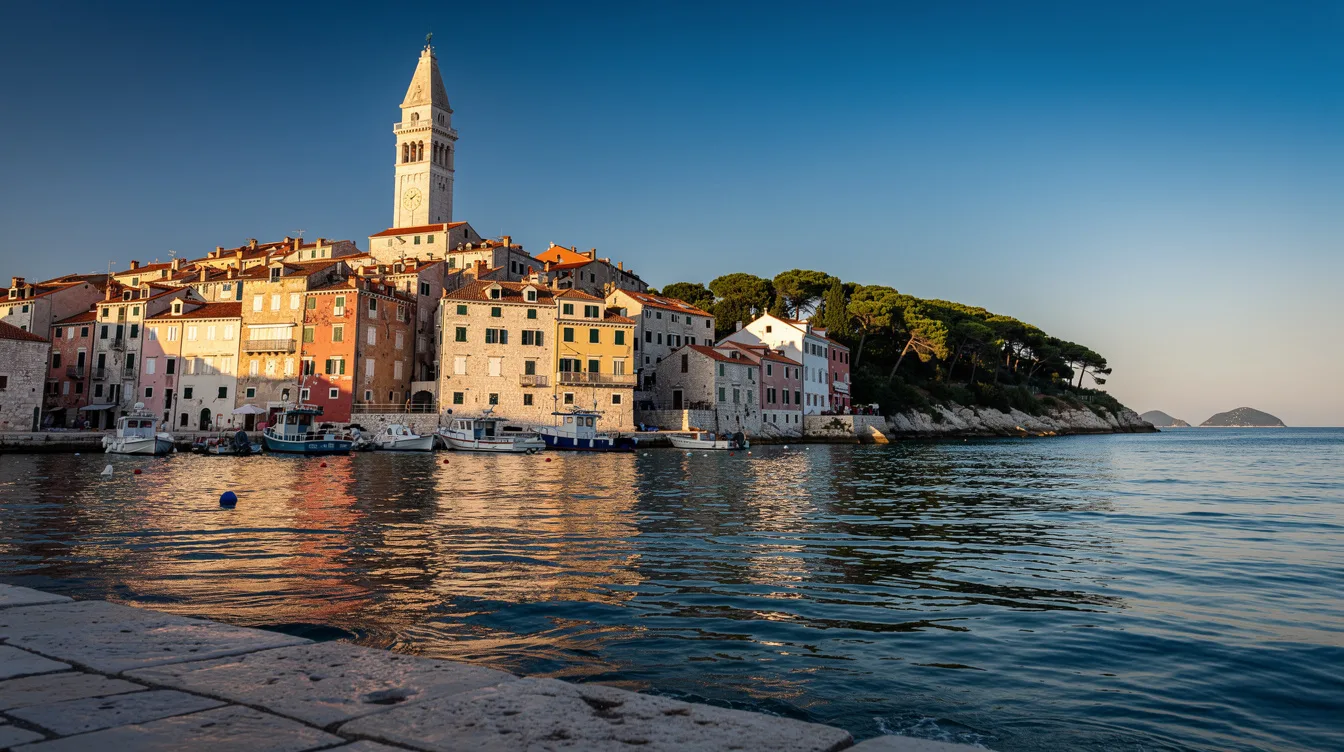
Rovinj wasn’t always attached to Croatia. The old town sits on what was a real island, cut off from the mainland by a channel, and that channel stayed open water until 1763. Fill it in, and you get the peninsula you walk today.
You can still feel the island logic in the street plan. Everything spirals uphill, tight and inward, the way a town builds when it has nowhere else to go.
Why the streets feel Italian before you hear a word of Croatian
From 1283 to 1797, Rovinj was one of the most important towns in Istria under the Republic of Venice. Five centuries leaves marks. Two rows of defensive walls went up, plus three town gates, and pieces of both survive.
The one you’ll walk through is Balbi’s Arch on the pier, dating from 1680. There’s a late-Renaissance clock tower beside it. Croatian, but Venetian in the bones.
And the language isn’t a museum piece. At the last Austrian census in 1911, 97.8% of the population spoke Italian. The town is officially bilingual today, so signs and documents run in both.
Closer to Venice than the map suggests
In summer, a direct high speed ferry connects Venice to Rovinj in about 2.5 hours one way. That’s a morning crossing, not an expedition. It’s the single best argument for tacking Istria onto an Italy trip.
Otherwise you fly. Pula airport is 20 miles out, Trieste-Ronchi about 70. Low-cost carriers run direct summer flights to both from western Europe.
Can you get there without a car?
Yes, but a car makes inland Istria far easier. Buses link Rovinj to Pula, Poreč and Zagreb, and some Trieste and Venice runs are seasonal. There’s no train station in town.
The nearest rail is Kanfanar, 10 miles away, and locals will tell you the bus beats it. Rovinj had its own branch line from 1876 to 1966.
The sunniest town you’ve never counted on
Rovinj is the third sunniest city on the Adriatic, with 134 sunny days and 2,437 hours of sunshine a year. From May through September it gets more than 10 hours of sun daily. That’s the reason the stone stays warm past dinner.
July averages 22.3 °C (72.1 °F). January drops to 4.8 °C (40.6 °F), which is when the galleries shorten their hours and the town exhales.
When is the sea actually warm enough?
The sea holds above 20 °C (68 °F) from mid-June to September. So May and June and September are the sweet spot: swimmable water, fewer people, everything still open. Bars, restaurants and galleries run long hours May to September and cut back hard off-season.
But be honest about August. Beds are abundant and usually overbooked, and the old town lanes get shoulder-to-shoulder. Book early or come later.
What to actually do with two days
Climb to St. Euphemia’s Basilica at the top. The church is free; the bell tower charges and runs seasonally, so check before you climb.
Go early or at dusk, when the lanes are quiet and the light is low.
Down at the old harbor, the Casa della Batana is a small community ecomuseum built around the batana, the flat-bottomed boat the local fishing families made. It’s on UNESCO’s Register of Good Safeguarding Practices. Twenty minutes, and the harbor reads differently afterward.
Water, forest, and 22 islets
The Rovinj archipelago includes 22 islets. Sveta Katarina sits right off the port. Crveni otok, Red Island, is the classic beach run, with sand and walking paths.
South of the old town, Zlatni Rt forest park gives you holm oak and Alpine pine right to the shoreline. The protected stretch runs from St. Ivan promontory to Barbariga.
Mulini Beach is the easy, groomed option near the center.
The trade-off nobody mentions
The old town is fully pedestrian. Sleep inside it and you get sunsets and dinner on foot, but you’ll park outside and drag your bag over cobbles. That’s a real cost with a heavy suitcase.
Rovinj is more seductive than convenient. It’s a place you walk, not a box you tick.
Eat Istrian while you’re here: seafood off the boats, truffle pasta, local olive oil, pršut, and Malvazija or Teran in the glass. Carera Street, the pedestrian spine, is where the independent shops and galleries are.
Give it three nights. One for the old town and the water, one for the islands, one for a drive to Pula or Motovun and the wine estates inland.
And when the last summer ferry clears the harbor for Venice, the lanes go quiet, the clock tower catches the last light, and the island Rovinj used to be feels a little closer to the surface.