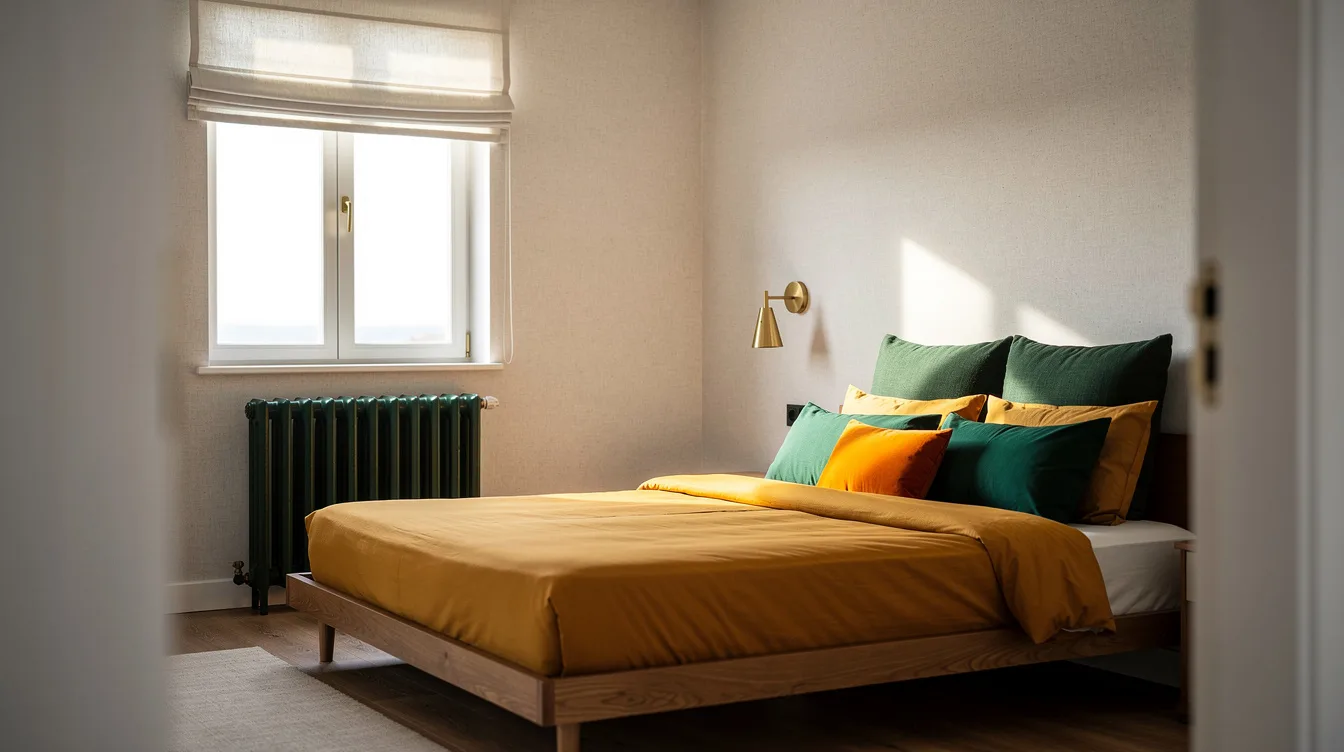
My bedroom in the last apartment was 45 square meters total, and the radiator sat dead center under the only window. Every layout I sketched put the bed right on top of it.
So I spent a winter with a warm headboard and a cold room, which is a fantastic way to learn how convection works.
The fix turned out to be a rule, not a purchase: keep roughly 20 to 30 cm clear in front of the radiator and treat that wall as an open heat zone instead of storage. Everything else follows from there.
Measure the Real Footprint, Valves and All
Grab a tape measure before you move a single thing. The number you need isn’t the width of the white panel, it’s the panel plus the thermostatic valve and the pipe elbow sticking out of the wall.
In my last rental that added roughly four extra inches I hadn’t planned for, and it’s why my nightstand never fit.
The working target: leave about 20 to 30 cm clear in front, and 10 to 15 cm on either side when the room allows it. That side gap is what makes the valve reachable in February when you actually want to turn it.
Write the numbers on painter’s tape and stick it to the floor. It’s ugly for a weekend and it saves you a return trip to Home Depot.
Put the Bed on the Longest Uninterrupted Wall
This is the plan that works in most small bedrooms, and it’s the one people skip because the window feels like the natural anchor.
Run the bed lengthwise along the wall opposite or perpendicular to the radiator. A typical full is 140 by 190 cm, a small double 120 cm, so measure your wall before you fall for a frame online.
Then keep the radiator wall deliberately quiet: a mirror, one framed print, maybe a narrow shelf mounted high. IKEA‘s slim wall shelves run under $20 and do the job without crowding anything.
Aim for a 55 to 60 cm walking strip on your main route. At a secondary side, 45 cm is survivable.
Swap the Nightstand for a Wall-Mounted Shelf
A standard nightstand is around 40 cm deep and it will bridge straight across a radiator if the bed sits anywhere near it.
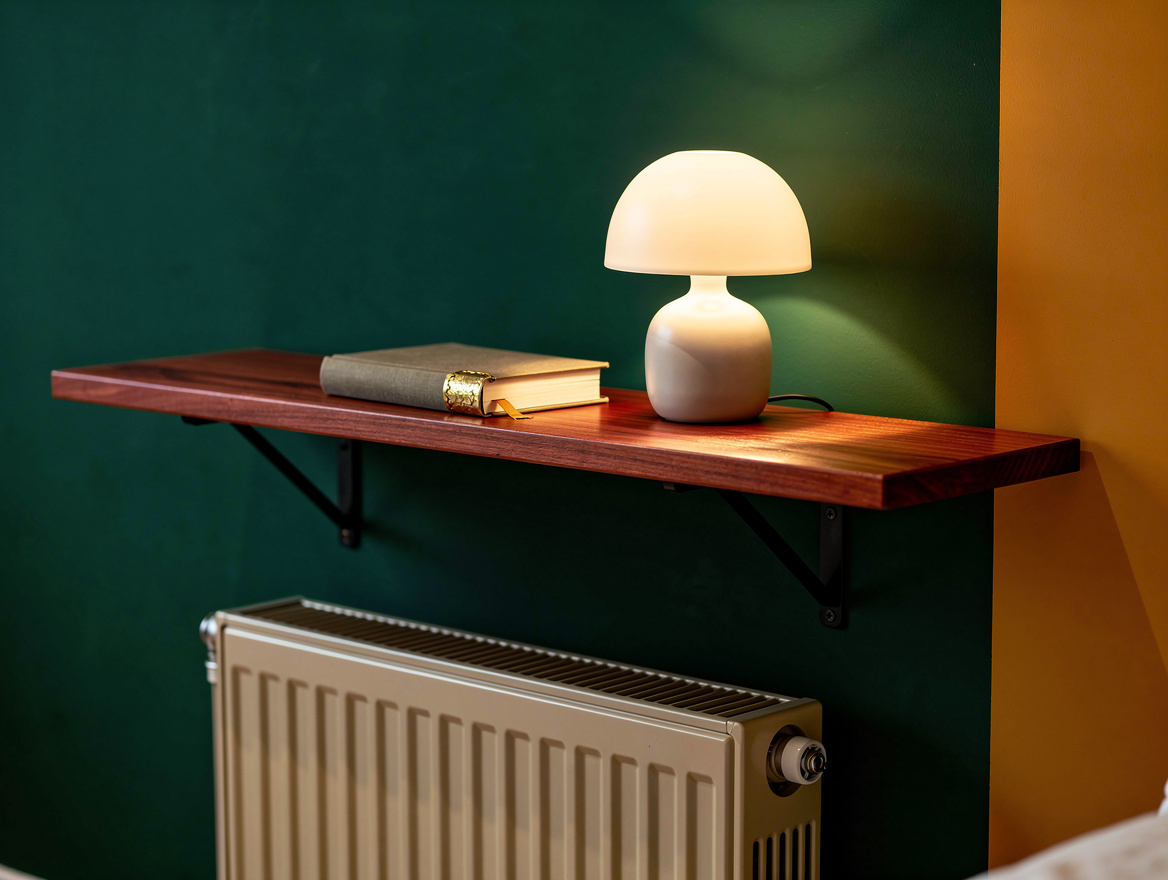
Go shallow instead. A wall-mounted shelf 20 to 30 cm wide and 15 to 20 cm deep holds a lamp, a book, and a glass of water, which is genuinely everything a nightstand does.
I use a single piece of red oak on black brackets at bed height. Total cost was under $35 at Lowe’s, cut in store.
Mount it so the underside clears the radiator top by at least 10 cm. Heat rises, and a shelf directly above becomes a lid.
Cut Your Curtains Short and Stack Them Wide
Floor-length panels hanging over a radiator are the single most common mistake I see, and they quietly push warm air up behind the fabric and out the cold glass.
Two fixes. Either end the panels just above the radiator top, or hang the rod wide enough that the fabric stacks fully to the sides when open.
A flat Roman shade inside the window frame is the cleanest option in a tight room, since it never touches the wall below. Target and Wayfair both carry cordless versions in the $40 to $70 range for standard widths.
Skip the puddled linen look here. Save it for a room with baseboard heat.
Place the Bed Beside the Radiator, Never in Front
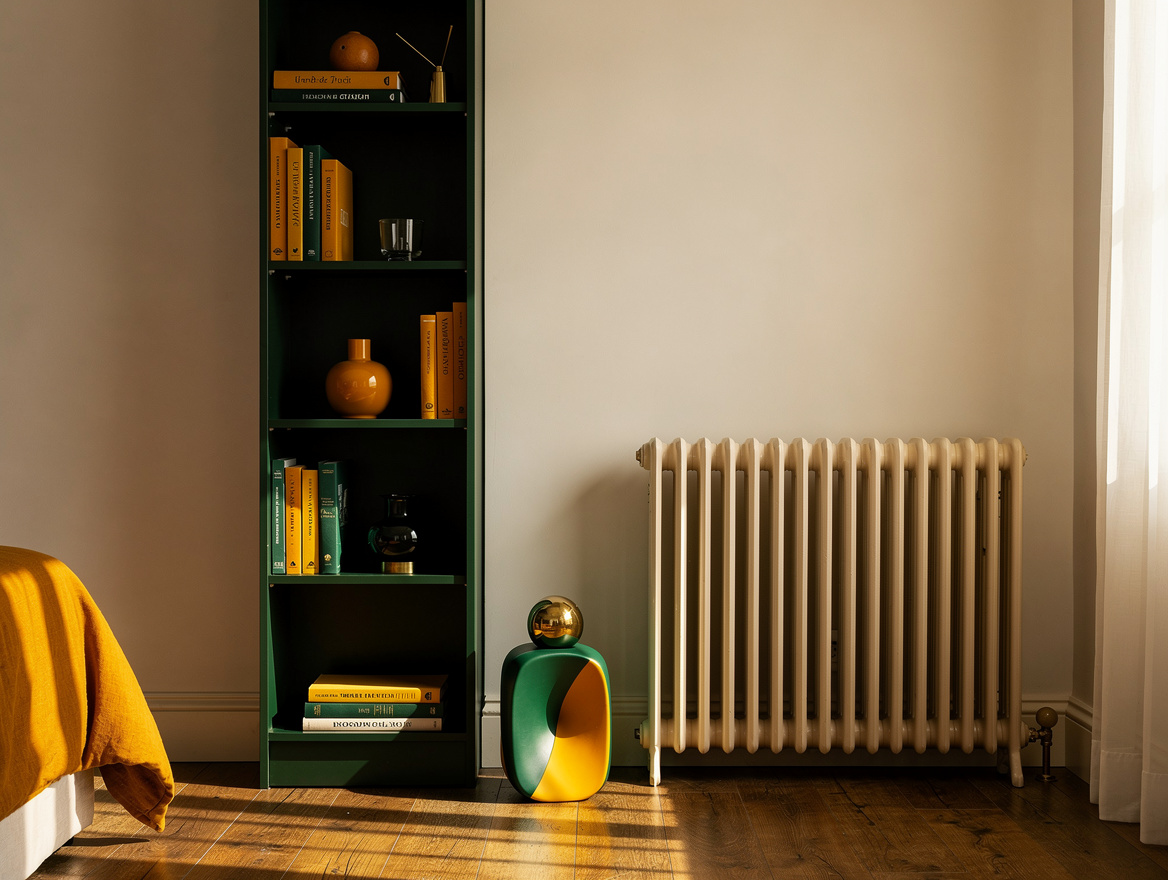
Sometimes the room gives you no choice and the bed has to share the radiator wall. Fine. Put it alongside, not across.
Leave a 10 to 15 cm gap between the frame and the radiator’s side. Then check the soft stuff: an overhanging duvet or a deep upholstered headboard turns your bed into a radiator cover, which is worse than a wooden one.
Ideally you want about 30 cm between the bed and the radiator itself. A metal frame with open sides breathes better here than a solid platform base.
Tuck the duvet at the foot rather than letting it drape. Small habit, real difference.
Choose Shallow Storage for Every Other Wall
Once the radiator wall is off limits for storage, the rest of the room has to work harder. Depth is where you win.
A 30 cm deep bookcase reads as furniture. A 20 cm one reads as wall. Wall-mounted pegboard, over-door hooks, and under-bed bins from Walmart for around $12 each pick up the slack.
Vertical is your other lever. Run one tall, narrow unit to within a few inches of the ceiling instead of two squat ones eating floor space.
And keep the floor visible. Seeing the baseboard run uninterrupted around two walls makes a 10 by 11 room feel considerably less packed.
Dress the Radiator Instead of Hiding It
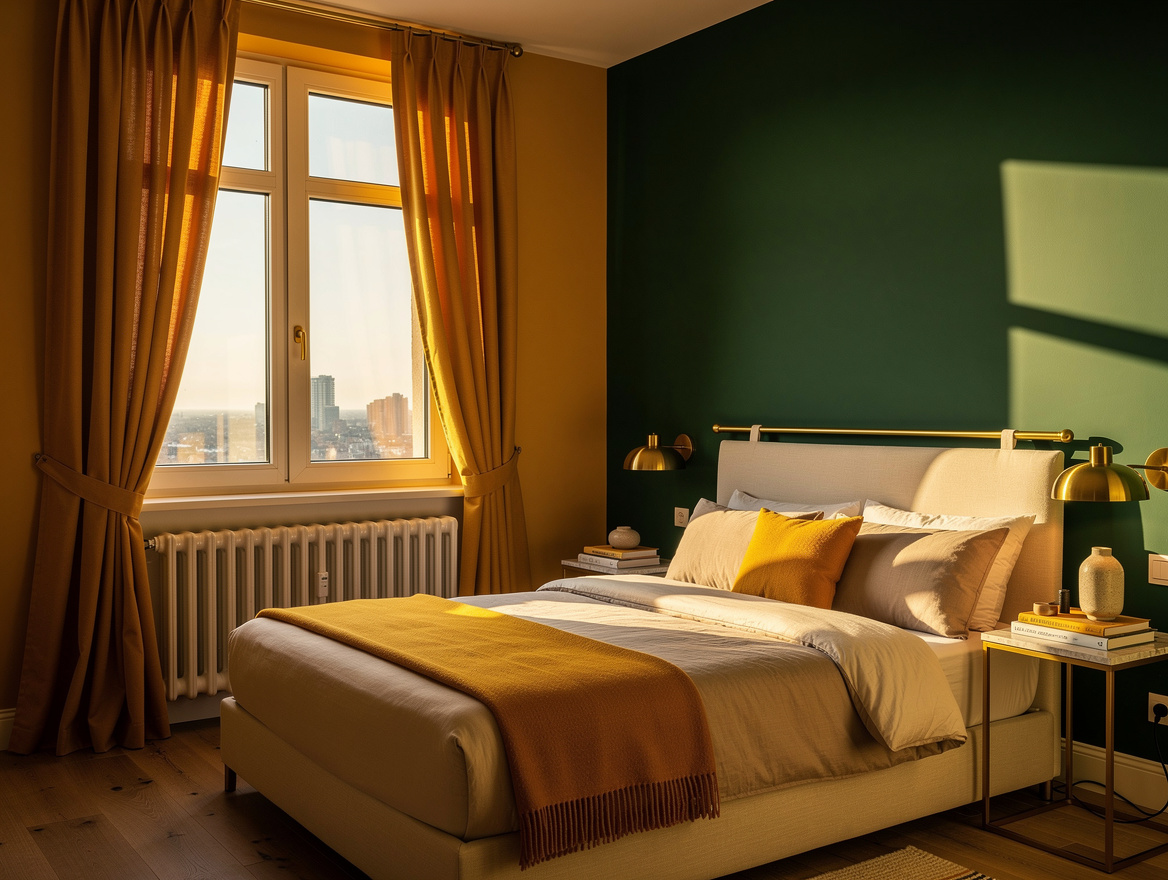
Radiator covers are tempting and most of them cost you heat. If the cover has a solid top or a tight grille, you’ve built the exact obstruction you spent the weekend avoiding.
Paint is the better move. A cast iron radiator rolled in the same eggshell as the wall disappears almost completely, and a quart of radiator-rated enamel runs about $25 at Ace Hardware.
If you want the opposite effect, go dark and deliberate. A matte black radiator against a pale wall looks like it was chosen, not tolerated.
Either way the top outlet stays open. That’s the whole rule.
Start with the tape measure and the painter’s tape, because every decision after that depends on knowing your real clearances. Then move the bed, then deal with the curtains.
Do it in that order and you’ll spend under $100 fixing a room that’s been fighting you for years.
Mia Carter writes about small-space living and budget home makeovers. She has restyled three rentals and tests most ideas in her own 45 sqm flat.