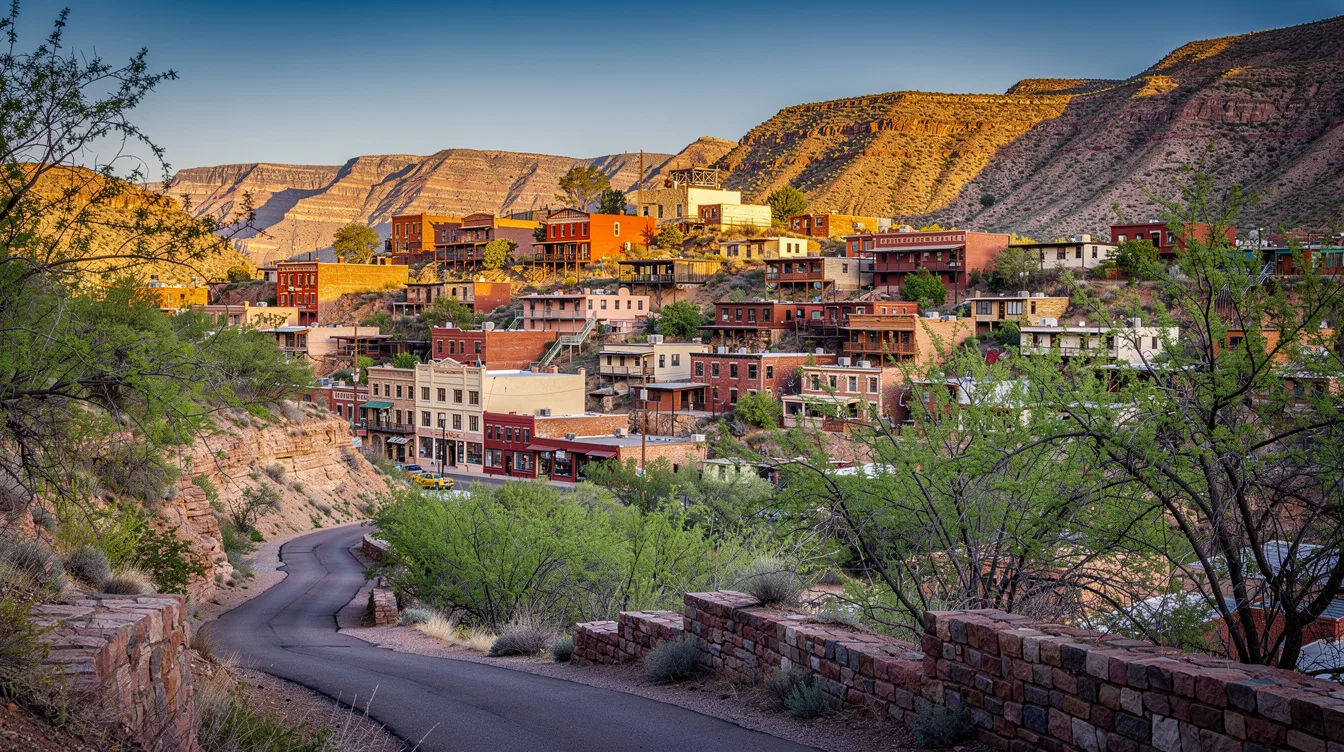
Bisbee once had more than 20,000 residents, drawn to copper, silver, and gold in Arizona’s Mule Mountains. The mines fell silent in the 1970s, but the town didn’t flatten into a roadside memory. It climbed the hills instead, all narrow streets, painted facades, and stairways that make you earn the view.
Founded in 1880, Bisbee grew fast because mineral discoveries turned a hard corner of southeastern Arizona into a major Western mining town. Today it has roughly 5,000 residents, so the scale shift is startling. You can feel it in Old Bisbee, where former commercial buildings now hold galleries, cafes, bars, and antique shops.
More than 20,000 people once filled these hills
At its early-20th-century peak, Bisbee counted more than 20,000 residents. That number matters because this isn’t a town built around a single tidy main street. It spills uphill through tight passages and steep staircases, with Victorian houses perched above the old center.
And you should walk rather than rush it. Some hillside homes are accessible only on foot, which gives the town its appeal and its small inconvenience. The grades can be demanding, especially if you arrive expecting flat desert pavement.
Old Bisbee is lively, but it doesn’t feel engineered for crowds. Independent businesses set the pace, and the old mining-era bones keep the place from becoming merely cute. You’ll find art, coffee, old buildings, and the occasional bar that makes an afternoon stop feel entirely reasonable.
The mine explains why Bisbee looks this way
The Copper Queen Mine Tour is the clearest way to understand the town’s original purpose. It takes visitors underground into a former copper mine, putting the geology and labor behind Bisbee’s growth closer than any streetside plaque can.
But don’t skip the Bisbee Mining & Historical Museum if you want the wider story. The town’s past includes mining, social history, and a scale of industry that feels almost improbable once you are standing among cafes and galleries.
Then there is Lavender Pit, a vast open-pit mine that stopped producing in 1975. It is a quick stop, but an effective one. The pit makes the town’s reinvention easier to grasp, because its size leaves no room for romanticizing what copper extraction required.
The air changes the visit
Bisbee sits at elevation. That height keeps it generally more temperate than Tucson, sometimes by 10 to 15 degrees Fahrenheit, so the town works especially well when much of southern Arizona feels too hot for aimless walking.
Late September through early November is the most comfortable window for exploring on foot. The light catches the hill houses and old facades, while the air is better suited to stair climbing. Summer can be quieter and sometimes less expensive, but it is still hot.
And that altitude creates a useful contrast. Bisbee is in Arizona and close to the Mexican border, yet it doesn’t deliver the flat, furnace-like desert scene many visitors expect. The hills close in around the streets, and the climb gives every block a different angle.
Getting there means committing to southeastern Arizona
Bisbee is in Cochise County, to the southeast of Tucson. Plan on a car. It is useful for reaching the town and exploring the region, although Old Bisbee itself is best handled at walking speed.
You can pair it with Tombstone, about 30 minutes away by car, for a road trip with two very different versions of Arizona history. But Bisbee has more urban texture. Tombstone leans into Western mythology, while Bisbee feels like a mining town that found a second life without scrubbing away the rough edges.
How long should you stay in Bisbee?
Stay at least one night. Two is better if you want time for the mine tour, the museum, Lavender Pit, and an unhurried walk through Old Bisbee. The town is compact, but its stairways and corners reward a slower schedule.
By evening, the hills turn quiet above the old center. The last light sits on the painted houses, and the former mining town feels less like a relic than a place still deciding what to do with its steep streets.