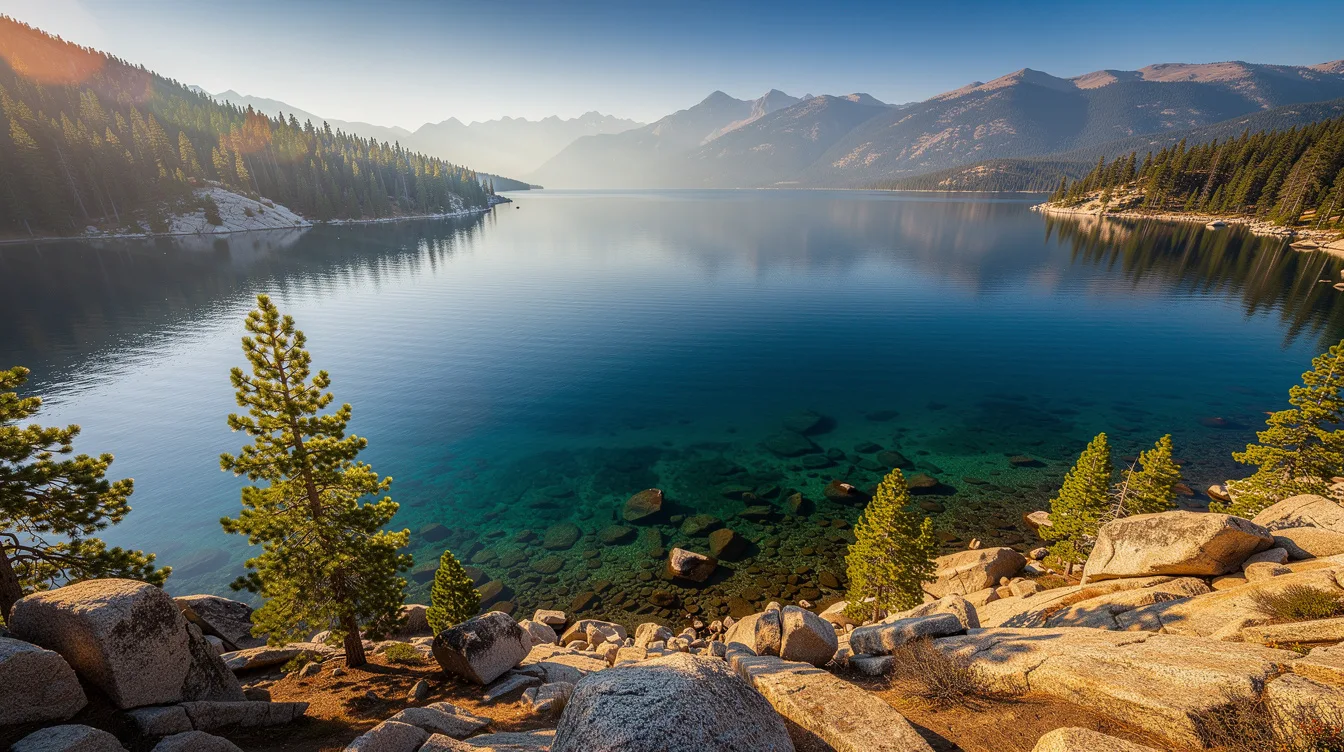
Lake Tahoe looks calm from shore, a hard blue sheet held between California and Nevada. But the surface keeps a serious secret: the lake drops to 1,644 feet at its deepest point, placing it second in the United States behind Crater Lake.
That depth changes how Tahoe feels. You can stand at the water’s edge in warm sun, hear small waves fold over the sand, and know there is an immense cold basin below you.
The number beneath Tahoe’s blue surface
Lake Tahoe is about 21.7 miles long and 11.8 miles wide, so it reads more like an inland sea than a mountain pond. And because it is also North America’s largest alpine lake, the far shore can feel surprisingly distant.
Its surface sits at 6,225 feet above sea level in the Sierra Nevada. That elevation keeps the water fresh even in summer, which is why a beach day here can feel glorious and bracing at once.
You don’t need to see the lake from a mountaintop to understand its scale. Look across the water on a clear morning, when the pines make a dark edge against the blue, and the basin seems to keep going.
But Tahoe isn’t gentle in every sense. Its depth is real, and the water stays cold even when the air feels hot, so treat swimming as a refreshing dip rather than an all-afternoon float.
California’s shore has two very different moods
South Lake Tahoe is the California side’s busiest base, with beaches, restaurants, lodging, and quick access to Stateline, Nevada. It is convenient, but it can feel crowded in summer, especially when parking fills early.
From there, Emerald Bay State Park delivers the view people come for: steep wooded slopes, dark water, and the historic Vikingsholm on the bay. It is popular for good reason, though you should expect company.
Pope Beach and Kiva Beach offer a softer version of Tahoe, where sand meets pine forest and the air smells faintly of sun-warmed needles. And Fallen Leaf Lake nearby feels quieter, a useful change after the South Shore bustle.
The route along CA-89 links South Lake Tahoe and Tahoe City beside the water. It is the kind of drive that makes you pull over more than planned, but mountain-road conditions and seasonal openings still matter.
Tahoe City reveals where the water goes
Tahoe City sits on the northwest shore, where the Truckee River leaves the lake. Tahoe has dozens of tributaries, but this is its only natural outlet, flowing northeast through Reno toward Pyramid Lake.
That simple fact gives the town more interest than a standard lakeside stop. You can watch the water begin its exit from a lake fed by snow, rain, and streams, then walk back toward a shoreline that seems almost still.
The West Shore is more residential and wooded than the South Shore. But quieter does not mean empty, so a car remains the practical choice if you want freedom to move between beaches, overlooks, and trail access.
Farther north, Kings Beach and Carnelian Bay lean toward family time and mountain recreation. Truckee is not directly on the lake, yet it can work well as a base for the north basin and nearby ski areas.
Choose the season for the water, not the calendar
For beaches and swimming, aim for late June through early September. The altitude keeps the water cool, which is welcome after a hot afternoon but may surprise anyone expecting a warm California swim.
For hiking and scenic drives, July through October is the better window, subject to mountain-road openings. And autumn often brings calmer conditions and fewer people, though the weather can turn quickly at this elevation.
Winter is for Palisades Tahoe, Heavenly, Northstar, and Kirkwood, when snow shifts the whole basin’s rhythm. The lake remains there, dark and broad beneath the cold light, while the roads and lodging demand more planning.
Tahoe’s water is protected as an Outstanding National Resource Water under the Clean Water Act. That status matters because clarity is not just a pretty detail here, it is part of what makes the lake feel so improbable.
Bring out what you bring in, clean water equipment, and check local rules for fires, parking, and swimming before you go. By late afternoon, when the wind wrinkles that deep blue surface and the pines go quiet, Lake Tahoe finally shows its scale.