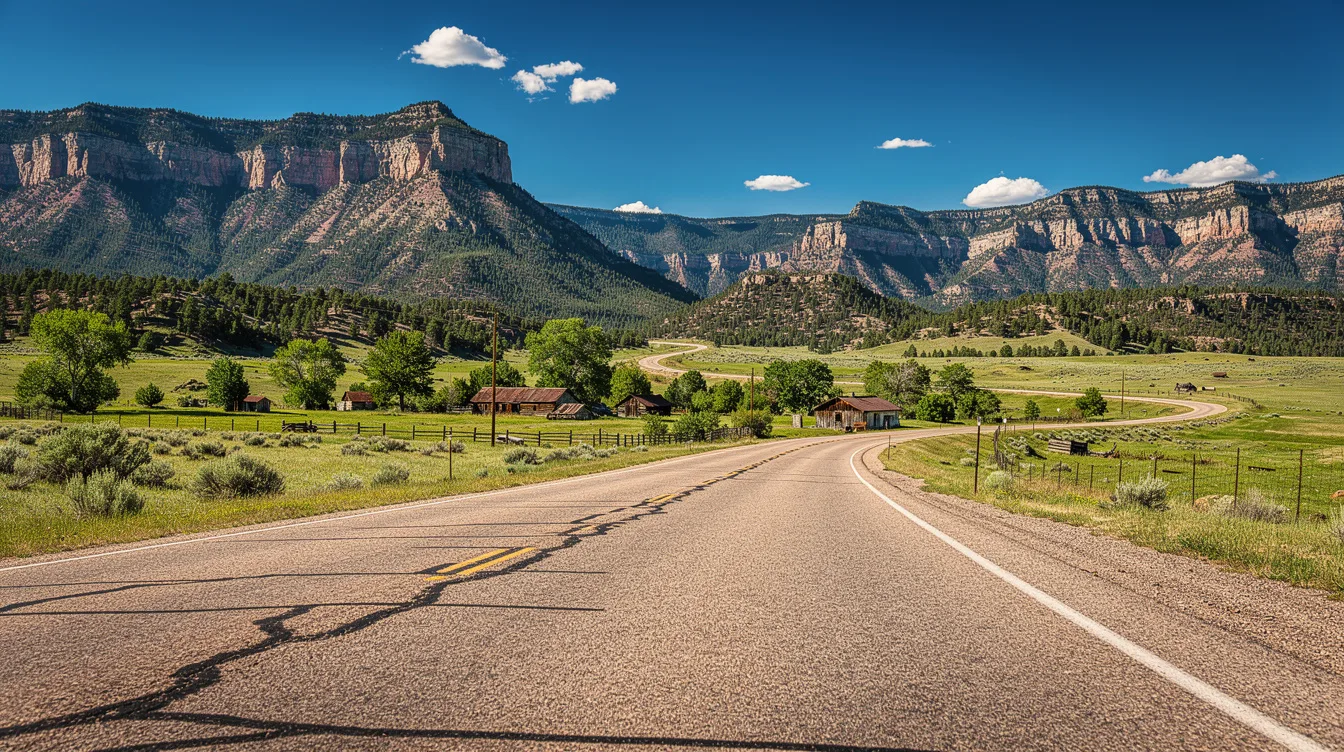
Boulder, Utah, sat apart from the rest of southern Utah for so long that a year-round road arrived only in 1939. The route north across Boulder Mountain stayed unpaved until 1985, which explains why this tiny town still feels like a pause button between Escalante and Capitol Reef.
You’ll find it in Garfield County on Scenic Byway 12, about 27.3 miles northeast of Escalante. The road gets you there now. But the isolation that shaped Boulder never entirely left.
A road arrived, but slowly
For decades, Boulder was cut off when weather turned rough. A practical year-round road changed that in 1939, yet electricity did not arrive until 1947. And the northern route over Boulder Mountain remained a dirt road for another generation.
That late paving matters because roads dictate the rhythm of a place. Boulder did not become a roadside stop built around speed. It grew as a small community where travel required planning, patience, and a willingness to turn around when conditions said no.
The town also claims the distinction of being the last community in the continental United States to receive mail by mule train. You can feel the logic of that claim while looking toward Boulder Mountain: this was not a convenient gap in the road network. It was a hard-to-reach settlement.
Why Scenic Byway 12 still feels remote
Scenic Byway 12 now links Boulder with Escalante to the south and the Torrey and Capitol Reef area to the north. It is a road-trip route, certainly, but it does not erase the distances between services. You should arrive with fuel, water, food, and lodging plans already handled.
And Boulder has only 227 residents, according to the 2020 census. That small number is not a marketing angle. It is the practical reason you will find limited restaurants, accommodations, and supplies, especially when other Utah gateway towns are busy.
The setting has a clear edge. Boulder sits near Forest Service and Bureau of Land Management lands and beside Grand Staircase-Escalante National Monument, so the developed town gives way quickly to open country, slickrock, narrow canyons, and remote tracks.
Can you use Boulder as a national park base?
Yes, if you want a quieter stop between destinations. Capitol Reef National Park is about 36 miles away, and Boulder works well for travelers linking Capitol Reef, Escalante, and Bryce Canyon rather than sleeping in larger hubs such as Moab, Springdale, or Page.
But it is not the easy-choice base for a packed itinerary. Bryce Canyon is roughly 80 miles southwest via Highway 12, and the surrounding roads reward a slower schedule. Give the drive room to become part of the day.
The Burr Trail is where the pavement ends
The Burr Trail begins at Boulder and heads toward Capitol Reef backcountry and desert country near Bullfrog. It is the kind of route that makes an afternoon disappear, because every bend asks you to keep looking instead of checking the clock.
Not every section is paved. After rain or during flash-flood conditions, unpaved canyon routes and parts of the Burr Trail can become impassable. That is the trade-off here: the same lack of development that keeps the country quiet also demands more self-reliance from you.
For a different kind of drive, the Hogsback section of Highway 12 puts the road along a narrow, winding ridge with wide views on both sides. It is memorable, but it is not a stretch for distracted driving. Let passengers watch the drop-offs.
Come for the quiet, plan for the conditions
Boulder’s elevation is about 6,700 feet, so nights can feel cool even during much of summer. Winter can complicate road conditions, and that old history of delayed connection starts to make practical sense when snow enters the picture.
And this is not an urban detour with wilderness nearby. It is a rural base for people who prefer roads, hiking, and dark skies over a long list of conveniences. The town’s appeal comes from what it has not rushed to become.
Visit the Anasazi State Park Museum for context on the valley’s earlier Indigenous occupation, then return to the road. By the time the light drops behind the open country, Boulder feels less like a destination invented for travelers and more like a place the pavement finally caught up with.