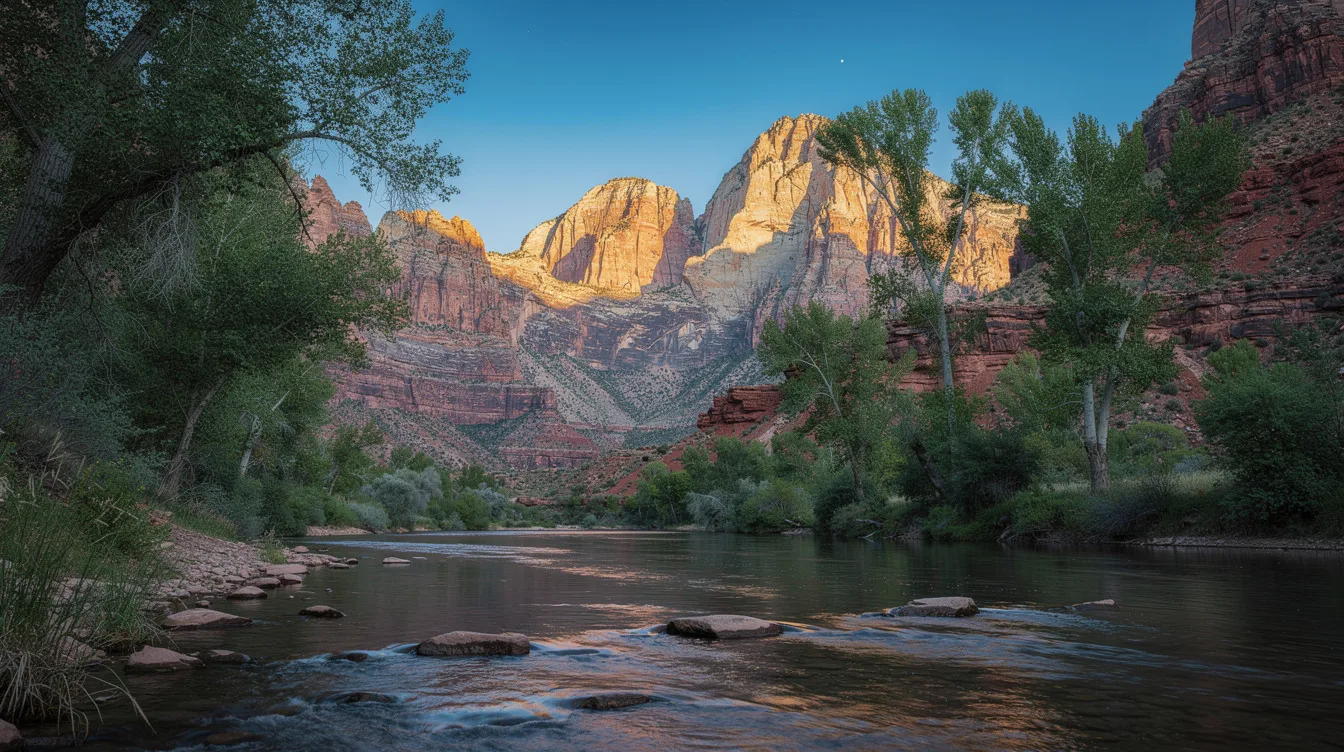
Springdale sits about 1 hour from St. George, directly outside Zion National Park’s south entrance. That makes the town an easy choice for Zion by day, then a darker, quieter sky after dinner.
It’s touristy, certainly, but the red-and-white cliffs make even a grocery run feel like part of the trip.
And Springdale is more than a park overflow lot. This tiny Washington County town, with about 500 permanent residents, is an International Dark Sky Community. You can spend the afternoon inside Zion Canyon, then step outside later and look up without driving anywhere else.
Zion is right outside the door
Zion National Park begins at Springdale’s southern edge, so you don’t need to make a long morning commute before a hike. The town follows the North Fork of the Virgin River at the mouth of Zion Canyon, with canyon walls rising above hotels, cafes, galleries, and bike rentals.
But this convenience comes with a price. Springdale is busy in spring, fall, and school-holiday periods, and lodging can be expensive. If you’re visiting from March through May or September through November, book early, because those are the months when the weather pulls everyone outdoors.
You can pick up the Zion shuttle at several Springdale stops. That matters because parking near the entrance can become a chore, while the shuttle lets you leave the car behind for the day. For a town this small, that’s a genuinely useful luxury.
And the options inside the park are broad without asking you to change hotels. The Narrows, Angels Landing, Emerald Pools, Watchman Trail, and Pa’rus Trail are all part of the Zion conversation here. You can choose a demanding day or an easier walk, then return to a real bed and dinner on Zion Park Boulevard.
Can you hike The Narrows safely?
You can, but conditions decide the day. The Narrows run through a narrow canyon, so flash flooding can turn dangerous during storms, even when rain falls somewhere else. Check conditions before you go, and don’t treat clear skies over Springdale as the whole forecast.
Summer brings serious heat, which is why early starts feel less like discipline and more like common sense. The air warms quickly between the cliffs. By late morning, the shade you ignored at breakfast becomes the thing you’re searching for.
The road from St. George is simple
From St. George, Springdale is roughly an hour by car. From Las Vegas, expect about 2 hours 45 minutes to 3 hours, depending on traffic.
Most travelers use Interstate 15 and Utah State Route 9, passing through Hurricane before the road begins to feel more dramatic.
But you’ll still want a car to reach Springdale and explore beyond town. Once you’re headed into Zion Canyon, the shuttle is often the easier move. That split works well: drive to the gateway, then let someone else handle the park-day logistics.
Las Vegas is the practical airport for international flights and rental cars. St. George is closer, though its flight options are more limited.
If you’re coming from Salt Lake City, the drive is about 4 hours 30 minutes to 5 hours, so it’s better suited to a longer Utah route.
And Springdale works best when you give it two to four nights. One day can go to Zion Canyon. Another can go to The Narrows or Angels Landing, depending on conditions and permits.
The pace is flexible, but the town is not a bargain stop.
Dark skies change the second half of the day
International Dark Sky Community status gives Springdale a second identity after sunset. The canyon walls lose their hard edges. Street activity softens, and the open patch above the cliffs starts to matter more than whatever is on your phone.
This isn’t a remote backcountry campout. You’re still on a main street with restaurants, motels, lodges, and stores. But that is the appeal: you can eat well, walk back to your room, and still find a night that feels larger than the town.
And there’s a useful contrast here. Springdale can feel crowded during the day because Zion draws huge attention. At night, the focus shifts upward, and the same compact town feels less like a staging area and more like a place with its own reason to stay.
By the time the last diners drift off Zion Park Boulevard, the canyon is mostly silhouette, the river is somewhere below the road, and the sky has taken over.