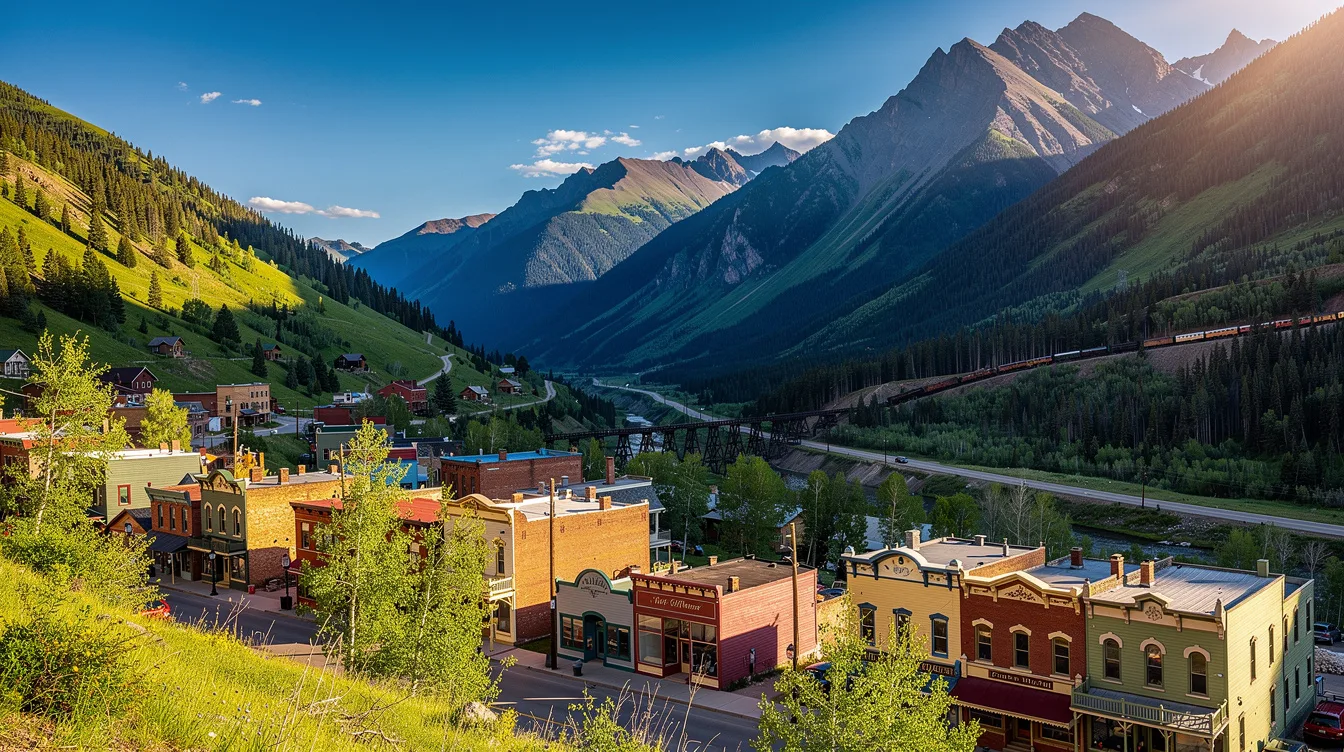
Georgetown sits about 40.4 miles west of Denver on I-70, but its real draw is older than the highway. The Georgetown, Silver Plume Historic District became a National Historic Landmark in 1966, preserving a mountain town shaped by Colorado’s mining years.
And that designation matters because this isn’t a made-up Old West stop built for an afternoon photo. You can walk streets where Victorian storefronts, cafés, and small shops still set the pace, with steep Rocky Mountain walls rising beyond the roofs.
A landmark district with a real mountain setting
The district connects Georgetown with Silver Plume, and the road between them makes the scale clear. You arrive from Denver’s traffic, then the air feels cooler and thinner almost at once. At roughly 8,530 feet, Georgetown asks you to slow down.
But don’t treat altitude as a minor detail if you’ve come from low elevation. Drink water, skip hard exertion right away, and carry a warm layer even in summer because mountain conditions can shift quickly.
Georgetown began during Colorado’s 19th-century mining rush, with silver as a major part of its story. It has the old-town look people want from a mountain day trip, but it doesn’t feel like a modern ski village wearing a costume.
And you’ll get more from it if you leave room to wander rather than chasing a packed itinerary. Sixth Street concentrates the historic core, where brick, painted wood, and shop windows make a slow stroll feel like the correct choice.
The 1884 railroad is the day’s main event
The Georgetown Loop Railroad is why many visitors come, and it earns the attention. Built in 1884, the historic narrow-gauge line links the Georgetown area with Silver Plume through mountain terrain and its famous looping viaduct.
But book ahead during the busy summer period. The railroad is at its liveliest then, and a reserved seat leaves you free to enjoy the clatter of the train and the sudden open views instead of worrying about availability.
You don’t need to be a rail devotee to enjoy it. The ride works because the route makes the mountain engineering visible, with the track curving through a setting that feels far larger than Georgetown’s compact center.
And the railroad gives a practical shape to a day here. Start with the train, then return to town for lunch and a museum. That combination is more satisfying than trying to bolt on every outdoor option before sunset.
Sixth Street rewards an unhurried afternoon
The Hotel de Paris Museum offers a direct window into the silver-era town. It opened as a hotel and restaurant in 1875, and it was considered one of the more elegant establishments in the American West at the time.
But Georgetown’s pleasure is not confined to an admission desk. You can spend time on Sixth Street, step into a café, and listen to the quieter rhythm that settles in once visitors head back toward I-70.
That’s the town’s best contrast: close enough for an easy Denver outing, yet far enough away to feel properly mountain-bound. You’ll see why it works as a stop between the city and central Colorado, especially when the roadside rush fades behind you.
And don’t expect a huge downtown full of endless choices. Georgetown is small, which is exactly why its preserved streets feel coherent rather than scattered. One good meal and a long walk can be enough.
Summer is easiest, but every season has a catch
Summer brings the most activity, including the railroad, hiking, and time around Guanella Pass. It’s the simplest season for first-time visitors, though that popularity also means more people sharing the town and the road from Denver.
But spring and fall require more flexibility because high-elevation conditions can change. Fall adds crisp air and color, while spring can still carry snow in the surrounding mountains. Check conditions before building a day around outdoor plans.
Winter has its own appeal, with snow settling around the village and nearby skiing drawing traffic toward the Continental Divide. You can pair Georgetown with Loveland Ski Area, but I-70 and mountain-pass roads may be difficult in poor weather.
And if you stay overnight, you gain the town’s quietest hour. By the time the last daylight fades from the mountain slopes, Sixth Street grows still, and the old storefronts hold the cold blue light.